

A Proven Method for Evaluating Insurance Providers
TL;DR:
- Evaluating insurance providers in the Philippines requires a structured approach that includes financial stability, patient experience, network coverage, and claims process efficiency. Relying solely on brochures or sales pitches is insufficient; thorough documentation like IC-filed financial statements and CAHPS survey results is essential for an objective decision. Combining these criteria into a weighted scorecard ensures an audit-ready, defensible selection aligned with local regulatory and operational standards.
A structured method for evaluating insurance providers combines financial stability analysis, standardized patient experience data, provider network verification, and claims process inspection to give Philippine business owners a defensible basis for selecting employee health coverage. The Insurance Commission’s 2026 regulatory updates, PhilHealth’s expanding YAKAP network, and internationally recognized tools like CAHPS surveys have changed what a thorough insurance provider assessment looks like. Relying on a provider’s brochure or a sales rep’s word is no longer sufficient. This guide walks you through each evaluation layer so you can make a decision that holds up under scrutiny.
What is the best method for evaluating insurance providers?
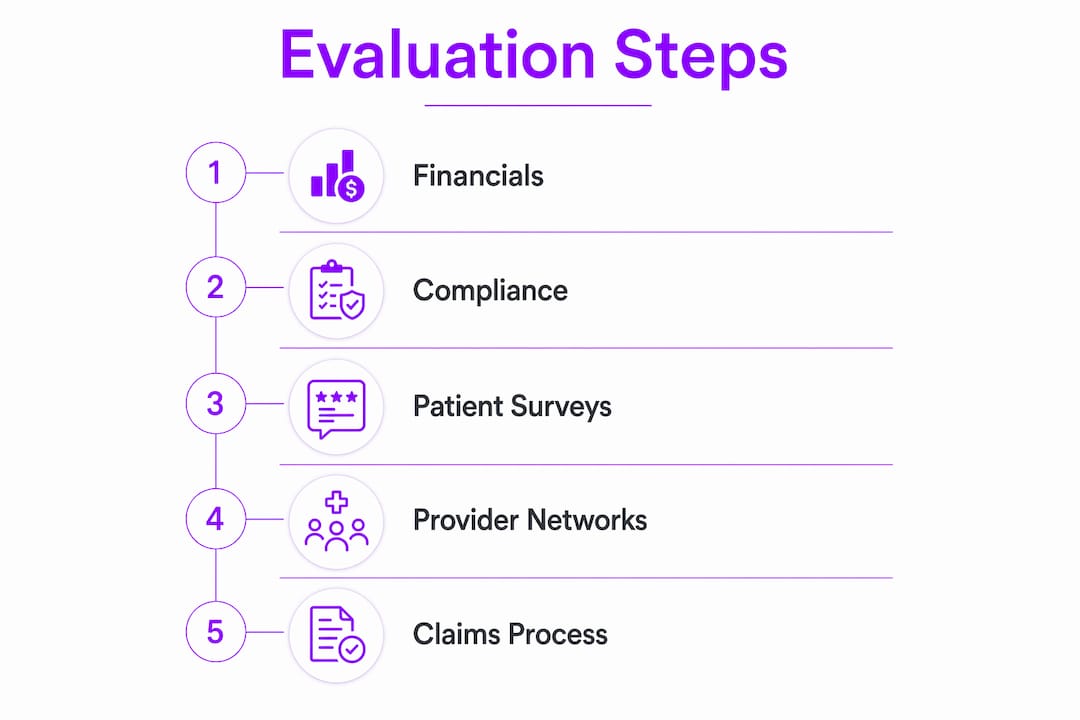
The recognized industry term for this process is vendor due diligence, applied specifically to health insurance procurement. It covers four interconnected assessment areas: financial and regulatory compliance, patient experience quality, provider network adequacy, and claims process efficiency. Each area answers a different risk question. Financial compliance tells you whether the insurer will still be operating in three years. Patient experience data tells you whether employees will actually receive quality care. Network adequacy tells you whether that care is accessible. Claims process efficiency tells you whether employees will be reimbursed without a fight.

No single criterion is sufficient on its own. A provider with a pristine balance sheet but a broken claims process still creates operational headaches for your HR team. A provider with glowing testimonials but no accredited hospitals near your Cebu or Davao offices leaves employees stranded. The best methods for insurance evaluation treat these four areas as equally weighted pillars, then adjust based on your workforce’s specific geography and health profile.
How to assess financial stability and regulatory compliance
The Insurance Commission (IC) is the primary regulatory body for HMOs and insurers in the Philippines, and its 2026 guidelines set a clear baseline for what financial transparency looks like. IC Circular Letters 2026-04 and 2026-07 now require HMOs to submit audited financial statements electronically using IC-prescribed templates. This means you can request these documents directly and verify their format and completeness before signing any contract.
The audit opinion attached to those statements is your most important signal. An unqualified opinion means the auditor found no material issues. A qualified opinion means exceptions were noted, and the provider must attach a Management Letter explaining them. Daily penalties for delayed submissions under the new IC rules are a practical risk indicator. A provider that consistently files late is showing you something about its internal governance before you ever sign a contract.
The table below summarizes the key IC reporting requirements and what each means for your evaluation:
| IC Requirement | What to Check | Risk Signal |
|---|---|---|
| Electronic AFS submission (CL 2026-04, 2026-07) | Confirm provider has filed using IC templates | Missing or late filings indicate governance gaps |
| Unqualified audit opinion | Request the audit report directly | Qualified opinion requires Management Letter review |
| Management Letter (if qualified) | Read the exceptions and management responses | Unresolved exceptions signal financial control weaknesses |
| Interim financial statement deadlines | Verify submission history with the IC | Repeated delays trigger daily penalties and reflect operational risk |
Pro Tip: Ask your shortlisted providers to send their most recent IC-filed audited financial statements before any formal proposal. A provider that hesitates or cannot produce these documents within five business days is already failing a basic governance test.
Focusing on financial reports and audit opinions rather than marketing claims creates a defensible and transparent selection process aligned with local governance standards. This is not bureaucratic box-checking. It is the foundation of every other evaluation step.
How do CAHPS surveys improve insurance provider comparison?
CAHPS, which stands for Consumer Assessment of Healthcare Providers and Systems, is a standardized patient experience framework developed by the Centers for Medicare and Medicaid Services (CMS) and the Agency for Healthcare Research and Quality (AHRQ). It uses consistent question sets to measure how patients experience care across dimensions like communication, coordination, and access, making cross-provider comparisons reliable rather than anecdotal.
The critical distinction here is between patient experience and patient satisfaction. Satisfaction is subjective and varies by individual expectation. Experience measures whether specific, observable events occurred: Did the doctor explain the diagnosis clearly? Was the referral processed on time? CAHPS surveys focus on objective patient experience, which gives you data you can actually act on and compare across providers.
As a business owner evaluating insurance options, you have two practical ways to use CAHPS-style data:
- Request third-party survey results. Ask providers whether they commission independent CAHPS or CAHPS-equivalent surveys. Providers that do are signaling a commitment to measurable quality. Providers that rely only on internal Net Promoter Scores are giving you data they control.
- Require standardized reporting formats. Specify in your RFP that satisfaction data must follow a standardized methodology. This prevents providers from cherry-picking favorable internal metrics.
- Cross-reference public data. For providers with accreditation from the Philippine Health Insurance Corporation or international bodies, public performance data may already exist.
- Weight experience dimensions by workforce profile. If your employees are mostly young and healthy, outpatient communication scores matter more than inpatient coordination scores.
Pro Tip: When reviewing provider-submitted satisfaction data, always ask: “Who conducted this survey, and what was the response rate?” A survey with a 12% response rate from self-selected respondents tells you almost nothing. A third-party survey with a 60% response rate tells you a great deal.
Employers should insist on standardized reporting frameworks to avoid unreliable, subjective internal feedback and ensure accurate comparisons of provider performance. This is one of the most overlooked steps in evaluating insurance options, and it is where many procurement decisions go wrong.
How to evaluate provider networks in the Philippine context
Provider network adequacy is where insurance evaluation gets local fast. A network that looks impressive on paper in Metro Manila may leave your Iloilo or Cagayan de Oro employees with no accessible accredited clinic within a reasonable distance. The criteria for insurance selection must account for where your employees actually live and work.
PhilHealth’s YAKAP initiative adds a layer of complexity and opportunity here. PhilHealth accredits over 4,000 YAKAP centers nationwide as of January 2026 for early screening and detection. Employees registered under YAKAP-accredited centers gain access to preventive care that reduces long-term health costs. When you evaluate an HMO provider’s network, cross-checking its accredited facilities against the YAKAP center list in your employees’ areas gives you a more complete picture of actual coverage.
A two-ecosystem approach, combining the insurer’s HMO network with PhilHealth’s services, reduces employee surprises and improves benefit comprehensiveness. Use the following checklist when validating network adequacy:
- Confirm the provider’s accredited hospital list includes facilities within 10 kilometers of your primary office locations.
- Verify that at least one accredited primary care clinic exists in each city where you have more than five employees.
- Check whether the network includes YAKAP-accredited centers for preventive screening.
- Request the provider’s out-of-network reimbursement policy and processing time for employees in underserved areas.
- Ask for the network’s update frequency. A list that was last verified 18 months ago may include hospitals that have since dropped accreditation.
You can review accredited provider lists from Hmoplans to understand what a well-documented network looks like before benchmarking other providers against it.
What claims process red flags should you look for?
The claims process is where the gap between a provider’s promises and its actual service delivery becomes visible. A thorough claims process assessment includes verifying documented workflows for pre-authorization, network verification, and claims submission, because these operational details greatly impact employee experience beyond surface-level network listings.
Request a written, end-to-end description of the claims process from every provider you are seriously considering. The document should cover pre-authorization requirements, letter of approval (LOA) issuance timelines, network verification steps, outpatient and inpatient claims submission procedures, and reimbursement timelines for out-of-network care. If a provider cannot produce this document, that is your answer.
The comparison table below gives you a scoring framework for claims process assessment:
| Claims Process Factor | Strong Provider | Weak Provider |
|---|---|---|
| Pre-authorization turnaround | LOA issued within 2 hours for standard cases | No documented SLA; approval times vary widely |
| Claims submission channels | Digital portal plus in-person option | Paper-only or single-channel submission |
| Dispute resolution process | Written process with defined timelines | Informal, handled case by case |
| Out-of-network reimbursement | Defined timeline, typically 15 to 30 days | No stated timeline or reimbursement cap |
| Employee support access | 24/7 hotline with dedicated account manager | Business-hours-only general hotline |
Pro Tip: Ask your provider contact to walk you through a real LOA request scenario during your evaluation meeting. Watch how long it takes them to explain the process clearly. If they struggle to describe their own workflow, your employees will struggle to navigate it.
How to build a scorecard for insurance provider selection
A structured scorecard turns your evaluation criteria into a defensible, auditable decision. Designing scorecards tied to IC filings minimizes disputes around provider selection and strengthens audit readiness by grounding decisions in documented compliance data. Here is a step-by-step approach to building one:
- Define your four evaluation pillars. Financial compliance, patient experience, network adequacy, and claims process efficiency. Assign a percentage weight to each based on your workforce’s priorities. A company with 200 employees spread across 10 provinces should weight network adequacy more heavily than a Metro Manila-only firm.
- Identify measurable data sources for each pillar. IC-filed audited financial statements for compliance, CAHPS-equivalent survey results for experience, verified provider lists cross-checked against employee locations for network, and documented workflow descriptions for claims.
- Score each provider on a consistent scale. A 1-to-5 scale works well. Define what each score level means before you start evaluating, so the same standard applies to every provider.
- Document your evidence for each score. Attach the IC filing, the survey report, the network list, and the claims process document to each provider’s scorecard entry. This is your audit trail.
- Calculate weighted totals and rank providers. The provider with the highest weighted score is your top candidate. If two providers score within five percent of each other, move to a qualitative tiebreaker round.
- Review the scorecard with your legal or compliance team before finalizing the selection. A documented, evidence-based process protects you if the decision is ever questioned.
For a broader comparison of HMO coverage options in the Philippines, reviewing published comparisons alongside your scorecard adds external validation to your internal process.
Key takeaways
A defensible insurance provider selection in the Philippines requires combining IC-mandated financial disclosures, CAHPS-style patient experience data, verified network coverage, and documented claims workflows into a single weighted scorecard.
| Point | Details |
|---|---|
| Financial compliance is the baseline | Request IC-filed audited financial statements and check audit opinion status before any other evaluation step. |
| Standardized experience data beats testimonials | Require CAHPS-equivalent third-party survey results to compare providers on objective, consistent metrics. |
| Network adequacy must match employee geography | Cross-check accredited provider lists against employee locations and PhilHealth YAKAP centers in each city. |
| Claims process documentation reveals real service quality | Ask for written end-to-end claims workflows; providers that cannot produce them are a governance risk. |
| Scorecards create audit-ready decisions | Weight your four evaluation pillars, document evidence for each score, and attach source documents to every entry. |
What I’ve learned about evaluating insurers in the Philippine market
The most common mistake I see business owners make is treating insurance provider assessment as a price comparison exercise. They collect three quotes, pick the middle one, and call it due diligence. That approach works fine until an employee needs a major procedure and discovers the provider’s network does not include the specialist they need, or the LOA takes four days to arrive.
The regulatory compliance angle is genuinely underused. Most decision-makers do not know they can request IC-filed financial statements, and most providers do not volunteer them. When you ask for these documents and a provider stalls, you have learned something important before spending a peso.
I am also skeptical of providers who lead with their hospital list. The Big 9 Hospitals are a legitimate selling point, but a list of prestigious names does not tell you whether the pre-authorization process works at 9 PM on a Saturday. The HMO partner evaluation guide from Hmoplans captures this operational focus well. The providers worth your business are the ones who can hand you a documented claims workflow and walk you through it without hesitation.
One more thing: the PhilHealth YAKAP integration is not a nice-to-have. With over 4,000 accredited centers nationwide, it is a real coverage multiplier for employees outside Metro Manila. Any provider that cannot explain how its network complements PhilHealth benefits is leaving a significant gap in your employees’ coverage.
— Eumir
How Hmoplans makes this evaluation easier for Philippine SMEs
Hmoplans, through its Purple Cow partnership, is built specifically for the evaluation criteria this article describes. Its plans offer 100% coverage for pre-existing conditions, congenital conditions, and special procedures up to the Maximum Benefit Limit, which directly addresses the network and claims adequacy concerns most SME owners raise during procurement.

The plan features page details coverage structure, add-on options including dental HMO and annual physical exams, and the PhilHealth independence option that gives your team flexibility beyond standard government benefits. For decision-makers who want to see how the claims and member support process works before committing, the member services overview provides the documented workflow transparency that a proper scorecard evaluation requires.
FAQ
What documents should I request when evaluating an insurance provider?
Request the provider’s most recent IC-filed audited financial statements, their documented claims process workflow, and any third-party patient experience survey results. These three documents cover financial compliance, operational quality, and care experience in one request.
How do CAHPS surveys differ from standard satisfaction surveys?
CAHPS surveys measure specific, observable patient experiences rather than general satisfaction, using standardized questions that allow reliable comparisons across providers. Standard satisfaction surveys are typically self-designed and not comparable across organizations.
Why does the Insurance Commission audit opinion matter for my evaluation?
An unqualified audit opinion confirms no material financial issues were found, while a qualified opinion requires a Management Letter explaining exceptions. Providers with unresolved audit exceptions present a governance risk that should factor into your scoring.
How do I verify that a provider’s network covers my employees’ locations?
Request the provider’s current accredited facility list, filter it by your employees’ cities, and cross-check against PhilHealth’s YAKAP center registry. Any gaps between the two lists represent areas where your employees may face out-of-pocket costs or limited access.
How many providers should I evaluate before making a selection?
Evaluate at least three providers using a consistent scorecard to generate a meaningful comparison. Reviewing a shortlist of top health insurance providers in the Philippines can help you identify which providers are worth including in your formal assessment process.
