

Accident insurance coverage for Philippine SMEs: Key facts
TL;DR:
- Accident insurance provides quick, lump-sum financial support for injuries and disabilities.
- It fills gaps left by government benefits, especially for non-work-related accidents.
- Proper communication and administrative procedures are essential for effective employee coverage.
Many HR managers and business owners assume that SSS, ECC, and PhilHealth are enough to protect employees when accidents happen. They are not. Government benefits cover some costs, but they come with delays, payout caps, and strict eligibility rules that leave real financial gaps for both employees and employers. A single workplace accident or commuting injury can disrupt income, strain team morale, and expose your business to unexpected costs. This article explains what accident insurance coverage is, what it actually covers, what it excludes, how it works inside a Philippine SME, and how it fits alongside the government-mandated options you already provide.
Table of Contents
- What is accident insurance coverage?
- Why SMEs need accident coverage for employees
- How accident insurance plans work for Philippine SMEs
- Coverage limits, exclusions, and compliance essentials
- The hard truths about accident insurance SMEs must know
- Next steps: Protecting your team with tailored coverage
- Frequently asked questions
Key Takeaways
| Point | Details |
|---|---|
| Comprehensive protection | Accident insurance covers employee injuries, disability, and death with lump-sum benefits beyond government plans. |
| Affordable group options | Group accident policies are cost-effective for SMEs, offering flexible coverage for staff and families. |
| Critical exclusions | Most policies exclude self-harm, intoxication, high-risk activities, and pre-existing conditions, so review your terms closely. |
| SME compliance matters | Successful claims require full disclosure and prompt reporting according to the Insurance Code of the Philippines. |
What is accident insurance coverage?
Accident insurance coverage is a policy that pays out financial benefits when an insured person is injured, disabled, or killed due to an accident. Unlike health insurance, which covers illness and ongoing medical conditions, accident insurance focuses specifically on sudden, unplanned physical events. Think of it as a financial safety net that activates the moment something unexpected and physical goes wrong.
For Philippine SMEs, this typically comes in the form of group personal accident insurance, where the employer purchases a single policy that covers all enrolled employees. Accident insurance coverage provides financial protection against injuries, disability, or death caused by accidents, typically offering lump-sum payments for accidental death (100% of sum assured), dismemberment benefits scaled by body part, permanent or total disability income, and optional medical reimbursement or hospital cash.
Here is what a standard group accident plan typically includes:
- Accidental death benefit: 100% of the sum assured paid to the beneficiary
- Dismemberment benefits: Partial payouts based on which body part is lost (e.g., loss of one hand may pay 50% of sum assured)
- Permanent total disability: Monthly income replacement or a lump sum if the employee can no longer work
- Medical reimbursement: Optional add-on that covers hospital and treatment costs after an accident
- Hospital cash benefit: A daily cash allowance during hospitalization due to an accident
To give you a clearer picture, here is how dismemberment benefits are typically scaled:
| Injury type | Typical benefit (% of sum assured) |
|---|---|
| Accidental death | 100% |
| Loss of both hands or feet | 100% |
| Loss of one hand and one foot | 100% |
| Loss of one hand or foot | 50% |
| Loss of sight in one eye | 50% |
| Loss of one finger | 10-15% |
Group plans from providers like PowerWealth often cover over 150 types of injuries, which means even less dramatic accidents, like a broken bone or a partial hearing loss, can trigger a benefit payment. This breadth of coverage is what makes accident insurance meaningfully different from a basic life insurance policy.
If you are already exploring HMO health insurance for SMEs, accident insurance works alongside it rather than replacing it. HMO covers illness and ongoing care; accident insurance covers the sudden financial shock of physical injury.
Why SMEs need accident coverage for employees
Government-mandated programs do provide a foundation. SSS offers sickness and disability benefits. ECC (Employees’ Compensation Commission) covers work-related injuries. PhilHealth helps with hospitalization costs. But there are three critical gaps these programs leave open.
First, government payouts are slow. ECC claims can take weeks or months to process, and employees dealing with injury-related income loss cannot always wait. Second, benefit amounts are capped and often modest relative to actual financial need. Third, coverage is usually limited to work-related incidents, which means accidents during a personal commute or off-site errand may not qualify.

Accident coverage complements SSS/ECC/PhilHealth and provides faster, flexible support than daily government benefits. For SMEs, this speed and flexibility is the real differentiator.
Here are three strong reasons to add accident insurance to your employee benefits package:
- Employee financial protection: A lump-sum payout helps employees cover rent, food, and medical costs without waiting for government processing.
- Employer risk reduction: When employees feel financially protected, they are less likely to pursue legal action or file disputes after accidents.
- Talent attraction and retention: Offering accident coverage signals that you take employee welfare seriously, which matters to job seekers comparing SME offers.
Understanding how accident-related pay works under Philippine labor law also helps you design benefits that are compliant and competitive.
Many SMEs already invest in PhilHealth plus HMO combinations to maximize health coverage. Accident insurance is the next logical layer. You can also explore how SME health investments deliver measurable returns in productivity and engagement.
“The businesses that retain the best people are not always the ones paying the highest salaries. They are the ones whose employees feel genuinely protected.”
Pro Tip: When you present accident insurance to your team, frame it as income protection, not just insurance. Employees respond better when they understand it puts cash in their hands quickly after an accident, rather than waiting for reimbursements.
How accident insurance plans work for Philippine SMEs
Setting up a group accident insurance plan is simpler than most HR managers expect. Here is the typical process:
- Step 1: Choose between employer-paid (company covers premiums) or voluntary (employees opt in and pay their own premiums, sometimes with employer subsidy)
- Step 2: Select a sum assured per employee, usually ranging from PHP 100,000 to PHP 1,000,000 depending on role and risk level
- Step 3: Register all eligible employees with the insurer, providing basic personal and employment details
- Step 4: Receive policy documents and benefit schedules for distribution to employees
- Step 5: In the event of an accident, the employee or HR files a claim with supporting documents (medical records, police report if applicable, proof of accident)
Premium costs are generally affordable. For a basic group accident plan, expect to pay roughly PHP 300 to PHP 800 per employee per year, depending on the sum assured and the nature of the work. Higher-risk industries like construction or logistics will pay more than office-based teams.
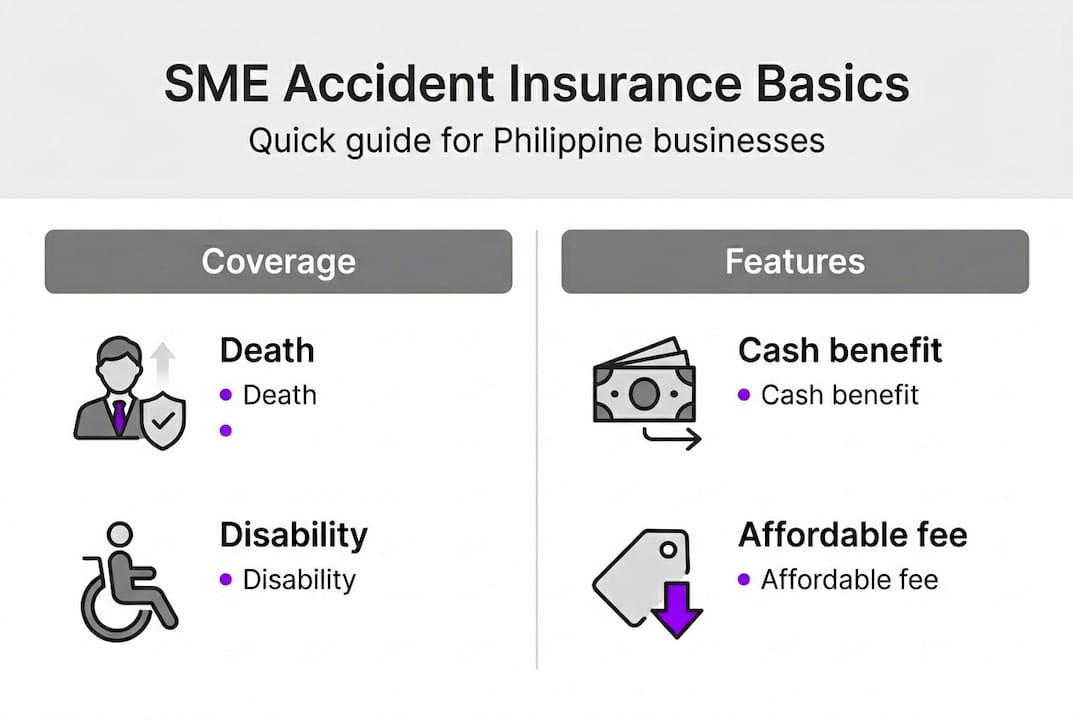
Here is a quick comparison of accident insurance versus government benefits:
| Feature | Accident insurance | SSS/ECC/PhilHealth |
|---|---|---|
| Payout type | Lump sum or cash benefit | Reimbursement or daily allowance |
| Processing speed | Days to weeks | Weeks to months |
| Coverage scope | Work and non-work accidents | Primarily work-related |
| Benefit flexibility | Customizable sum assured | Fixed by law |
| Family coverage | Optional add-on | Limited |
Group personal accident insurance is available from providers like Manulife ChinaBank and BPI AIA, with affordable premiums and options for employee, spouse, and dependent coverage. Etiqa, the underwriter behind HMO Plans, also offers accident coverage as an add-on to group health plans.
For more context on how the broader benefits landscape is shifting, check out 2025 health trends for SMEs and what forward-thinking companies are doing differently. You can also explore group accident options from local insurers to compare structures and premiums.
Coverage limits, exclusions, and compliance essentials
Accident insurance is powerful, but it has clear boundaries. Understanding what is not covered is just as important as knowing what is.
Common exclusions in Philippine accident insurance policies include:
- Self-inflicted injuries: Any intentional harm is excluded
- Intoxication: Accidents occurring while under the influence of alcohol or drugs are typically not covered
- Hazardous activities: Extreme sports, racing, and other high-risk activities without special riders are excluded
- Pre-existing conditions: Injuries aggravated by prior medical conditions may be denied
- War and terrorism: Events related to armed conflict or civil unrest are excluded
- Criminal acts: Accidents occurring while committing a crime are not covered
Accident insurance only applies to injuries caused by violent, external, and visible means. This legal phrase means the cause must be physically observable and sudden, not gradual or internal. A slip on a wet floor qualifies. A repetitive strain injury that develops over months typically does not.
Common exclusions include self-harm, intoxication, and hazardous activities, and claims require prompt notification and compliance with RA 10607, the Insurance Code of the Philippines. Concealing material facts, like a high-risk hobby or a prior injury, can result in policy rescission, meaning the insurer voids the policy and returns premiums without paying claims.
For claims, the standard requirement is notification within 30 days of the accident. Late filing is one of the most common reasons valid claims get denied. Train your HR team to act fast when an accident occurs.
For more on SME compliance updates under Philippine law, and to review the HMO features for SMEs that pair well with accident coverage, those resources will help you build a complete picture. You can also review the implications of claims and disclosures to avoid costly mistakes.
Pro Tip: Always disclose prior injuries and risky job profiles when applying for group accident insurance. Transparency at enrollment protects your employees when they need to file a claim.
The hard truths about accident insurance SMEs must know
Most guides on accident insurance stop at the mechanics. Here is what they leave out.
Many SMEs buy accident coverage and assume the job is done. It is not. Coverage that is never communicated to employees provides zero morale or retention benefit. If your team does not know the plan exists or how to use it, the investment is wasted.
Another overlooked risk: commuting accidents. Many group accident plans cover 24-hour incidents, but some work-only plans exclude accidents during personal travel. If your employees commute long distances, which is common in Metro Manila and surrounding provinces, verify that your plan covers them door to door.
Accident insurance also does not replace health coverage. It handles the financial shock of injury, but it will not manage chronic recovery, follow-up care, or the long-term treatment an employee may need after a serious accident. Pairing it with a solid HMO plan is the only way to close that gap.
Finally, claims get denied for administrative failures more often than for actual coverage disputes. Late notification, missing documents, and undisclosed information are the top three reasons. Admin training is not optional. Visit the Purple Cow SME blog for practical guidance on building benefits programs that actually work for your team.
Next steps: Protecting your team with tailored coverage
You now understand what accident insurance covers, why it matters for Philippine SMEs, and where the real risks lie. The next step is finding a plan that fits your team size, industry, and budget.
HMO Plans, powered by Purple Cow and underwritten by Etiqa, offers accident insurance as a flexible add-on to group health coverage. You can explore the full range of Purple Cow plan features to see how accident, health, and dental benefits can work together in one streamlined package. If you are ready to compare options or talk through what your team actually needs, HMO Plans makes it straightforward to get started. You can also reach out through Purple Cow member services for personalized support.
Frequently asked questions
What does accident insurance actually cover for employees?
Accident insurance covers accidental death, dismemberment, permanent disability, and often reimburses medical or hospital expenses, typically with a fixed benefit schedule tied to the type and severity of injury.
How is accident insurance different from PhilHealth, SSS, or traditional HMO?
Accident insurance supplements SSS/ECC/PhilHealth by offering direct cash payouts for accidents, while government and HMO plans mainly reimburse costs for illness or work-related events with longer processing timelines.
What are common exclusions in accident insurance?
Exclusions include self-harm, intoxication, hazardous activities without special riders, war-related events, and pre-existing conditions that directly contribute to the injury.
Can SMEs cover families or just employees with group accident plans?
Group accident policies can cover employees as well as spouses and dependents, often for an additional premium, making them a flexible option for businesses that want to offer broader family protection.
What’s the basic process for filing a claim?
Claims require timely notification within 30 days of the accident and submission of required documents such as medical records and proof of the incident, as specified in your policy and regulated under the Insurance Code of the Philippines.
Recommended
- HMO Health Insurance for Small and Medium Enterprises in the Philippines
- Beyond PhilHealth: How SMEs Can Maximize Health Investments for Better ROI
- 2025 Health Trends for SMEs in the Philippines: Key Strategies for Smarter Benefits
- The Better HMO Plans for SMEs | Purple Cow | Features | Rai dela Cruz | Best HMO Plans Philippines - Purple Cow
- Business Insurance Types: Protect Your South African SME - Ready Accounting
