

Complete checklist for choosing the best HMO provider for SMEs
TL;DR:
- SMEs should thoroughly evaluate provider credibility, network access, and coverage features before choosing an HMO.
- Comparing plan details, costs, and after-sales support helps ensure employees get genuine, usable benefits.
- Conducting structured assessment and testing support services reduces risks of hidden costs and employee dissatisfaction.
Picking the right HMO provider for your small or medium enterprise in the Philippines is one of the most consequential decisions you’ll make as a business owner. With dozens of plans on the market, each with different coverage levels, network sizes, and price points, the pressure to get it right is real. A wrong choice means unhappy employees, surprise costs, and a benefits package that fails when people need it most. This checklist cuts through the noise and gives you a clear, step-by-step framework to evaluate, compare, and confidently choose the HMO plan that fits your team and your budget.
Table of Contents
- Define your company’s healthcare needs and priorities
- Evaluate HMO provider credentials and reliability
- Compare coverage, plan features, and exclusions
- Check hospital, clinic, and specialist access
- Review cost breakdowns and support services
- Our perspective: Why checklists work and what SMEs often overlook
- Get expert help: HMO solutions for your SME
- Frequently asked questions
Key Takeaways
| Point | Details |
|---|---|
| Assess company needs | Tailor your HMO selection to your SME’s actual healthcare priorities and employee profiles. |
| Verify provider credibility | Only consider accredited HMO providers with proven reliability in the Philippines. |
| Compare plan features | Review coverage, exclusions, and network reach using side-by-side comparisons for smarter choices. |
| Check support and costs | Understand total plan costs and customer support quality to avoid costly surprises later. |
Define your company’s healthcare needs and priorities
Before you even open a brochure or take a sales call, you need to know what your business actually requires from an HMO plan. This step is the foundation. Without it, you’ll end up comparing plans that don’t match your reality.
Start by taking stock of your workforce. How many employees do you have? What is the age range? Are most of your staff single, or do many have families? A team of 25-year-old tech workers has very different healthcare needs than a team of 40-year-old professionals with dependents. Assessing employee demographics and common health needs is the foundation for effective HMO selection.
Next, list the non-negotiable coverage types your team needs:
- Outpatient care: Regular consultations, lab tests, and prescription support
- Inpatient care: Hospitalization, room and board, and surgical procedures
- Emergency services: 24/7 access to emergency rooms and urgent care
- Specialist access: Referrals to cardiologists, dermatologists, and other specialists
- Preventive care: Annual physical exams and wellness screenings
Once you have that list, weigh it against your budget. There’s no point falling in love with a platinum-tier plan if it blows your payroll budget. The goal is the best possible coverage for a realistic spend. Review the important HMO planning questions you should be asking before you commit to any provider.
Pro Tip: Send a short, anonymous survey to your employees asking which benefits they value most. You’ll often find that dental and telemedicine rank higher than management expects. This data gives you leverage when negotiating with providers.
With a clear picture of your priorities, you’re ready to start screening actual providers.
Evaluate HMO provider credentials and reliability
Not all HMO providers are created equal. Some have been in the market for decades with solid financial backing. Others are newer players with attractive prices but thin track records. Your job is to separate the reliable from the risky before you invest.
Here’s what to verify for every provider on your shortlist:
- Insurance Commission accreditation: This is non-negotiable. Providers should be accredited by the Insurance Commission and have proven track records in the SME market.
- Years in operation: Longer operating history generally signals financial stability and claims reliability.
- Claim payout ratio: A high ratio means the provider actually pays out when members file claims. Ask for this number directly.
- Client testimonials from SMEs: Reviews from businesses similar to yours carry more weight than generic ratings.
- Digital health platform partnerships: Providers that work with trusted digital health platforms signal a forward-thinking approach to member care.
“An HMO’s stability secures your investment in employee health.”
Don’t skip this step under time pressure. A provider that looks affordable on paper but has a poor claims reputation will cost you far more in lost productivity, employee frustration, and administrative headaches. Check HMO provider credentials carefully, and browse SME health insurance insights to understand what other business owners have experienced in the Philippine market.
Once you’ve confirmed a provider is credible, you’re ready to dig into the actual plan details.
Compare coverage, plan features, and exclusions
This is where most SME owners make mistakes. They compare monthly premiums without reading what’s actually covered. Two plans at the same price can have wildly different value depending on their inclusions, exclusions, and benefit limits.

Different plans offer variations in hospitalization, specialist access, dental, and wellness benefits. Some digital health features may be included or available as add-ons, which can significantly change the total value of a plan.
Key areas to compare side by side:
- Pre-existing condition coverage: Does the plan cover conditions employees already have, or is there a waiting period of 1 to 2 years?
- Maternity and dependent coverage: Are spouses and children included, and at what additional cost?
- Dental and vision: Are these bundled in, or do they require a separate add-on premium?
- Annual physical exams: Is this a standard inclusion or an upgrade?
- Maximum Benefit Limit (MBL): The total amount the plan will pay per member per year. Higher is better.
Pro Tip: Build a simple comparison matrix in a spreadsheet. List each provider across the top and each coverage feature down the side. Fill in yes, no, or the dollar amount. This makes differences impossible to miss.
Here’s a sample comparison to illustrate what this looks like in practice:
| Feature | Basic Plan | Standard Plan | Premium Plan |
|---|---|---|---|
| Inpatient coverage | Yes | Yes | Yes |
| Outpatient consultations | Limited | Unlimited | Unlimited |
| Dental HMO | Add-on | Add-on | Included |
| Annual physical exam | No | Yes | Yes |
| Pre-existing conditions | Waiting period | Partial | Full coverage |
| Telemedicine | No | Yes | Yes |
| MBL per member | PHP 100,000 | PHP 200,000 | PHP 500,000 |
Review plan feature highlights to understand what a well-structured SME plan should include before you finalize your comparison. The SME HMO comparison framework can also guide your analysis.
Check hospital, clinic, and specialist access
A plan with great coverage means nothing if your employees can’t actually use it. Network access is one of the most overlooked factors in HMO selection, and it’s often where employee satisfaction lives or dies.
A wide network and telemedicine services support employee productivity by reducing the time and friction involved in getting care. Here’s how to assess network quality systematically:
- Map partner hospitals to employee locations. If most of your staff lives in Quezon City, a provider with strong Makati coverage but nothing in the north is a problem.
- Check if top-tier hospitals are included. Access to premier facilities like the Big 9 Hospitals makes a real difference for serious medical events.
- Confirm clinic availability for routine visits. Healthway Clinics and similar chains make outpatient care fast and convenient.
- Evaluate telemedicine options. Digital consultations reduce absenteeism and are especially valuable for remote or hybrid teams. Review digital healthcare pricing to understand what these services typically cost when bundled versus standalone.
- Ask about appointment turnaround times. A provider with a 10-day wait for specialist referrals is not delivering real access.
Here’s a sample network coverage comparison to help you visualize what to look for:
| Provider | Partner hospitals | Clinics nationwide | Telemedicine | Out-of-network reimbursement |
|---|---|---|---|---|
| Provider A | 200+ | 50+ | Yes | No |
| Provider B | 400+ | 100+ | Yes | Yes |
| Provider C | 150+ | 30+ | No | No |
When you evaluate provider networks, always ask for the actual list of accredited hospitals and clinics, not just the headline number. Quality and location matter more than raw count.
Review cost breakdowns and support services
The monthly premium is just the starting point. The real cost of an HMO plan includes every fee, co-payment, and administrative charge that adds up over a year. Transparency here separates good providers from frustrating ones.
Here’s a numbered breakdown of cost elements to review before signing:
- Annual premium per member: The base cost. Compare this across plans with similar coverage, not just the cheapest option.
- Co-payments: Some plans require a fixed fee per consultation or procedure. Even small co-pays add up across a large team.
- Administrative fees: Enrollment, ID card issuance, and mid-year additions can carry hidden charges.
- Upgrade costs for add-ons: Dental, vision, and life insurance add-ons each carry their own premium. Get itemized quotes.
- Out-of-network reimbursement terms: If an employee visits a non-accredited hospital, what percentage does the plan reimburse?
Ongoing support and transparent costs are critical for maximizing ROI on your health benefits investment. SMEs that bundle admin support with their HMO plan consistently report lower total costs and fewer billing disputes over time.
Beyond the numbers, assess the quality of after-sales service. How fast does the provider respond to claims questions? Is there a dedicated account manager for your business? What’s the escalation process when something goes wrong? These questions reveal whether a provider will be a true partner or just a vendor. Consider combining HMO and PhilHealth to stretch your budget further while maximizing employee coverage.
Our perspective: Why checklists work and what SMEs often overlook
After working with SMEs across tech, hospitality, and healthcare, we’ve seen one pattern repeat itself: businesses that skip structured evaluation almost always regret it. They choose based on price alone, or they trust a sales pitch without verifying the details, and six months later they’re fielding complaints from employees who can’t get appointments or are surprised by out-of-pocket costs.
A checklist works because it forces you to ask questions you wouldn’t think to ask under pressure. It exposes gaps. It reveals hidden risks. But here’s what most guides won’t tell you: the checklist only works if you complete it before you’re emotionally committed to a provider. Once you’ve sat through a polished presentation, it’s human nature to rationalize the gaps.
The step most SMEs skip is testing after-sales support before signing. Call the provider’s member services line. Ask a complex question. See how long it takes to get a real answer. Understanding HMO basics for new HR managers is also worth sharing with your team so everyone knows what to expect from day one.
Pro Tip: Don’t finalize your shortlist until you’ve confirmed after-sales support works in real scenarios, not just on paper.
Get expert help: HMO solutions for your SME
You’ve done the hard work of building your criteria and knowing what to look for. Now it’s time to find a plan that actually delivers.
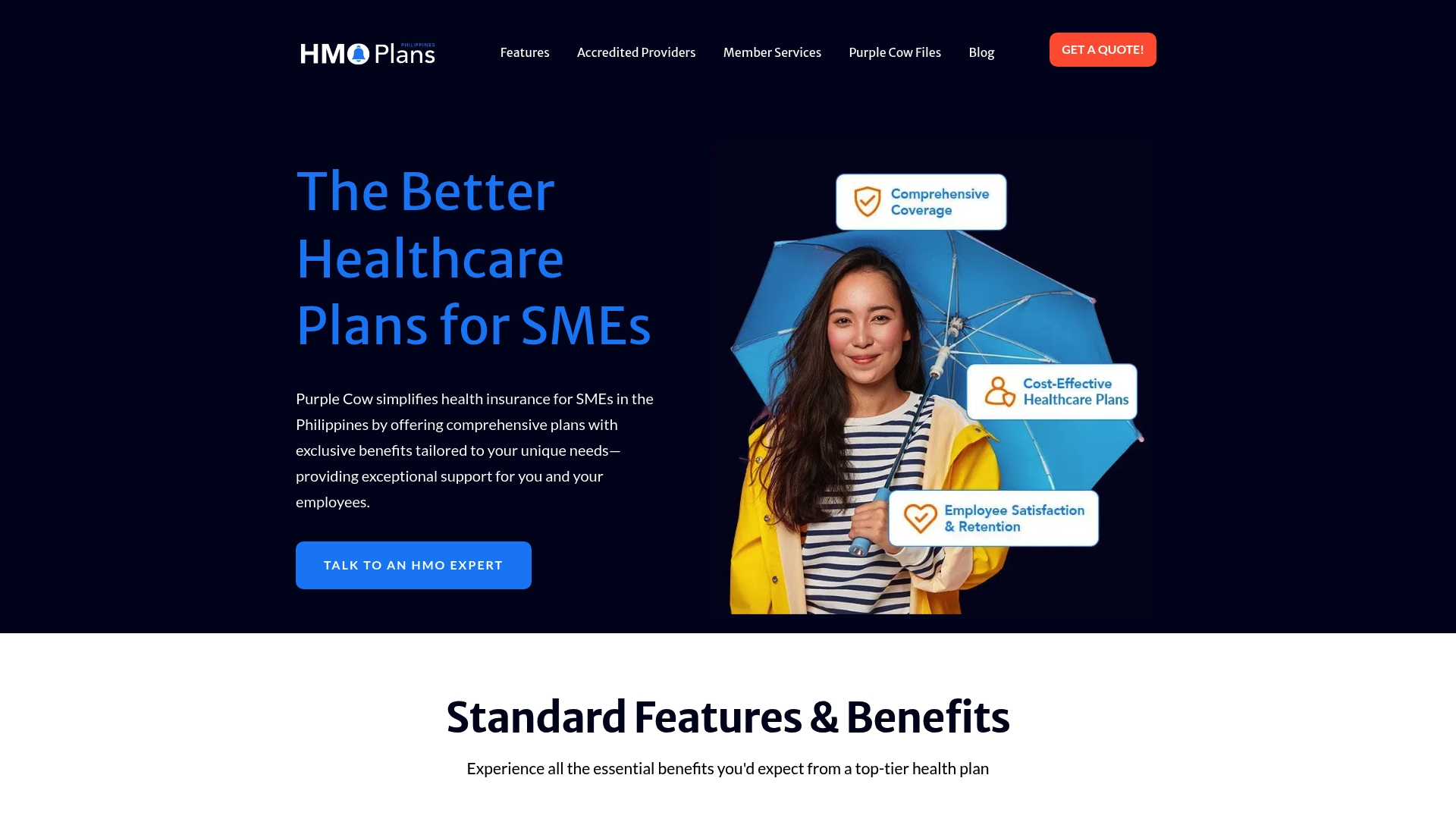
HMO Plans connects SMEs in the Philippines with straightforward, cost-effective health coverage backed by Purple Cow and Etiqa. Explore affordable plan features built specifically for growing businesses, with 100% coverage for pre-existing conditions, cashless hospital access, and flexible add-ons that fit your team’s real needs. Our dedicated member services team is ready to guide you from enrollment to claims with zero runaround. Ready to compare your options? Explore top HMO providers and get a plan that works as hard as your team does.
Frequently asked questions
What are the most important factors when choosing an HMO provider in the Philippines?
Prioritize provider credibility, coverage features, access network, and total cost. Local market priorities for SMEs in HMO selection center on balancing affordability with genuine, usable benefits.
How can SMEs verify the legitimacy of an HMO provider?
Confirm accreditation and reputation with the Insurance Commission and review client testimonials from other SMEs in your industry before signing.
What plan features are most valuable for SME employees?
Outpatient, inpatient, emergency, dental, and telemedicine access are the most requested. Popular SME plan features also include annual physical exams and specialist referrals.
Can SMEs combine HMO and PhilHealth for better coverage?
Yes. Combining PhilHealth and HMO maximizes employee healthcare value and significantly reduces out-of-pocket costs for both the business and its team members.
What red flags should SMEs watch out for when reviewing HMO contracts?
Watch for vague exclusions, unclear network lists, and poor after-sales support. Common pitfalls in HMO contracts often surface only after enrollment, so review every clause before signing.
