

How dental coverage in HMO plans boosts SME employee health
TL;DR:
- HMO dental coverage offers significantly broader benefits than PhilHealth, including check-ups, cleanings, and simple procedures.
- Proper planning and network verification are essential to maximize dental benefits for SME employees.
- Regular monitoring and employee communication increase utilization and value of dental HMO plans.
Many SME owners in the Philippines assume PhilHealth already handles their employees’ dental needs. It does not. PhilHealth covers only up to PHP1,000 per year for a narrow set of preventive procedures, leaving most oral health expenses entirely out of pocket. For a workforce where dental problems are common and often ignored until they become serious, that gap is costly. This guide breaks down what HMO dental coverage actually includes, how it works for your SME, what the fine print says, and how to choose a plan that genuinely serves your team.
Table of Contents
- Why dental coverage matters for SMEs
- What dental coverage in HMO actually includes
- How dental HMO plans work for your SME
- Limitations and what SMEs often miss
- Our perspective: Dental HMO plans are powerful, but not magic bullets
- How to get better dental coverage for your SME
- Frequently asked questions
Key Takeaways
| Point | Details |
|---|---|
| Dental coverage boosts SME health | Employee dental benefits enhance retention and keep teams healthy and productive. |
| HMO outpaces PhilHealth for dental | HMOs cover a wider range and quantity of dental services than PhilHealth alone. |
| Know plan limits and exclusions | Orthodontics, major treatments, and pre-existing conditions are often excluded or delayed. |
| Utilize provider networks smartly | Staying within network ensures cashless claims and easier access for employees. |
| SME strategy matters most | Maximize coverage value by negotiating group rates and monitoring utilization. |
Why dental coverage matters for SMEs
Let’s start with a number that should get your attention. Health programs deliver a 47% ROI through measurable productivity gains, and dental coverage is a core part of that equation. When employees are dealing with toothaches, infections, or gum disease, they are not performing at their best. Some skip work entirely. Others show up but are distracted and uncomfortable.
The scale of the problem in the Philippines is significant. 7 out of 10 Filipinos have oral health issues, which means the majority of your workforce is likely affected at some level. Oral health research consistently links poor dental health to systemic conditions like diabetes, cardiovascular disease, and respiratory infections. A cavity left untreated does not stay a cavity.
For SMEs specifically, the business case for dental coverage is straightforward:
- Reduced absenteeism: Employees with access to routine dental care miss fewer days due to pain or emergency procedures.
- Lower long-term costs: Preventive cleanings cost far less than treating advanced gum disease or infections that require hospitalization.
- Stronger retention: Benefits packages with dental coverage signal that you value employee well-being beyond the minimum.
- Better recruitment: In a competitive hiring market, dental coverage is a tangible differentiator that candidates notice.
“Dental coverage is no longer a luxury benefit. For SMEs competing for skilled workers, it is a baseline expectation that directly affects whether people stay or leave.”
Learning more about dental benefits for employee wellness can help you frame this investment correctly within your broader HR strategy. And if you are building a proactive health culture, implementing preventive care across your organization amplifies the impact even further. The point is simple: dental health is not separate from general health, and treating it as optional is a costly mistake.
What dental coverage in HMO actually includes
With the value proposition clear, let’s look at the real-world details: what does dental HMO coverage provide that PhilHealth does not?
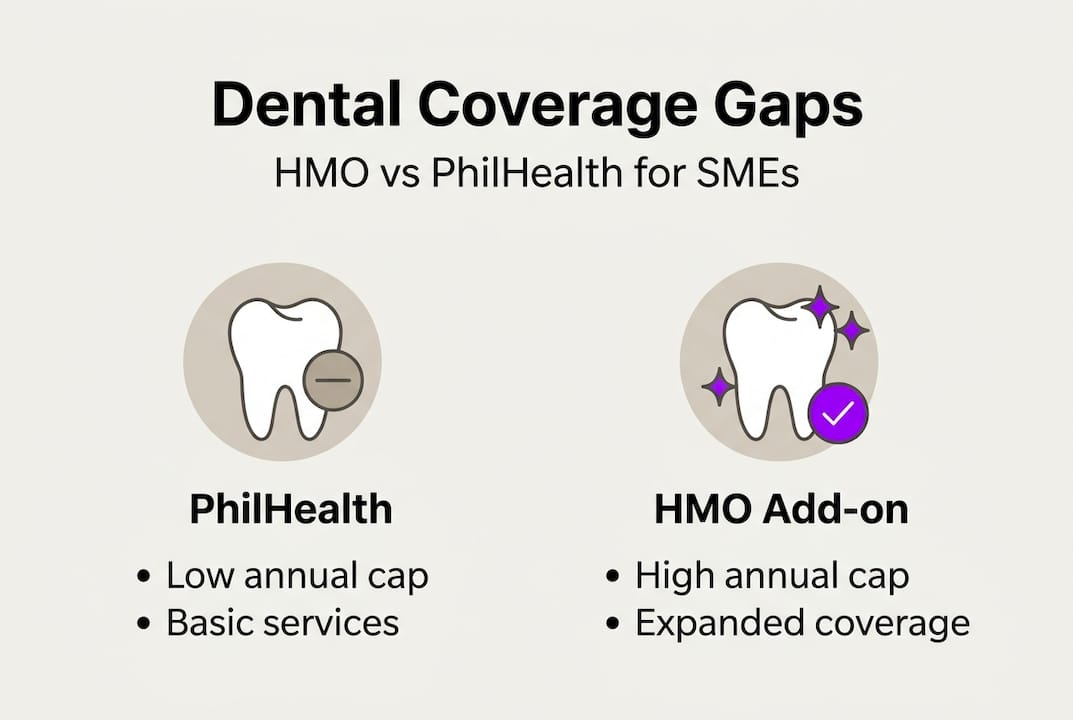
Dental coverage in Philippine HMOs typically includes check-ups, professional cleaning (prophylaxis), fillings, simple extractions, and gum treatments, often with annual limits far exceeding what PhilHealth offers. Here is a side-by-side comparison:
| Benefit | PhilHealth | HMO dental add-on |
|---|---|---|
| Annual limit | Up to PHP1,000 | PHP5,000 to PHP15,000+ |
| Routine check-up | Limited | Covered |
| Prophylaxis (cleaning) | Limited | Covered |
| Fillings | Not covered | Covered |
| Simple extractions | Limited | Covered |
| Gum treatment | Not covered | Covered |
| Orthodontics (braces) | Not covered | Not covered |
| Dental implants | Not covered | Not covered |
The difference is stark. PhilHealth was never designed to be a dental plan. HMO dental add-ons fill that gap meaningfully for everyday oral care.
Here is what is typically included in a standard HMO dental benefit:
- Oral examination and consultation
- Teeth cleaning and scaling
- Fluoride treatments
- Amalgam and composite fillings
- Simple and surgical extractions
- Gum disease treatment (basic)
What is usually not covered includes orthodontic treatment, cosmetic procedures, dental implants, crowns, bridges, and major oral surgery. These either fall under exclusions or carry long waiting periods before coverage kicks in.
For a deeper look at how HMO plans are structured overall, the HMO health insurance guide for SMEs is a solid starting point. You can also explore how cultivating a healthier workforce connects dental and general health benefits into one coherent strategy.
For a direct comparison of HMO vs PhilHealth coverage, the gap in dental benefits alone often justifies the cost of adding a dental rider to your plan.
Pro Tip: Aim for plans offering PHP5,000 to PHP15,000 in annual dental benefits per member. That range covers most routine needs without overpaying for benefits employees rarely use.
How dental HMO plans work for your SME
Now that you know what is covered, let’s break down how your business and employees can actually use HMO dental coverage every day.
The process is simpler than most people expect. Here is a typical step-by-step flow:
- Employee checks their HMO app or card to confirm dental benefits are active and locate accredited dental clinics nearby.
- Employee calls or visits an accredited clinic and presents their HMO card or digital ID.
- Clinic verifies coverage through the HMO portal or by requesting a Letter of Authorization (LOA) for certain procedures.
- Treatment is performed and billed directly to the HMO up to the covered limit.
- Employee pays nothing for covered procedures at accredited clinics (cashless claim).
- For non-network clinics, the employee pays out of pocket and submits a reimbursement claim with receipts and documentation.
Cashless services at accredited clinics through providers like Maxicare and iCare use app or LOA-based verification, making the process relatively seamless when employees know what to do.
Here is a quick reference for how claim types differ:
| Claim type | Process | Reimbursement |
|---|---|---|
| Accredited clinic | Present card or app, LOA if needed | None needed (cashless) |
| Non-accredited clinic | Pay upfront, submit claim | Capped reimbursement |
“The biggest source of employee frustration is not the coverage itself. It is not knowing which clinics are in-network or how to get an LOA before a procedure.”
Provider network density matters a lot here. A plan with 500 accredited dental clinics nationwide is only useful if several of them are near where your employees actually live and work. Always check network coverage by city or barangay before committing to a plan.
For SMEs looking to get more out of their health investment overall, maximizing your SME’s health investment covers the broader strategy. And if you are onboarding new hires, onboarding with better benefits explains how dental coverage strengthens your offer from day one.
Limitations and what SMEs often miss
Even with a good plan, certain exclusions or misunderstood mechanics can frustrate employees and employers alike. Here is what to watch out for.
The most common surprises SMEs encounter with HMO dental coverage include:
- Orthodontics and implants are excluded. Orthodontics, cosmetic treatments, and major surgeries are either excluded outright or heavily limited. Do not promise employees that braces are covered unless you have confirmed it in writing.
- Pre-existing condition (PEC) waiting periods. Most plans require 9 to 12 months before covering dental conditions that existed before enrollment. An employee with a known cavity on day one may not get it covered immediately.
- Non-accredited provider caps. Reimbursements for out-of-network dental visits are capped, often well below actual costs. Employees who use their regular dentist outside the network may be disappointed.
- Per-procedure limits. Even within the annual benefit, individual procedures may have their own caps. A single extraction might be covered up to PHP500 even if the actual cost is PHP800.
- Benefit summaries vary widely. Two plans with the same annual limit can have very different covered procedures. Always request a written benefit summary before signing.
When evaluating providers, choosing the right HMO partner walks you through the questions that separate good plans from frustrating ones. If you operate in a specific industry, health coverage in food and beverage shows how sector-specific needs affect plan selection.
Pro Tip: Before finalizing any HMO dental plan, verify the network coverage in your employees’ home cities, not just near your office. Then negotiate group rates. Most providers will move on pricing for groups of 10 or more.
Our perspective: Dental HMO plans are powerful, but not magic bullets
After guiding many SMEs through the process of selecting and implementing dental coverage, one pattern stands out clearly. The businesses that get the most value from dental HMO plans are not the ones that spent the most. They are the ones that asked the right questions before signing.
Most disappointment with dental coverage comes from two mistakes. First, choosing a plan based on premium price alone without checking provider network density or per-procedure limits. Second, assuming coverage is automatic without communicating clearly to employees about how to use their benefits.
Always negotiate group rates and check provider network density before committing. This is not optional advice. It is the difference between a benefit your team actually uses and one that sits unused because the nearest accredited clinic is 45 minutes away.
The other underused strategy is tracking utilization. When you monitor how often employees use dental benefits and for what procedures, you gain real leverage at renewal. Low utilization might mean your network is inconvenient. High utilization in specific procedures might mean you need a higher annual limit. That data makes your next plan better and often cheaper. SME HMO vendor selection is an ongoing process, not a one-time decision.
How to get better dental coverage for your SME
Ready to take action on smarter HMO dental benefits for your team?
At HMO Plans, we work specifically with SMEs in the Philippines to build health coverage that fits your team size, budget, and location. Dental HMO services are available as a flexible add-on to your core plan, giving you the ability to customize coverage without overcomplicating your benefits package.
Our accredited HMO dental providers network spans clinics nationwide, so your employees can access cashless dental care close to where they live and work. Need help navigating claims or plan options? Our member services team is ready to support you and your employees every step of the way. Book a consultation today and find out which dental coverage option makes the most sense for your business.
Frequently asked questions
What dental procedures are typically covered by HMO plans in the Philippines?
Most HMO plans cover routine check-ups, cleanings, fillings, and simple extractions, but orthodontics and cosmetic treatments are generally excluded from standard coverage.
How do HMOs with dental coverage compare to PhilHealth?
HMOs provide significantly broader dental benefits with higher annual limits, while PhilHealth dental limits are capped at PHP1,000 per year for a narrow set of preventive procedures only.
Are there waiting periods for dental coverage in HMO plans?
Pre-existing dental conditions typically carry a 9 to 12 month waiting period before coverage applies, though routine preventive care is usually covered from the start of enrollment.
Can employees use HMO dental coverage at any clinic?
Cashless claims require accredited clinics; visits to non-network providers require upfront payment and reimbursement claims, which are subject to documentation requirements and benefit caps.
How can SMEs maximize the value of dental coverage in HMOs?
Prioritize higher annual limits and negotiate group rates, and always confirm that accredited dental clinics are conveniently located near where your employees actually live and work.
Recommended
- The Better HMO Plans for SMEs | Purple Cow | Blog | Rai dela Cruz | Best HMO Plans Philippines - Purple Cow
- Eumir
- PhilHealth + HMO: Maximizing Your SME’s Health Investment
- Onboarding New Employees with Better Health Benefits: A Winning Hiring Strategy for SMEs
- National Dental Plan – Humm - Paynless Dental Clinic
