

Emergency care for employees: Philippine SME guide 2026
Most small business owners in the Philippines assume strict workplace health rules only apply to large corporations with hundreds of employees. That assumption is wrong, and it can cost you. Every SME, regardless of headcount, carries legal obligations for emergency medical care under Philippine law. Fail to meet them, and you face daily fines, criminal exposure, and the kind of reputational damage that drives talent away. This guide walks you through exactly what the law requires, how government and private coverage work together, and the practical steps you can take right now to protect your team and your business.
Table of Contents
Best practices and mandatory provisions for first aid readiness at work
Coordinating government and private healthcare coverage for workplace emergencies
Key Takeaways
PointDetailsLegal obligationsAll SMEs must provide emergency medical care under strict Philippine labor laws.Compliance stepsFollow clear requirements for first aid, reporting, and documentation to avoid steep fines.Coverage gapsPhilHealth and SSS support mandatory care, but HMO fills gaps for non-work injuries and offers added employee value.Risk reductionWell-designed OSH programs and staff training reduce legal and reputational risks.Proactive actionRegular reviews, drills, and choosing the right HMO create safer, more resilient workplaces.
Why emergency care matters in the Philippine SME workplace
The stakes for SME owners are higher than most realize. Under RA 11058, non-compliance with occupational safety and health standards carries fines of PHP20,000 to PHP100,000 per day. That is not a one-time penalty. Every day your workplace falls short, the meter keeps running.
“Workplace injuries do not just hurt employees. They disrupt operations, damage morale, and expose owners to liability that can outlast the incident itself.”
Beyond the legal risk, there is a direct business case. Employees who feel safe and supported are more productive and more loyal. A single poorly handled emergency can unravel months of trust-building. Consider what is actually at stake when your emergency care program is weak:
Employee safety and life: Delayed care in a medical emergency can be fatal.
Morale and retention: Teams notice how leadership responds under pressure.
Productivity: Workplace injuries cause lost workdays and operational disruption.
Legal and financial exposure: Fines, lawsuits, and reputational harm compound quickly.
Reviewing a solid workplace wellness checklist is a smart starting point, but compliance requires going further. Understanding how to start maximizing your SME’s health investment means treating emergency readiness as a core business function, not an afterthought.
Philippine legal requirements for emergency medical care
The Philippine Labor Code mandates emergency medical services based on company size. Here is a simplified breakdown of what is required:
Company sizeFirst aid kitTrained first aiderOn-site clinicMedical personnel1 to 49 employeesRequiredAt least 1 per shiftNot requiredNot required50 to 199 employeesRequiredAt least 1 per shiftRequiredPart-time nurse200 to 299 employeesRequiredAt least 1 per shiftRequiredFull-time nurse300 or more employeesRequiredAt least 1 per shiftRequiredNurse, physician, dentist
Regardless of size, the law is clear on what must happen the moment an emergency occurs. Employers must immediately provide first aid, arrange transport to a hospital at the company’s own expense, and report the incident to DOLE within 24 hours and to SSS and ECC within 5 days.
Here is the required sequence when a workplace emergency happens:
Administer first aid immediately using on-site supplies and trained personnel.
Call emergency services or arrange direct transport to the nearest accredited hospital.
Shoulder all transport and initial care costs as the employer.
Notify DOLE of the incident within 24 hours.
File the formal accident report with SSS and ECC within 5 working days.
Document every detail: time, location, nature of injury, actions taken, and personnel involved.
Pro Tip: Thorough incident documentation is your best legal defense. A well-kept record shows you acted responsibly and followed protocol, which significantly reduces your liability exposure in any dispute.
Staying current on your PhilHealth compliance obligations is also part of this picture, since proper enrollment affects what benefits your employees can access during a hospitalization.
Best practices and mandatory provisions for first aid readiness at work
Meeting the legal minimum is the floor, not the ceiling. Smart SMEs build readiness programs that go beyond what DOLE requires, because the cost of prevention is always lower than the cost of a crisis.
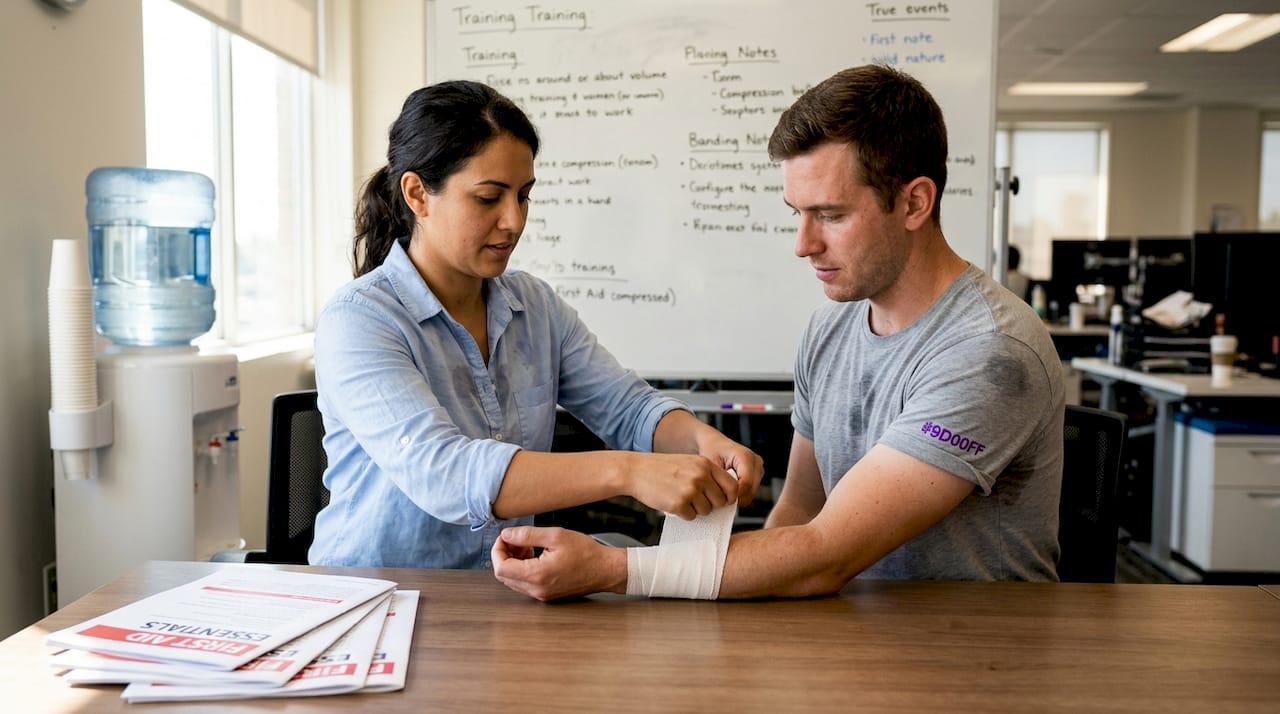
Under DO 252-25, SMEs with fewer than 50 employees must maintain first aid kits and trained personnel. Smaller firms can also cluster together under a shared OSH program, which reduces individual compliance costs while still meeting legal standards.
Here is what a practical first aid readiness program looks like for most SMEs:
First aid kit contents: Bandages, antiseptic solution, gauze pads, adhesive tape, scissors, gloves, CPR face shield, and a basic first aid manual.
Posted emergency contacts: Local emergency hotlines, nearest hospital address, and your company’s designated emergency coordinator.
Trained staff: At minimum, one certified first aider per shift. Certification through the Philippine Red Cross or DOLE-accredited providers is widely available.
Mock drills: Conduct at least one emergency drill per year. Twice is better.
Kit inspection schedule: Check and restock kits monthly. Expired supplies are a compliance violation and a safety risk.
Evacuation plan: Posted, practiced, and updated whenever your office layout changes.
A thorough employee wellness checklist can help you audit your current setup against these standards.
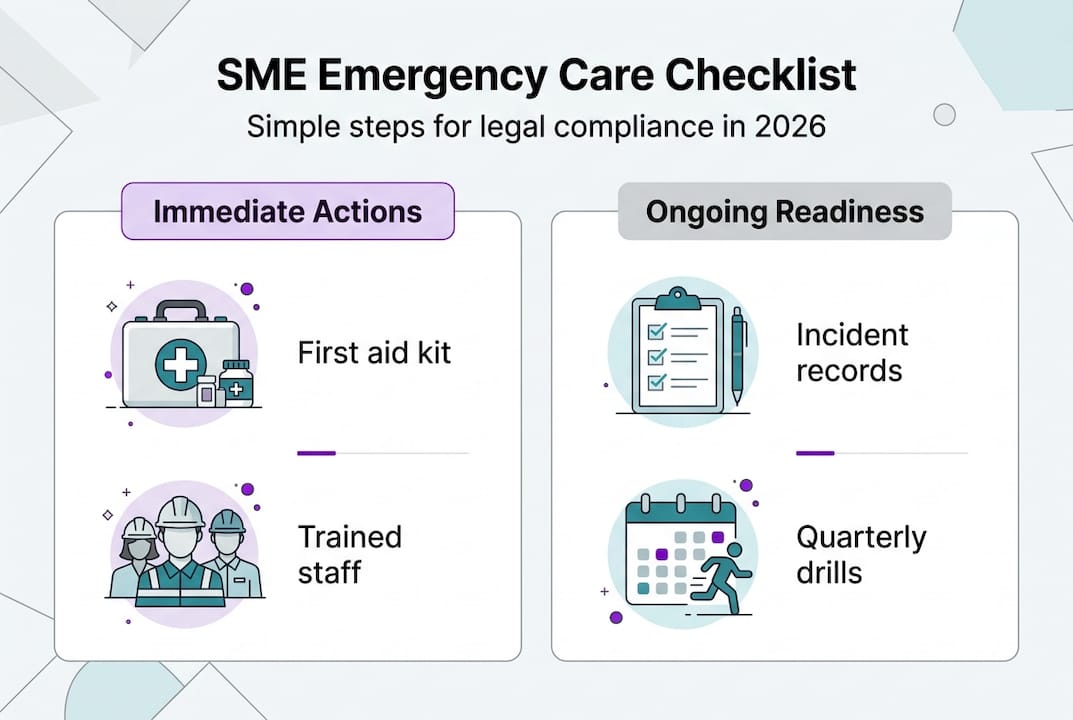
Pro Tip: Designate and train at least two staff members as first aiders, not just one. If your sole trained person is on leave or is the one who gets injured, you have no coverage. Redundancy is not optional in emergency planning.
For SMEs looking to go further, reviewing SME health investment strategies can help you build a program that supports both compliance and long-term employee retention.
Coordinating government and private healthcare coverage for workplace emergencies
Understanding which program covers what during an emergency saves time and prevents costly mistakes. Here is how the main programs stack up:
Coverage sourceWhat it covers in emergenciesKey limitationPhilHealthHospitalization, surgery, ER visitsPartial coverage, co-pays applySSSSickness benefit (cash), disabilityDoes not cover medical bills directlyEmployees’ Compensation (EC)Work-related injuries: full medical care, TTD at 90% salaryWork-related onlyHMO planCashless hospital access, outpatient, ER, specialistDepends on plan terms
“The Employees’ Compensation Program under PD 626 covers work-related injuries with full medical care and temporary total disability benefits at 90% of the employee’s average daily salary credit.”
For non-work-related emergencies, PhilHealth is the primary government safety net, but it rarely covers the full bill. That gap is where HMO insurance for SMEs becomes essential. A well-structured HMO plan provides cashless access to hospitals, covers what PhilHealth does not, and removes the financial burden from both the employee and the employer.
To make sure your team is properly covered, follow these steps:
Confirm all employees are enrolled in PhilHealth and SSS before their first day.
Register new hires with ECC through SSS within 30 days of employment.
Identify which emergencies qualify as work-related versus personal health events.
For remote or telework employees, note that duty-related injuries are compensable even outside the office.
Supplement statutory coverage with an HMO plan to close gaps in outpatient, specialist, and emergency care.
Reviewing how PhilHealth and HMO coverage work together helps you avoid situations where employees are left with large out-of-pocket bills after an emergency.
Common pitfalls, legal risks, and how SMEs stay protected
Most compliance failures in SMEs are not intentional. They come from gaps in knowledge, outdated systems, and the assumption that small size means small risk. Here are the most common mistakes:
Poor record-keeping: No incident log, missing accident reports, or incomplete documentation.
Untrained staff: First aiders whose certifications have lapsed or who were never formally trained.
Expired first aid kits: Supplies that have not been checked or restocked in months.
Delayed reporting: Missing the 24-hour DOLE window or the 5-day SSS/ECC deadline.
Assuming PhilHealth covers everything: Employees left with large bills because the employer did not supplement coverage.
“An employer can be held solidarily liable if negligence contributed to the severity of an employee’s injury. Solid documentation and a functioning OSH program are your primary defenses.”
According to employer liability guidance, documenting every incident, even minor ones, is critical. Courts and labor tribunals look at the totality of your response, not just whether you had a first aid kit on the shelf.
Building a real OSH program also reduces the likelihood of litigation. When employees see that safety is taken seriously, they are less likely to pursue legal action after an incident. For guidance on protecting employee health in complex situations, including special procedures and high-cost emergencies, having the right coverage structure matters enormously. Understanding ergonomics in injury prevention is another layer of proactive risk management worth exploring.
A step-by-step roadmap to SME emergency care compliance
If you are not sure where your business stands right now, this roadmap gives you a clear path forward. Employers in SMEs who ensure PhilHealth and SSS enrollment, maintain first aid readiness, and supplement with HMO coverage are best positioned to handle any emergency without legal or financial fallout.
Assess your current readiness. Audit your first aid kits, check staff certifications, and review your incident reporting records.
Fill the gaps. Restock expired supplies, schedule first aid training, and update your emergency contact postings.
Confirm enrollment. Verify that every employee is enrolled in PhilHealth, SSS, and ECC.
Review your coverage. Identify where PhilHealth and EC leave gaps, and evaluate whether an HMO plan addresses them.
Create an incident response protocol. Write down the exact steps your team follows when an emergency happens, and make sure everyone knows them.
Document everything. Set up a simple incident log and make it a habit to record every health-related event, no matter how minor.
Schedule regular reviews. Revisit your emergency program every quarter to catch new risks and stay current with regulatory updates.
Pro Tip: Schedule a quarterly emergency drill and a compliance review on the same day. It keeps both habits alive without doubling your calendar load.
For ongoing updates and practical guidance, the SME health care blog is a useful resource to bookmark.
Empower your workforce with better health protection
Meeting the legal minimum protects you from fines. But the SMEs that attract and keep great people go further. They build health programs that make employees feel genuinely valued, not just covered on paper.
HMO Plans, powered by Purple Cow and underwritten by Etiqa, is built specifically for SMEs in the Philippines. Their plans cover emergency care, inpatient and outpatient services, and pre-existing conditions up to the Maximum Benefit Limit, with cashless access to the Big 9 Hospitals and Healthway Clinics. No complicated exclusions, no surprise gaps. Explore the full range of SME HMO features or connect with the team through HMO member services to find a plan that fits your team size and budget. Your employees deserve more than the minimum, and so does your business.
Frequently asked questions
What immediate steps must an SME take during an employee emergency?
Provide first aid on the spot, arrange hospital transport at the company’s expense, and file accident reports with DOLE within 24 hours and SSS/ECC within 5 working days.
Are telework and remote injuries covered under SME emergency care rules?
Yes. If the injury happens while the employee is performing official work duties, it is compensable and must be reported, regardless of where the employee was working.
What are the penalties for not complying with emergency care laws for employees?
RA 11058 penalties range from PHP20,000 to PHP100,000 per day of non-compliance, and company officers can face criminal liability on top of the fines.
Is an HMO plan required by law for SMEs?
No, but many SMEs provide HMO plans to fill coverage gaps beyond PhilHealth and to strengthen employee loyalty beyond the statutory minimum.
