

Emergency Care in HMO: Why Coverage Matters
An employee suddenly collapses at work and the nearest hospital is not on your HMO network. In moments like these, knowing exactly how HMO emergency care coverage works can make all the difference for your company’s safety and your team’s well-being. For HR managers in the Philippines, understanding what truly counts as an emergency and how coverage applies regardless of network is vital for both employee protection and legal compliance. This guide demystifies emergency coverage so you can provide answers and real security when every second counts.
Table of Contents
- Defining Emergency Care In HMO Plans
- Types Of Emergency Situations Covered
- How Emergency Care Coverage Works
- Cost-Sharing, Exclusions, And Limitations
- Employer Obligations And Common Pitfalls
Key Takeaways
| Point | Details |
|---|---|
| Emergency Coverage | Emergency care is fully covered in HMO plans, regardless of network status, ensuring immediate access to life-saving treatment. |
| Employee Education | It’s essential for employees to understand what qualifies as an emergency under their HMO plan to avoid unnecessary costs or coverage issues. |
| Cost-Sharing Awareness | Employees should be informed about potential cost-sharing elements like copays and coinsurance that may apply even in emergencies. |
| Compliance Responsibility | HR must ensure clear communication of emergency benefits and compliance with legal requirements to minimize organizational liability. |
Defining Emergency Care in HMO Plans
Emergency care in HMO plans isn’t the same as what you might think. It’s a specific category of coverage that kicks in when your employees face sudden, life-threatening situations that require immediate medical attention. Understanding this distinction matters because it directly affects your employees’ financial protection and your company’s liability exposure.
When we talk about emergencies in HMO coverage, we’re referring to situations requiring urgent treatment to prevent death or serious bodily harm. HMO plans are organized networks of doctors, clinics, and hospitals that provide comprehensive services for a fixed monthly cost. The critical part for your HR team to know: emergency care is covered even if your employee rushes to an out-of-network hospital during a genuine crisis.
Here’s what makes emergency coverage unique in HMOs:
- Network restrictions don’t apply during true emergencies, meaning your employees aren’t penalized for going to the nearest available facility
- Coverage is immediate regardless of prior authorization or approval requirements
- Out-of-network providers are covered at the same rate as in-network facilities when handling emergencies
- No referral required from a primary care physician to access emergency services
Your employees likely understand that HMOs require them to use network providers for routine care. What they may not know is that emergency services bypass these network restrictions entirely, creating a safety net for unexpected crises.
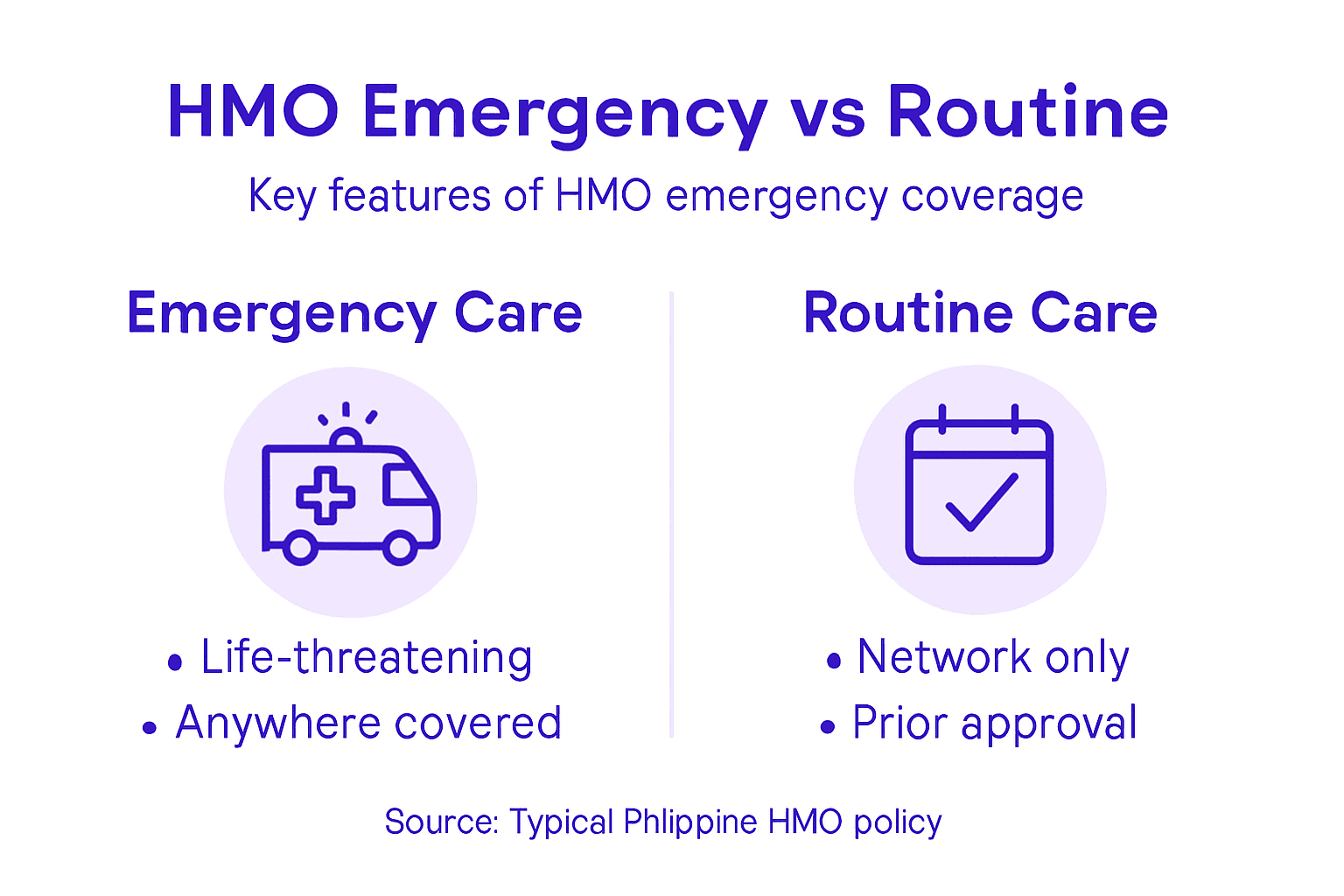
The key distinction matters in real workplace scenarios. An employee suffers chest pain at 2 AM on a Sunday. They can’t reach their primary care physician. They go to the nearest emergency room, which happens to be out-of-network. Under HMO emergency care rules, that treatment is fully covered.
In the Philippines context, this coverage is particularly valuable for your workforce. Traffic accidents, workplace injuries, sudden health emergencies—these happen without warning, and they don’t care which hospital is on your HMO network.
Your employees need to understand that “emergency” has a medical definition in their HMO plan, not a personal one. Feeling sick isn’t always an emergency, but difficulty breathing certainly is.
The definition of emergency typically includes conditions like acute chest pain, severe injuries, loss of consciousness, difficulty breathing, severe allergic reactions, and sudden severe illness. Each HMO plan defines emergency care specifically in its policy documents, so review yours carefully.
For your SME organization, this means employees can access life-saving care without worrying about whether the hospital is on their provider list. This reduces your potential liability if an employee delays treatment due to network concerns and suffers worse outcomes.
Pro tip: _Educate employees during onboarding that emergencies are covered everywhere, but they should still call their primary care physician afterward for continuity of care and to understand follow-up coverage for any related treatment.
Here’s a quick comparison of emergency care versus non-emergency (routine) care within HMO plans:
| Aspect | Emergency Care Coverage | Non-Emergency (Routine) Care |
|---|---|---|
| Provider Choice | Any hospital, in or out-of-network | Limited to network providers |
| Prior Authorization | Not required | Often required before treatment |
| Referrals | Not needed | Usually required from primary doctor |
| Employee Cost | Lower copay; coinsurance may apply | Standard copay, higher out-of-pocket |
| Coverage Start | Immediate payout by HMO | Coverage subject to network rules |
| Claim Process | Cashless, HMO pays provider | May require upfront payment & filing |
Types of Emergency Situations Covered
Not every health problem qualifies as an emergency under your HMO plan. Your employees need to know which situations trigger coverage and which don’t. This clarity prevents costly mistakes and ensures they use their benefits correctly.

HMO plans cover a variety of emergency situations including life-threatening illnesses and injuries that require immediate medical attention. The common thread: the condition must be serious enough that delaying treatment could result in death or serious disability. This is the standard insurers use to determine coverage.
Here are the emergency situations your employees’ HMO will cover:
- Heart attack or stroke symptoms including chest pain, sudden weakness, difficulty speaking, or facial drooping
- Severe injuries and accidents such as car crashes, falls, or workplace trauma requiring urgent intervention
- Breathing difficulties including severe asthma attacks, choking, or inability to breathe normally
- Loss of consciousness or sudden severe confusion that suggests a serious medical event
- Severe burns, poisoning, or allergic reactions that threaten immediate health
- Seizures or convulsions indicating a neurological emergency
- Severe abdominal or chest pain that could signal organ damage or internal bleeding
For your HR team managing a workforce, the practical difference matters. An employee with a persistent headache might be uncomfortable, but it’s not typically an emergency unless accompanied by other symptoms like fever or neck stiffness.
Typical examples covered include heart attacks, strokes, and trauma from accidents requiring immediate care. Severe pain alone doesn’t automatically qualify—the pain must indicate a serious underlying condition.
In the Philippines workplace context, traffic accidents are unfortunately common emergencies your coverage will handle. So are construction injuries, electrical incidents, or sudden cardiac events. Your employees can go directly to any hospital emergency room, and the HMO covers it.
The key question isn’t whether your employee feels bad—it’s whether a reasonable person would believe immediate medical care is necessary to prevent serious harm.
Many employees confuse “urgent care” with “emergency care.” A bad flu might need a same-day clinic visit, but it’s not an emergency. A severe allergic reaction is both urgent and an emergency. Understanding this distinction saves your company from argument about coverage.
One important note for your workforce: emergency coverage applies even if they don’t call ahead or get approval first. They should seek treatment immediately, then handle the paperwork later.
Pro tip: Include specific emergency examples in your employee handbook so staff members understand what qualifies, and remind them that when in doubt during a crisis, it’s better to go to the emergency room and let medical professionals assess whether treatment is necessary.
How Emergency Care Coverage Works
Emergency care coverage operates differently than your standard HMO benefits. Understanding the mechanics helps you explain it correctly to employees and prevents confusion when a crisis happens.
When an employee faces a life-threatening situation, emergency care coverage under HMOs functions by ensuring services are covered even if provided by out-of-network providers. This breaks the normal HMO rule requiring in-network care. The system prioritizes saving lives over network restrictions.
Here’s how the process actually unfolds:
- Immediate activation happens the moment your employee seeks emergency treatment, with no prior authorization needed
- Any facility accepted means your employee can go to the nearest hospital, regardless of network status
- Coverage applies instantly for ambulance services, emergency room visits, and stabilization care
- Out-of-pocket costs lower compared to non-emergency out-of-network services because emergency coverage is treated differently
Your employee doesn’t need to call their primary care physician first. They don’t need approval from the HMO. They go directly to the emergency room, and coverage activates immediately.
After stabilization, the process shifts. HMOs maintain coverage for emergency care outside their network without requiring prior authorization, but once the immediate crisis passes, your employee may need to transition to in-network facilities for ongoing treatment. This is where the HMO’s cost control mechanisms kick back in.
Imagine an employee in a car accident on the way to a client meeting. They’re rushed to the nearest hospital, which happens to be out-of-network. The emergency room stabilizes them. Coverage is full. But if they need follow-up surgery, the HMO may require transfer to a network hospital for that procedure.
For your SME organization, this distinction matters significantly. Out-of-network care guidance helps employees understand reimbursement options when treatment extends beyond the initial emergency phase.
Emergency coverage is automatic and unrestricted. Follow-up care often requires coordination with your HMO to maintain coverage at preferred levels.
Your employees should know that the HMO pays the emergency room bills directly under the cashless arrangement. They don’t need to pay out-of-pocket and fight for reimbursement later. The HMO absorbs the cost immediately.
One crucial detail: ambulance services are included in emergency coverage. Your employee doesn’t pay for transport to the hospital. The HMO covers it fully as part of emergency care.
Pro tip: Keep your employee benefits contact information easily accessible and remind staff to notify the HMO about any emergency treatment within 24 hours, even though coverage is automatic, so the plan can coordinate follow-up care appropriately.
Cost-Sharing, Exclusions, and Limitations
Emergency care coverage sounds comprehensive, but your employees need to understand the financial reality. Even with emergency benefits, cost-sharing applies, and certain limitations exist that could affect their wallet or coverage eligibility.
HMOs usually include cost-sharing components such as deductibles, copayments, and premiums, which vary by plan. Emergency services typically have lower or no deductibles compared to routine care. This means your employee might pay nothing at the emergency room, or they might have a small copay, depending on your specific HMO plan design.
Here’s what cost-sharing typically looks like in emergency situations:
- Emergency room copays usually range from $100 to $300 per visit, though some plans waive this entirely
- Deductibles may not apply to emergency care, making it truly accessible regardless of whether employees have met their annual deductible
- Coinsurance (percentage of costs) might apply for admitted hospital stays, typically 10-20% after deductible
- Out-of-pocket maximums protect patients from catastrophic costs, capping total annual expenses
Your company needs to clarify these details with your HMO before employees face an emergency. A $200 emergency room copay seems manageable until an employee faces a $50,000 hospital bill and learns they’re responsible for 20% coinsurance.
Exclusions and limitations matter just as much as coverage. Consumer protections exist to help clarify cost-sharing complexities, with regulations ensuring patients are not balance-billed unexpectedly for emergency services from out-of-network providers. However, limitations still apply in specific scenarios.
Common exclusions in emergency coverage include treatment deemed not medically necessary, elective procedures disguised as emergencies, and substance abuse treatment in some plans. Pre-existing condition exclusions rarely apply to emergency care, but your specific plan language matters.
Emergency care protections are strong, but follow-up care and non-emergency treatment may have stricter limitations and higher cost-sharing.
For your Philippine SME workforce, understanding special procedures and complex coverage protections helps clarify what happens after the emergency stabilization phase. This is where employees discover unexpected gaps in coverage.
One critical detail: your HMO should have an out-of-pocket maximum that caps total yearly expenses for emergency care. Once your employee hits this limit, the plan covers remaining emergency services at 100%. This protection prevents financial catastrophe.
Routine care outside the network carries no such protections. If your employee chooses an out-of-network doctor for a regular checkup, they typically pay full price and request reimbursement. Emergency care works differently—the network restriction simply disappears.
Pro tip: Create a simple one-page reference sheet showing your specific emergency care copays, deductibles, and out-of-pocket maximums, and distribute it during benefits enrollment and again quarterly so employees know exactly what they’ll pay before facing a crisis.
Employer Obligations and Common Pitfalls
Your responsibilities as an HR manager extend beyond selecting an HMO plan. Federal and state law requires you to ensure emergency care coverage meets specific standards, and failure to do so creates legal and financial liability for your company.
Employers offering group health plans including HMOs must ensure the plans comply with state and federal mandates regarding coverage, accessibility, and quality of services. This means your plan documents must explicitly state that emergency care is covered regardless of network status. If your HMO plan fails to include this language, you’re violating regulatory requirements.
Here are your core obligations:
- Provide clear plan documents outlining emergency benefits, cost-sharing, and exclusions without ambiguity
- Ensure network adequacy so employees have reasonable access to emergency facilities throughout your service area
- Communicate coverage rules to employees through multiple channels during onboarding and annually
- Verify compliance with federal and state requirements before implementing any plan changes
- Document employee education showing you’ve trained staff on emergency benefits and procedures
Many Philippine SMEs overlook critical compliance requirements. You might have emergency coverage in your plan, but if employees don’t know it exists, your company still faces liability when someone delays treatment due to uncertainty.
Employers with 25 or more employees are required by federal law to offer coverage including emergency medical services. This isn’t optional. Even smaller companies should follow best practices to protect themselves.
Common pitfalls that create problems:
- Inadequate communication leaving employees confused about their emergency coverage
- Outdated plan materials with conflicting information about out-of-network emergency care
- No written protocol for employees to follow when experiencing emergencies
- Insufficient staff training meaning HR can’t answer basic questions about coverage
- Failure to review plan documents annually, missing updates or regulatory changes
Your HR team must understand the plan thoroughly enough to explain it to employees. If you can’t confidently answer “Is emergency care covered outside our network?” you haven’t met your obligation.
Liability follows incomplete communication more than incomplete coverage. A well-documented, well-communicated HMO plan protects your company better than a comprehensive plan nobody understands.
Balancing cost controls with adequate coverage creates tension. Your company wants to manage expenses, but cutting emergency coverage creates legal exposure that costs far more than savings.
Regularly audit your compliance. Review plan documents quarterly, update employee materials annually, and document all training sessions. This creates a paper trail proving you took compliance seriously.
Pro tip: Schedule a quarterly benefits review meeting with your HMO representative to ensure your company remains compliant with current regulations, and use these meetings to identify coverage gaps or communication improvements before employees discover problems.
Use this summary table to identify employer responsibilities and potential pitfalls in managing HMO emergency care benefits:
| Responsibility | Description | Common Pitfall |
|---|---|---|
| Plan Documentation | Clearly outline benefits & exclusions | Outdated or unclear plan documents |
| Employee Communication | Inform staff through trainings and handbooks | Inadequate explanation or confusion |
| Compliance Review | Regularly audit for legal and policy alignment | Missing updates or regulatory changes |
| Response Protocols | Provide written steps for emergencies | No clear emergency action plan |
Secure Your Team’s Future with Trusted Emergency Care Coverage
The article highlights the critical challenge SMEs face in providing employees with reliable emergency care coverage under HMO plans. Many employees fear delays or high out-of-pocket costs when emergencies happen outside network hospitals. Your goal is to eliminate that uncertainty by offering comprehensive HMO benefits that include unrestricted emergency care, cashless claims, and seamless out-of-network reimbursements.
At HMO Plans, we specialize in solutions tailored for Small and Medium Enterprises in the Philippines that address these exact concerns. Our partnership with Purple Cow and Etiqa ensures your workforce receives 24/7 nationwide emergency coverage without worrying about network restrictions or surprise bills. With 100% coverage on pre-existing conditions and special procedures plus access to premier hospitals, your employees get the care they need when they need it most.

Take control of your company’s health benefits now by choosing an HMO plan that guarantees comprehensive emergency care and peace of mind. Visit HMO Plans to learn how our affordable, straightforward plans protect your employees and your business from costly liabilities. Don’t wait until an emergency catches you unprepared. See how our flexible plans can work for your team today and experience the difference that true coverage makes.
Frequently Asked Questions
What qualifies as an emergency under an HMO plan?
An emergency under an HMO plan typically includes life-threatening conditions requiring immediate medical attention, such as heart attacks, strokes, severe injuries, or difficulty breathing. Delaying treatment for these conditions could result in serious harm or disability.
How does emergency care coverage work in HMO plans?
Emergency care coverage in HMO plans allows employees to seek treatment at any hospital, in or out-of-network, without prior authorization. Coverage activates immediately for emergency services, ensuring financial protection during urgent medical situations.
Are there any costs associated with emergency care in HMO plans?
Yes, employees may have cost-sharing components such as copayments or coinsurance for emergency services. Emergency room visits often have lower costs compared to non-emergency care, and certain plans may even waive copayments entirely.
What happens after an employee receives emergency care from an out-of-network provider?
After stabilization in an emergency, follow-up care may need to transition to in-network facilities, and specific approvals could be required for continued treatment. It’s important for employees to communicate with their HMO regarding ongoing care after an emergency.
Recommended
- Understanding HMO Basics: A Guide for New HR Managers in SMEs
- Evaluating Vendors: How SMEs Can Choose the Right HMO Partner
- Navigating Out-of-Network Care: A Guide to Reimbursements for Employees
- Navigating Congenital and Special Condition Coverage: Inclusive Healthcare for Every Employee
- NHS vs Private Ear Treatment: Making Informed Choices
- Affordability in Hearing Healthcare – Why It Matters – Audora
