

HMO add-ons guide for SMEs in Philippines 2026
Choosing the right HMO plan for your team is already complex, but understanding HMO add-ons often leaves HR managers overwhelmed with options they don’t fully grasp. Many SMEs either over-invest in unused benefits or miss critical coverage that employees actually need. This guide cuts through the confusion by explaining what HMO add-ons are, which ones matter most for Philippine SMEs, and how to select them strategically to maximize both employee satisfaction and your health benefits budget.
Table of Contents
- What Are HMO Add-Ons And Why Do SMEs Need Them?
- Common Types Of HMO Add-Ons And Their Features
- How To Evaluate And Choose The Right HMO Add-Ons For Your SME
- Integrating HMO Add-Ons Into Your Company’s Health Benefits Strategy
- Explore Better HMO Plans Tailored For SMEs
- Frequently Asked Questions
Key takeaways
| Point | Details |
|---|---|
| HMO add-ons expand base coverage | Supplementary services like dental, optical, and outpatient care customize your employee health plan beyond standard benefits. |
| Strategic selection controls costs | Analyzing employee health data and usage patterns ensures you invest in add-ons your team will actually use. |
| Regular reassessment optimizes value | Annual reviews based on claims data and employee feedback keep your benefits aligned with evolving workforce needs. |
| Integration drives engagement | Communicating add-on benefits clearly and linking them to wellness programs increases utilization and employee satisfaction. |
| Customization attracts talent | Tailored health benefits differentiate your SME in competitive hiring markets and improve retention rates. |
What are HMO add-ons and why do SMEs need them?
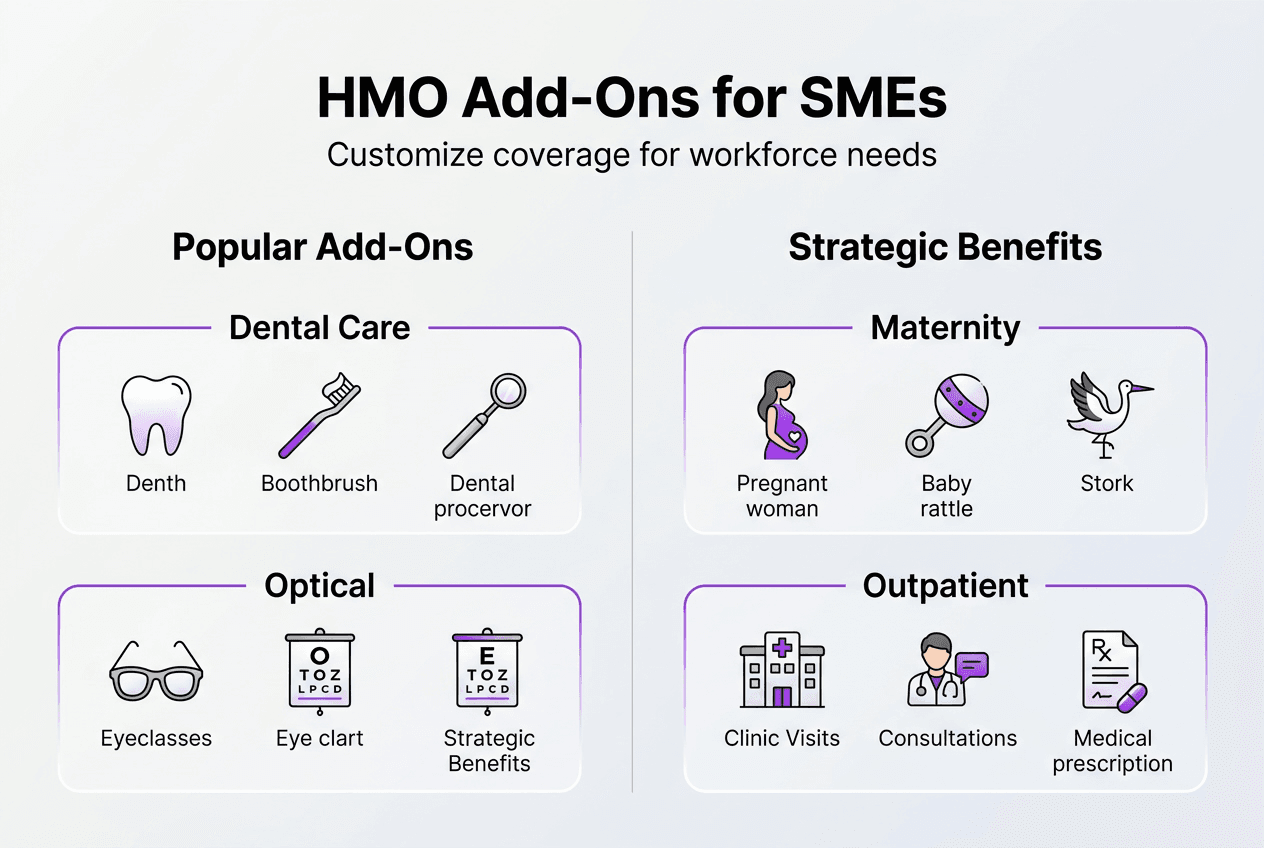
HMO add-ons are supplementary health service benefits that extend beyond your base HMO plan’s coverage. While your core HMO typically covers hospitalization, emergency care, and basic consultations, add-ons provide additional customizable benefits like dental services, optical care, outpatient treatments, maternity packages, and enhanced emergency coverage limits.
For Philippine SMEs, these add-ons solve a critical challenge: creating competitive employee benefits without the massive budgets of large corporations. Your workforce has diverse health needs that a one-size-fits-all plan cannot address effectively. A tech startup with young employees might prioritize optical care for screen-intensive work, while a manufacturing SME might need stronger emergency coverage.
Common HMO add-ons include:
- Dental HMO services covering cleanings, extractions, and restorative procedures
- Optical benefits for eye exams, prescription glasses, and contact lenses
- Outpatient care upgrades expanding consultation limits and diagnostic coverage
- Maternity packages including prenatal care, delivery, and postnatal support
- Emergency care enhancements raising coverage caps for accidents and urgent treatments
- Annual physical examination programs for preventive health monitoring
SMEs choose add-ons for three strategic reasons. First, tailoring benefits shows employees you understand their specific health priorities, building loyalty and morale. Second, you control costs by paying only for services your team actually needs rather than bundled packages with unused features. Third, customized health benefits become a powerful recruitment tool when competing for talent against larger companies.
Pro Tip: Survey your employees anonymously about their top three health concerns before selecting add-ons. This data-driven approach prevents wasting budget on benefits nobody uses while ensuring you address real needs.
The flexibility of add-ons also helps SMEs adapt as their workforce evolves. A company hiring more parents might add maternity coverage, while one expanding its sales team might prioritize outpatient care for frequent travelers. Understanding HMO basics provides the foundation for making these strategic customization decisions.
Common types of HMO add-ons and their features
Understanding specific add-on options helps you match benefits to your workforce profile. Each add-on type serves distinct employee needs and comes with different cost implications for your SME.
Dental and outpatient care rank among the most utilized add-ons in the Philippines because they address frequent, predictable health needs. Dental HMO typically covers preventive services like cleanings and X-rays at 100%, with partial coverage for fillings, extractions, and basic restorations. Annual limits usually range from ₱5,000 to ₱15,000 per employee, with premium increases of 8-12% over base HMO costs.
Optical add-ons provide eye examinations, prescription lenses, and frames with typical annual limits of ₱3,000 to ₱8,000. These benefits particularly appeal to office workers experiencing digital eye strain. Premium surcharges run 5-8% above standard plans.
Outpatient care upgrades expand consultation limits, diagnostic test coverage, and specialist visits beyond base plan restrictions. Instead of the standard 10-15 consultations annually, upgraded plans might offer 30-50 visits. Laboratory work and imaging studies receive higher reimbursement caps. Expect 10-15% premium increases for comprehensive outpatient enhancements.

Maternity packages bundle prenatal consultations, delivery coverage, and postnatal care with limits typically between ₱40,000 and ₱100,000. These add-ons make sense for companies with employees in family-building years, though premium increases of 15-20% reflect the higher claim probability.
Emergency care enhancements raise coverage caps for accidents, urgent treatments, and ambulance services. Standard plans might cap emergency coverage at ₱50,000, while enhanced options extend to ₱150,000 or more. Premium impacts range from 6-10%.
| Add-on Type | Key Features | Typical Annual Limit | Premium Increase | | — | — | — | | Dental HMO | Cleanings, extractions, restorations | ₱5,000 - ₱15,000 | 8-12% | | Optical Care | Eye exams, lenses, frames | ₱3,000 - ₱8,000 | 5-8% | | Outpatient Upgrade | Extended consultations, diagnostics | 30-50 visits | 10-15% | | Maternity Package | Prenatal, delivery, postnatal | ₱40,000 - ₱100,000 | 15-20% | | Emergency Enhancement | Higher accident/urgent care caps | ₱150,000+ | 6-10% |
Advantages and scenarios for each add-on:
- Dental works best for established teams with predictable maintenance needs
- Optical suits office-heavy workforces experiencing screen fatigue
- Outpatient benefits high-utilization employees managing chronic conditions
- Maternity targets demographics in prime family-building years
- Emergency coverage protects field workers and high-risk roles
Pro Tip: Request utilization reports from your current HMO showing which services employees access most frequently. This historical data reveals whether you’re paying for add-ons that sit unused or missing coverage your team actually needs. When planning your 2026 strategy, these insights become invaluable for optimizing your benefits mix.
How to evaluate and choose the right HMO add-ons for your SME
Strategic evaluation improves cost-effectiveness and employee satisfaction with your HMO plan. Follow this systematic approach to select add-ons that deliver genuine value.
- Analyze your workforce health profile by reviewing demographics, existing health conditions, and historical medical claims data from your current provider.
- Survey employees about their top health priorities and which services they would actually use if covered.
- Calculate your total benefits budget and determine what percentage you can allocate to add-ons beyond base coverage.
- Request detailed proposals from HMO providers showing exact costs, coverage limits, exclusions, and claim procedures for each add-on.
- Compare employee premium contributions if you’re implementing cost-sharing versus fully employer-paid benefits.
- Pilot high-priority add-ons with a subset of employees before company-wide rollout to test actual utilization.
- Set clear metrics for evaluating add-on success, such as utilization rates, employee satisfaction scores, and cost per claim.
Critical questions to ask HMO providers about add-on terms:
- What are the exact coverage limits, deductibles, and co-payment requirements for each add-on?
- Which services require pre-authorization or have waiting periods before coverage begins?
- Are add-ons available for all employees or only certain tiers based on position or tenure?
- Can we adjust or remove add-ons mid-contract if utilization doesn’t meet expectations?
- How do add-ons integrate with PhilHealth coverage to avoid redundant benefits?
- What documentation and claims processes do employees follow to access add-on services?
- Are there network restrictions limiting which providers accept specific add-ons?
Common pitfalls to avoid when selecting add-ons:
- Over-insuring by adding every available benefit without analyzing actual employee needs
- Choosing add-ons based on what competitors offer rather than your specific workforce profile
- Ignoring utilization data from previous years that shows low adoption of certain services
- Failing to communicate add-on benefits clearly, resulting in employees not using available coverage
- Selecting add-ons with restrictive networks that limit access in your employees’ locations
- Not reviewing and adjusting add-ons annually based on changing workforce demographics
The importance of HMO for SMEs extends beyond basic coverage to strategic benefits design. Your add-on selection should align with broader business goals like reducing absenteeism, improving productivity, and strengthening your employer brand. A manufacturing company might prioritize emergency and outpatient coverage to address workplace injuries quickly, while a creative agency might focus on mental health and wellness add-ons.
Timing matters too. Evaluate add-ons during your annual renewal period when you have the most negotiating leverage with providers. Mid-contract changes often come with administrative fees and prorated premium adjustments that reduce cost-effectiveness.
Integrating HMO add-ons into your company’s health benefits strategy
Selecting the right add-ons is only half the battle. Effective integration ensures employees understand, access, and benefit from the coverage you’ve invested in.
Communication drives utilization. Create simple, visual guides explaining what each add-on covers, how to access services, and which providers accept the benefits. Host brief lunch-and-learn sessions where employees can ask questions about new add-ons. Send quarterly reminders highlighting underutilized benefits with step-by-step instructions for making appointments.
Customizing benefits enhances employee wellness when you align add-ons with broader wellness initiatives. If you’ve added dental coverage, partner with local clinics to offer on-site cleaning days. Optical add-ons pair well with ergonomic workstation assessments to reduce eye strain. Maternity packages become more valuable when combined with flexible work arrangements for expecting parents.
PhilHealth integration prevents redundant coverage and maximizes value. Since PhilHealth provides baseline benefits, structure your HMO add-ons to fill gaps rather than duplicate services. For example, PhilHealth covers basic maternity care, so your add-on should focus on upgraded hospital accommodations, additional prenatal visits, or newborn care that exceeds government minimums.
Best practices for integrating add-ons:
- Create a centralized benefits portal where employees can view all coverage details, find network providers, and submit claims digitally
- Assign HR point persons who understand add-on details and can guide employees through accessing services
- Monitor monthly utilization reports to identify add-ons with low adoption that may need better promotion or reconsideration
- Collect employee feedback through annual benefits surveys asking what’s working and what needs improvement
- Benchmark your add-on offerings against industry standards to ensure you remain competitive
- Document all add-on policies, procedures, and provider contacts in an employee handbook section dedicated to health benefits
Periodic reassessment keeps your benefits current. Schedule quarterly reviews of utilization data with your HMO provider to spot trends. If dental add-ons show 80% utilization but optical coverage sits at 20%, you might reallocate budget during the next renewal. Employee demographics shift as people join, leave, age, and start families, so your add-on mix should evolve accordingly.
Integrated health benefits contribute measurably to employee morale and productivity. Workers who feel their health needs are genuinely supported show higher engagement scores, take fewer sick days, and stay with companies longer. When choosing HMO vendors, prioritize those offering robust member support, easy claims processes, and responsive customer service that makes using add-ons simple rather than frustrating.
The administrative burden of managing multiple add-ons can overwhelm small HR teams. Look for HMO providers offering consolidated billing, unified claims portals, and single-point-of-contact support that simplifies administration. Digital platforms that let employees check coverage, find providers, and track claims independently reduce the support workload on your team.
Explore better HMO plans tailored for SMEs
Now that you understand how to evaluate and integrate HMO add-ons strategically, it’s time to explore plans designed specifically for Philippine SMEs like yours. Finding better HMO plans for SMEs means partnering with providers who understand your unique challenges: limited budgets, diverse workforce needs, and the importance of flexible customization.
Our comprehensive HMO plan features include all standard benefits plus the flexibility to add dental, optical, annual physical exams, and life insurance based on your team’s priorities. We eliminate complicated terms and provide straightforward coverage that your employees can actually understand and use. With 100% coverage for pre-existing conditions up to your Maximum Benefit Limit and access to premier facilities including the Big 9 Hospitals, you get enterprise-level benefits at SME-friendly pricing. Explore our member services to see how we support both HR managers and employees throughout the coverage year with responsive assistance and digital tools that simplify benefits administration.
Frequently asked questions
What are HMO add-ons and how do they differ from basic coverage?
HMO add-ons are supplementary health services you can purchase beyond your base HMO plan’s standard coverage. While basic HMO plans cover hospitalization, emergency care, and essential consultations, add-ons expand into specialized areas like dental care, optical services, enhanced outpatient limits, maternity packages, and upgraded emergency coverage caps. Think of your base plan as the foundation and add-ons as customizable modules you attach based on your workforce’s specific health priorities and budget.
Which HMO add-ons are most important for small to medium businesses in the Philippines?
Dental and outpatient care consistently rank as top priorities for Philippine SMEs because they address frequent, predictable employee needs at reasonable premium increases. Dental coverage handles routine cleanings and common procedures that employees need regularly, while outpatient upgrades expand consultation limits for managing chronic conditions and preventive care. The specific importance depends on your workforce demographics; younger teams might prioritize optical care for screen work, while companies with more parents might value maternity packages higher.
How can HR managers evaluate if an HMO add-on is cost-effective for their company?
Start by analyzing your past employee healthcare claims and utilization data to identify which services your team actually accesses most frequently. Compare the add-on’s annual cost against the expected benefits based on your workforce size and health profile. Calculate the cost per employee for each add-on, then survey your team to gauge interest and likely utilization before committing. An add-on is cost-effective when at least 40-50% of eligible employees will use it regularly and the coverage value exceeds the premium increase. Review evaluating HMO vendors for comprehensive assessment frameworks.
Can HMO add-ons be adjusted annually based on employee feedback?
Most HMO providers allow annual reassessment and changes to your add-on selections during your policy renewal period. This flexibility lets you add new benefits, remove underutilized ones, or adjust coverage levels based on employee feedback and claims data from the previous year. Regular feedback collection through surveys and utilization monitoring helps you optimize your benefits mix to match evolving workforce needs. Some providers may charge administrative fees for mid-contract changes, so plan major adjustments for your annual renewal to maximize cost-effectiveness and negotiating leverage.
Recommended
- HMO Health Insurance for Small and Medium Enterprises in the Philippines
- Eumir
- The Better HMO Plans for SMEs | Purple Cow | Blog | Rai dela Cruz | Best HMO Plans Philippines - Purple Cow
- PhilHealth + HMO: Maximizing Your SME’s Health Investment
- Cómo aprovechar beneficios dentales HMO para tratamientos especializados
