

HMO eligibility explained: A guide for SMEs in the Philippines
Most SME owners assume that getting an HMO plan with pre-existing condition (PEC) coverage means jumping through hoops, waiting months for benefits to kick in, or paying premiums that blow the HR budget. That assumption is wrong. Corporate group HMO plans work very differently from individual plans, and the eligibility rules are far more straightforward than most people expect. This guide walks you through exactly who qualifies, how PEC coverage works, what documents you need, and how to handle tricky scenarios like probationary employees or dependents aging out of coverage.
Table of Contents
- Understanding HMO eligibility for SMEs in the Philippines
- Pre-existing condition coverage: What SME corporate HMOs offer
- Enrollment steps and documentation for SME HMO plans
- Edge cases and post-employment options
- How HMO complements PhilHealth for SME employees
- Our expert take: Why SMEs should prioritize corporate HMOs
- Find the right HMO plan for your SME
- Frequently asked questions
Key Takeaways
| Point | Details |
|---|---|
| SMEs eligible from 3-10 employees | Corporate HMO plans are accessible to SMEs with as few as three employees, making coverage practical for small teams. |
| PEC coverage starts day 1 | Group SME HMO plans cover pre-existing conditions immediately, while individual plans require waiting periods and restrictions. |
| Enrollment is straightforward | SME owners can enroll employees without medical exams, and premiums are tax-deductible up to PHP10,000 per year for each employee. |
| HMO and PhilHealth work together | Pairing HMO with PhilHealth provides both routine and inpatient coverage for SMEs, optimizing health benefits and costs. |
| Post-employment conversion options | Employees can convert SME HMO coverage to individual plans after leaving, ensuring continued access to healthcare. |
Understanding HMO eligibility for SMEs in the Philippines
Before you start comparing plans, you need to know whether your business and your employees actually qualify. The good news: the bar is lower than most SME owners think.
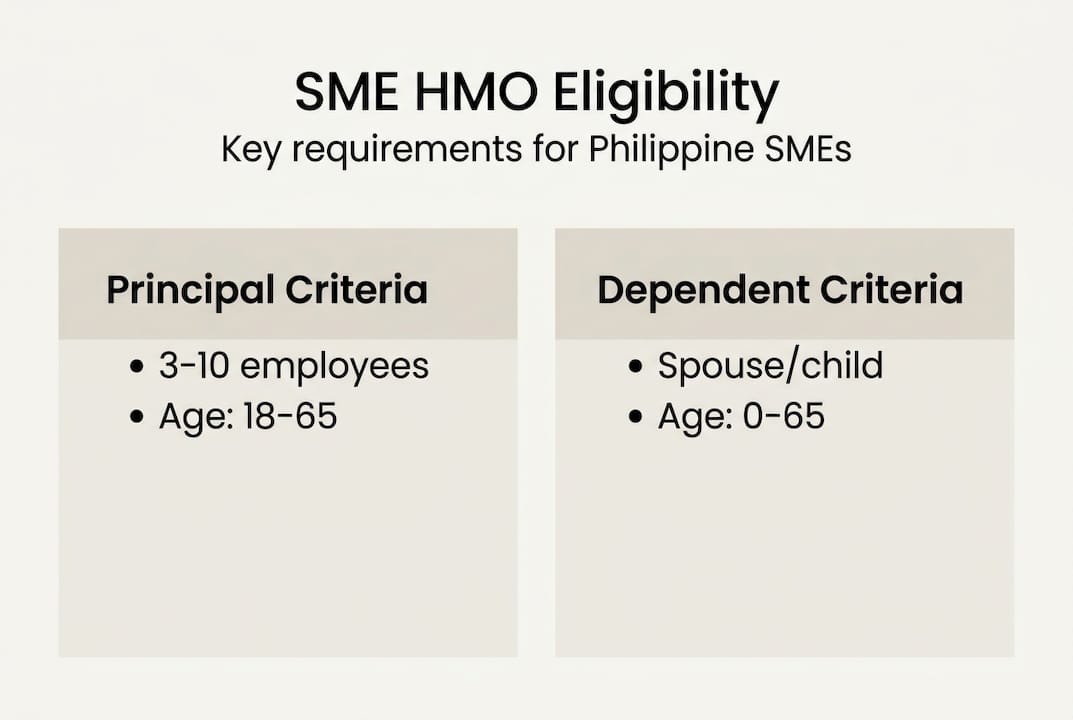
SME HMO requirements are generally built around the concept of “principals,” which means the actual employees being covered. Most providers set the minimum at 3 to 10 principals to open a corporate account. That means even a lean startup or a small family business can access group rates and group benefits.
Age eligibility follows a standard range. For principals, corporate HMO eligibility typically runs from 18 to 65 years old. Dependents, meaning spouses and children, follow slightly different rules. Children are usually covered from 15 days old up to 21 or 25 years old depending on the provider, and spouses are covered as long as the principal remains enrolled.
Here is a quick summary of the typical eligibility criteria:
| Criteria | Principals (employees) | Dependents |
|---|---|---|
| Minimum group size | 3 to 10 employees | N/A |
| Age range | 18 to 65 years old | 15 days to 21 or 25 years |
| Eligible dependents | N/A | Spouse, children |
| Medical exam required | No (under 50 employees) | No |
| Coverage start | Day 1 of enrollment | Upon regularization |
A few things trip up employers during enrollment. One common mistake is forgetting to count part-time or probationary workers when calculating the minimum principal count. Another is assuming dependents are automatically enrolled. In most plans, dependents must be actively declared during enrollment or within a set window after a qualifying life event like marriage or childbirth.
Pro Tip: If your headcount fluctuates, check whether your provider allows mid-year additions. Many SME plans do, but there may be a short enrollment window after a new hire’s start date.
The minimum principal requirement of 3 to 10 employees for corporate plans makes group HMO accessible to even the smallest registered businesses in the Philippines. That is a significant advantage over individual plans, which carry stricter underwriting and longer waiting periods.
Pre-existing condition coverage: What SME corporate HMOs offer
This is where corporate HMO plans genuinely stand apart. Pre-existing conditions are health issues that existed before the policy start date, things like diabetes, hypertension, asthma, or a history of surgery.
In individual HMO plans, PEC waiting periods typically run 6 to 24 months, with 12 months being the most common. During that window, claims related to those conditions are denied. Corporate SME plans flip this entirely. Most group plans cover PEC from day 1, up to the Maximum Benefit Limit (MBL), which is the total annual cap on claims.
“Pre-existing condition coverage is a game-changer for SMEs. Employees can walk in on their first day of coverage and access care for conditions they already have, without waiting, without penalty.”
Here is how the two plan types compare:
| Feature | Corporate SME HMO | Individual HMO |
|---|---|---|
| PEC waiting period | None (day 1 coverage) | 6 to 24 months |
| PEC coverage limit | Up to MBL | Often sub-limited initially |
| Underwriting | Group-based, no exams | Individual health screening |
| Enrollment ease | Simple, batch processing | Case-by-case assessment |
You can review the full HMO features for PEC to understand exactly what conditions are typically included. Providers like HMO Plans through Purple Cow offer 100% coverage for PEC, congenital conditions, and special procedures up to the MBL, with no complicated exclusion clauses.
One critical rule: always disclose PEC history honestly during enrollment. Hiding a condition to avoid scrutiny can result in claims being denied later. Corporate plans are designed to cover these conditions, so there is no benefit to concealment and significant risk if you do. You can also check HMO policy differences across providers to see how each one handles specific conditions.
For PEC coverage details at the plan level, always request a copy of the coverage matrix before signing. This tells you exactly which conditions are covered, at what limits, and under what circumstances.
Enrollment steps and documentation for SME HMO plans
Once you confirm that your team qualifies and you understand the coverage, enrollment is the next step. The process is more streamlined than most HR managers expect.
Here is the standard enrollment flow for SME corporate HMO plans:
- Choose your plan and provider. Compare Annual Benefit Limits (ABLs), network hospitals, and add-on options. Work with a broker or directly with the provider.
- Submit the master application form. This is the employer’s formal request to open a corporate account. It includes company details, employee count, and desired coverage tier.
- Collect employee enrollment forms. Each principal fills out a personal enrollment form with basic health history. Dependents require separate declaration forms.
- Gather required documents. For principals: one valid government-issued ID and proof of employment. For dependents: birth certificates for children, marriage certificate for spouses.
- Pay the initial premium. Employers typically pay annually or quarterly. Premium payment activates the policy.
- Receive ID cards and policy documents. Most providers issue digital and physical HMO cards within a few business days.
One major advantage of SME HMO applications for groups under 50 employees: no medical exams are required. This speeds up the process significantly and removes a common barrier for employees with known health issues.

Pro Tip: HMO premiums paid by employers are tax-deductible up to PHP 10,000 per employee per year. That makes corporate HMO not just a benefit but a smart financial decision. Keep receipts and documentation organized for your annual tax filing.
For dependent documentation, make sure documents are current and certified. Expired or uncertified documents are a common reason for dependent enrollment delays. It also helps to schedule a reviewing health plans session annually to catch gaps before renewal.
Edge cases and post-employment options
Real-world workforce management creates situations that do not fit neatly into standard enrollment rules. Here is how to handle the most common ones.
Probationary employees can typically be enrolled as principals from day 1. However, their dependents after regularization are usually only added after the employee completes the regularization period, which is commonly six months. This is a policy most providers follow to manage risk.
Common edge cases and what employers should do:
- Employee turns 65 during the policy year: Coverage typically ends at renewal. Plan for a transition to a senior individual plan or PhilHealth supplemental coverage.
- Dependent child ages out (reaches 21 or 25): Most providers allow a conversion to an individual plan without new underwriting. Notify the employee in advance.
- Employee resigns or is terminated: Coverage ends on the last day of employment or at the end of the billing cycle. The employee may have the option to convert to individual coverage within a set window, usually 30 days.
- Employee goes on extended leave: Coverage rules vary. Some providers continue coverage during paid leave; unpaid leave may suspend benefits.
- New dependent added mid-year: Most plans allow additions within 30 days of a qualifying event like birth or marriage.
Pro Tip: Inform employees of their post-employment conversion rights during offboarding. Many employees do not know they can convert to an individual plan without a waiting period, and this is a genuine benefit worth communicating clearly.
For edge case coverage questions, consult directly with your provider’s account manager. These scenarios are common enough that most providers have clear written policies.
How HMO complements PhilHealth for SME employees
PhilHealth and HMO are not competitors. They are designed to work together, and understanding how they layer coverage helps you get the most value from both.
PhilHealth is mandatory, government-funded, and focused primarily on inpatient care. It covers a portion of hospital room and board, surgical fees, and certain medicines during confinement. The benefit amounts are fixed and relatively modest. HMO plans fill the gaps: outpatient consultations, diagnostic tests, emergency care, preventive check-ups, and additional inpatient coverage beyond what PhilHealth provides.
| Coverage type | PhilHealth | HMO plan |
|---|---|---|
| Inpatient confinement | Partial (fixed rates) | Up to ABL |
| Outpatient consultations | Limited | Covered |
| Preventive care | Minimal | Covered (with APE add-on) |
| Emergency care | Partial | Covered |
| Annual Benefit Limit | N/A | PHP 70,000 to PHP 200,000+ |
For SMEs, the financial case for pairing both is strong. Affordable SME HMO plans like entry-level corporate options can start with ABLs around PHP 70,000, which already covers most routine and moderate health events on top of PhilHealth.
Key financial benefits of pairing HMO with PhilHealth:
- Employees face lower out-of-pocket costs during hospitalization
- HMO covers outpatient and preventive care that PhilHealth does not
- Employers reduce absenteeism by enabling early treatment
- Combined coverage reduces the risk of catastrophic out-of-pocket expenses
You can learn more about PhilHealth and HMO pairing strategies and how to maximize health investment for your team. Staying current on PhilHealth updates also ensures you are not missing mandatory contribution changes that affect your total benefits budget.
Our expert take: Why SMEs should prioritize corporate HMOs
Here is the honest truth most brokers will not say directly: individual HMO plans are the wrong choice for most SME employees. They cost more per person, exclude PECs for up to a year, and require individual health screenings that slow everything down.
Corporate group plans, by contrast, are built for speed and inclusivity. For SME health insurance buyers, group plans like those available for 10 to 99 employees waive waiting periods and exams entirely, covering PEC from day 1 with tax advantages built in.
From our experience working with SMEs across tech, hospitality, and healthcare sectors, the businesses that retain talent longest are the ones that offer health benefits employees can actually use on day one. Waiting periods and PEC exclusions create distrust. When an employee cannot use their HMO for a condition they already have, they feel deceived.
Our recommendation: fully disclose all PECs during enrollment, use your management prerogative to set eligibility tiers that reflect your workforce structure, and choose a plan that covers what your employees actually need. Corporate HMO is not a luxury. For SMEs competing for skilled workers, it is a strategic tool.
Find the right HMO plan for your SME
Understanding eligibility is the first step. The next is finding a plan that actually fits your team’s size, health needs, and budget. HMO Plans, powered by Purple Cow and underwritten by Etiqa, offers SME-focused plans with 100% PEC coverage, no complicated exclusions, and flexible add-ons like dental, annual physical exams, and life insurance.
You can explore our accredited HMO providers to see which hospitals and clinics are in-network, access SME member services for enrollment support, or simply browse SME HMO plans to compare options side by side. Our team is ready to match your business with the right plan, at the right price, without the runaround.
Frequently asked questions
What is the minimum employee requirement for SME HMO plans in the Philippines?
Most providers require 3 to 10 employees as principals to open a corporate group HMO account, making coverage accessible even for very small businesses.
Are pre-existing conditions covered for SME employees under corporate HMO plans?
Yes. Most SME corporate group HMO plans cover PEC from day 1, up to the Maximum Benefit Limit, with no waiting period unlike individual plans.
Do dependents get covered immediately upon SME employee enrollment?
Not always. Dependents are typically added after the employee completes the regularization period, which is usually six months from the start date.
How do HMO plans complement PhilHealth coverage for SMEs?
PhilHealth handles inpatient costs at fixed rates, while HMO adds outpatient and preventive care coverage, together giving employees far more complete protection than either plan alone.
