

HMO Terms Explained: Clarity for Philippine SMEs
Choosing the best health plan can feel confusing for any HR manager, especially when faced with complex HMO jargon. For Philippine SMEs, knowing the difference between an HMO and traditional insurance is more than just paperwork—it shapes how you protect employees and control company costs. Understanding the essentials of a health care system that assumes or shares financial and delivery risks for comprehensive medical services to a voluntarily enrolled population for a fixed prepaid fee will help you explain benefits, address myths, and avoid costly legal mistakes.
Table of Contents
- Defining HMO Terms And Common Misconceptions
- Key HMO Plan Features And Benefits
- Understanding Maximum Benefit Limits And Coverage
- Legal Requirements For HMO Plans In The Philippines
- Obligations, Exclusions, And Reimbursement Scenarios
Key Takeaways
| Point | Details |
|---|---|
| Understanding HMO Benefits | HMOs provide predictable healthcare costs through fixed monthly premiums, making them an attractive option for SMEs. |
| Flexibility in Care | Modern HMOs offer flexibility not available in the past, allowing employees access to specialists and urgent care within their networks. |
| Pre-existing Conditions Coverage | Many contemporary HMO plans have eliminated exclusions for pre-existing conditions, enhancing coverage for employees. |
| Legal Obligations for Employers | Offering HMO benefits creates legal obligations; employers must transparently communicate coverage and ensure compliance with regulations. |
Defining HMO Terms and Common Misconceptions
When you first encounter HMO terminology as an HR manager at an SME, the jargon can feel overwhelming. The truth is, understanding what an HMO (Health Maintenance Organization) actually is forms the foundation for every decision you make about employee health benefits. At its core, an HMO is a health care system that assumes or shares financial and delivery risks associated with providing comprehensive medical services to voluntarily enrolled employees for a fixed prepaid fee. Unlike traditional insurance models where you pay per service, HMOs operate on a prepaid basis, meaning your company pays one set monthly premium regardless of how many times employees use healthcare services. This cost predictability makes HMOs particularly attractive for SMEs managing tight budgets.
The distinction between HMOs and other health plan types creates confusion in most SMEs. Many HR managers mistakenly believe HMOs function like traditional fee-for-service insurance, where employees can visit any provider and insurance covers the claim. That’s not how it works in real life. HMOs integrate health insurance and provider services to manage hospital, ambulatory, and preventive care through coordinated networks. This means your employees access care through a network of accredited facilities and providers, not wherever they choose. The system was specifically designed to control rising healthcare costs while improving care coordination, which directly benefits your team through better preventive care and streamlined treatment pathways.
Common misconceptions create real problems in SMEs. Many HR managers worry that HMOs restrict employee choice too severely, but in the Philippine context, modern HMO plans offer flexibility that earlier generations didn’t provide. For instance, employees aren’t locked into visiting only one doctor for all care needs. They can access specialists within the network, visit any accredited hospital during emergencies, and receive coverage for out-of-network services through reimbursement provisions. Another widespread myth is that HMOs exclude pre-existing conditions. This outdated belief persists even though many HMO providers now offer 100% coverage for pre-existing conditions up to the Maximum Benefit Limit, eliminating a major employee concern. Understanding these differences between outdated perceptions and current HMO realities directly impacts how you communicate benefits to your team and shapes their satisfaction with the plan you choose.
Here’s a concise comparison of HMO and traditional insurance models for SMEs:
| Aspect | HMO | Traditional Insurance |
|---|---|---|
| Payment Model | Fixed monthly fee | Pay-per-service claims |
| Provider Access | In-network only (except emergencies) | Any licensed provider |
| Cost Predictability | High, due to prepaid fees | Low, varies with usage |
| Claim Processing | Minimal paperwork | Requires claim submissions |
| Coverage for Pre-existing Conditions | Often included up to limit | Frequently excluded or with waiting period |
| Preventive Care Emphasis | Integrated and covered | May have separate charges |
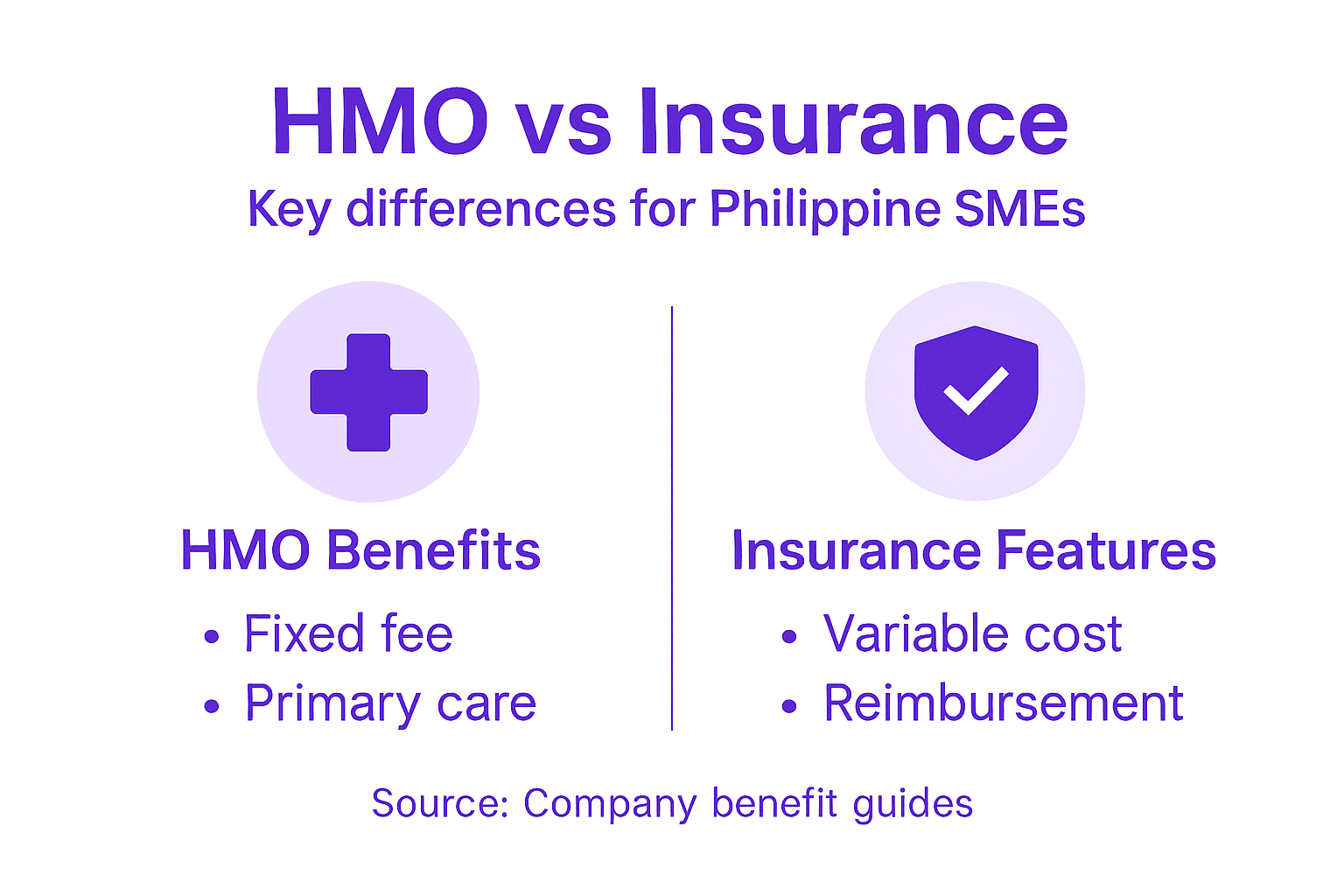
Pro tip: Create a simple one-page comparison chart showing how your company’s HMO differs from traditional insurance and clearly highlight pre-existing condition coverage—then share it during onboarding to address misconceptions before they affect employee satisfaction.
Key HMO Plan Features and Benefits
Your employees care about one thing when it comes to health benefits: will this actually help me when I need it? Understanding what an HMO covers forms the backbone of effectively communicating value to your team. HMOs provide healthcare services through a network of contracted providers for a fixed prepaid fee, which means your company knows exactly what it will spend each month. The core benefit structure includes outpatient care, inpatient hospitalization, diagnostic services like imaging and lab work, preventive care such as annual checkups and vaccinations, and emergency services. Unlike traditional insurance where employees might pay different amounts depending on the provider, HMOs emphasize coordinated care with predictable out-of-pocket costs. This predictability matters for SME budgeting because you can confidently project healthcare expenses without surprise increases.
The real power of HMOs for your team centers on how they work in practice. Every HMO member designates a primary care provider who coordinates care and provides referrals to specialists within the network. This gatekeeper role might sound restrictive, but it actually benefits your employees by ensuring they receive integrated care rather than fragmented services. When an employee sees their primary care doctor for back pain, that provider knows their full medical history and can coordinate specialist referrals, diagnostic imaging, and follow-up care. The result is better outcomes and fewer duplicate tests. Your company also sees the benefit through lower premiums, reduced copays, and lower deductibles compared to traditional health insurance plans. For an SME with limited HR resources, this streamlined approach reduces administrative burden because everything flows through coordinated networks rather than requiring claim submissions and reimbursement processing.
HMOs emphasize preventive care in ways that directly protect your workforce. HMO plans cover preventive services and health promotion activities to help employees stay healthy before problems develop. This means your team members can access wellness programs, preventive screenings, and health education without additional costs, which reduces illness-related absences and improves productivity. However, understanding network limitations is crucial for managing expectations. HMOs typically restrict coverage to in-network providers except in emergency situations, which means employees cannot visit any hospital or specialist they prefer and expect the same coverage levels. This is where clear communication becomes essential. When introducing an HMO plan, explain that your chosen provider networks include major accredited facilities and specialists so employees still have quality options. Many modern HMOs, particularly those serving Philippine SMEs, also provide out-of-network reimbursement provisions, allowing employees flexibility while maintaining cost control.
When comparing HMO options for your SME, pay attention to how networks are structured and what additional benefits are included. A comprehensive HMO should cover emergency services anywhere in the country, provide access to major hospitals and clinic networks, and offer clear referral procedures so employees know when they need specialist approval. Beyond basic coverage, optional add-ons like dental HMO services, annual physical exams, and life and accident insurance can enhance your value proposition without overwhelming your budget. The key is selecting a plan structure that aligns with your employee demographics and business needs rather than choosing based on premium price alone.
Pro tip: When selecting an HMO provider, request a detailed map of their network facilities and specialist availability in your area—then share this with employees during enrollment to show them exactly where they can access care, removing the mystery from the network limitations.
Understanding Maximum Benefit Limits and Coverage
One of the most misunderstood aspects of HMO plans is the concept of maximum benefit limits, yet it directly impacts your employees’ out-of-pocket expenses and your company’s financial planning. A Maximum Benefit Limit (MBL) represents the highest amount an insurance provider will pay for covered services within a specified period. Think of it as a ceiling on what the insurance company will reimburse. Maximum benefit limits define the dollar amount beyond which the insurer stops paying for covered services, and these limits can be structured as lifetime maximums, annual maximums, or per-incident maximums. For an SME with budget constraints, understanding these limits prevents surprises when employees need significant medical care. However, the Philippine HMO landscape has evolved considerably, and modern plans like those offered through HMO Plans often provide substantially higher limits or alternative structures designed specifically to protect employees from catastrophic healthcare costs.

The type of maximum benefit limit in your chosen HMO matters enormously for coverage predictability. Some plans cap benefits per calendar year, meaning once an employee reaches that limit in January through December, the insurance stops covering services until the new year begins. Other plans structure limits per incident, covering only a certain amount for a specific diagnosis or hospitalization. Lifetime limits are increasingly rare in quality HMO offerings, but they historically placed a ceiling on total benefits an employee could receive over their entire lifetime. Understanding which structure your plan uses determines how you communicate coverage to employees and helps them plan for potential gaps. For instance, if your plan has a one million peso annual maximum benefit limit and an employee faces unexpected major surgery costing 1.2 million pesos, knowing this limitation upfront allows your company to explore supplemental coverage or budget for the gap.
A critical distinction for Philippine SMEs is that quality HMO providers now offer 100% coverage for pre-existing conditions, congenital conditions, special procedures, and no-fault scenarios up to the maximum benefit limit, eliminating historical exclusions that created coverage gaps. This represents a major shift from older HMO models that simply refused coverage for certain conditions regardless of the benefit limit. When evaluating HMO providers, clarify what happens once the maximum benefit limit is reached. Does the employee pay full out-of-pocket costs, or does supplemental coverage kick in? Can the limit be renewed mid-year in emergency situations? These details distinguish competent HMO providers from those offering only bare-minimum coverage. Additionally, many HMOs now provide options to increase maximum benefit limits through optional add-ons or enhanced plan tiers if your SME can accommodate higher premiums. Special procedures and complex medical needs often require careful consideration of coverage limits to ensure employees receive necessary care without financial devastation.
Your responsibility as an HR manager includes communicating these limits transparently so employees understand exactly what the plan covers and what they might pay out-of-pocket. Create a simple reference sheet showing your plan’s maximum benefit limit, what triggers reset periods, and what happens when limits are approached. Many employees mistakenly believe their HMO covers everything once they enroll, leading to shock when they encounter limit notifications during treatment. The solution is proactive communication during enrollment and periodic reminders. Additionally, when an employee faces a condition that might approach their benefit limit, HR should promptly notify them and the HMO provider to explore options like phased treatment plans or accessing supplemental coverage. Forward-thinking SMEs also track aggregate healthcare spending by monitoring benefit limit usage trends, which informs future plan selection decisions.
Pro tip: Request from your HMO provider a detailed benefits summary showing your plan’s maximum limit, annual reset dates, and procedures for requesting limit increases or accessing supplemental coverage if limits are approached, then create a simple one-page employee handout explaining this specific information.
Legal Requirements for HMO Plans in the Philippines
Here’s what might surprise you about HMO regulations in the Philippines: Philippine labor laws do not mandate private employers to provide HMO benefits. This fundamentally changes how you should approach HMO planning as an HR manager. While the Labor Code requires statutory contributions to PhilHealth and other government-mandated insurance agencies, it does not compel employers to offer private HMO coverage. This means your decision to implement an HMO plan is entirely voluntary, not legally required. However, this voluntary nature does not mean you can ignore legal obligations once you decide to offer HMO benefits. The moment you include HMO coverage in your employment contracts, offer letters, or collective bargaining agreements, you create an enforceable legal obligation. Employees can then expect that coverage consistently, and your company must honor those commitments. Understanding this distinction prevents future disputes and protects both your organization and your workforce.
The legal landscape becomes more complex when HMO benefits are contractually promised. Once an HMO benefit becomes part of an employment agreement or collective bargaining agreement, labor law treats it as a binding obligation that your company must fulfill. This means you cannot arbitrarily remove HMO coverage without following proper legal procedures for modifying employment terms. If you promise HMO coverage in writing but later discontinue it, employees have legal grounds to challenge the change. Additionally, your company must comply with all existing labor standards and regulations when administering the HMO benefit. This includes ensuring that HMO contributions do not reduce other mandated benefits, maintaining accurate records of HMO enrollment and coverage, and providing employees with clear documentation of what the HMO plan covers. Many SMEs encounter compliance issues not because they violated explicit HMO regulations but because they failed to maintain proper documentation or inadvertently reduced other benefits when implementing HMO coverage.
What complicates HMO compliance for many Philippine SMEs is the intersection of voluntary HMO coverage with mandatory PhilHealth requirements. Your company must continue paying PhilHealth contributions regardless of whether you offer private HMO coverage. Some employers mistakenly believe that providing HMO means they can reduce or eliminate PhilHealth contributions, which creates serious legal exposure. The correct approach is treating PhilHealth and private HMO as complementary systems. PhilHealth remains the baseline mandatory coverage, while private HMO supplements it with enhanced benefits and expanded networks. When evaluating HMO providers and selecting plans, prioritize those that work alongside PhilHealth rather than attempting to replace it. Additionally, if your company operates under a collective bargaining agreement or has union representation, any changes to HMO benefits may require union notification or negotiation, depending on your specific agreement terms. Forward-thinking SMEs typically document their HMO policy clearly in employee handbooks and make this information available during hiring and onboarding to prevent misunderstandings.
Practical Compliance Steps for Your SME
Start by documenting your HMO policy in writing. Include when HMO coverage begins, what conditions must be met to qualify, what the company pays versus employee responsibility, and how employees can access the benefit. This documentation protects your company by creating a clear record of what was promised. Next, ensure your HMO provider is a legitimate, regulated entity authorized to operate in the Philippines. Verify their credentials with the Insurance Commission and confirm they maintain proper compliance with Philippine regulations. When communicating HMO benefits to employees, be explicit about what is covered and what is not. Vague promises about healthcare coverage create legal liability if employees later claim the coverage was insufficient. If you make changes to HMO plans, communicate these changes in advance and allow employees reasonable time to adjust. Sudden changes without notice can trigger grievances or legal challenges. Most importantly, keep detailed records of HMO enrollment, coverage activation dates, claims processed, and any employee communications regarding the benefit. These records protect you if disputes arise and demonstrate good faith compliance with whatever HMO commitments you made.
Pro tip: Have your legal counsel review your HMO policy documentation and employment contracts to ensure they clearly state what HMO benefits are being provided and any conditions for eligibility, protecting your company from future disputes while setting accurate employee expectations.
Obligations, Exclusions, and Reimbursement Scenarios
Once you commit to providing HMO benefits, your company accepts real legal obligations that extend far beyond simply paying premiums. If HMO benefits become part of employment contracts or company policies, those benefits become legally binding and enforceable. This means you cannot arbitrarily reduce, modify, or withdraw HMO coverage without following proper legal procedures and risking significant liability. An employee who is promised HMO coverage in their contract gains a legally protected right to that benefit. If your company later removes or significantly reduces that coverage, employees can file complaints with the Department of Labor or pursue legal action for breach of contract. The obligation becomes even stronger if you make promises about specific coverage types. For example, if your employment contract states the HMO covers emergency services, outpatient care, and hospitalization, you cannot later decide to exclude emergency services without violating that commitment. Understanding these binding obligations helps you make thoughtful decisions when initially selecting HMO plans rather than discovering legal exposure after implementation.
HMO exclusions and limitations deserve careful attention because they directly impact what your company is legally obligated to provide. Most quality HMO plans exclude certain services like cosmetic surgery, experimental treatments not yet approved by medical authorities, or treatments deemed medically unnecessary. The key legal principle is transparency: your company must clearly communicate what the HMO covers and what it does not. If an employee undergoes a procedure believing it is covered, only to discover later that the HMO excludes it, your company faces potential liability for that employee’s out-of-pocket costs. This is why providing written summaries of coverage and exclusions during enrollment is not just good practice but legal protection. Common HMO exclusions typically include elective procedures, certain dental services outside the plan scope, vision care beyond basic screening, fertility treatments in many plans, and alternative medicine treatments. However, modern HMO providers serving Philippine SMEs often provide optional add-ons that expand coverage for dental, vision, and other services if your company budget allows. When selecting an HMO plan, work with your provider to clearly document all exclusions so you can communicate them to employees before enrollment. This prevents misunderstandings and protects both your company and your workforce.
To help HR managers evaluate HMO plan options, here is a summary of common HMO exclusions and related considerations:
| Exclusion Type | Typical Reason | Employee Impact |
|---|---|---|
| Cosmetic Surgery | Considered non-essential | Out-of-pocket payment required |
| Experimental Treatments | Not medically approved | Coverage denied until approval |
| Elective Procedures | Not medically necessary | Cost responsibility on employee |
| Alternative Medicine | Usually not covered | Must self-fund these treatments |
| Fertility Treatments | Often excluded | Limited family planning benefits |
| Dental/Vision Add-ons | Require extra premium | Can enhance overall coverage |
Reimbursement scenarios create confusion for both HR managers and employees, especially when out-of-network care becomes necessary. Navigating out-of-network care requires understanding reimbursement procedures and timelines for employees to recover costs. Most HMO plans restrict coverage to in-network providers, but emergency situations or specialized treatments sometimes require out-of-network care. Understanding your HMO provider’s reimbursement process is essential for managing these scenarios. Typically, when an employee receives out-of-network care, they pay the provider directly and then submit a reimbursement claim to the HMO with supporting documentation like invoices and medical records. The reimbursement amount depends on your plan’s specific provisions. Some plans reimburse at the in-network rate, meaning the employee bears the difference if the out-of-network provider charges more. Other plans reimburse at a percentage of actual charges. The critical obligation for your company is ensuring employees understand this process before they need it. If an employee receives emergency care out-of-network and later discovers the reimbursement is less than expected, confusion about the process creates frustration and potential complaints. As an HR manager, you should maintain clear documentation of your HMO plan’s reimbursement procedures and share this with employees during enrollment and through periodic reminders.
Key Scenarios and Your Company’s Obligations
Consider these real-world reimbursement situations and how your obligations work:
-
Emergency hospitalization outside the network: An employee is traveling outside your HMO provider’s service area and requires emergency hospitalization. Your obligation is to ensure the HMO covers emergency care regardless of location. The employee should not face denial of coverage for seeking necessary emergency treatment.
-
Referral to a specialist outside the network: An employee’s primary care provider refers them to a highly specialized surgeon not in the network. Your obligation depends on your HMO plan terms. Some plans cover this if the specialist is not available in-network; others require prior authorization. Clarify these details with your HMO provider so you can accurately explain them to employees.
-
Employee pays full cost initially: An employee receives treatment and pays the full amount out-of-pocket, then submits for reimbursement. Your obligation includes ensuring the HMO processes the reimbursement claim within a reasonable timeframe and communicating clearly about documentation requirements.
Additionally, employee consent is required for any salary deductions associated with HMO premiums. This means you cannot unilaterally deduct HMO contributions from employee salaries without their explicit agreement. If implementing a new HMO plan that involves employee contributions, secure written consent from each employee before deducting premiums from their payroll.
Pro tip: Create a simple one-page reimbursement flowchart showing when employees should use in-network versus out-of-network providers, how to submit reimbursement claims, and typical processing timelines, then distribute this during enrollment and keep it readily available in your HR documentation.
Clear Health Protection Starts with Understanding Your HMO Options
Navigating Health Maintenance Organization terms can feel overwhelming for Philippine SME HR managers. You want to provide your employees with reliable, comprehensive coverage that controls costs while offering peace of mind. Key challenges like managing maximum benefit limits, ensuring 100% coverage for pre-existing conditions, and understanding in-network versus out-of-network reimbursements require a partner who simplifies these details and delivers transparency.
HMO Plans offers tailored health insurance solutions designed specifically for SMEs. Backed by Purple Cow and Etiqa, they provide cashless access to premier hospitals and clinics nationwide. Their commitment to comprehensive inpatient, outpatient, and emergency care along with flexible add-ons like dental and life insurance makes it easier to customize your coverage. You no longer need to worry about outdated HMO misconceptions or hidden exclusions because they cover special procedures and congenital conditions fully up to the maximum benefit limit.
Ready to eliminate guesswork and provide your team with a trusted, straightforward health plan? See how HMO Plans can help your SME navigate HMO complexities confidently.
Explore their innovative SME health solutions today and empower your workforce with clarity and care. Visit HMO Plans now and choose a plan that fits your company’s needs and budget perfectly.
Frequently Asked Questions
What is an HMO, and how does it work?
An HMO, or Health Maintenance Organization, is a healthcare system that offers comprehensive medical services to enrolled employees for a fixed monthly fee. Unlike traditional insurance, HMOs require members to access care through a network of providers, emphasizing cost predictability and coordinated care.
What are the primary benefits of an HMO plan for employees?
HMO plans typically cover a range of services—including outpatient care, inpatient hospitalization, preventive care, and emergency services—at predictable costs. This structure reduces out-of-pocket expenses, promotes preventive health measures, and provides coordinated care, which can result in better health outcomes.
How do HMO plans handle pre-existing conditions?
Many modern HMO providers offer coverage for pre-existing conditions, often up to a specified Maximum Benefit Limit. This means employees can receive essential medical care for existing health issues without facing the exclusions that many traditional insurance plans impose.
What are Maximum Benefit Limits in HMO plans?
Maximum Benefit Limits represent the highest amount an HMO will reimburse for covered services within a specific time period. Understanding these limits is crucial for both employees and employers alike to avoid unexpected out-of-pocket expenses when significant medical care is needed.
Recommended
- Understanding HMO Basics: A Guide for New HR Managers in SMEs
- HMO Health Insurance for Small and Medium Enterprises in the Philippines
- Evaluating Vendors: How SMEs Can Choose the Right HMO Partner
- Why HMO for Small Businesses Matters
- Affordability in Hearing Healthcare – Why It Matters – Audora
- What Is Supplement Transparency? Complete Overview – Nutribliss Inc.
