

How to Use Your HMO in the Philippines: LOA, Pre-Authorization & Waiting Periods Explained
To use your company HMO, visit an accredited hospital or clinic, present your HMO card alongside a valid ID, and secure a Letter of Authorization (LOA), the HMO’s formal approval to cover your care. While routine consultations are usually approved on the spot, major procedures require pre-authorization in advance. Some benefits, such as pre-existing condition coverage, may also carry a waiting period. Mastering these three core concepts prevents unexpected out-of-pocket expenses for employees and drastically cuts down HR support tickets.
Most employees are handed an HMO card during onboarding with minimal explanation of how to actually use it leading to frustration, long hospital lines, and confused calls to HR from the billing counter.
For business owners and HR leaders, educating your team on these mechanics isn’t just a courtesy; it protects your healthcare investment and keeps productivity high. Here is the step-by-step reality of navigating the Philippine HMO system with zero friction.
Step 1: Find an Accredited Hospital, Clinic, or Specialist
Your HMO plan pays healthcare providers directly only if they are part of its official accredited network.
In-Network: The hospital or clinic bills the HMO directly. You pay nothing out of pocket unless you exceed your benefit limit or request non-covered services.
Out-of-Network: You will likely need to pay upfront in cash or credit, then file a lengthy reimbursement claim (which is typically capped at lower rates).
HR Tip: Encourage employees to check accredited hospital HMO listings or use member apps (such as the Etiqa mobile portal) before booking an appointment. Always confirm that both the facility and the attending physician are accredited by your specific HMO provider.
Step 2: Present Your HMO Card and Valid ID
Upon arrival at an accredited facility, proceed directly to the HMO Concierge or Industrial Coordinator Desk. You will need to present:
Your Active HMO Card (physical card or digital card via the provider’s mobile app).
One Valid Government-Issued ID (Driver’s License, Passport, UMID, PRN, etc.).
The coordinator verifies your membership status and checks whether your account is active before generating your coverage clearance.
Step 3: Secure Your LOA (Letter of Authorization)
If you’ve ever wondered “what is an LOA in HMO systems?”—this is the single most critical document in Philippine corporate healthcare.
A Letter of Authorization (LOA) is the official document issued by the HMO confirming that it will cover the costs of a specific medical service, consultation, or diagnostic test.
For Routine Outpatient Consults: The hospital coordinator or doctor’s clinic usually requests the LOA electronically on the spot. Many modern networks also allow members to generate an instant LOA directly through their provider’s mobile app.
Why It Matters: Without a valid LOA, the clinic cannot bill your provider, and you will be asked to pay the consultation fee yourself.
Step 4: Request Pre-Authorization for Planned Procedures
While a routine consultation LOA takes minutes, HMO pre-authorization is required for higher-cost, scheduled medical events such as elective surgeries, MRIs, CT scans, endoscopies, or planned hospital admissions.
Pre-authorization gives the HMO time to review medical necessity, check your remaining Maximum Benefit Limit (MBL), and verify policy terms.
The Gold Rule: Never schedule an elective procedure without securing pre-approval at least 3 to 5 business days in advance. Skipping this step risks complete denial of coverage, leaving the financial burden entirely on the employee.
Step 5: Handling Emergency Care
Medical emergencies ignore protocol. If an employee suffers a life-threatening injury or sudden severe acute condition, go to the nearest emergency room immediately, regardless of accreditation status.
At Accredited ERs: Present the HMO card as soon as stable. The ER staff will notify the HMO to issue an emergency LOA.
At Non-Accredited ERs: Pay the emergency stabilization fees and preserve all medical abstracts, official receipts (ORs), and itemized bills. You can file for reimbursement through member services under emergency exception clauses.
HMO Waiting Period Explained: Why Some Benefits Aren’t Immediate
A common source of confusion for new hires is the HMO waiting period—the window between when an employee’s policy becomes active and when specific high-tier benefits become available.
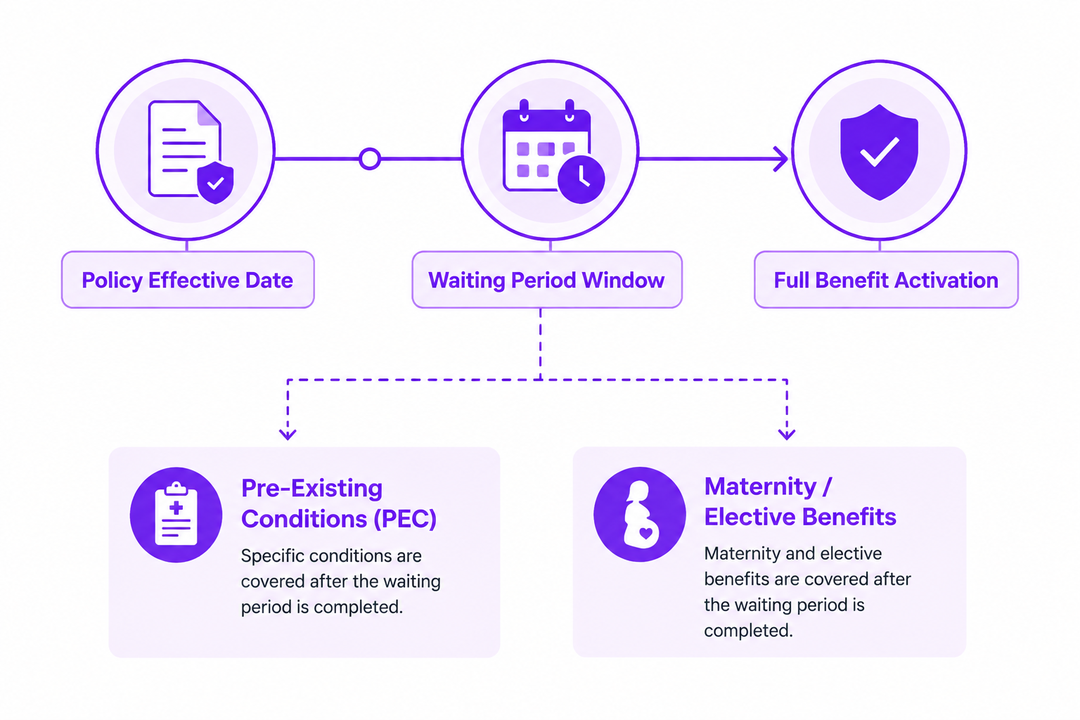
3.Pre-Existing Conditions (PEC): Conditions present prior to coverage (e.g., hypertension, diabetes, asthma) are often subject to a 6-to-12-month waiting period unless the employer has negotiated immediate day-one PEC coverage.
4.Specialized Diagnostics & Maternity: Some group plans enforce a waiting period before members can claim maternity benefits or complex elective procedures.
Understanding these timelines helps business owners set clear expectations during employee onboarding, avoiding disappointment down the line.
MBL: Tracking Your Coverage Ceiling
Every approved LOA deducts directly from your Maximum Benefit Limit (MBL)—the annual allocation assigned per member, per disease condition, or per year depending on plan design. Keeping tabs on utilization ensures employees aren’t caught off guard by unpaid hospital balances during major medical events.
For a detailed walkthrough on structuring MBLs for your workforce, read our guide on HMO Benefit Limits Explained for Philippine SMEs.
Quick Reference Summary for Employees & HR
Give Your Team Friction-Free Healthcare Access
When employees know how LOAs, pre-authorizations, and accredited networks work, they get fast, stress-free medical care, and your HR team stays focused on strategic growth rather than troubleshooting medical bills.
If your current plan leaves your team guessing at the billing counter, it’s time to re-evaluate. Explore our tailored corporate health solutions on our features page, or take the first step toward a friction-free benefits experience today.
Get a Custom HMO Quote for Your Team →
Frequently Asked Questions (FAQ)
What is an LOA in HMO coverage?
A Letter of Authorization (LOA) is an official document generated by an HMO that guarantees payment to an accredited doctor, clinic, or hospital for specific medical services rendered to a member.
How does HMO pre-authorization work in the Philippines?
Pre-authorization requires submitting medical requests, doctor notes, or diagnostic requisitions to your HMO prior to undergoing major scheduled procedures (e.g., surgeries, CT scans). The HMO reviews medical necessity and issues formal approval before the service takes place.
Can I use my HMO card at any hospital in the Philippines?
No. Standard cashless coverage only applies at accredited hospitals and clinics with in-network doctors. Visiting non-accredited facilities generally requires paying out-of-pocket and applying for reimbursement, which may not be covered in non-emergency situations.
How long is a typical HMO waiting period?
For standard SME plans, waiting periods for pre-existing conditions typically range from 6 to 12 months from the policy effective date. However, corporate plans can often negotiate to waive or reduce waiting periods for tailored group accounts.
