

Medical insurance networks explained for Philippine SMEs
TL;DR:
- Medical insurance networks are curated groups of accredited hospitals and providers controlling costs and care quality.
- Coordinating PhilHealth benefits with private HMO plans can significantly reduce employee out-of-pocket expenses.
- Ongoing network management and provider verification are essential to prevent costly claim denials and surprises.
Your employee ends up in the emergency room at a hospital they trust. The claim comes back rejected, or the coverage is so thin that they’re left with a bill they didn’t expect. For many SME owners in the Philippines, this is the moment they realize that not all health plans are built the same. Medical insurance networks are the invisible architecture behind every HMO plan, and misunderstanding them costs real money. This guide breaks down exactly how networks work, how to compare them, and how to use them strategically so your team is protected without surprises.
Table of Contents
- What are medical insurance networks?
- HMOs vs. PhilHealth: Comparing provider networks
- Common pitfalls: Out-of-network claims and surprise costs
- Best practices: Managing health coverage using networks
- Why most SMEs underestimate network management (and what actually works)
- Partnering for better coverage: How we help SMEs succeed
- Frequently asked questions
Key Takeaways
| Point | Details |
|---|---|
| Networks drive coverage results | Choosing the right provider network ensures employees get the care promised by your plan. |
| Out-of-network risks are real | Using non-accredited providers leads to denied claims or higher employee expenses. |
| PhilHealth and HMO work together | Coordinating both plans can maximize benefits and minimize costs for personnel. |
| Active management avoids surprises | Regularly updating network maps and policies keeps your SME’s health coverage efficient and effective. |
What are medical insurance networks?
A medical insurance network is simply a group of hospitals, clinics, and doctors that have a formal agreement with your HMO or insurance provider. These providers have negotiated rates and agreed service standards with the insurer. When your employee visits an accredited facility, the HMO pays according to those pre-agreed terms. When they don’t, things get complicated fast.
Insurers build networks for a practical reason: cost control. By directing members toward contracted providers, they can negotiate lower rates, monitor care quality, and process claims faster. For SME owners, this structure is actually a benefit when you understand it. Your employees get cashless access, streamlined approvals, and predictable coverage. The trouble starts when they walk into a facility that isn’t on the list.
Here’s a quick look at how network structures typically differ:
| Feature | HMO network | PhilHealth network |
|---|---|---|
| Provider selection | Curated, accredited list | All PhilHealth-accredited facilities |
| Access method | Cashless, card-based | Billing deduction from case rate |
| Coverage control | Managed per plan terms | Standardized government benefits |
| Quality monitoring | Active by HMO | Varies by facility |
| Out-of-network option | Limited or with reimbursement | Not applicable |
The core limitation to remember is this: coverage is generally tied to accredited hospitals, clinics, and doctors. Going outside that network can limit your benefits significantly.
For SMEs, the most important practical step is understanding how HMO health insurance basics apply to your specific plan. Not every HMO network is the same size. Some cover major metro areas extensively but thin out in provincial regions. Some include specialty clinics and others don’t.
Key things every SME owner should know about networks:
- In-network care is covered at full or near-full benefit levels
- Out-of-network care may be partially covered, fully denied, or require reimbursement claims
- Network size matters especially if your team is spread across multiple cities or provinces
- Doctor affiliations matter too: a doctor at an accredited hospital may still be personally unaccredited
- Specialty coverage varies: mental health, therapy, and similar services often have narrower networks
Pro Tip: Before signing any HMO plan, ask for the full provider directory and filter it by the cities where your employees actually live and work. A large-sounding network is meaningless if none of the hospitals are near your team.
HMOs vs. PhilHealth: Comparing provider networks
PhilHealth and private HMOs both use provider networks, but the logic behind each is fundamentally different. PhilHealth casts a wider net. Because it’s a government program, PhilHealth’s provider network covers all PhilHealth-accredited hospitals across the country, using a case-rate billing system for inpatient care. That’s a large footprint, but the coverage depth per case is standardized and often modest.
Private HMOs, by contrast, curate their networks intentionally. They select hospitals and clinics based on quality metrics, service agreements, and geographic coverage plans. The result is a smaller but more controlled list, often with extras like faster claims processing, cashless access, and supplemental benefits that PhilHealth doesn’t offer.
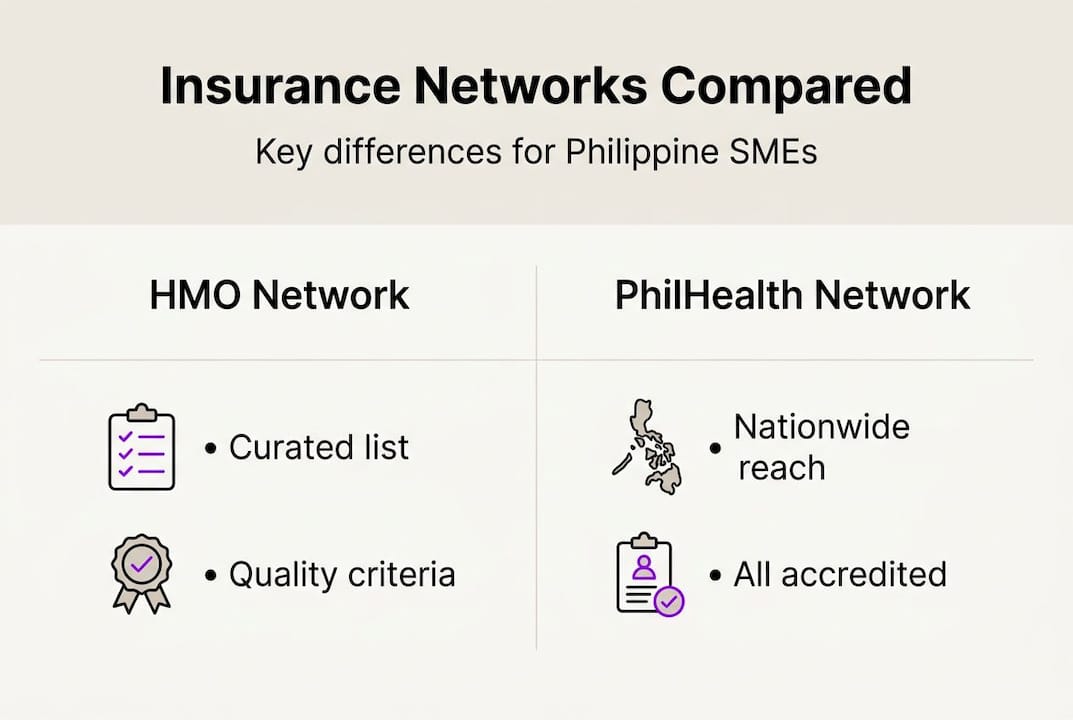
Here’s a direct comparison:
| Category | PhilHealth | Private HMO |
|---|---|---|
| Network breadth | Nationwide, all accredited | Curated, varies by HMO |
| Billing model | Case-rate (inpatient) | Negotiated rates, cashless |
| Extras included | Basic coverage only | Add-ons, specialist access |
| Claims speed | Slower, document-heavy | Faster, often real-time |
| Out-of-pocket risk | Higher for complex care | Lower within network |
For SME employers, the practical decision isn’t PhilHealth vs. HMO. It’s PhilHealth plus HMO, layered correctly. PhilHealth typically pays first for covered inpatient cases, and the HMO steps in to cover remaining balances. This coordination, when set up well, dramatically reduces what your employees pay out of pocket.
Here’s a simple sequence to understand:
- Employee is admitted to a PhilHealth-accredited and HMO-accredited hospital
- PhilHealth applies its case-rate deduction to the bill
- HMO covers the remaining balance up to the Maximum Benefit Limit
- Employee pays only what exceeds both coverages
The key insight is not choosing between PhilHealth and an HMO, but ensuring both are coordinated so employees face as little financial exposure as possible.
To get the most from both systems, explore how PhilHealth and HMO coverage can be layered for your team’s specific needs. The quality and accessibility of your HMO’s curated network will directly affect how well this coordination works in practice.
Common pitfalls: Out-of-network claims and surprise costs
Here’s a scenario that plays out regularly. An employee needs urgent care. They go to the nearest hospital. It turns out that hospital isn’t on the HMO’s accredited list. The claim comes in, and coverage is reduced or denied entirely, leaving the employee with costs they expected their employer’s plan to handle.

This isn’t a fringe case. It’s one of the most common sources of employee complaints about health benefits. And it’s almost always preventable.
The specific financial risks include:
- Balance billing: The non-accredited hospital charges the employee the full rate, with no negotiated discount
- Claim denial: If the provider isn’t accredited, the HMO may reject the claim outright
- Reduced reimbursement: Some plans allow out-of-network care but reimburse at a lower rate
- Delayed processing: Out-of-network claims require manual review, adding days or weeks
- Lost cashless access: Employees must pay upfront and file for reimbursement separately
For therapy and mental health care specifically, network gaps are especially common. Many specialty providers operate independently and may not be on your HMO’s list. Understanding how insurance benefits for therapy typically work can help you ask the right questions when evaluating plans.
Pro Tip: Run a simple internal mapping exercise before finalizing your HMO plan. List the five hospitals or clinics your employees most frequently use and verify each one against the HMO’s accredited providers list. This takes less than an hour and can save thousands in denied claims.
Administrative delays are often overlooked but genuinely costly. Out-of-network reimbursement claims require your HR team to collect receipts, complete forms, and follow up manually. Multiply that by several employees and several incidents per year, and the administrative time adds up. Setting clear internal policies about pre-authorization requirements and referral procedures before an incident happens is far more effective than managing the fallout after.
Best practices: Managing health coverage using networks
Getting value from your HMO plan isn’t a one-time decision. It’s an ongoing management responsibility. Here’s a practical framework SME owners can follow to reduce risk and maximize coverage.
- Map your workforce’s geography: Identify where employees live and work, then verify network coverage in those areas
- Build a preferred provider list: Narrow the HMO’s full accredited list to hospitals and clinics your team will realistically use
- Set up benefit coordination policies: Document how PhilHealth and your HMO interact so HR and employees know the sequence
- Create a pre-authorization checklist: For non-emergency procedures, ensure employees know what requires advance approval
- Establish a referral process: Clarify when employees need a referral from a primary care physician before seeing a specialist
- Schedule annual reviews: Provider lists change. What was accredited last year may not be this year
Coordinating PhilHealth and your HMO correctly is where most SMEs leave money on the table. The sequence of deductions and coverage matters: PhilHealth is generally treated as primary for covered items, and the HMO handles remaining balances. When employees or HR staff don’t understand this sequence, they sometimes submit claims in the wrong order, causing delays and underpayment.
To build this into your company’s operations, consider reading up on how to maximize SME health investments and properly coordinate PhilHealth and HMO for smoother outcomes. For additional context on how both systems compare in practice, the PhilHealth vs HMO guide is worth reviewing.
Employee onboarding is another underused opportunity. When new team members join, walk them through:
- How to find an accredited provider near them
- What to do in an emergency vs. a scheduled visit
- How to request pre-authorization for planned procedures
- Who to contact at the HMO if they have questions
Pro Tip: Assign one HR staff member as the internal HMO point of contact. This person maintains the provider list, tracks plan renewals, and handles benefit coordination questions before they become billing disputes.
Why most SMEs underestimate network management (and what actually works)
Most SME owners treat network management as a box they check at renewal time. Pick a plan, distribute cards, move on. We’ve seen what happens a year later: confused employees, denied claims, and frustrated HR teams sorting through paperwork that should never have existed.
The companies that avoid these headaches aren’t necessarily spending more on their health plans. They’re spending more attention. They review their accredited provider lists mid-year, not just at renewal. They talk to employees about which hospitals they actually use. They catch provider deaccreditation before someone shows up at a clinic that’s no longer covered.
There’s a real difference between a company that distributes HMO cards and a company that manages HMO coverage. Assign someone to periodically check for provider list updates. Build a simple annual review into your HR calendar. Train your team on optimizing HMO and PhilHealth usage so they’re not guessing when something happens. Network management isn’t complicated. It just requires treating it as an ongoing operational task rather than a one-time purchase decision.
Partnering for better coverage: How we help SMEs succeed
Now that you understand how medical insurance networks work and how to manage them effectively, the next step is making sure your plan is built for your team’s real needs.
At Purple Cow, we specialize in HMO features designed specifically for SMEs in the Philippines. Our accredited provider network includes premier facilities, and we help you map coverage to your team’s actual locations from day one. Our member services for SMEs include dedicated onboarding support, ongoing provider alignment assistance, and straightforward coordination with PhilHealth so nothing falls through the cracks. No confusing terms. No surprises. Just coverage that works when your employees need it most.
Frequently asked questions
What happens if my employee uses a hospital outside the HMO network?
The claim may be denied or benefits drastically reduced, leaving high out-of-pocket costs for the employee. Always verify that a facility is accredited before seeking non-emergency care.
Can PhilHealth and HMO plans be used together?
Yes. PhilHealth pays first for covered items, and the HMO can cover the remaining balance, significantly reducing what your employee pays out of pocket.
How can SMEs ensure employees are covered in their preferred facilities?
SMEs should map employees’ preferred hospitals against the HMO’s accredited provider list in each coverage area before finalizing a plan.
Are all HMOs the same in their provider networks?
No. Each HMO builds its own curated accredited network of hospitals and doctors, which means coverage quality and facility access can vary considerably between providers.
Recommended
- HMO Health Insurance for Small and Medium Enterprises in the Philippines
- The Better HMO Plans for SMEs | Purple Cow | Blog | Rai dela Cruz | Best HMO Plans Philippines - Purple Cow
- Eumir
- The Better HMO Plans for SMEs | Purple Cow | Features | Rai dela Cruz | Best HMO Plans Philippines - Purple Cow
- Why dental insurance networks matter for family care
