

Understanding PhilHealth obligations: what SMEs need to know
TL;DR:
- No legal option for SMEs to opt out of PhilHealth; compliance with registration and contributions is mandatory.
- Employers must register employees, deduct and remit contributions on time, and avoid penalties for non-compliance.
- Building comprehensive health benefits with HMO plans and wellness programs enhances employee care beyond minimum requirements.
Many business owners and HR managers in the Philippines search for a way to gain “PhilHealth independence” for their companies, hoping to reduce mandatory contributions or replace them with a private alternative. The reality is simpler and stricter: no established procedure for opting out exists. This guide walks you through what the law actually requires, the real risks of non-compliance, and the smarter path forward: pairing solid PhilHealth compliance with supplementary health benefits that give your employees more value and give your business a competitive edge.
Table of Contents
- Clarifying the myth: Is ‘PhilHealth independence’ possible for SMEs?
- Mandatory PhilHealth procedures and compliance steps for SMEs
- Common pitfalls and legal risks in PhilHealth compliance
- Alternative strategies: Enhancing employee health benefits beyond PhilHealth
- Our take: Why the real opportunity lies in SME benefit strategy, not independence
- Find SME-tailored health solutions with Purple Cow
- Frequently asked questions
Key Takeaways
| Point | Details |
|---|---|
| No opt-out path | SMEs cannot opt out of PhilHealth or create self-insurance alternatives under current law. |
| Strict compliance required | Employers must follow the mandated procedure for PhilHealth registration, deductions, and remittance. |
| Penalties for non-compliance | Fines, interest, and legal liability await SMEs that miss PhilHealth obligations or deadlines. |
| Enhance through HMOs | The best way for SMEs to increase employee health benefits is to supplement PhilHealth with HMO or wellness programs. |
Clarifying the myth: Is ‘PhilHealth independence’ possible for SMEs?
The phrase “PhilHealth independence” circulates in business forums and HR groups, often used to describe a scenario where a company manages its own health fund or uses a private insurer in place of PhilHealth. It sounds appealing. But it does not exist as a legal option in the Philippines.
Every employer, regardless of company size, is legally bound to register employees with PhilHealth, deduct the correct contributions from their salaries, and remit those contributions on time. There is no government-recognized program that allows a business to self-insure or substitute another arrangement for PhilHealth. The PhilHealth deduction mandate is explicit: contributions are not optional.
To make this clearer, here is a side-by-side look at what compliance actually involves versus what “independence” would theoretically mean:
| Feature | Standard PhilHealth compliance | Supposed ‘independence’ option |
|---|---|---|
| Legal basis | RA 7875, RA 11223, related circulars | Does not exist |
| Employer obligation | Mandatory registration and remittance | No recognized substitute |
| Employee coverage | Government health insurance benefits | No equivalent alternative |
| Penalty for non-compliance | Fines, interest, criminal liability | Same penalties apply |
| Self-insurance allowed | No | No |
Our PhilHealth compliance guide covers the specific updates and deadlines you need to track as an SME employer.
“No established procedure for ‘PhilHealth independence’ exists for employers or SMEs in the Philippines. All employers are required to register their employees and remit contributions in accordance with the law.”
This is not a matter of interpretation. Every legal and government source points to the same conclusion: PhilHealth compliance is mandatory, and there is no workaround.
Mandatory PhilHealth procedures and compliance steps for SMEs
Knowing there is no independence path, here is what the law actually requires SMEs to do for PhilHealth compliance.
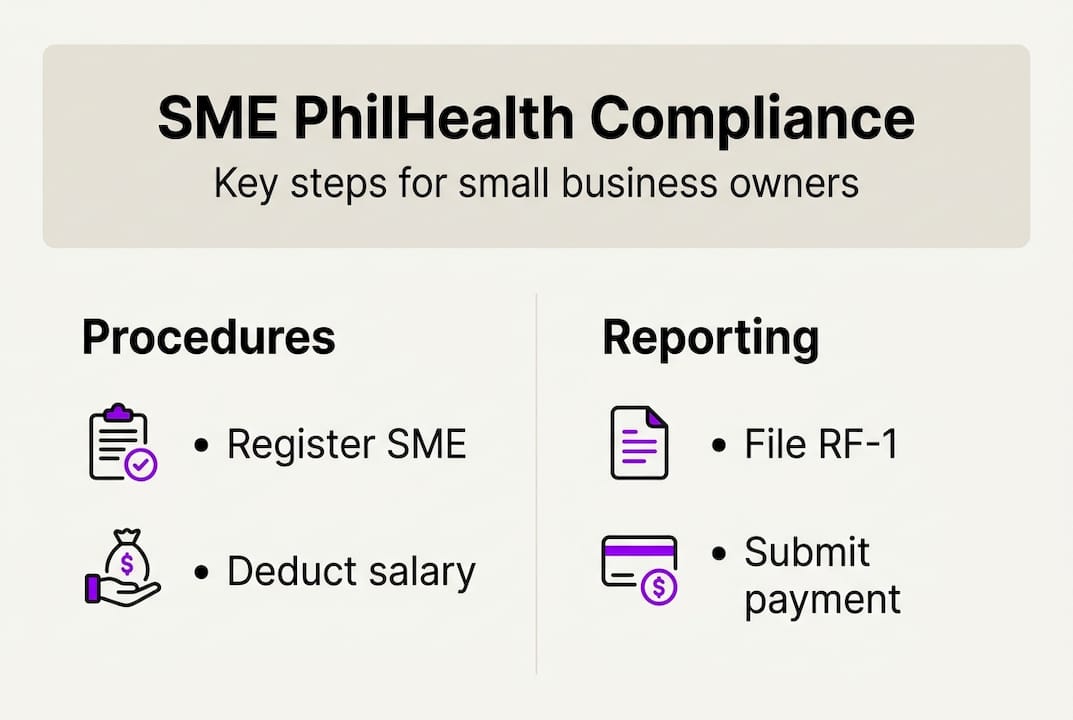
PhilHealth membership and contributions are mandatory for all employers under RA 7875 (as amended), RA 11223 (the Universal Health Care Act), and related circulars. These laws apply to every business with at least one employee on payroll.
Here is the step-by-step process your business must follow:
- Register your business with PhilHealth as an employer using the Employer Data Record (ER1 form) at your nearest PhilHealth branch or online.
- Register each employee upon hiring using the PhilHealth Membership Registration Form (PMRF), ensuring they receive a PhilHealth Identification Number (PIN).
- Compute the correct contribution based on the employee’s basic monthly salary. In 2026, the contribution rate is 5% of the monthly basic salary, shared equally between employer and employee (2.5% each), with a salary floor of ₱10,000 and a ceiling of ₱100,000.
- Deduct the employee’s share from their monthly salary at the time of payroll processing.
- Remit both shares (employer and employee) to PhilHealth on or before the deadlines based on your employer number, typically within the first 10 to 15 days of the following month.
Here is a quick breakdown of the key figures:
| Item | Details |
|---|---|
| Contribution rate | 5% of monthly basic salary |
| Employer share | 2.5% |
| Employee share | 2.5% |
| Salary floor | ₱10,000/month |
| Salary ceiling | ₱100,000/month |
| Late remittance penalty | 2% per month surcharge |
Your remittance obligations also include filing the RF-1 form (Remittance Report) along with payment. Failure to file this form, even if payment is made, can still result in compliance issues.

Pro Tip: Automate your PhilHealth computation and remittance using payroll software or a third-party HR service. Manual computation errors are one of the most common reasons SMEs face penalties. Automation also creates a digital paper trail that protects you during audits.
For a broader look at how PhilHealth for SMEs fits into your overall health investment, and to understand SME health trends shaping benefit decisions in 2026, it helps to see the full picture beyond just the contribution numbers.
Common pitfalls and legal risks in PhilHealth compliance
Even when you follow the standard process, it is easy to make mistakes. Here is what to avoid and what could happen if you do not comply.
The most common compliance mistakes SMEs make include:
- Deducting but not remitting. Some employers deduct the employee’s share from their paycheck but fail to actually send the funds to PhilHealth. This is the most serious violation.
- Late remittance. Missing the deadline, even by a few days, triggers a 2% monthly surcharge on the unpaid amount.
- Incorrect salary base. Using the wrong salary figure (for example, excluding allowances that should be included or using gross instead of basic pay) leads to under-contribution.
- Failure to register new hires promptly. Employees must be registered before they can use their PhilHealth benefits. Delays leave workers unprotected and expose you to liability.
- Assuming contractors are exempt. If a worker is classified as a regular employee under DOLE standards, PhilHealth obligations apply, regardless of how the contract is worded.
The consequences are serious. Non-remittance despite deductions leads to employer liability including interest of 2 to 3% per month, fines ranging from ₱5,000 to ₱50,000, and potential criminal charges against responsible officers. This is not a theoretical risk. PhilHealth actively audits employers, and employees can file complaints directly.
Employees have the right to check their contribution history through the PhilHealth member portal. If they discover missing or unposted contributions, they can file a formal complaint, which triggers an employer investigation. This is another reason why clean, updated records matter.
For HMO vs PhilHealth comparisons and how each layer of coverage works, it is worth understanding what PhilHealth actually covers before deciding what to add on top.
For PhilHealth compliance for SMEs, the rules apply even to corporations that may have limited active employees.
Pro Tip: Conduct a quarterly self-audit of your PhilHealth records. Cross-check your payroll deductions against your remittance receipts and posted contributions. Catching a discrepancy early is far less costly than addressing it after a formal complaint.
Alternative strategies: Enhancing employee health benefits beyond PhilHealth
Since PhilHealth is unavoidable, let’s see what additional steps you can take to provide robust health coverage.
PhilHealth covers the basics, but it has real limits. Room and board reimbursements are modest, specialist consultations require co-payments, and outpatient coverage is restricted. This is where supplementary benefits come in, and where SMEs have genuine flexibility.
Businesses seeking ‘options’ should focus on HMO add-ons or compliance assistance programs rather than trying to replace PhilHealth. The right approach is layering.
Supplementary options SMEs commonly add on top of PhilHealth include:
- HMO plans with cashless access to accredited hospitals and clinics
- Annual physical exams covered under a corporate wellness program
- Dental HMO coverage for routine and emergency dental care
- Life and accident insurance bundled with health coverage
- Mental health support programs or employee assistance programs (EAPs)
- Telemedicine access through digital health platforms
Here is how PhilHealth and a private HMO compare in practical terms:
| Feature | PhilHealth | Private HMO |
|---|---|---|
| Cashless hospital access | Limited to accredited facilities | Broad network, cashless transactions |
| Outpatient coverage | Restricted | Included in most plans |
| Dental coverage | Not included | Available as add-on |
| Room and board | Capped at low daily rates | Higher limits based on plan |
| Pre-existing conditions | Covered with waiting periods | 100% covered up to MBL (Purple Cow) |
| Flexibility | Fixed by law | Customizable per employer needs |
For SMEs thinking about maximizing health ROI, the data is clear: companies that offer supplementary health benefits report higher employee retention and lower absenteeism. A well-communicated benefits package also strengthens your employer brand, which matters when competing for talent against larger corporations.
The key is transparency. When employees understand exactly what PhilHealth covers and what the HMO adds, they feel more secure and more valued. That clarity alone drives satisfaction.
Our take: Why the real opportunity lies in SME benefit strategy, not independence
Here is the uncomfortable truth most articles avoid: the search for PhilHealth independence is a distraction. It pulls your attention toward a dead end instead of toward the decisions that actually move your business forward.
The SMEs we see thriving are not the ones trying to reduce their PhilHealth obligations. They are the ones who treat compliance as a baseline and then build something genuinely valuable on top of it. They use SME health investment strategies to turn a mandatory cost into a talent advantage.
The real competitive edge is not in finding a loophole. It is in offering your team coverage that makes them feel genuinely cared for, from cashless hospital access to dental care to mental health support. When employees know their employer went beyond the minimum, loyalty follows. That is the ROI that matters.
Compliance first. Then build a health benefit strategy that reflects your company’s values and your team’s real needs.
Find SME-tailored health solutions with Purple Cow
If you have been searching for a way to do more for your employees’ health without getting lost in complicated policy language, you are in the right place. Purple Cow, through HMO plans for SMEs, is built specifically for businesses like yours: straightforward coverage, no hidden exclusions, and 100% coverage for pre-existing and congenital conditions up to the Maximum Benefit Limit.
Whether you need to supplement your existing PhilHealth setup or build a full employee health benefits package from scratch, Purple Cow offers flexible plans with optional dental, annual physical exams, and life insurance add-ons. Explore your SME health insurance options and request a customized quote today. Your team deserves coverage that actually covers them.
Frequently asked questions
Can SMEs in the Philippines opt out of PhilHealth or self-insure their employees?
No, all SMEs must comply with PhilHealth registration and remittance. There is no legal mechanism for opting out or replacing PhilHealth with a self-insurance arrangement.
What are the consequences for failing to remit PhilHealth contributions?
Delinquent employers may face 2-3% monthly interest, fines of ₱5,000 to ₱50,000, and possible criminal charges against responsible company officers.
Are there any exemptions or reduced rates for small businesses?
No. PhilHealth obligations and contribution rates apply uniformly to all employers, with no special exemptions or reduced rates for SMEs.
How can SMEs offer more comprehensive health coverage?
Many SMEs supplement PhilHealth with HMO plans or wellness programs, but these are additions to PhilHealth, not substitutes. Focusing on HMO add-ons is the recognized strategy for expanding employee health benefits legally.
How can employees verify their PhilHealth contributions?
Employees can check their contribution history and posted payments through the official PhilHealth member portal online, and may file a formal complaint if they find missing or unposted contributions from their employer.
Recommended
- Beyond PhilHealth: How SMEs Can Maximize Health Investments for Better ROI
- PhilHealth Updates & Compliance in 2025: A Guide for SMEs in the Philippines
- PhilHealth + HMO: Maximizing Your SME’s Health Investment
- The Better HMO Plans for SMEs | Purple Cow | Features | Rai dela Cruz | Best HMO Plans Philippines - Purple Cow
