

PhilHealth vs HMO: Key Differences for SMEs
Choosing the right health coverage for your workforce is a vital decision for any HR manager in the Philippines. Balancing the strengths of the government’s PhilHealth program with private HMO options presents unique challenges for small and medium enterprises. This comparison uncovers how PhilHealth provides essential baseline protection while HMOs deliver more flexible and comprehensive support, helping you craft an employee benefits strategy that meets both legal requirements and practical healthcare needs.
Table of Contents
- What Is PhilHealth and How It Works
- How HMOs Deliver Employee Health Coverage
- Coverage Limits: PhilHealth Vs HMO Compared
- Employer Legal Duties For Health Benefits
- Costs, Claims, And Employee Impact
Key Takeaways
| Point | Details |
|---|---|
| PhilHealth’s Mission | PhilHealth aims to provide affordable healthcare coverage for all Filipino citizens through mandatory contributions and government subsidies. |
| HMO Focus on Employee Wellness | Health Maintenance Organizations offer comprehensive health coverage, prioritizing preventive care and cost-effective medical services for employees. |
| Coverage Differences | PhilHealth provides essential coverage for critical medical needs, while HMOs offer broader services including outpatient and preventive care. |
| Employer Legal Obligations | Employers must carefully manage health benefits compliance, balancing mandatory PhilHealth contributions and optional HMO requirements. |
What Is PhilHealth and How It Works
PhilHealth is the Philippine government’s national health insurance program designed to provide affordable and accessible healthcare coverage for all Filipino citizens. Established in 1995, this government-owned health insurance corporation plays a critical role in ensuring healthcare accessibility across the Philippines.
The core mission of PhilHealth revolves around universal health coverage through a structured social health insurance system. Members contribute premiums based on their employment status, which enables the program to reimburse medical expenses at accredited healthcare facilities. Unlike private health insurance, PhilHealth focuses on providing basic healthcare financial support across various demographic groups.
Key characteristics of PhilHealth include:
- Mandatory membership for formal sector employees
- Voluntary enrollment for informal workers and self-employed individuals
- Partial reimbursement for medical procedures and hospitalizations
- Coverage that extends to inpatient and selected outpatient services
- Contribution rates that vary depending on income and employment classification
The financial mechanism of PhilHealth operates through a combination of member contributions, employer payments, and government subsidies. The national health insurance program aims to distribute healthcare costs equitably, ensuring that even low-income individuals can access essential medical services.
Pro tip: Always maintain updated PhilHealth membership records and understand your specific coverage details to maximize potential reimbursement benefits.
How HMOs Deliver Employee Health Coverage
Health Maintenance Organizations (HMOs) represent a strategic approach to delivering comprehensive employee health coverage for small and medium enterprises. Health maintenance organizations provide prepaid healthcare through a structured network of medical providers, offering businesses an efficient way to manage healthcare expenses while ensuring employee wellness.
The core mechanism of HMO coverage involves a carefully designed system that prioritizes preventive care and cost-effective medical services. Unlike traditional insurance models, HMOs focus on coordinating healthcare delivery through a primary care physician who oversees and manages an employee’s medical needs. This approach ensures:
- Comprehensive medical coverage across multiple healthcare domains
- Predictable monthly healthcare costs for employers
- Streamlined access to medical services through designated provider networks
- Proactive health management through regular screenings and preventive care
- Reduced out-of-pocket expenses for employees
HMO models typically operate through different structural approaches, each designed to optimize healthcare delivery and cost management. Comprehensive care networks prioritize preventive healthcare by integrating medical services, financing, and patient care into a unified system. This integrated approach allows businesses to provide robust healthcare support while maintaining financial predictability.

Pro tip: When selecting an HMO for your business, carefully evaluate the provider network, coverage scope, and flexibility to ensure it meets your specific employee healthcare needs.
Coverage Limits: PhilHealth vs HMO Compared
Understanding the nuanced differences in coverage limits between PhilHealth and HMOs is crucial for small and medium enterprises seeking comprehensive employee health protection. Health coverage varies significantly between these two healthcare financing models, each serving distinct purposes in the Philippine healthcare ecosystem.
PhilHealth operates with a standardized approach, providing fundamental health coverage through predetermined case rates for specific medical conditions. Key characteristics of PhilHealth coverage include:
- Fixed reimbursement rates for inpatient services
- Limited outpatient program coverage
- Mandatory low monthly contributions
- Government-mandated baseline medical protection
- Focused primarily on major medical events and hospitalizations
HMO plans, in contrast, offer more flexible and comprehensive coverage. Benefit coverage includes detailed service limitations that extend well beyond PhilHealth’s basic framework. These plans typically encompass:
- Broader outpatient consultation services
- Comprehensive diagnostic testing
- Wellness and preventive care programs
- Faster medical service access
- More extensive provider networks
- Optional supplementary medical packages
The primary distinction lies in their approach: PhilHealth provides a safety net for critical medical expenses, while HMOs deliver more proactive and wide-ranging healthcare support. Smart employers often recommend maintaining both to ensure maximum health coverage for their employees.
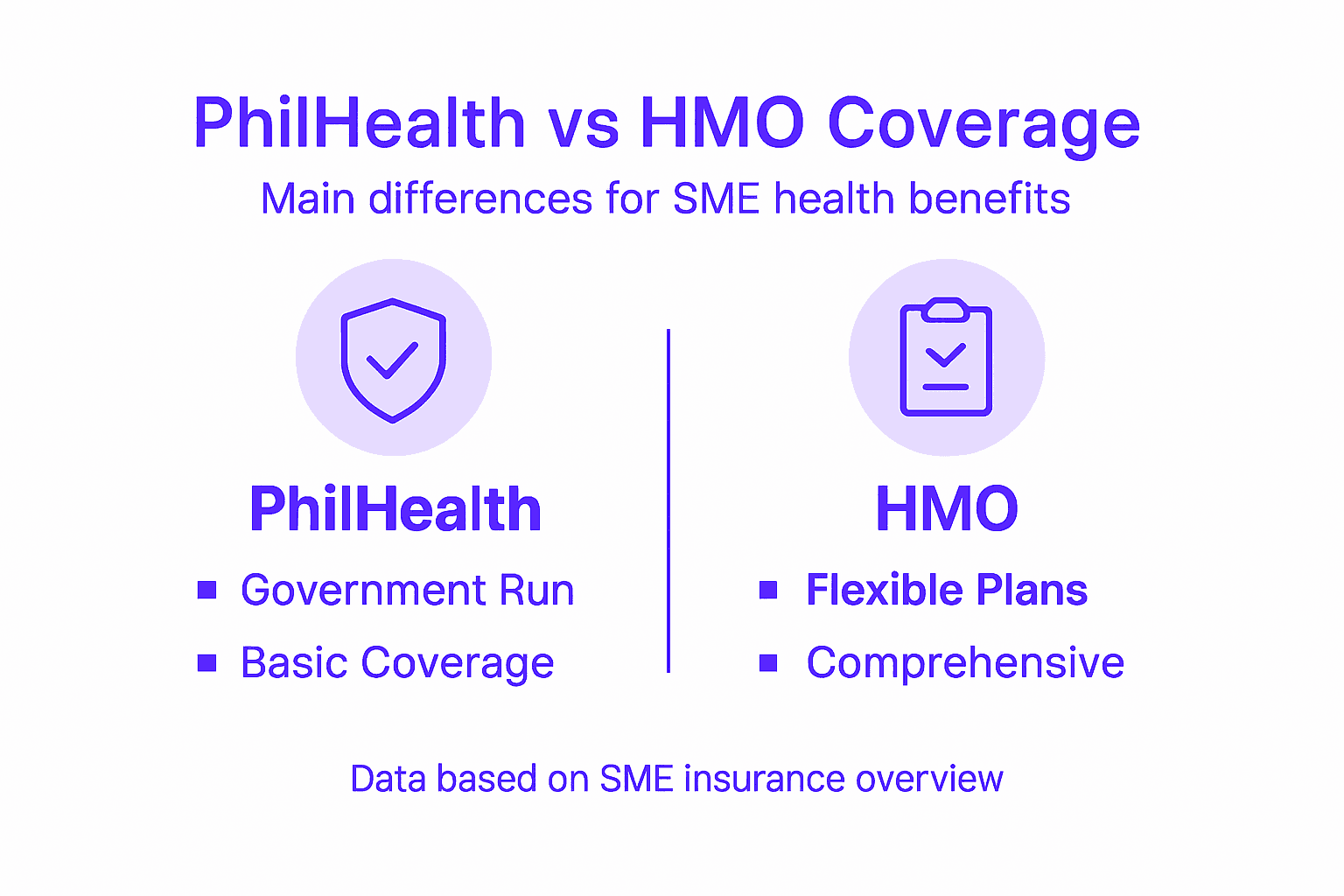
Here’s how PhilHealth and HMOs differ in practical business impact:
| Aspect | PhilHealth | HMO |
|---|---|---|
| Coverage Scope | Essential health services | Broad medical services and wellness |
| Access Speed | Standard hospital queue | Priority access through provider network |
| Claims Process | Simplified reimbursement | Detailed documentation, direct billing |
| Value to SMEs | Baseline protection | Strategic talent retention boost |
Pro tip: Conduct a thorough comparison of your employees’ specific healthcare needs before selecting between PhilHealth and HMO coverage to optimize your health benefits strategy.
Employer Legal Duties for Health Benefits
Employers in the Philippines face complex legal obligations when managing employee health benefits, requiring careful navigation of both mandatory and voluntary healthcare requirements. Employer responsibilities extend across multiple healthcare frameworks that demand strategic compliance and proactive management.
For PhilHealth, legal duties are strictly defined and non-negotiable. These mandatory obligations include:
- Registering all employees with PhilHealth
- Accurately calculating and remitting monthly contributions
- Submitting proper documentation for employee claims
- Ensuring compliance with National Health Insurance Program regulations
- Maintaining updated employee membership records
HMO benefits, in contrast, represent a more nuanced legal landscape. Health insurance obligations depend on specific contractual agreements that can vary significantly between organizations. While providing HMO coverage remains generally voluntary, once promised in employment contracts or company policy, these benefits become legally enforceable.
The legal framework emphasizes the principle of non-diminution of benefits, meaning employers cannot arbitrarily reduce or eliminate health benefits once they have been established. This requires careful planning and consistent implementation of health benefit strategies that protect both employer interests and employee welfare.
Below is a quick reference of employer obligations regarding employee health benefits:
| Obligation Type | PhilHealth Requirement | HMO Requirement |
|---|---|---|
| Enrollment Process | Mandatory for all employees | Optional, based on company policy |
| Payment Structure | Shared contribution (employee/employer) | Fully employer-funded or mixed |
| Legal Enforcement | Governed by national law | Based on contractual agreements |
| Benefit Adjustments | Regulated, set by government | Flexible, but protected once promised |
Pro tip: Consult with legal and HR professionals to develop a comprehensive health benefits strategy that balances compliance requirements with organizational capabilities.
Costs, Claims, and Employee Impact
The landscape of healthcare costs and claims in the Philippines presents a complex ecosystem for small and medium enterprises navigating employee health benefits. Benefit expenses have undergone significant recent transformations, impacting both employer strategies and employee expectations.
PhilHealth’s cost structure is characterized by its All Case Rates (ACR) system, which offers predictable financial frameworks for medical services. Key aspects of this system include:
- Fixed reimbursement rates for specific medical procedures
- Annual cost adjustments reflecting healthcare inflation
- Standardized claims processing mechanisms
- Reduced out-of-pocket expenses for members
- Transparent pricing for medical treatments
HMO plans introduce additional layers of financial complexity. Healthcare claims processing involves intricate documentation requirements that demand careful navigation by both employers and employees. Unlike PhilHealth’s standardized approach, HMOs offer more flexible coverage options with varying cost structures.
The ultimate impact on employees transcends mere financial considerations. Comprehensive health benefits directly influence job satisfaction, productivity, and overall workplace morale. Smart employers recognize that robust health coverage is not an expense, but a strategic investment in human capital that yields significant returns through reduced absenteeism and enhanced worker engagement.
Pro tip: Conduct an annual review of your health benefits package to ensure alignment with employee needs and emerging healthcare market trends.
Ensure Your SME’s Health Coverage Stands Out with the Right Choice
Navigating the complex differences between PhilHealth and HMO coverage can be a challenge for small and medium enterprises striving to offer the best healthcare benefits. The article highlights the critical need for broad, proactive, and flexible health coverage that goes beyond PhilHealth’s baseline protection. If your goal is to boost employee welfare, streamline costs, and secure priority access to quality medical care, embracing a comprehensive HMO plan is essential.
Discover how HMO Plans empowers SMEs with 100 percent coverage for pre-existing conditions, no-fault scenarios, and extensive inpatient and outpatient services. Our partnerships with premier hospitals and clinics, including the Big 9 Hospitals and Healthway Clinics, guarantee your employees get seamless and cashless access nationwide. Don’t settle for limited coverage when you can provide superior health protection tailored to your workforce’s needs. Take the step now to enhance your benefits package with HMO Plans and experience simple, cost-effective solutions designed specifically for SMEs.
Frequently Asked Questions
What is PhilHealth and how does it work?
PhilHealth is a national health insurance program in the Philippines that provides affordable and accessible healthcare coverage for Filipino citizens through member contributions, employer payments, and government subsidies.
How do HMOs differ from PhilHealth in terms of coverage?
HMOs offer more flexible and comprehensive coverage, including broader outpatient services and preventive care, while PhilHealth focuses on essential health services and hospitalizations with standardized reimbursement rates.
What are the legal obligations of employers regarding PhilHealth and HMOs?
Employers must register all employees with PhilHealth and remit monthly contributions, while HMO obligations depend on contractual agreements and can vary between organizations.
How do healthcare costs and claims differ between PhilHealth and HMOs?
PhilHealth uses a fixed reimbursement rate system, providing predictable costs, whereas HMO plans can have more variable pricing structures and complex claims processes, affecting both employers and employees.
Recommended
- HMO Health Insurance for Small and Medium Enterprises in the Philippines
- Beyond PhilHealth: How SMEs Can Maximize Health Investments for Better ROI
- Evaluating Vendors: How SMEs Can Choose the Right HMO Partner
- Understanding HMO Basics: A Guide for New HR Managers in SMEs
- Beneficios de seguros dentales PPO: acceso y ahorro
