

Room and board in HMO plans: a guide for Philippine SMEs
Managing employee health benefits in the Philippines means navigating complex coverage details that often surprise SME managers. Up to 40% of HMO users pay out-of-pocket for room and board despite having coverage. Many assume their HMO plan fully covers all hospital accommodation costs, only to face unexpected bills when employees are confined. This guide clarifies room and board coverage components, financial limits, and customization options to help you optimize employee benefits while controlling costs.
Table of Contents
- What Is Room And Board Coverage In HMO Plans?
- Understanding Financial Limits And Maximum Benefit Limits (MBL) For Room And Board
- How Room Type Influences Coverage And Costs
- Customization And Add-On Options For SMEs
- PhilHealth Coordination And Its Effect On Room And Board Costs
- Common Misconceptions About Room And Board Coverage In HMO Plans
- Implementation Tips For SME Managers
- Explore The Best HMO Plans For Your SME
Key takeaways
| Point | Details |
|---|---|
| Room and board basics | Covers hospital accommodation, meals, and nursing care during inpatient stays with specific daily limits. |
| Financial boundaries | Daily coverage ranges from PHP 3,000 to 12,000, with maximum benefit limits capping total inpatient claims. |
| Room type impact | Shared rooms are standard; private or suite upgrades require additional premiums or supplemental coverage. |
| PhilHealth coordination | Reduces overall costs by covering up to PHP 25,000 per confinement, with HMOs supplementing the difference. |
| Customization options | Add-ons and riders allow SMEs to enhance coverage limits and room types based on employee needs and budget. |
What is room and board coverage in HMO plans?
Room and board represents a fundamental component of HMO health insurance for SMEs in the Philippines. It covers the essential elements employees need during hospital confinement beyond medical procedures and medications.
This coverage includes several core components:
- Hospital accommodation charges for the room itself
- Three meals per day provided by the facility
- Basic nursing care and monitoring services
- Utilities like electricity, air conditioning, and water
- Housekeeping services for the hospital room
Standard HMO packages typically cover shared room rates with basic nursing and meal services. Understanding this distinction helps you align benefit packages with what employees actually expect and need. Room and board exists as a separate coverage element from surgical procedures, diagnostic tests, or prescription medications. The accommodation component often represents a significant portion of total inpatient costs, making it crucial for SME managers to grasp the coverage parameters.
Many employees assume full coverage for any room type, creating disappointment when they discover limits. Setting clear expectations from the start prevents dissatisfaction and reduces administrative burden on your HR team.
Understanding financial limits and maximum benefit limits (MBL) for room and board
Every HMO plan establishes daily coverage limits that determine how much the insurer pays for room and board charges. These boundaries directly affect employee out-of-pocket expenses and overall satisfaction with your benefits package.
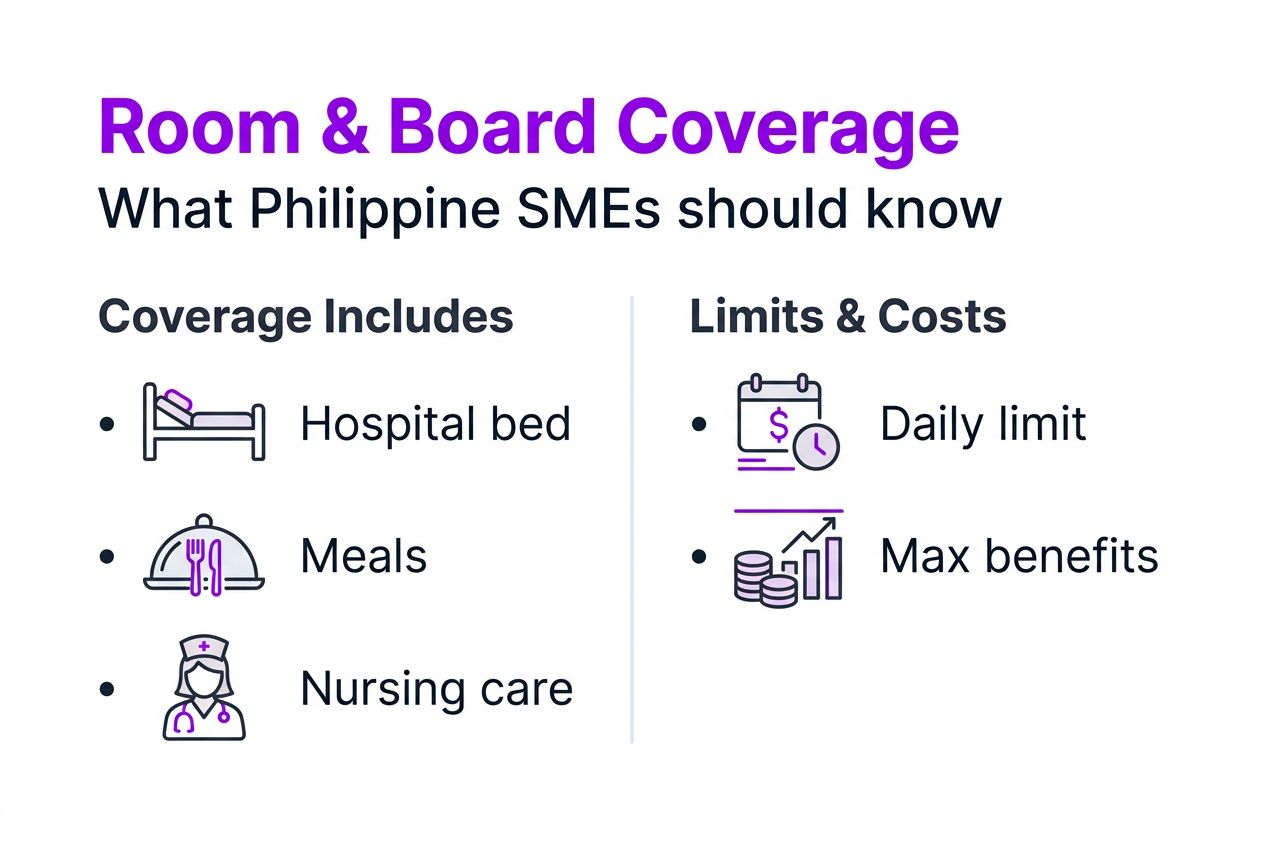
Daily room and board coverage limits in Philippine HMO plans typically range between PHP 3,000 and PHP 12,000. The specific amount depends on your chosen plan tier, the hospital’s classification, and the room type. Budget plans usually cap daily coverage around PHP 3,000 to PHP 5,000, while premium tiers may extend to PHP 10,000 or higher.
The maximum benefit limit (MBL) adds another layer of financial boundaries. This cap applies to total inpatient claims throughout the policy year, including room and board, procedures, medications, and all other covered services. Once an employee reaches the MBL, all subsequent costs become their responsibility unless supplemental coverage exists.
Excess room and board charges require out-of-pocket payment or supplementary insurance when daily limits are exceeded. This commonly leads SMEs to offer supplemental coverage for higher tier rooms or longer stays to avoid employee dissatisfaction.
Key financial consequences include:
- Employees paying the difference when daily rates exceed plan limits
- Faster MBL depletion for extended hospital stays
- Potential financial strain on employees during serious illnesses
- Increased employee complaints and reduced benefit satisfaction
Pro Tip: Calculate average hospital room rates at facilities your employees commonly use, then compare against your HMO’s daily limits to identify potential coverage gaps before claims arise.
How room type influences coverage and costs
The room category your employees choose during hospital confinement dramatically affects both coverage adequacy and premium costs. Understanding these differences helps you make informed decisions about plan customization.

Shared rooms serve as the baseline coverage in most Philippine HMO plans. These multi-bed accommodations typically house two to four patients and come with the lowest daily limits and premium costs. Standard plans usually cover shared room rates fully or nearly fully, minimizing employee out-of-pocket expenses.
Private and suite rooms present different financial dynamics. Private single-occupancy rooms can cost two to three times more than shared accommodations. Suites with separate living areas and enhanced amenities may reach five times shared room rates. Most HMOs only cover the shared room equivalent, leaving employees to pay substantial differences for upgrades.
Here’s how room types compare:
| Room Type | Typical Daily Rate | Standard HMO Coverage | Employee Cost |
|---|---|---|---|
| Shared (2-4 beds) | PHP 3,000 - 5,000 | Fully covered | None to minimal |
| Semi-private (2 beds) | PHP 5,000 - 8,000 | Partial coverage | PHP 2,000 - 3,000 |
| Private (single) | PHP 8,000 - 15,000 | Shared rate only | PHP 5,000 - 10,000 |
| Suite | PHP 15,000 - 30,000 | Shared rate only | PHP 12,000 - 25,000 |
Room type choice significantly impacts employee satisfaction and benefits appeal. Many professionals prefer private rooms for privacy and recovery comfort. Offering enhanced room coverage through add-ons can differentiate your benefits package without dramatically increasing base premiums.
Consider your workforce demographics when evaluating room type coverage. Younger employees may accept shared accommodations more readily, while senior staff often value private room access. Explore inpatient treatment coverage nuances to understand how room preferences vary by medical condition and recovery needs.
Pro Tip: Balance upgrades with budget by selectively offering private room add-ons for management tiers or high-risk positions rather than company-wide coverage, controlling costs while enhancing perceived value.
Customization and add-on options for SMEs
Tailoring room and board coverage through add-ons and riders helps SMEs meet diverse employee needs without overspending on unnecessary benefits. Strategic customization maximizes satisfaction while maintaining budget control.
Add-ons can increase daily room and board limits by up to PHP 5,000 beyond base coverage. This enhancement often costs 15 to 25 percent more in premiums but prevents substantial employee out-of-pocket expenses during confinement. Common customization options include upgraded room type coverage (from shared to private), extended coverage days beyond standard limits, and supplemental nursing care for serious conditions.
Assessing your specific needs requires examining employee demographics, historical utilization patterns, and budget constraints. Companies with older workforces or those in high-stress industries may benefit more from enhanced coverage. Review the HMO plans blog for industry-specific customization strategies and case studies showing ROI on various add-ons.
Follow these steps to customize room and board coverage effectively:
- Conduct an employee needs assessment through surveys or focus groups to understand room type preferences and willingness to contribute for upgrades
- Review current plan utilization data to identify actual vs. expected room and board claims and coverage gaps
- Negotiate with HMO vendors to obtain quotes for various add-on combinations and tier structures
- Communicate options clearly to employees, explaining coverage levels, premium impacts, and out-of-pocket responsibilities
- Monitor plan performance quarterly, tracking claim patterns, employee satisfaction scores, and budget adherence
Consider tailored HMO coverage for SMEs that demonstrates how strategic customization reduces absenteeism and improves workforce health outcomes. Clear prioritization helps balance costs against perceived employee benefit value.
New HR managers should review HMO basics for HR managers to understand foundational concepts before diving into customization decisions. Building expertise gradually prevents costly mistakes and ensures optimal benefit design.
PhilHealth coordination and its effect on room and board costs
PhilHealth coordination with HMO plans creates significant cost savings for both SMEs and employees through complementary coverage structures. Understanding this partnership helps you maximize value from both insurance programs.
PhilHealth covers up to PHP 25,000 per confinement for basic room and board and medical services under its case-based payment system. This government insurance serves as the primary payer for eligible claims, with your HMO providing supplemental coverage for amounts exceeding PhilHealth limits or for services outside its scope.
Proper coordination eliminates duplicate claims processing and reduces employee out-of-pocket costs substantially. When both programs work together seamlessly, employees enjoy true cashless hospital access without advance payments or reimbursement delays. The hospital billing department coordinates directly with both insurers, settling accounts without patient involvement.
Key coordination benefits include:
- Significant cost reduction through layered coverage from both programs
- Streamlined claim processing with single submission to the hospital
- Expanded coverage scope beyond what either program offers alone
- Enhanced employee satisfaction through genuine cashless convenience
Explore PhilHealth and HMO coordination strategies to maximize your health investment. The coordination process requires proper documentation and timely submission, but the financial benefits far outweigh administrative effort.
Cashless access through coordinated HMO and PhilHealth processes represents one of the strongest value propositions you can offer employees. This convenience factor often matters more to staff than coverage amounts, making coordination a critical implementation focus.
Common misconceptions about room and board coverage in HMO plans
Misunderstandings about room and board coverage create frustration and unexpected expenses for employees. Clarifying these misconceptions helps you set accurate expectations and prevent dissatisfaction.
The most widespread misconception is that HMO plans fully cover all room types without limitations. Standard policies typically cover only shared room rates, regardless of the actual room chosen. Employees who assume private room coverage often face shocking bills when discharged.
Another common misunderstanding involves coverage duration. Some employees believe room and board coverage continues indefinitely during hospitalization. Most plans cap covered days at 30 to 45 days per confinement, with longer stays requiring special approval or resulting in out-of-pocket costs.
“Up to 40% of inpatient users face partial non-coverage of room and board charges due to misconceptions about coverage scope.”
Many also incorrectly assume that specialized nursing care, like one-on-one monitoring or ICU nursing services, falls under standard room and board coverage. These services typically require separate authorization and may have distinct coverage limits or exclusions.
Common misconceptions to address:
- Believing all hospital room types receive equal coverage
- Assuming unlimited days of coverage for chronic conditions
- Thinking specialized nursing automatically comes with room and board
- Expecting coverage for companion beds or guest accommodations
- Presuming no coordination requirement between PhilHealth and HMO
Review HMO room and board misconceptions to understand common employee confusion points. Proactive education through orientation sessions, benefit guides, and clear policy documents prevents most misunderstandings before they cause problems.
The importance of reviewing plan details carefully and educating employees cannot be overstated. Invest time upfront in comprehensive communication to avoid costly surprises and maintain trust in your benefits program.
Implementation tips for SME managers
Effective implementation of room and board benefits requires clear communication, strategic planning, and ongoing management. These practical strategies help you maximize satisfaction while minimizing complaints and confusion.
Educate employees thoroughly on coverage limits and exclusions during onboarding and annual enrollment periods. Use specific examples showing how different room choices affect out-of-pocket costs. Visual aids like comparison charts make abstract concepts concrete and memorable.
Consider supplemental insurance or riders for popular room types or positions with higher health risks. Senior management, field staff exposed to occupational hazards, and employees with known chronic conditions benefit most from enhanced coverage. Tiered benefit structures let you target additional coverage strategically.
Regularly review plan utilization patterns, employee feedback, and claim data to identify improvement opportunities. Quarterly reviews reveal trends before they become major issues. Look for patterns in claim denials, employee complaints about specific hospitals, or room type preferences that suggest coverage gaps.
Key implementation actions:
- Develop clear, jargon-free benefit summaries explaining room and board coverage in simple terms
- Create decision tools helping employees calculate expected costs for different room types
- Establish dedicated HR contact points for coverage questions and claims support
- Schedule annual benefit reviews with employees to assess satisfaction and gather improvement suggestions
- Document all coverage communications to reference during disputes or claim challenges
Pro Tip: Establish transparent communication channels for coverage questions and claims support, including a dedicated email address or phone line that employees can access 24/7 during medical emergencies.
Partner with reliable HMO vendors to ensure claim efficiency and cashless hospital access. Review choosing the right HMO partner for evaluation criteria and due diligence processes. Vendor reliability directly impacts employee satisfaction and your administrative workload.
Understand the importance of HMO for small businesses when making coverage decisions. Health benefits serve as powerful retention and recruitment tools, making proper implementation a strategic imperative beyond mere compliance.
Consider outsourcing benefits administration functions if your HR team lacks bandwidth for proper management. Specialized brokers and consultants bring expertise that prevents costly mistakes and ensures optimal plan design.
Explore the best HMO plans for your SME
Navigating room and board coverage complexities becomes simpler with the right HMO partner supporting your SME’s unique needs. Now that you understand coverage components, financial limits, and customization strategies, take the next step toward optimized employee benefits.
Explore comprehensive HMO solutions specifically designed for Philippine businesses at Better HMO plans for SMEs. Find flexible room and board options that fit diverse employee needs and budgets, from standard shared room coverage to premium private room add-ons. Our plans include straightforward claim processing and genuine cashless hospital access at premier facilities nationwide.
Discover practical insights and industry-specific strategies on the HMO plans blog, featuring real SME case studies and expert guidance. Implement the knowledge from this guide by tailoring coverage that aligns with your workforce demographics, budget constraints, and strategic benefits goals. Contact our team to review your current coverage and identify opportunities for enhanced employee satisfaction without premium increases.
FAQ
What does room and board cover in Philippine HMO plans?
Room and board typically covers hospital accommodation, meals, basic nursing care, and utilities during an inpatient stay. It usually excludes medical procedures, diagnostic tests, prescription medications, and specialized nursing services. Standard coverage applies to shared room rates, with private or suite accommodations requiring additional premiums or resulting in out-of-pocket costs for employees.
How do daily room and board limits affect employee out-of-pocket costs?
When room and board charges exceed the HMO daily limit, employees must pay the difference out-of-pocket or via supplemental coverage. For example, if your plan covers PHP 5,000 daily but the chosen room costs PHP 8,000, the employee pays PHP 3,000 per day. Understanding and communicating these limits reduces financial surprises and prevents dissatisfaction during already stressful medical situations.
Can SMEs customize room and board coverage in their HMO plans?
Yes, SMEs can add upgrades and riders to enhance room and board limits and expand covered room types. Customization options include increasing daily coverage limits, adding private room access, or extending covered days beyond standard policy limits. This flexibility helps balance cost control with employee benefit appeal, allowing strategic investment in coverage areas that matter most to your workforce.
How does PhilHealth coordinate with HMO plans for room and board benefits?
PhilHealth covers basic room and board up to PHP 25,000 per confinement under its case-based payment system. HMOs supplement expenses beyond PhilHealth limits, creating layered coverage that significantly reduces employee costs. Review PhilHealth and HMO coordination strategies to maximize benefits from both programs through proper claim submission and documentation processes.
Recommended
- HMO Health Insurance for Small and Medium Enterprises in the Philippines
- Eumir
- The Better HMO Plans for SMEs | Purple Cow | Blog | Rai dela Cruz | Best HMO Plans Philippines - Purple Cow
- Understanding HMO Basics: A Guide for New HR Managers in SMEs
- Cheap Expat Health Insurance: Complete Resource Guide - Unparalleled Global Benefits
