

Streamline employee health benefits: SME guide 2026
TL;DR:
- Philippine SMEs must provide PhilHealth, SSS, and Pag-IBIG benefits, with HMO as voluntary support.
- Proper registration and timely remittance of contributions are essential to ensure coverage and avoid penalties.
- A proactive, automated workflow helps streamline benefits management, reduce errors, and improve employee trust.
Managing employee health benefits in the Philippines sounds straightforward until you’re juggling PhilHealth registration deadlines, SSS remittance schedules, Pag-IBIG contributions, and HMO enrollment all at once. For HR managers and business owners at small and medium enterprises (SMEs), the coordination alone can eat hours every month. Miss one step, and you’re looking at fines, gaps in coverage, or frustrated employees at the hospital counter. This guide breaks down the full workflow: from understanding what’s mandatory to enrolling new hires, managing payroll deductions, and handling claims without the usual headaches.
Table of Contents
- Understanding mandatory employee health benefits in the Philippines
- Preparing for implementation: Registration and documentation checklist
- Step-by-step workflow: Enrolling and administering employee health benefits
- Troubleshooting claims and optimizing employee coverage
- Our take: Why a proactive workflow transforms SME health benefits
- Take the next step with simplified health benefits for your team
- Frequently asked questions
Key Takeaways
| Point | Details |
|---|---|
| Mandatory plus optional coverage | SMEs must provide PhilHealth, SSS, and Pag-IBIG, but offering HMO boosts employee satisfaction and hiring. |
| First-payroll compliance | New hires must be registered and covered starting with their first payroll. |
| Penalties for missed payments | Late or missing contributions can result in fines, interest, and even criminal liability. |
| Clear claims process | PhilHealth always processes first, with HMO covering any remaining balance. |
| Proactive workflows win | A proactive, step-by-step approach greatly reduces errors and improves employee experience. |
Understanding mandatory employee health benefits in the Philippines
Before you build any workflow, you need to know exactly what the law requires and where HMO fits in. Philippine SMEs must provide three government-mandated benefits: PhilHealth (health insurance), SSS (social security), and Pag-IBIG (housing fund). HMO coverage sits outside the mandate, but it plays a critical supporting role.
What each benefit covers:
- PhilHealth: Government health insurance covering hospitalization, surgeries, outpatient procedures, and select medicines. It pays a fixed benefit amount, not full costs.
- SSS: Social insurance covering disability, maternity, retirement, and death benefits. It also has a sickness benefit component.
- Pag-IBIG (HDMF): Primarily a housing fund, but it also offers calamity loans and short-term loans employees often rely on.
- HMO (voluntary): Employer-sponsored private health coverage that covers what PhilHealth doesn’t, including room upgrades, specialist consultations, dental, and outpatient care beyond government limits.
In 2026, salary ceilings and compliance rules apply strictly across all three government agencies. PhilHealth contributions are computed at 5% of monthly basic salary, with a ceiling at PHP 100,000 (meaning maximum monthly contribution is PHP 5,000, shared equally by employer and employee). SSS has its own salary bracket table. Non-remittance isn’t a minor oversight: penalties include surcharges, interest, and even criminal liability for employers.
| Benefit | Type | Who pays | Primary purpose |
|---|---|---|---|
| PhilHealth | Mandatory | Employer + employee | Government health insurance |
| SSS | Mandatory | Employer + employee | Social security and sickness |
| Pag-IBIG | Mandatory | Employer + employee | Housing and emergency loans |
| HMO | Voluntary | Employer (often) | Supplemental private health coverage |
For a deeper look at how PhilHealth and HMO work together, maximizing PhilHealth and HMO offers practical context for SMEs weighing their options.
Pro Tip: If your SME is owner-operated or has self-employed directors, those individuals must register and remit separately from the company payroll. Lumping them into employee records is one of the most common audit red flags.
Preparing for implementation: Registration and documentation checklist
Knowing which benefits to provide is step one. Getting employees properly registered before their first payroll run is step two. Many SMEs stumble here because they treat registration as an afterthought rather than a first-day task.

New employees are covered under PhilHealth from their first payroll month. That means if someone joins your company on the 3rd of the month and gets paid on the 30th, they need to be registered and reported before that payroll closes. Delays cost both the employee and your compliance record.
Documents required for government registrations:
- Accomplished PhilHealth Member Registration Form (PMRF)
- SSS E-1 form (for new members) or E-4 for updates
- Pag-IBIG Membership Registration Form (MDF)
- Government-issued ID (passport, driver’s license, or national ID)
- Birth certificate (for SSS and PhilHealth, particularly for dependents)
- Tax Identification Number (TIN)
Step-by-step registration process:
- Collect all required documents from the new hire on Day 1 or during preboarding.
- Register the employee with PhilHealth online via the PhilHealth Member Portal.
- Submit the SSS E-1 or update form through the SSS employer account online.
- Register with Pag-IBIG through the Virtual Pag-IBIG employer portal.
- Add the employee to your HMO provider’s system (if applicable) and submit proof of employment.
- Confirm all IDs and membership numbers are received before the first payroll run.
| Benefit | Online portal available | Processing time | Key form |
|---|---|---|---|
| PhilHealth | Yes | 1 to 3 days | PMRF |
| SSS | Yes | 3 to 5 days | E-1 / E-4 |
| Pag-IBIG | Yes | 1 to 2 days | MDF |
| HMO | Depends on provider | Varies | Enrollment form |
For a broader view of how health benefits fit into your overall onboarding new employees strategy, treating benefits enrollment as part of the hiring experience makes a strong first impression. If you’re managing multiple new hires monthly, digital tools for HR can significantly reduce manual errors and processing time.
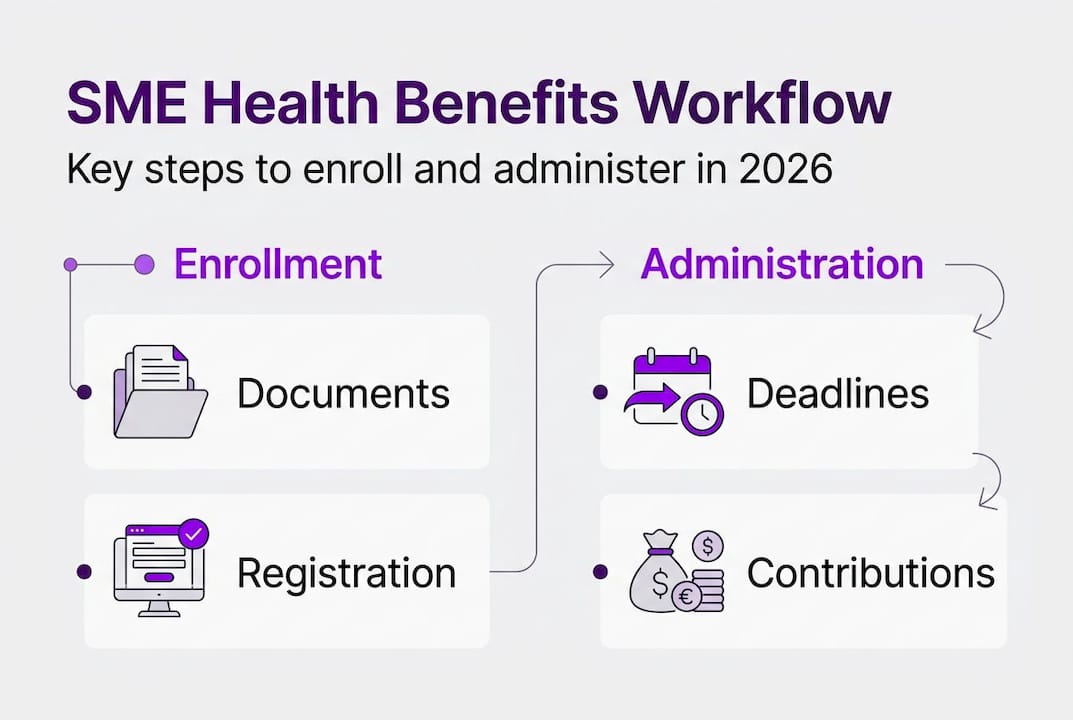
Step-by-step workflow: Enrolling and administering employee health benefits
Registration is a one-time setup. Administration is ongoing. The real workflow challenge is keeping contributions accurate, remittances timely, and records clean every single month.
Monthly health benefits administration workflow:
- Update payroll records for any new hires, salary changes, or separations before the payroll cut-off date.
- Calculate contributions based on current salary brackets. Apply the PhilHealth 5% rate, the SSS contribution table, and the Pag-IBIG contribution (2% of monthly compensation, capped at PHP 5,000 contribution base).
- Deduct employee shares from gross pay. Employer shares are added on top as a business expense.
- Generate contribution reports for each agency using their respective employer portals.
- Remit contributions by the deadline: PhilHealth on or before the last day of the applicable month, SSS by the 10th to 15th depending on employer number, Pag-IBIG by the 10th to 15th as well.
- File and archive payment confirmations for audit readiness. Keep at least three years of records.
For employees with multiple employers, benefits are prorated to the salary ceiling and immediate coverage applies from the first payroll. This means you cannot assume another employer is handling the full contribution: your share is always your responsibility.
“Compliance isn’t just about avoiding fines. It’s about making sure your employee has functioning coverage on the day they need it most. One late remittance can invalidate a hospital claim.”
Pro Tip: Set calendar reminders two business days before each agency’s deadline. Late remittances trigger a 2% monthly interest surcharge for SSS and a 2% penalty per month for PhilHealth. Over a year, that adds up fast for a 20-person team.
For SMEs ready to automate this process, using HR automation tools can handle contribution calculations and deadline alerts without manual intervention. If you’re planning your benefits spend strategically, reviewing employee benefits budgeting frameworks will help you allocate costs correctly across the fiscal year.
Troubleshooting claims and optimizing employee coverage
Even when enrollment and contributions are perfect, claims can still go sideways. This is usually where HR managers feel the most pressure, because it involves a frustrated employee in a hospital dealing with paperwork.
PhilHealth claims are processed first, then HMO is tapped for balance billing. This is the standard sequence in accredited hospitals. The hospital bills PhilHealth for the covered portion, and whatever remains, including room upgrades, non-covered procedures, or professional fees above the case rate, gets charged to the HMO. Employees who skip this sequence and try to file HMO directly will almost always get denied or delayed.
Common claims issues and fixes:
- Missing PhilHealth MDR (Member Data Record): Ensure every employee has an updated MDR on file. Outdated records cause automatic denials.
- HMO letter of authorization (LOA) not requested: Employees must call the HMO provider before or within 24 hours of admission for non-emergency cases. No LOA means no coverage.
- Proration errors for new hires: If contributions weren’t filed on time, the employee may not yet appear in the PhilHealth system. This delays both PhilHealth and HMO processing.
- Out-of-network hospital use: Remind employees to check the HMO accredited hospital list before choosing a facility, except in genuine emergencies.
Helping employees understand their benefits before they need them is critical. A simple one-page guide covering the claims sequence, LOA process, and emergency hotline numbers can prevent most issues. For a practical framework, maximizing coverage communication tips provide ready-to-use approaches for HR teams.
“An employee who knows exactly what to do at the hospital counter is an employee who trusts the company. Benefits communication is a retention tool, not just compliance paperwork.”
For SMEs thinking longer term, pairing PhilHealth with HMO dental coverage creates a fuller safety net. Understanding HMO dental plan basics helps HR explain what’s included when employees ask about teeth cleanings or extractions. And for those evaluating the return on their benefits spend, health investments for SMEs breaks down the actual cost-benefit picture.
Our take: Why a proactive workflow transforms SME health benefits
Most HR headaches in benefits administration don’t come from complicated rules. They come from reactive habits. Teams that wait for an employee complaint to discover a missed remittance, or only check PhilHealth records when a claim gets denied, are always playing catch-up. The complexity isn’t the problem. The timing is.
What we’ve seen consistently across SMEs in tech, hospitality, and healthcare is this: the teams with the smoothest benefits operations aren’t the ones with the biggest HR departments. They’re the ones who built their workflow around prevention. They check contribution reports before remittance day, not after. They update employee records the week someone joins, not the week someone gets sick.
Shifting to a proactive mindset means treating health benefits like payroll: non-negotiable, scheduled, and audited regularly. When you pair that discipline with streamlining with digital tools, you reduce the manual effort that causes errors. The result isn’t just fewer fines. It’s a workforce that feels genuinely taken care of, and that trust shows up in retention numbers.
Take the next step with simplified health benefits for your team
You now have the full picture: what’s required, how to register employees, how to run the monthly workflow, and how to handle claims without chaos. The next step is choosing an HMO partner that actually simplifies your job instead of adding to it.
HMO Plans, powered by Purple Cow and underwritten by Etiqa, is built specifically for Philippine SMEs. From 100% coverage for pre-existing conditions to cashless access at the Big 9 Hospitals, the plan removes the fine print that usually slows HR teams down. Explore the full list of Philippine SME HMO features, check what’s available through member services, or compare HMO plans that fit your team size and budget. Getting started takes less time than you’d expect.
Frequently asked questions
When does PhilHealth coverage start for new SME employees?
Coverage for new employees begins from their first payroll month as required by Philippine law. This makes same-month registration essential to avoid gaps.
What happens if an SME misses a PhilHealth or SSS contribution?
Non-remittance triggers fines, interest charges, and possible criminal liability under Philippine law. Even a single missed month can affect an employee’s active coverage status.
Do SMEs have to provide HMO plans or is PhilHealth enough?
PhilHealth is mandatory while HMO coverage is a voluntary benefit, but adding HMO significantly improves your ability to attract and retain quality employees.
How are PhilHealth and HMO claims processed together?
PhilHealth processes first, covering its case rate portion, and then the HMO pays any remaining balance. Skipping PhilHealth and going directly to HMO almost always results in a denied or delayed claim.
Recommended
- SME Year-End Health Benefits Check-Up: Ensuring Coverage & Readiness for 2025
- Maximize Health Benefits Before Year-End: A Guide for SMEs and Employees
- Planning Employee Benefits for 2025: Budgeting for a Healthier Workforce
- 2025 Health Trends for SMEs in the Philippines: Key Strategies for Smarter Benefits
- Blog Articles | Chameleon
