

Streamline workplace healthcare workflow for SME success
TL;DR:
- Philippine SMEs must comply with DOLE and OSH law requirements for workplace health and safety.
- Automating HR and health record processes helps SMEs avoid costly manual compliance errors.
- Building a culture of preventative care and trust enhances employee loyalty and organizational health.
Managing employee health in a Philippine SME is not just about caring for your people. It is also about staying on the right side of the law. HR managers at small and medium enterprises face a constant balancing act: juggling DOLE mandates, PhilHealth contributions, sick leave protocols, and return-to-work requirements, all with lean teams and limited budgets. One missed medical certificate or a late annual report can trigger penalties and erode employee trust fast. This guide breaks down a practical, compliant, and streamlined workplace healthcare workflow so your team spends less time firefighting and more time building a healthier, more productive workplace.
Table of Contents
- Understanding workplace healthcare workflow requirements
- Preparing your workplace: Tools, partners, and documentation
- Step-by-step: Handling employee illness, leave, and return-to-work
- Tying it all together: Integrating benefits, compliance, and reporting
- Rethinking SME healthcare workflow: Beyond checkboxes to trust and prevention
- Upgrade your healthcare workflow with tailored SME solutions
- Frequently asked questions
Key Takeaways
| Point | Details |
|---|---|
| Legal compliance is essential | Philippine SMEs must follow explicit OSH, DOLE, and health reporting rules to stay compliant. |
| Preparation smooths the process | Having the right tools, partnerships, and documents ready prevents workflow breakdowns and errors. |
| Stepwise response is key | A clear workflow for illness, documentation, and return-to-work makes HR and employee lives easier. |
| Integration boosts results | Tying health workflow to SSS, PhilHealth, and annual reports protects your company and employees. |
| Culture matters | Workplaces thrive when trust and wellness go beyond basic compliance activities. |
Understanding workplace healthcare workflow requirements
First, let’s clarify what the law requires and what an SME must have in place.
Workplace healthcare workflows in Philippine SMEs center on compliance with RA 11058 and DOLE standards, which set the minimum floor for occupational safety and health. RA 11058, also known as the OSH Law, applies to all workplaces regardless of size. That means your 20-person tech startup and your 200-person retail chain are both covered.
Under Rule 1020, every employer must register their workplace with DOLE before operations begin or whenever significant changes occur. Beyond registration, the law requires an active OSH program that includes hazard identification, risk assessment, and control measures. Pre-employment and annual physical exams are mandatory for covered employees. You also need to submit an Annual Medical Report to DOLE every year by March 31.
For many SMEs, the challenge is not understanding what the law says. It is finding the time and resources to execute it properly. Manual payroll systems, small HR teams, and limited budgets create real friction. Understanding HMO compliance essentials and staying current on PhilHealth updates are two areas where SMEs often fall behind without realizing it.
Minimum legal healthcare workflow requirements for Philippine SMEs
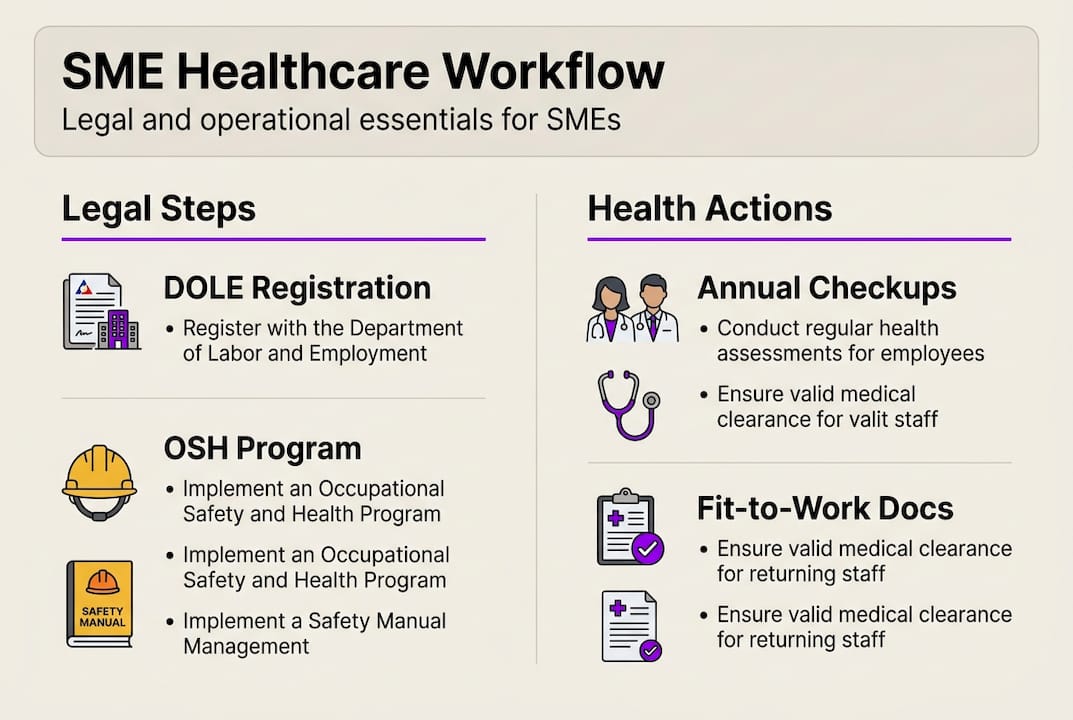
| Requirement | Details | Deadline/Frequency |
|---|---|---|
| DOLE Rule 1020 registration | Register workplace before operations | One-time, update on changes |
| OSH program | Risk assessment, hazard controls, emergency plan | Ongoing |
| Pre-employment health exam | Required for all new hires | Before start date |
| Annual physical exam | Covered employees | Yearly |
| Annual Medical Report | Submit to DOLE | March 31 each year |
| PhilHealth contributions | Monthly remittance | Monthly |
Here is a quick checklist to confirm your foundational setup is complete:
- DOLE workplace registration certificate secured
- OSH program document drafted and signed
- Designated safety officer assigned and trained
- Health exam records stored securely
- Annual Medical Report template ready
- PhilHealth and SSS contribution schedules set up
- HMO partner identified and enrolled
Tracking health trends for SMEs can also help you anticipate regulatory shifts before they catch you off guard.
Preparing your workplace: Tools, partners, and documentation
With the requirements clear, next prepare your workplace with the right partners and documentation.
DOLE DO 252-25 simplifies compliance via clustered OSH services and LGU partnerships, which is genuinely good news for SMEs that cannot afford a full-time occupational health physician on staff. Clustered OSH arrangements let multiple small businesses share the cost of a safety officer or clinic, making compliance more affordable without cutting corners.
Digital HR tools are another game-changer. Platforms that automate leave tracking, health record storage, and contribution remittances eliminate the manual errors that cause most compliance headaches. Explore digital tools for HR to see how automation can free your team from repetitive admin work.

Outsourced OSH services vs. in-house solutions
| Factor | Outsourced OSH | In-house solution |
|---|---|---|
| Cost | Lower fixed cost, shared | Higher fixed cost |
| Compliance expertise | Specialist-level | Depends on staff training |
| Setup time | Faster | Longer |
| Control | Less direct | Full control |
| Scalability | Easy to scale | Requires hiring |
For documentation, these best practices protect your business and your employees:
- Store health records in encrypted digital systems, not paper folders
- Limit access to health data to HR and authorized personnel only
- Keep a clear audit trail for every health-related transaction
- Use standardized forms for risk assessments and incident reports
- Back up records monthly and test your recovery process quarterly
- Align your drug screening workflow with your broader health documentation system
Building an integrated safety and wellness approach from the start saves you from patching gaps later.
Pro Tip: Use a single cloud-based HR platform to house OSH records, leave requests, and health exam results. When DOLE audits come, you can pull everything in minutes instead of scrambling through filing cabinets.
Step-by-step: Handling employee illness, leave, and return-to-work
Once your toolkit is set, here is how to respond when employees report illnesses or require leave.
A clear, written protocol removes guesswork for both HR and employees. Based on standard medical certificate guidance, here is a practical numbered workflow:
- Employee reports illness to their direct supervisor and HR on the first day of absence, via phone, messaging app, or email.
- HR logs the absence in the HR system with the date, reason, and expected return date.
- Medical certificate submission: For absences longer than two to three days, the employee must submit a medical certificate from a licensed physician upon return.
- HR verifies the certificate for completeness: doctor’s name, license number, diagnosis, and recommended rest period.
- Privacy check: All health information is handled under the Data Privacy Act. Only authorized HR personnel access medical details.
- Fit-to-work assessment: After hospitalization, mental health leave, or contagious illness, a fit-to-work certificate from the employee’s doctor is required before they resume duties.
- Benefits coordination: HR cross-checks eligibility for SSS sickness benefits, PhilHealth reimbursements, and HMO coverage, then files claims on the employee’s behalf.
- Return-to-work meeting: A brief check-in with HR or the employee’s manager ensures a smooth reintegration, especially after extended absences.
“All employee health information must be treated as strictly confidential under the Data Privacy Act of 2012. HR teams should only share medical details on a need-to-know basis, and never include diagnoses in general communications or group emails.”
A digital healthcare case study shows how one retail chain cut return-to-work processing time by 40% simply by digitizing this workflow. The biggest wins came from removing paper-based bottlenecks.
Common mistakes to avoid: skipping the medical certificate for absences just under the threshold, failing to require a fit-to-work cert after mental health leave, and not documenting the return-to-work conversation. These gaps seem minor until a labor dispute surfaces.
Pro Tip: For remote employees, allow digital submission of medical certificates via secure email or HR portal. Use a complete employer guide to align your verification steps with industry best practices. Pair this with strong onboarding health benefits communication so employees know the process before they ever need to use it.
Tying it all together: Integrating benefits, compliance, and reporting
After handling individual cases, you will need to keep everything aligned for seamless benefits and compliance.
The real test of a workplace healthcare workflow is not how it handles one sick employee. It is how it holds up across dozens of cases, multiple benefit systems, and an annual reporting cycle. Synchronizing your illness and leave data with SSS, PhilHealth, and your HMO provider is where most SMEs lose efficiency.
Here is how to keep your annual compliance cycle on track:
- January to February: Audit all health records from the previous year. Identify gaps in medical certificates or missing fit-to-work clearances.
- February: Compile the Annual Medical Report using DOLE’s prescribed format. Include data on occupational illnesses, injuries, and health exams conducted.
- March 31: Submit the Annual Medical Report to DOLE. Late submissions attract penalties.
- Monthly: Remit PhilHealth and SSS contributions on time. File SSS sickness benefit claims within the prescribed period after each qualifying absence.
- Ongoing: Update your HMO provider on new hires and separations to keep coverage accurate.
Manual errors cause 60% of compliance failures in SME benefit administration, which is a staggering number when you consider how preventable most of those errors are. Automating contribution remittances and using digital leave tracking cuts that risk significantly.
Review medical reporting best practices to benchmark your process against industry standards. SMEs that invest in streamlined reporting also tend to see better outcomes when maximizing health ROI because they catch coverage gaps early. Regularly measuring health ROI helps you justify the investment to leadership and refine your benefits strategy year over year.
Rethinking SME healthcare workflow: Beyond checkboxes to trust and prevention
With the what and how covered, let us step back to discuss what truly sets healthy organizations apart.
Here is an uncomfortable truth: most SMEs treat healthcare workflow as a compliance exercise. File the report, collect the certificate, check the box. Done. But that mindset leaves enormous value on the table.
Compliance is the baseline. It keeps you out of trouble. What actually differentiates high-performing SMEs is a culture where employees trust that the company genuinely cares about their health, not just their attendance records. That shift from reactive to proactive changes everything. When employees see preventive care in SMEs treated as a priority rather than a budget line, chronic absenteeism drops and loyalty rises. Global wellness research consistently shows that well-run wellness programs improve recruitment and retention, often more than salary increases do. The workflow you build is not just an HR process. It is a signal to every employee about what your organization values.
Upgrade your healthcare workflow with tailored SME solutions
If you are ready to put a streamlined, SME-friendly workflow in place, here is where you can find tools designed just for you.
Building a compliant, efficient healthcare workflow is easier when your HMO partner is built for SMEs from the ground up. Purple Cow, through HMO Plans, offers plans that cover pre-existing conditions, congenital conditions, and special procedures up to the Maximum Benefit Limit, with no complicated exclusion clauses to decode.
Explore the full range of HMO features for SMEs to see how cashless access, digital platforms, and 24/7 coverage can slot directly into the workflow you have just built. Need help coordinating claims or verifying coverage for a returning employee? The member services team is set up to support HR managers at every step, so your workflow runs smoothly even on your busiest days.
Frequently asked questions
What are the minimum legal requirements for SME workplace healthcare workflows in the Philippines?
SMEs must register under Rule 1020, establish an OSH program with risk assessment, provide pre-employment and annual health exams, and submit annual medical reports to DOLE by March 31 each year.
When is a fit-to-work certificate required after employee illness?
A fit-to-work certificate is required after hospitalization, mental health leave, contagious illnesses, or extended absences to confirm the employee can safely return to their role without risk to themselves or colleagues.
How can SMEs streamline handling health benefits and compliance reporting?
SMEs can automate leave tracking and contribution remittances with digital HR tools and integrate SSS and PhilHealth procedures into a single system, directly reducing the manual errors that account for most compliance failures.
What is the deadline for submitting the annual medical report to DOLE?
The annual medical report must be submitted to DOLE by March 31 each year, covering occupational illnesses, injuries, and health examination data from the previous calendar year.
Recommended
- 2025 Health Trends for SMEs in the Philippines: Key Strategies for Smarter Benefits
- Leveraging Digital Tools for HR Efficiency: Streamlining Employee Healthcare Management
- SME Spotlight: How a Retail Chain Improved HR Efficiency with Digital Healthcare
- Onboarding New Employees with Better Health Benefits: A Winning Hiring Strategy for SMEs
- Streamline insurance drug testing workflow for compliance
- Affordable Virtual Care Plans for Employers & Teams | Chameleon
