

How supplemental employee coverage strengthens SME benefits
TL;DR:
- Supplemental HMO plans fill healthcare gaps left by PhilHealth, offering private hospital and outpatient access.
- They work alongside PhilHealth, with HMO covering costs beyond basic government coverage.
- Offering HMO benefits improves employee satisfaction, reduces absenteeism, and supports HR strategies.
Many HR managers and business owners assume that enrolling employees in PhilHealth is enough to cover their health needs. It is not. PhilHealth provides basic coverage, while HMO group plans fill the major gaps that government insurance simply cannot address, from private hospital access to faster outpatient care. This article walks you through what supplemental employee coverage means for SMEs, how it works alongside PhilHealth, the real benefits for your team, and how to decide if it is the right move for your business.
Table of Contents
- What is supplemental employee coverage?
- How supplemental coverage works alongside PhilHealth
- Key benefits and practical scenarios for SMEs
- Is supplemental coverage worth it for your SME?
- Why most SMEs undervalue the real impact of supplemental coverage
- How to get started with the right supplemental coverage
- Frequently asked questions
Key Takeaways
| Point | Details |
|---|---|
| Fills PhilHealth gaps | Supplemental coverage ensures employees get essential health benefits that PhilHealth alone does not provide. |
| Boosts retention | Offering HMO benefits makes it easier for SMEs to attract and keep top talent. |
| Flexible options | Employers can customize plans for full-time, part-time, or dependents to meet staff needs and budgets. |
| Tax and compliance advantages | Employers gain from potential tax exemptions and smoother compliance using de minimis provisions for HMO premiums. |
What is supplemental employee coverage?
Supplemental employee coverage refers to any health benefit an employer provides on top of mandatory government programs like PhilHealth. For SMEs in the Philippines, the most common form is a group HMO plan, which pools employees together under a single contract with a licensed health maintenance organization.
Here is what these plans typically cover:
- Inpatient care: Room and board, surgical fees, and specialist consultations during hospital stays
- Outpatient care: Clinic visits, laboratory tests, and diagnostic procedures without requiring admission
- Emergency care: Accidental injuries, acute illnesses, and emergency room services
- Dependent coverage: Spouses and children can often be added, usually at an additional premium
- Dental and vision add-ons: Optional riders that expand the core HMO benefit
For an overview of HMO coverage and how it applies to SMEs specifically, the structure is straightforward: employers pay a monthly premium per head, and employees gain cashless access to a network of accredited hospitals and clinics.
One important detail: group HMO plans through licensed providers can include dependents, and waiting periods may apply for certain conditions. This means you need to plan enrollment timing carefully, especially for new hires.
Premiums can be fully employer-paid or shared with employees through salary deductions. From a tax standpoint, premiums paid by the employer for rank-and-file employees are generally treated as a business expense, and within certain limits, they qualify as de minimis benefits, which means they are tax-exempt for the employee.
Eligibility is broader than many SME owners realize. Full-time, part-time, and even on-call staff can be covered, as long as an employer-employee relationship exists. You can also check the list of accredited HMO providers to compare networks before committing to a plan.
Pro Tip: Even a small SME with 10 employees can access competitive group HMO rates. The per-head premium often drops significantly when you bundle coverage, making it far more affordable than individual health insurance policies.
How supplemental coverage works alongside PhilHealth
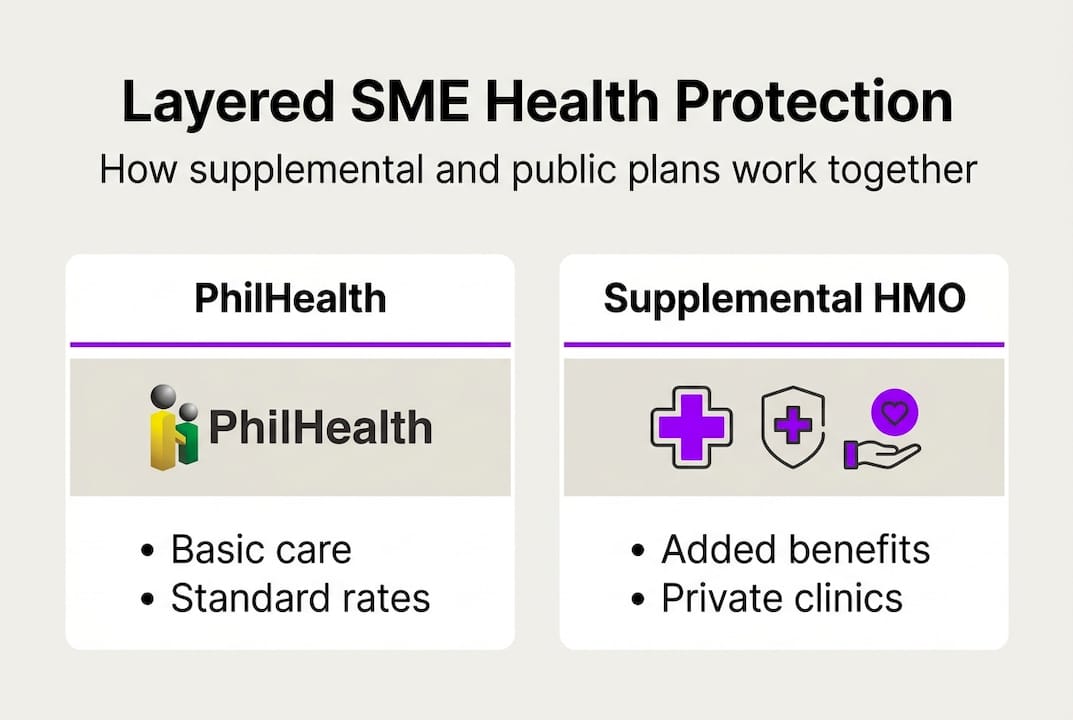
Understanding how PhilHealth and HMO coverage interact is key to getting the most value from both. Think of them as two layers of protection, not two competing programs.
PhilHealth is mandatory and covers basic inpatient and outpatient services through its case-rate system. In 2026, the contribution rate is 5% of the monthly basic salary, split equally between employer and employee. It works well for government hospitals and accredited facilities, but PhilHealth covers basic services while HMO plans fill the gaps, especially for private hospitals and non-emergency services where out-of-pocket costs can be steep.
| Feature | PhilHealth | HMO group plan |
|---|---|---|
| Coverage type | Case-rate, basic services | Comprehensive, cashless |
| Hospital access | Government and accredited | Private and accredited network |
| Outpatient services | Limited | Broad, including clinics |
| Emergency care | Partial | Full, up to MBL |
| Dependent coverage | Yes, limited | Yes, with add-ons |
| Premium source | Employee and employer | Employer-paid or shared |
For a deeper look at the integration of PhilHealth and HMO benefits, the coordination process follows a clear order. Here is how a typical claim works:
- Employee seeks care at an accredited hospital or clinic
- PhilHealth is applied first as the primary payer, covering its case-rate portion
- The HMO plan absorbs the remaining balance up to the Maximum Benefit Limit
- If costs exceed the MBL, the employee pays the difference out of pocket
- For non-network care, the employee pays upfront and submits a reimbursement claim
This layered approach is especially critical for private hospital admissions, specialist referrals, and diagnostic procedures that PhilHealth either covers partially or excludes entirely. The PhilHealth vs HMO comparison makes it clear: PhilHealth handles the baseline, and your HMO plan handles the reality of what healthcare actually costs in the private sector.
Key benefits and practical scenarios for SMEs
Beyond the mechanics, supplemental coverage has real, day-to-day implications for how you run your business and support your team.

Tax treatment matters. For rank-and-file employees, HMO premiums paid by the employer are generally considered de minimis benefits and are exempt from income tax up to the allowed threshold. For managerial or supervisory employees, the same premiums may be classified as fringe benefits and subject to the fringe benefit tax, which the employer pays. Getting this right from the start saves you from compliance headaches later.
Dependent coverage is one of the most valued aspects of any group plan. Dependent coverage, salary deductions, and end-of-employment rules all affect how benefits are administered in practice. Spouses and children up to a certain age are typically eligible, and the additional premium is often deducted directly from the employee’s salary with their written consent.
Here is a quick look at typical HMO benefit tiers for SMEs:
| Benefit | Basic plan | Mid-tier plan | Premium plan |
|---|---|---|---|
| Annual MBL | PHP 100,000 | PHP 200,000 | PHP 500,000 |
| Room and board | PHP 800/day | PHP 1,500/day | PHP 2,500/day |
| Outpatient limit | PHP 5,000 | PHP 10,000 | PHP 20,000 |
| Dental add-on | Optional | Optional | Included |
For part-time and on-call staff, coverage is possible as long as the employment relationship is documented. This matters for industries like hospitality and retail where flexible staffing is common.
What about when an employee leaves? Coverage ends on the date of resignation or termination. If premiums were paid in advance, the unused portion may be deducted from the employee’s final pay. Planning for this in your HR processes avoids disputes.
- Review smart SME health benefit strategies when designing your benefits package
- Consider complex coverage options for employees with specialized medical needs
Pro Tip: Include a clear benefits summary in your employee onboarding kit. Employees who understand their HMO coverage from day one use it more effectively and report higher satisfaction with their benefits package.
Is supplemental coverage worth it for your SME?
This is the honest question most SME owners eventually ask. The short answer: yes, but context matters.
“PhilHealth is sufficient for catastrophic cases but not routine or fast-access care. HMO is more convenient but adds cost.” This tension is real, and your decision should reflect your workforce’s actual needs, not just the minimum legal requirement.
From a retention standpoint, health benefits consistently rank among the top reasons employees stay or leave a company. Offering an HMO plan signals that you value your team beyond their output. That matters more in a tight labor market.
The non-diminution principle is a legal risk worth understanding. Once you offer supplemental coverage as a standard benefit, removing it later can be considered a violation of employee rights under Philippine labor law. This is not a reason to avoid offering it, but it is a reason to plan carefully before you commit.
Here is a checklist to help you decide:
- Do your employees frequently request advances or loans for medical expenses?
- Are you losing candidates to competitors who offer HMO coverage?
- Is your current PhilHealth-only setup causing absenteeism due to delayed care?
- Do you have employees with dependents who need broader coverage?
- Can your business absorb a modest per-head monthly premium?
If you answered yes to two or more of these, the case for supplemental coverage is strong. You can also explore ways to maximize health ROI so the investment works harder for your business.
Why most SMEs undervalue the real impact of supplemental coverage
Most SMEs approach health benefits as a compliance checkbox or a cost line item. That framing misses the bigger picture entirely.
The real return on supplemental coverage is not in the claims paid. It is in the hours not lost to untreated illness, the hiring conversations that close faster because of a strong benefits package, and the HR time saved when employees are not scrambling to find a way to pay for a hospital visit.
We have seen businesses in the tech and hospitality sectors cut their average sick days significantly after introducing group HMO plans, simply because employees could access a clinic without worrying about the bill. That is a productivity gain that never shows up in a benefits cost analysis but is very real.
The other undervalued factor is onboarding. When you take the time to explain how the HMO plan works during employee orientation, utilization goes up and employee satisfaction scores follow. Coverage that is not understood is coverage that does not deliver value. Investing in maximizing your health ROI starts with making sure your team actually knows what they have.
How to get started with the right supplemental coverage
You have done the research. Now it is time to act on it.
Finding the right plan does not have to be complicated. At HMO Plans, we work specifically with SMEs in the Philippines to build group health coverage that fits your headcount, your budget, and your team’s actual needs. From cashless access to the Big 9 Hospitals to 100% coverage for pre-existing conditions up to the MBL, our plans are designed to remove the guesswork. Explore best HMO plans for SMEs or review the full list of HMO plan features to find the right fit for your business. Getting a quote takes minutes, and your team deserves coverage that actually works.
Frequently asked questions
Is supplemental employee coverage mandatory for SMEs in the Philippines?
No, supplemental HMO coverage is not legally required, but removing it once it has been granted as a standard benefit may violate non-diminution rules under Philippine labor law.
Can part-time and on-call employees be covered by HMO group plans?
Yes. On-call and part-time staff are eligible for group HMO coverage as long as a documented employer-employee relationship exists.
What happens to HMO benefits when an employee resigns?
Termination ends HMO coverage on the separation date, and any advanced premiums that were paid on the employee’s behalf may be deducted from their final pay.
Is HMO coverage for dependents a taxable benefit?
HMO premiums for rank-and-file employees are often tax-exempt as de minimis benefits, while the same coverage for managerial employees may be subject to fringe benefit tax paid by the employer.
Recommended
- Onboarding New Employees with Better Health Benefits: A Winning Hiring Strategy for SMEs
- Health Coverage for SMEs in the Food & Beverage Industry
- The Better HMO Plans for SMEs | Purple Cow | Home | Rai dela Cruz | Best HMO Plans Philippines - Purple Cow
- SME Year-End Health Benefits Check-Up: Ensuring Coverage & Readiness for 2025
- Formation secourisme : 8 avantages clés pour votre PME
