

Your guide to supplemental health benefits for Filipino SMEs
TL;DR:
- PhilHealth offers basic coverage but leaves employees exposed to significant out-of-pocket costs.
- Supplemental benefits like HMO plans and insurance fill coverage gaps efficiently and improve employee retention.
- Coordinating PhilHealth with supplemental plans and educating staff maximizes healthcare investment value.
Many SME owners in the Philippines assume their PhilHealth obligation is enough to keep employees protected. It isn’t. While PhilHealth provides mandatory basic coverage that every employer must honor, its fixed case rates, session caps, and structural gaps leave employees exposed to real out-of-pocket costs. The result: medical emergencies become financial emergencies, morale drops, and your best people start looking elsewhere. This guide breaks down what PhilHealth actually covers, which supplemental options make the most sense for cost-conscious SMEs, and how to build a benefits package that retains talent without breaking your budget.
Table of Contents
- Understanding basic PhilHealth coverage for SMEs
- Comparing supplemental health benefit options for SMEs
- Coordinating PhilHealth and supplemental benefits: How to maximize value
- Building a cost-effective benefits package: Strategies for Philippine SMEs
- What most SMEs miss about supplemental health benefits
- How to get started with better SME health benefits
- Frequently asked questions
Key Takeaways
| Point | Details |
|---|---|
| PhilHealth is limited | PhilHealth provides only baseline coverage and leaves significant gaps for many employee needs. |
| Group HMO offers value | Group HMOs and private insurance plans are more affordable for SMEs due to lower per-employee premiums. |
| Coordination prevents gaps | Using PhilHealth as primary and supplemental insurance as secondary ensures better employee protection and cost control. |
| Tax perks for SMEs | Premiums for employee HMO packages are deductible, making improved coverage cost-effective for businesses. |
| Benefit packages aid retention | A robust health benefits program helps SMEs compete for and retain top talent in the Philippine market. |
Understanding basic PhilHealth coverage for SMEs
PhilHealth is not optional. Every employer in the Philippines must enroll employees and remit contributions on their behalf. But understanding what you are actually paying for, and what it does not cover, is where most SME owners fall short.
The PhilHealth contribution rate sits at 5% of an employee’s monthly basic salary, split evenly between employer and employee. That means each side pays 2.5%. The salary base is bounded between PHP 10,000 and PHP 100,000 per month, so the maximum combined monthly contribution per employee is PHP 5,000.
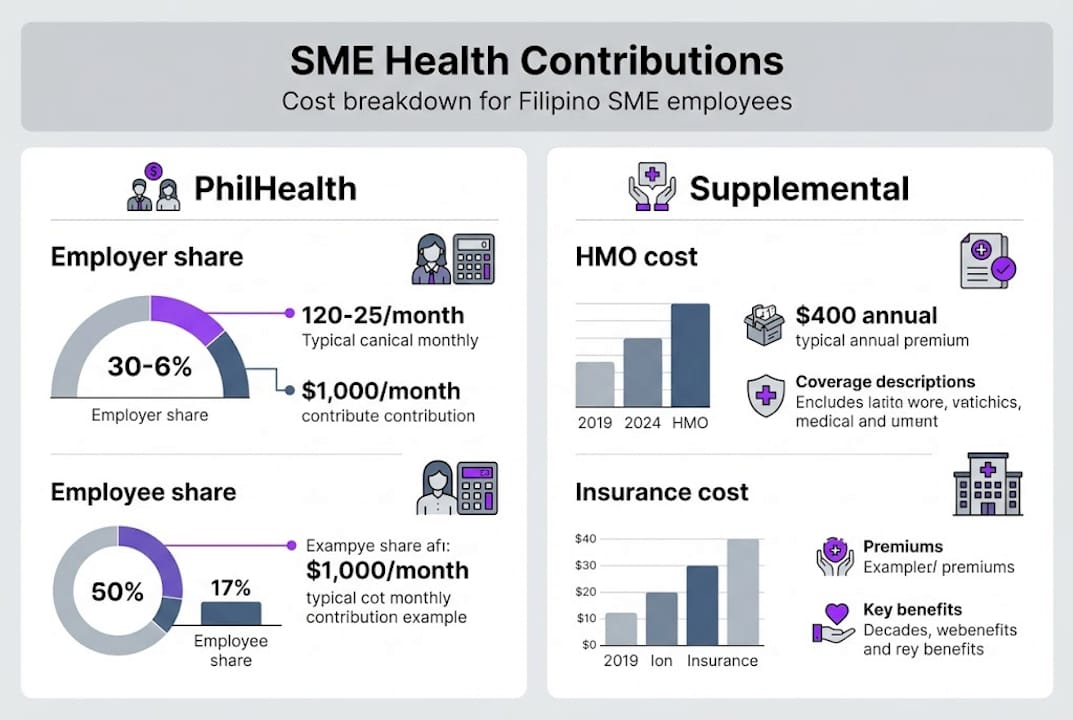
| Salary base | Total monthly contribution | Employer share | Employee share |
|---|---|---|---|
| PHP 10,000 | PHP 500 | PHP 250 | PHP 250 |
| PHP 50,000 | PHP 2,500 | PHP 1,250 | PHP 1,250 |
| PHP 100,000 (ceiling) | PHP 5,000 | PHP 2,500 | PHP 2,500 |
What does this buy your employees? PhilHealth covers inpatient care, outpatient consultations, select surgical procedures, maternity benefits, and diagnostic tests for specific conditions. It also includes Z-Benefit packages for catastrophic illnesses like leukemia and breast cancer.
Here is the problem. PhilHealth pays through fixed case rates, not actual hospital bills. If an employee is hospitalized for a week with a severe infection, the hospital receives a fixed payment from PhilHealth regardless of what the actual charges are. The balance, sometimes tens of thousands of pesos, falls on the patient. This is called balance billing.
Other common gaps include:
- No dental or vision coverage of any kind
- Session caps on rehabilitation and dialysis that leave chronic illness patients underserved
- No coverage for cosmetic procedures, ordinary outpatient consultations beyond select cases, and non-accredited facilities
- No allowance for non-medical expenses like transportation or companion accommodation
“PhilHealth is a foundation, not a ceiling. Employees who rely on it alone are one serious illness away from a financial crisis that affects their productivity and loyalty.”
For PhilHealth compliance guidance specific to SMEs, knowing the contribution schedule is just the start. Pairing it with HMO coordination strategies is where real protection begins.
Comparing supplemental health benefit options for SMEs
Now that the limitations of PhilHealth alone are clear, let’s examine the key supplemental health benefit options SMEs use to fill those gaps.
The three most common options are private HMO plans, group health insurance, and wellness or mental health programs. Each serves a different purpose, and the smartest SMEs layer them strategically.

| Benefit type | What it covers | Best for | Average cost range |
|---|---|---|---|
| Group HMO plan | Hospitalization, clinic visits, ER, Rx | Primary supplement | PHP 3,000–8,000/year per employee |
| Group life/health insurance | Lump-sum payouts, critical illness | Financial protection | PHP 2,000–5,000/year per employee |
| Dental or vision add-ons | Dental procedures, eyewear, eye exams | Holistic wellness | PHP 1,500–3,500/year per employee |
| Wellness/mental health programs | EAP, stress counseling, gym subsidies | Culture and morale | PHP 500–2,000/year per employee |
Group HMO plans are typically the most cost-effective per employee because underwriters spread risk across the group. This means a 20-person company can access rates that would be out of reach for an individual policyholder. Most HMOs also offer cashless access at accredited clinics and hospitals, which eliminates the stressful upfront payment most employees dread.
Here is a practical sequence most successful SMEs follow:
- Start with a group HMO plan to address hospitalization and outpatient gaps left by PhilHealth
- Add dental coverage once the primary HMO is in place, since dental issues are one of the most frequent employee complaints
- Layer in wellness programs as the team grows and culture becomes a recruitment priority
- Consider group life or critical illness insurance for senior roles or as a retention incentive
Pro Tip: Even adding PHP 3,000–5,000 per employee per year in HMO coverage can reduce absenteeism and increase perceived compensation value significantly. Employees consistently rank health benefits among the top three reasons they stay with an employer.
For a closer look at HMO options for SMEs in the Philippine market, or to explore a feature comparison of HMO plans, there are structured resources that can help you match plan depth to your actual headcount and budget.
Coordinating PhilHealth and supplemental benefits: How to maximize value
After choosing a supplemental benefit, maximizing your investment requires smart coordination with PhilHealth.
The key principle is simple: PhilHealth pays first. Your HMO or private insurer covers whatever PhilHealth does not. This is called the coordination of benefits, and when done correctly, it can dramatically reduce what your employees pay out of pocket without duplicating premiums.
Here is what that looks like in practice. An employee is admitted for appendectomy surgery. PhilHealth releases a fixed case rate payment directly to the hospital. The HMO then covers the remaining balance up to its own benefit limit. The employee may pay little to nothing if both plans are used properly.
But coordination mistakes are common. The most frequent ones HR teams make:
- Skipping accreditation checks: Both the hospital and the attending physician must be PhilHealth-accredited, or the claim is denied
- Missing pre-authorization: Most HMOs require advance approval for elective admissions. Missing this step leads to denied supplemental claims
- Ignoring session caps: PhilHealth limits dialysis and rehab sessions. Employees with chronic conditions hit these limits fast, and an HMO without add-on coverage leaves them stranded
- Failing to submit coordination letters: Some hospitals require a formal letter confirming HMO coverage to process the supplemental claim on discharge
For coordinating PhilHealth with HMO coverage effectively, documentation is everything. Maintain a clear internal checklist for HR staff. For ideas on maximizing health ROI across your workforce, a structured approach prevents costly reimbursement gaps.
Pro Tip: Run a short annual orientation for employees on how to use both their PhilHealth and HMO benefits together. Employees who understand the process make fewer errors, file cleaner claims, and report higher satisfaction with their benefits package.
Building a cost-effective benefits package: Strategies for Philippine SMEs
With the right coordination in place, you can now build a benefits package tailored to your budget and workforce. Here is a five-step framework to guide you.
- Assess your workforce’s actual health needs. Survey employees or review sick leave data to identify the most common medical concerns. This tells you whether hospitalization coverage, dental, or mental health support should be your first investment.
- Compare group plan options. Request quotes from at least two or three HMO providers. Group HMO premiums are tax-deductible as business expenses in the Philippines, which lowers your effective cost. Factor this into your budget calculation.
- Get group quotes based on headcount. Even small teams of 10–15 employees qualify for group rates. The more employees you enroll, the lower the per-head premium. Some providers have minimum enrollment thresholds, so confirm this before comparing.
- Check tax deductibility and compliance requirements. HMO premiums paid on behalf of employees are deductible under the National Internal Revenue Code. Confirm this with your accountant to maximize tax efficiency.
- Educate your staff. A benefits package that employees do not understand is a benefits package they do not value. Create a simple one-page reference guide showing what is covered, how to file claims, and who to contact.
For smart 2026 SME benefits strategies that account for current market conditions, staying updated on shifting contribution rates and coverage norms is essential. If you are just starting out, explore affordable HMO plans designed specifically for small teams.
Pro Tip: Start with a core HMO plan at the lowest viable benefit limit, then upgrade annually as your revenue grows. Locking in a group contract early also protects you from premium inflation as your team scales.
What most SMEs miss about supplemental health benefits
Stepping back, there is a bigger lesson most SME owners in the Philippines overlook when it comes to health benefits. They treat coverage as a compliance checkbox, not a competitive tool. That framing is expensive in ways that never show up on a premium invoice.
High employee turnover costs an SME roughly six to nine months of a departing employee’s salary when you factor in recruiting, onboarding, and lost productivity. Bare-minimum health coverage is one of the most cited reasons employees leave. SMEs that integrate PhilHealth and supplemental insurance into a coherent employer brand see measurably better retention, especially in industries where talent competition is fierce.
The smartest SME owners we have seen build benefits packages that grow with the company. They start lean, document everything, and position health benefits as a genuine differentiator in job offers. When you present a role with clear HMO coverage plus PhilHealth alongside a role with PhilHealth only, the decision is rarely close for top candidates.
Health benefits are not just a cost center. They are a long-term ROI driver when managed with intention. The SMEs that recognize this early tend to grow faster, retain stronger teams, and spend far less fixing the problems that come from underinsured employees.
How to get started with better SME health benefits
Ready to put these insights into action? Here is where you can start building a benefits plan that works for your SME.
At HMO Plans, we work specifically with SMEs across the Philippines to design group health coverage that goes beyond the basics. Our plans, underwritten by Etiqa through Purple Cow, offer 100% coverage for pre-existing conditions up to the Maximum Benefit Limit, cashless access to the Big 9 Hospitals and Healthway Clinics, and flexible add-ons including dental, annual physical exams, and life and accident insurance. Whether you are a 10-person tech startup or a 200-person hospitality group, we can build a plan that fits your team and your budget. Explore affordable HMO plans for SMEs or review our HMO features and providers to take the first step today.
Frequently asked questions
Who pays for PhilHealth contributions for SME employees?
PhilHealth contributions are split evenly, with SMEs and employees each paying 50% of the required 5% salary rate, based on a monthly salary floor of PHP 10,000 and a ceiling of PHP 100,000. The employer-employee split is mandatory for all registered businesses.
What types of supplemental health benefits are most cost-effective for SMEs?
Group HMO plans and private health insurance are usually the most cost-effective, offering lower premiums per employee and tax-deductible advantages that reduce net business costs significantly.
How should SMEs coordinate PhilHealth and supplemental insurance claims?
PhilHealth should be the primary payer for medical claims, with supplemental insurance covering remaining costs. Always confirm provider accreditation and benefit limits before admission to avoid denied claims.
Are SME supplemental health benefits tax-deductible?
Yes. Premiums paid for employee HMOs or group health insurance are tax-deductible business expenses under Philippine tax law, making them more affordable than their sticker price suggests.
Can MSMEs avail of any special government incentives for providing supplemental health benefits?
MSMEs are encouraged to provide supplemental coverage and may benefit from DOLE grace periods for enrollment, but there are currently no rate exemptions or significant contribution discounts for small employers.
Recommended
- 2025 Health Trends for SMEs in the Philippines: Key Strategies for Smarter Benefits
- PhilHealth Updates & Compliance in 2025: A Guide for SMEs in the Philippines
- Beyond PhilHealth: How SMEs Can Maximize Health Investments for Better ROI
- The Better HMO Plans for SMEs | Purple Cow | Blog | Rai dela Cruz | Best HMO Plans Philippines - Purple Cow
- 5 digital health management benefits for your family | MedFiles.ai
