

Understanding PhilHealth independence: A guide for SMEs 2026
Many SME owners mistakenly believe PhilHealth operates like a typical government agency with rigid bureaucracy and slow response times. In reality, PhilHealth’s independence enables it to operate autonomously in service delivery and governance, offering flexibility that directly impacts your business healthcare planning. Understanding this operational structure helps you make smarter decisions about employee benefits, optimize healthcare spending, and combine coverage options effectively. This guide breaks down what PhilHealth independence means for your SME in 2026 and how to leverage it for maximum value.
Table of Contents
- What Is PhilHealth Independence And Why It Matters To SMEs
- How PhilHealth Independence Affects Healthcare Providers And Member Services
- Practical Benefits Of PhilHealth Independence For SMEs And Ways To Optimize Healthcare Spend
- Discover Better Healthcare Solutions For Your SME Today
- Frequently Asked Questions About PhilHealth Independence For SMEs
Key takeaways
| Point | Details |
|---|---|
| Operational autonomy | PhilHealth manages funds, policies, and provider accreditation independently from direct government control |
| Service efficiency | Independent governance enables faster claims processing and more responsive member services for SME employees |
| Strategic flexibility | Understanding PhilHealth’s structure helps SMEs combine public and private coverage for optimal healthcare ROI |
| Provider standards | Autonomous accreditation ensures healthcare facilities meet consistent quality benchmarks nationwide |
| Policy adaptability | Independent operations allow PhilHealth to adjust programs more quickly to address emerging healthcare needs |
What is PhilHealth independence and why it matters to SMEs
PhilHealth operates as a government-owned and controlled corporation, but this legal structure grants significant operational independence. Unlike typical government departments that answer directly to cabinet secretaries, PhilHealth maintains autonomous decision-making authority over its internal operations, fund management, and policy implementation. This independence stems from Republic Act 7875, which established PhilHealth as a corporate entity with its own governing board.
This operational freedom translates into practical advantages for SME owners and their employees. PhilHealth can adjust benefit packages, update accreditation standards, and modernize claims systems without navigating layers of bureaucratic approval. The organization manages approximately 95% of the Philippine population’s health insurance, making its efficiency crucial for businesses nationwide.
For SME decision-makers, understanding this independence helps you anticipate how PhilHealth compliance requirements might evolve. When PhilHealth updates coverage policies or contribution rates, these changes reflect independent board decisions based on actuarial data rather than political cycles. This creates more predictable planning horizons for your employee benefits budget.
The independence also affects your relationship with healthcare providers. PhilHealth independently accredits hospitals and clinics, establishing quality standards and monitoring compliance. When you guide employees toward accredited facilities, you’re leveraging PhilHealth’s autonomous quality assurance system. This matters because accredited providers follow standardized billing practices and claims procedures, reducing administrative headaches for your HR team.
Key aspects of PhilHealth independence include:
- Autonomous fund management allowing PhilHealth to invest reserves and manage cash flow independently
- Self-directed policy development enabling rapid response to healthcare trends and member needs
- Independent accreditation authority ensuring provider quality without external political interference
- Direct claims processing systems that bypass traditional government procurement and payment delays
- Member service protocols designed by healthcare professionals rather than generic government service standards
This structure positions PhilHealth as a hybrid entity combining public mandate with private sector operational efficiency. For your SME, this means maximizing PhilHealth and HMO coverage together creates a robust healthcare safety net. You’re not dealing with a slow-moving government bureaucracy but rather a specialized health insurance corporation that can adapt to market conditions.
How PhilHealth independence affects healthcare providers and member services
PhilHealth’s autonomous governance structure directly shapes how healthcare providers deliver services to your employees. The organization independently establishes accreditation criteria, conducts facility inspections, and monitors compliance without requiring approval from other government agencies. This autonomous governance allows it to accredit and monitor providers independently, improving service quality across the network.
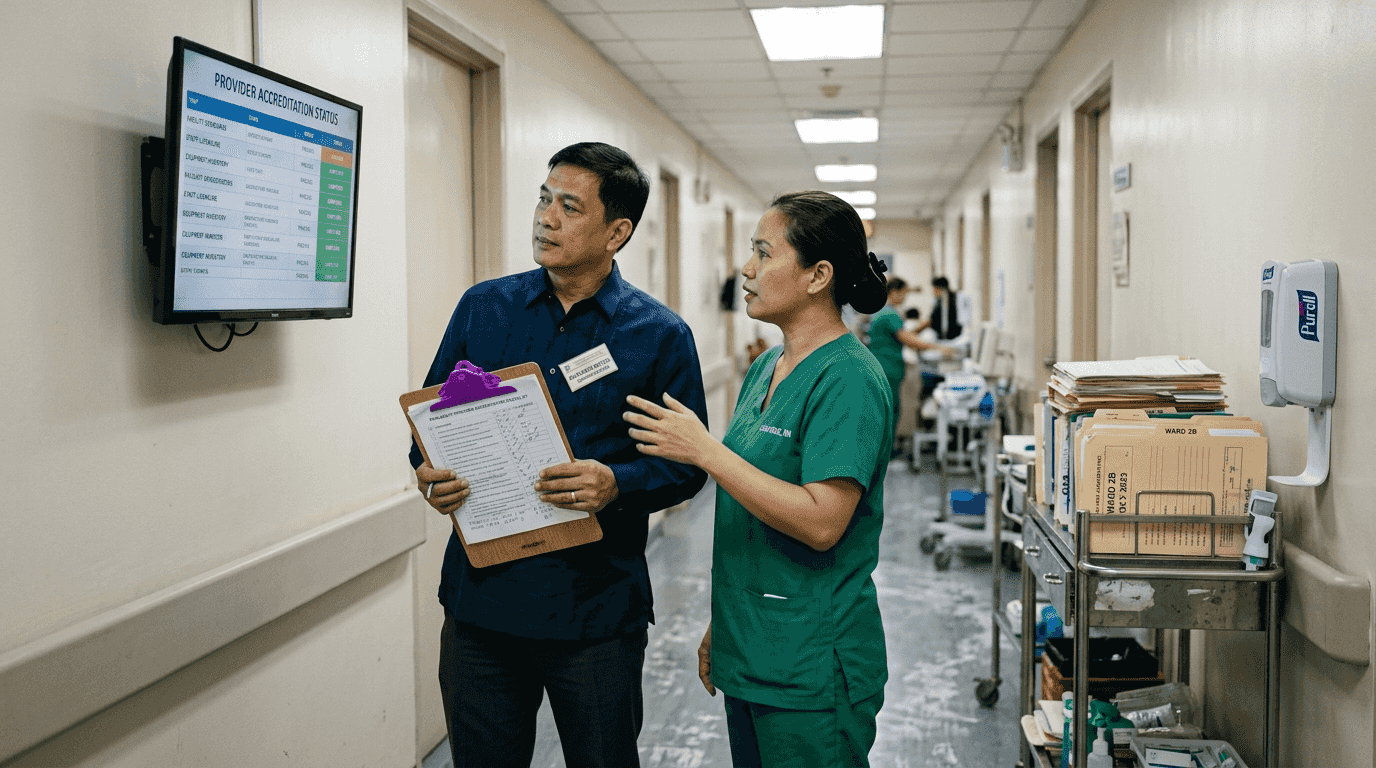
When a hospital or clinic seeks PhilHealth accreditation, it must meet specific infrastructure, staffing, and quality standards. PhilHealth evaluators assess facilities based on medical equipment availability, professional credentials of staff, infection control protocols, and patient safety measures. This independent evaluation process ensures consistent standards whether your employee visits a facility in Metro Manila or a provincial hospital.
The accreditation system creates a two-tier healthcare landscape that affects your employees’ out-of-pocket costs:
| Provider Type | PhilHealth Coverage | Employee Cost | Claims Processing |
|---|---|---|---|
| PhilHealth Accredited | Full benefit package coverage | Minimal to zero balance billing | Direct facility billing, faster settlement |
| Non-Accredited | Reimbursement basis only | Higher upfront payment required | Employee files claim, longer processing time |
| Out-of-Network | Limited or no coverage | Full payment at point of service | May require extensive documentation |
Claims processing efficiency represents another major impact of PhilHealth independence. The organization operates its own information technology systems, separate from general government IT infrastructure. This allows PhilHealth to implement electronic claims submission, real-time eligibility verification, and automated payment processing. For your employees, this means shorter wait times for claim approvals and faster reimbursements when applicable.
Member services follow protocols designed specifically for healthcare needs rather than generic government service standards. PhilHealth maintains dedicated hotlines, online portals, and local offices staffed by specialists who understand medical terminology and insurance concepts. When your HR team needs to verify employee coverage or resolve contribution issues, they interact with professionals trained in health insurance rather than general administrative staff.
The independent structure also enables PhilHealth to partner with accredited providers for specialized programs. These partnerships create streamlined pathways for specific treatments, reducing administrative barriers your employees might face. For example, PhilHealth’s dialysis and cancer treatment programs involve direct coordination with specialized facilities, eliminating multiple approval steps.
Pro Tip: Maintain an updated list of PhilHealth accredited facilities near your office and employees’ residential areas. Share this resource during onboarding to help new hires understand where they can maximize their benefits with minimal out-of-pocket expenses.
Understanding these operational realities helps you set accurate expectations with your team. When employees know the difference between accredited and non-accredited providers, they make cost-effective healthcare decisions. This knowledge becomes especially valuable when you’re maximizing health investments by layering private HMO coverage over PhilHealth benefits.
Practical benefits of PhilHealth independence for SMEs and ways to optimize healthcare spend
PhilHealth’s operational independence delivers concrete advantages that SME owners can leverage for smarter healthcare planning. The autonomous structure means you’re working with an organization that responds to healthcare market realities rather than political pressures. This creates opportunities to optimize your employee benefits strategy while controlling costs.
The predictability of PhilHealth’s independent operations helps you budget more accurately. Contribution rates and benefit packages change based on actuarial analysis rather than arbitrary political decisions. While rates may increase to reflect healthcare inflation, these adjustments follow transparent formulas tied to economic indicators. This allows you to forecast healthcare costs with reasonable confidence when planning annual budgets.
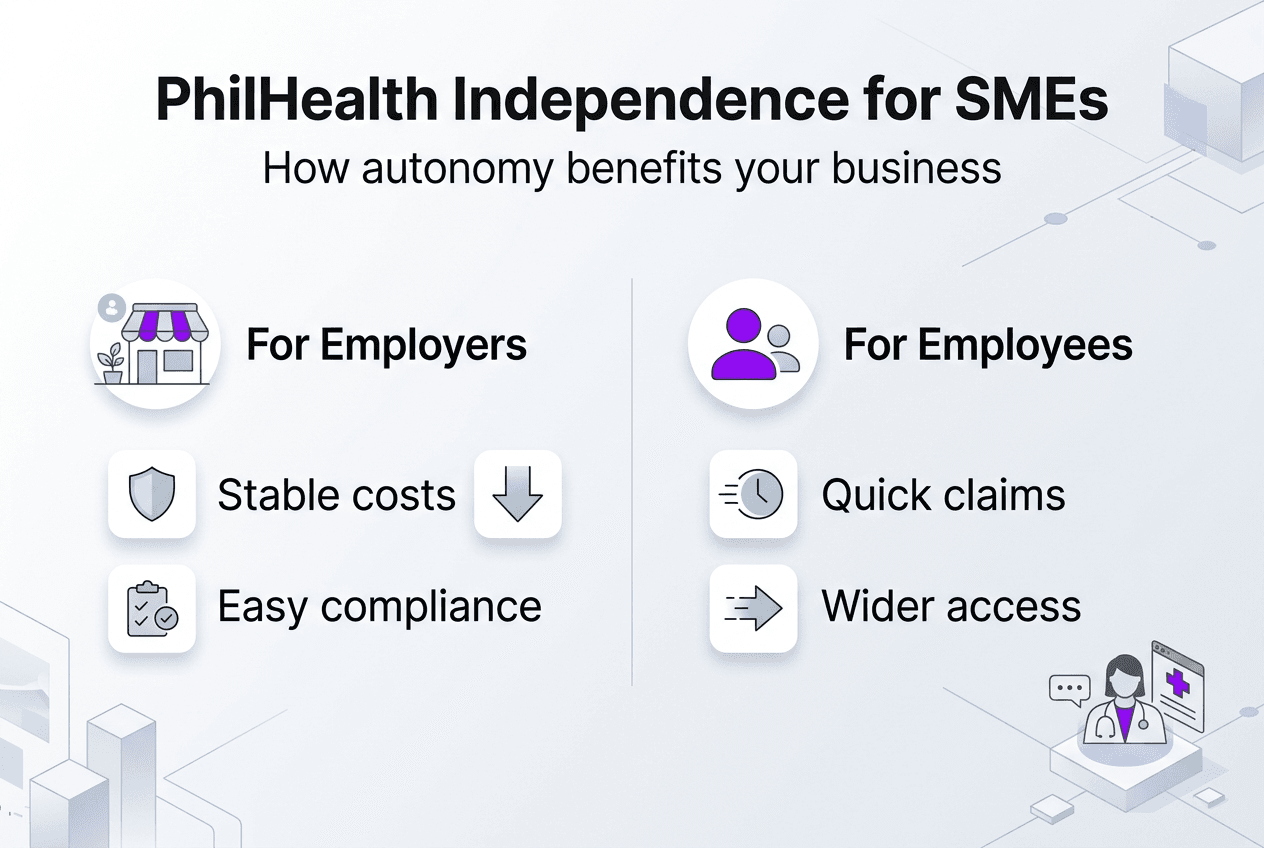
Combining PhilHealth with private HMO coverage creates a powerful healthcare safety net for your employees. PhilHealth provides baseline coverage for major medical events, while HMO plans fill gaps in outpatient care, preventive services, and access to premier facilities. Leveraging PhilHealth’s independent operations with complementary private HMOs allows SMEs to maximize healthcare ROI by avoiding redundant coverage while ensuring comprehensive protection.
Here’s a strategic approach to optimize your SME’s healthcare spend using PhilHealth independence:
- Audit your current PhilHealth compliance to ensure all employees are properly enrolled and contributions are current, establishing your baseline coverage.
- Identify coverage gaps where PhilHealth benefits end, particularly for outpatient consultations, diagnostic tests, and preventive care your team actually uses.
- Evaluate private HMO options that complement rather than duplicate PhilHealth coverage, focusing on benefits that address your specific workforce needs.
- Calculate the combined cost of PhilHealth contributions plus HMO premiums against potential out-of-pocket expenses employees would face with PhilHealth alone.
- Implement a communication strategy helping employees understand how to use both benefits effectively, maximizing value from each coverage layer.
- Review PhilHealth policy updates quarterly to adjust your complementary HMO coverage as PhilHealth benefits expand or contract.
The independent nature of PhilHealth’s provider network offers another strategic advantage. Because PhilHealth accredits facilities nationwide using consistent standards, your employees enjoy relatively uniform coverage quality regardless of location. This matters for SMEs with distributed teams or employees who travel for work. An employee needing emergency care in Cebu receives similar PhilHealth coverage as one in Manila, reducing the complexity of managing multi-location healthcare benefits.
PhilHealth’s autonomous claims processing also reduces administrative burden on your HR team. Electronic systems allow employees to verify coverage status online, check contribution history, and track claims without requiring HR intervention for routine inquiries. This self-service capability frees your team to focus on strategic benefits management rather than administrative tasks.
Pro Tip: Schedule an annual benefits review meeting where you share PhilHealth coverage updates alongside your HMO plan features. This helps employees understand their complete healthcare protection and encourages preventive care utilization, potentially reducing costly emergency treatments later.
The flexibility to customize your benefits package around PhilHealth’s stable foundation creates competitive advantage in talent acquisition. Candidates increasingly evaluate total compensation including healthcare benefits. When you can articulate a comprehensive strategy combining PhilHealth’s broad coverage with targeted HMO enhancements, you demonstrate sophisticated benefits planning that appeals to quality candidates.
Explore HMO plan features designed specifically to complement PhilHealth coverage. Look for options offering seamless coordination of benefits, where the HMO automatically covers amounts beyond PhilHealth limits without requiring employees to file separate claims. This integration simplifies the employee experience while ensuring maximum coverage.
Understanding PhilHealth and HMO optimization strategies positions your SME to deliver exceptional healthcare benefits without exceeding budget constraints. The key lies in recognizing PhilHealth’s role as a foundation rather than a complete solution, then strategically adding private coverage where it delivers the highest value for your specific workforce demographics and healthcare utilization patterns.
Discover better healthcare solutions for your SME today
Now that you understand how PhilHealth independence creates opportunities for smarter healthcare planning, consider how Purple Cow’s specialized HMO plans enhance your employee benefits strategy. Our SME-focused coverage seamlessly complements PhilHealth benefits, filling critical gaps in outpatient care, specialist access, and preventive services.
Purple Cow offers 100% coverage for pre-existing conditions, congenital conditions, and special procedures up to your Maximum Benefit Limit, eliminating the coverage uncertainties that often frustrate employees. Access premier facilities including the Big 9 Hospitals and Healthway Clinics, with flexible add-ons for dental care, annual physical exams, and life insurance. Our straightforward terms and digital platforms make benefits administration effortless for your HR team.
Explore our comprehensive plan features designed specifically for Philippine SMEs, or connect with our member services team to discuss customized solutions matching your workforce needs. Visit hmoplans.ph to discover how combining PhilHealth with Purple Cow coverage creates exceptional healthcare value for your employees while optimizing your benefits investment.
Frequently asked questions about PhilHealth independence for SMEs
What makes PhilHealth operationally independent from other government agencies?
PhilHealth operates as a government-owned and controlled corporation with its own governing board, giving it autonomy over fund management, policy development, and provider accreditation. This corporate structure allows PhilHealth to make operational decisions without requiring approval from cabinet departments or other government entities, enabling faster response to healthcare needs and more efficient service delivery.
How does PhilHealth independence improve claim processing for SME employees?
Independent IT systems and streamlined protocols allow PhilHealth to process claims faster than traditional government payment mechanisms. Electronic claims submission, real-time eligibility verification, and automated approvals reduce processing times significantly. Employees at accredited facilities often experience direct billing with minimal paperwork, while reimbursement claims are handled through dedicated healthcare-focused staff rather than general government administrators.
Can SMEs combine PhilHealth coverage with private HMO plans effectively?
Absolutely. PhilHealth provides baseline coverage for major medical events, while private HMOs fill gaps in outpatient care, preventive services, and access to premier facilities. This layered approach maximizes healthcare value by avoiding redundant coverage while ensuring comprehensive protection. Review PhilHealth updates and compliance requirements to understand how benefits coordinate for optimal employee protection.
What should SMEs know about PhilHealth accredited versus non-accredited providers?
Accredited providers offer direct PhilHealth billing with full benefit package coverage and minimal employee out-of-pocket costs. Non-accredited facilities require employees to pay upfront and file reimbursement claims later, often with limited coverage amounts. Steering employees toward accredited providers reduces their financial burden and simplifies claims administration for your HR team.
How often does PhilHealth update its policies due to operational independence?
PhilHealth typically reviews benefit packages and contribution rates annually based on actuarial analysis and healthcare cost trends. The independent board can implement changes more quickly than traditional government programs when responding to emerging healthcare needs. SMEs should monitor quarterly updates to adjust complementary benefits and maintain optimal coverage coordination.
What steps ensure PhilHealth compliance for SMEs in 2026?
Maintain accurate employee enrollment records, remit contributions by the 10th of each month, and verify coverage status regularly through PhilHealth’s online portal. Keep documentation of contribution payments and employee enrollment forms for audit purposes. Stay informed about policy changes through official PhilHealth channels and adjust your benefits communication to help employees maximize their coverage effectively.
Recommended
- PhilHealth Updates & Compliance in 2025: A Guide for SMEs in the Philippines
- Beyond PhilHealth: How SMEs Can Maximize Health Investments for Better ROI
- PhilHealth + HMO: Maximizing Your SME’s Health Investment
- The Better HMO Plans for SMEs | Purple Cow | Features | Rai dela Cruz | Best HMO Plans Philippines - Purple Cow
- Maîtriser la santé au travail en PME : guide 2026
