

Why Offer Group Health Insurance for SMEs
Managing health insurance for a growing team in the Philippines can be challenging, especially when pre-existing conditions are part of the equation. For HR managers at SMEs in tech and hospitality, the need for affordable solutions that protect every employee is pressing. Group health insurance for SMEs makes healthcare predictable, cost-effective, and easy to administer, offering your workforce reliable coverage from day one. Discover options designed to support your business and empower your staff without complexity.
Table of Contents
- Defining Group Health Insurance for SMEs
- Types of Group Health Insurance Plans Available
- Key Features of HMO Plans in the Philippines
- How Group Health Coverage Supports Business Growth
- Financial and Legal Implications for Employers
- Comparing Group Health Insurance to Alternatives
Key Takeaways
| Point | Details |
|---|---|
| Group Health Insurance is Integral for SMEs | Offers a comprehensive, cost-effective health coverage plan that simplifies management and supports employee wellbeing. |
| Flexibility and Customization | Plans can be tailored with add-ons to meet the specific needs of employees, enhancing satisfaction and retention. |
| Financial and Legal Considerations | Understanding the costs and compliance obligations is crucial to avoid potential financial strain and legal issues. |
| Comparison with Alternatives | Group HMOs generally provide the best balance of affordability and simplicity, making them ideal for most Philippine SMEs. |
Defining Group Health Insurance for SMEs
When you hear “group health insurance,” you might picture a large corporation signing a contract with an insurance company. But here’s the reality: SMEs are using this exact same approach, just tailored to fit smaller team sizes. Group health insurance for SMEs is employer-sponsored health coverage that extends to your entire workforce under a single policy. Instead of each employee hunting for individual plans, you—as the employer—negotiate one comprehensive policy that covers everyone. This fundamentally changes how healthcare costs flow through your business.
Think of it like buying supplies in bulk versus one item at a time. When SMEs with 5 to 250 employees pool their workforce together, insurance companies view them as a collective risk rather than scattered individuals. This collective approach allows employer-provided health plans to manage healthcare costs more effectively while spreading risk across multiple people. The insurer benefits from larger numbers, and you benefit from better rates. Your employees benefit from stable, employer-backed coverage without the hassle of individual enrollment.
Here’s what makes group health insurance specifically valuable for SMEs in the Philippines:
- Centralized management: You handle enrollment, policy updates, and claims for the entire team through one administrator
- Cost sharing: Premiums are split between employer contributions and employee deductions, making healthcare more affordable for staff
- Comprehensive coverage: Rather than basic PhilHealth protection, group plans typically include cashless hospital access, outpatient services, and emergency care
- Negotiated rates: Larger employee groups unlock better premiums and benefits than individuals could secure alone
- Employee attraction and retention: Offering health benefits signals that you value your team’s wellbeing
For tech startups experiencing rapid growth or hospitality businesses managing seasonal staff fluctuations, group insurance provides flexibility. You’re not locked into one-size-fits-all coverage. SMEs in the Philippines can customize their plans with optional add-ons like dental coverage, annual physical exams, or life and accident insurance based on what your workforce actually needs.
Group health insurance transforms healthcare from a financial burden each employee carries individually into a shared responsibility managed by the employer—benefiting everyone involved.
The mechanics work straightforwardly. Your company selects a plan, employees enroll (usually with basic health questionnaires), and the insurance provider becomes the intermediary between your team and healthcare facilities. When an employee visits an accredited hospital or clinic, they show their insurance card—no cash changes hands in most cases. Billing happens between the provider and your insurance company. This cashless access removes friction from healthcare decisions and prevents employees from choosing to skip doctor visits because they can’t afford the upfront cost.
What’s particularly relevant for SMEs managing pre-existing conditions is that quality group plans cover these conditions from day one. Unlike individual policies that often exclude or heavily restrict coverage for pre-existing health issues, group enrollment treats all employees equally regardless of their medical history. This matters tremendously in tech and hospitality sectors, where you might have experienced team members managing diabetes, hypertension, or other chronic conditions who need reliable coverage.
The definition also matters legally and financially. SMEs typically operate with between 11 and 250 employees, placing them in a specific category where group insurance works most efficiently. Below that threshold, plans exist but economies of scale weaken. Above that threshold, you’re moving toward enterprise solutions. For most Philippine SMEs in tech and hospitality, group health insurance hits the sweet spot between affordability and comprehensive coverage.
Pro tip: When evaluating group health insurance, ask specifically whether pre-existing conditions are covered from the enrollment date—not after waiting periods. This single factor often determines whether your plan truly protects your entire team.
Types of Group Health Insurance Plans Available
When you start shopping for group health insurance, you’ll quickly realize that “health insurance” isn’t one thing—it’s a category with multiple flavors. Each type operates differently, costs differently, and requires your employees to navigate healthcare in distinct ways. Understanding these variations matters because choosing the wrong plan type can frustrate your team or drain your budget unnecessarily.
The most common structure you’ll encounter splits into two broad categories: fully-insured plans and self-funded plans. With a fully-insured plan, your company pays premiums to an insurance company, and that insurer absorbs all the financial risk. If your employees have unexpectedly high medical claims one year, the insurer covers it—your costs stay predictable. Self-funded plans flip this model: your company essentially self-insures, meaning you pay claims directly as they arise. This approach can save money if your workforce stays relatively healthy, but it exposes you to significant financial risk if multiple employees need expensive procedures simultaneously. For most Philippine SMEs, fully-insured plans provide the safety and predictability needed to budget effectively.
Within the fully-insured category, several specific plan types exist. Health Maintenance Organizations, Preferred Provider Organizations, Exclusive Provider Organizations, and Point of Service plans each balance cost, flexibility, and network restrictions differently. Here’s how they compare:
- HMOs (Health Maintenance Organizations): Lowest premiums, but employees must use in-network providers and typically need referrals to see specialists. Think of it as the “stay-in-network-and-save” option
- PPOs (Preferred Provider Organizations): Higher premiums, but employees can see any doctor without referrals and still receive partial coverage out-of-network. Maximum flexibility with higher costs
- EPOs (Exclusive Provider Organizations): The middle ground between HMOs and PPOs. Lower costs than PPOs, but stricter than HMOs—no coverage outside the network except emergencies
- POS (Point of Service): Combines HMO and PPO features. In-network care works like an HMO with referrals; out-of-network care works like a PPO with higher costs
For SMEs in the Philippines specifically, HMO plans dominate the market and make practical sense. Your employees can access the Big 9 Hospitals and dedicated clinic networks without fighting insurance bureaucracy. When your team member needs emergency care at 2 AM, they show their card and receive treatment—no pre-authorization delays. This simplicity matters when you’re managing a lean HR team without dedicated benefits administrators.
The right plan type aligns with your employees’ actual healthcare needs and your company’s budget constraints—not just what sounds cheapest initially.
Beyond the network structure, you’ll also encounter different coverage models and special condition handling that can make or break the plan’s value. Some plans include pre-existing condition coverage from day one. Others exclude certain procedures or impose waiting periods. Some cover dental and vision. Others don’t. This is where the actual value lives—not in the plan type label, but in what specific benefits each plan includes.
When evaluating these options for your SME, ask your insurance broker or provider these specific questions:
- Is this fully-insured or self-funded?
- What’s the network size and does it include my employees’ preferred hospitals and clinics?
- Are pre-existing conditions covered immediately or after a waiting period?
- What’s excluded? (Ask for the exclusions list, not a summary)
- Can we add optional coverage like dental, vision, or life insurance?
- How flexible is the plan if we hire or lose employees?
The reality is that most Philippine SMEs benefit from fully-insured HMO plans because they offer stable costs, simplified administration, and nationwide network access. You’re not financing healthcare claims yourself; you’re buying peace of mind. Your employees get predictable costs without surprise out-of-pocket expenses at network providers. Everyone wins.
Here’s a side-by-side overview of major group health insurance plan types for SMEs:
| Plan Type | Cost Predictability | Network Flexibility |
|---|---|---|
| Fully-Insured (HMO) | Fixed premiums monthly | Strict in-network usage |
| PPO | Variable, higher premiums | Broad, out-of-network access |
| EPO | Moderate, fixed premiums | Some out-of-network restrictions |
| Self-Funded | Unpredictable, claims-based | Customizable networks |
Pro tip: Request sample benefits schedules and exclusion lists from multiple providers before deciding—what looks identical on paper often differs dramatically in actual coverage when claims happen.
Key Features of HMO Plans in the Philippines
Philippine HMO plans have evolved into something far more practical than generic health insurance. They’re specifically designed around how healthcare actually works in the country, with features that matter to both employers and employees. Unlike standardized plans elsewhere, Philippine HMOs understand the local healthcare landscape, regulatory environment, and what SMEs actually need to protect their workforce.
At their core, Philippine HMO plans provide comprehensive coverage across several critical areas. HMOs offer hospital confinement, emergency care, consultations, diagnostics, and preventive services that align with both employer budgets and employee healthcare realities. But the real power lies in how these services are delivered—through established networks of accredited hospitals and clinics that your employees can access without fighting insurance companies for authorization.
Here’s what sets Philippine HMOs apart for SMEs:
- Cashless access at accredited facilities: Your employees show their HMO card and receive treatment; billing flows directly to the insurer, eliminating upfront out-of-pocket costs at network providers
- Nationwide coverage: Whether your team member gets sick in Manila or Cebu, they’re covered through the same network
- 24/7 emergency care: No waiting period, no referral requirement. Emergency care is covered immediately, anywhere in the country
- Diagnostic services included: Lab work, X-rays, ultrasounds, and other diagnostics fall under coverage rather than being separate out-of-pocket expenses
- Preventive care emphasis: Regular checkups, vaccinations, and health screening are included to catch problems before they become expensive crises
For SMEs in the tech and hospitality sectors, one feature stands out: pre-existing condition coverage from day one. This is where quality Philippine HMOs differentiate from competitors. Your team member with diabetes, hypertension, or asthma doesn’t face exclusion or waiting periods. They’re covered immediately and completely, up to the maximum benefit limit. This matters tremendously when hiring experienced professionals who bring valuable skills but also bring existing health conditions.
Another practical feature is flexibility in customization. You’re not locked into a one-size-fits-all package. Most Philippine HMO providers allow you to add optional coverage like dental services, annual physical examinations, life insurance, and accident coverage. If your team spends significant time on motorbikes or in hazardous environments, you can add accident protection. If dental health matters to your culture, you can add dental HMO services. This modularity means you pay for what your specific workforce needs.
The strength of Philippine HMOs isn’t just what they cover—it’s how accessible they make healthcare, removing friction points that prevent employees from seeking treatment.
Regulation matters too. Philippine HMOs operate under the Insurance Commission’s oversight, which means protection for your company and your employees. Claims are processed according to established timelines. Dispute resolution mechanisms exist if claims are unfairly denied. This regulatory framework provides confidence that your insurance investment is backed by actual legal obligations, not just corporate goodwill.
Network quality separates good Philippine HMOs from mediocre ones. The best plans include access to the Big 9 Hospitals (the country’s premier facilities) plus extensive clinic networks. When your employee needs cardiac surgery, they’re accessing the same top-tier facilities that wealthy individuals use, not second-tier options. This quality matters for employee satisfaction and actual health outcomes.
One final feature worth highlighting: PhilHealth integration capability. Philippine HMOs work alongside PhilHealth rather than replacing it. This dual-coverage approach maximizes total protection. When an employee receives care, PhilHealth pays its portion first, and the HMO covers the gap or additional services. For employers, this means your investment supplements government coverage rather than duplicating it, stretching your healthcare budget further.
Pro tip: When comparing Philippine HMO plans, request a detailed comparison of what’s covered at each hospital tier and what diagnostic procedures require pre-authorization versus being automatic—these hidden restrictions dramatically affect employee experience.
Below is a summary of critical Philippine HMO plan features and their impact on SMEs:
| HMO Feature | Business Impact | Employee Benefit |
|---|---|---|
| Cashless access | Simplifies claims management | Removes upfront payments |
| Nationwide hospital network | Reduces business travel disruption | Access care anywhere in Philippines |
| Pre-existing condition coverage | Attracts experienced talent | Immediate and equal health protection |
| Customizable add-ons | Aligns with specific team needs | Extra benefits like dental or life |
How Group Health Coverage Supports Business Growth
You might think health insurance is purely a compliance checkbox or an employee benefit. Actually, it functions as a direct business growth tool. When your team stays healthy, shows up consistently, and feels valued through comprehensive coverage, your business momentum accelerates. The math is straightforward: healthier employees work more productively, miss fewer days, and stay longer with your company. Group health coverage creates the conditions where growth becomes sustainable rather than fragile.

The productivity connection runs deeper than attendance alone. Health insurance coverage correlates with improved workforce productivity, reduced absenteeism, and lower healthcare-related financial risks. When your team member develops chest pain, they don’t ignore it hoping it goes away—they schedule an appointment because they know it’s covered. They catch problems early before they become emergency room visits that consume days of recovery. Preventive care catches issues when they’re manageable, keeping your workforce operational. For tech startups managing tight project deadlines and hospitality businesses managing seasonal rushes, every missed day compounds into lost revenue and stressed remaining staff.
Here’s how group health coverage directly supports your business growth:
- Talent attraction: Experienced professionals compare total compensation packages, not just salaries. Offering group health insurance signals that you invest in your team’s wellbeing, making your company more attractive than competitors who don’t
- Talent retention: Employees with group health coverage stay longer. They’re less likely to jump to another company because benefits feel comprehensive. For SMEs, retaining experienced staff means institutional knowledge stays intact
- Predictable healthcare costs: Self-insured employees pay out-of-pocket and delay medical decisions, creating hidden productivity drains. With group coverage, healthcare costs become predictable, budgetable expenses rather than financial crises
- Reduced absenteeism: When employees delay care because they can’t afford it, minor issues become serious health emergencies requiring extended time off. Group coverage encourages proactive care, reducing sick days
- Improved focus and morale: Stressed employees about healthcare costs perform worse. Knowing their health is protected allows team members to focus on actual work rather than financial anxiety
Group health insurance isn’t a fringe benefit—it’s infrastructure for sustainable business performance.
The connection between health and business outcomes shows up in your hiring and onboarding processes too. Offering better health benefits creates a winning hiring strategy for SMEs competing with larger corporations. When you’re recruiting your fifth software engineer, your tenth hospitality manager, or your fifteenth customer service representative, benefits differentiate your offer from competitors offering only salary. A candidate sees your healthcare package and perceives a company that’s stable enough to invest in employee protection. That perception translates into better candidates accepting offers, staying longer, and performing better because they feel valued.
For SMEs specifically, group health coverage enables strategic hiring expansion. You can recruit experienced professionals who previously worked at larger corporations without forcing them into a downgrade lifestyle. Your team can include people with chronic conditions or health concerns who might avoid smaller companies without comprehensive coverage. This opens your talent pool significantly. When you’re building a tech team or hospitality management structure, excluding qualified people based on health status isn’t smart business. Group coverage removes that barrier.
The financial risk reduction matters substantially too. Without group health insurance, major health events become financial crises—both for employees and sometimes for your company if you feel obligated to help. An employee’s cancer diagnosis shouldn’t threaten your company’s stability. Group coverage distributes financial risk across many people and professionally manages it through the insurer. This allows you to budget healthcare costs predictably rather than facing unexpected financial shocks.
Growth-stage SMEs particularly benefit. As you scale from 10 employees to 50 to 100, health insurance becomes more important—and more affordable per employee. Larger groups negotiate better rates. Your healthcare cost per employee might actually decrease as you grow, while competitive advantages from offering comprehensive coverage compound. You attract better talent, retain them longer, and operate with healthier, more productive teams.
Pro tip: Track your healthcare metrics alongside business metrics—measure absenteeism before and after implementing group health insurance, then correlate it with productivity and revenue growth to quantify the actual business impact of your investment.
Financial and Legal Implications for Employers
Offering group health insurance isn’t a simple benefit decision—it’s a financial and legal commitment with real teeth. As an HR manager at an SME, you need to understand both sides: the costs eating into your budget and the legal obligations sitting on your shoulders. Get either one wrong, and you’ll face financial strain or regulatory problems that distract from running your business.
Let’s start with the financial reality. Employers face rising healthcare costs that significantly impact total compensation expenditures. Your premiums don’t stay flat year after year. Health insurance companies adjust rates based on claims experience, overall market inflation, and your workforce demographics. A 15% premium increase in one year might be normal when nationwide healthcare costs jump. What looked affordable last year might strain your budget this year. For SMEs operating on tighter margins than corporations, this cost escalation demands planning. You can’t simply pass entire premium increases to employees without risking retention or morale damage.
Understanding your financial obligations involves several considerations:
- Employer contribution requirements: You decide what percentage of premiums you cover versus employees pay. More employer contribution increases retention and morale but costs more money
- Administrative costs: Processing enrollments, managing claims disputes, handling benefit questions requires time and potentially third-party administrators
- Tax implications: Employer-paid health insurance premiums are typically tax-deductible business expenses, but you must understand how this works with Philippine tax regulations
- Claim volatility: Even with fully-insured plans, your employees’ actual healthcare usage affects renewal rates and future costs
- Compliance documentation: Maintaining proper records, managing COBRA-like notifications, and tracking benefits requires systems and oversight
The legal side is equally important. Employers must comply with national health insurance laws, manage tax obligations, and provide adequate coverage to employees. In the Philippines specifically, you’re operating within the Insurance Commission’s regulatory framework. This means your selected HMO provider must be authorized, your plans must meet minimum standards, and your implementation must follow labor laws.
Group health insurance creates legal obligations that go beyond the insurance contract itself—you’re making promises to your employees that Philippine labor law will hold you accountable for.
Here’s what makes this legally complex for SMEs:
- Regulatory compliance: Your HMO provider must be properly authorized. Using unauthorized providers exposes you to liability and your employees to uncovered claims
- Labor law alignment: Offering group health insurance affects employment contracts, severance obligations, and separation procedures. When you terminate an employee, health coverage typically ends on specific dates
- Documentation requirements: You must maintain clear records of what coverage you’re providing, who’s eligible, enrollment dates, and change management
- Contribution transparency: Philippine labor law requires clear communication about benefits. Hidden terms or surprise deductions create legal exposure
- Consistency in application: You can’t offer coverage to some employees and deny it to others in similar roles without legal justification
One frequently overlooked implication: group health insurance affects your hiring and firing decisions legally. Once you offer it as a standard benefit, removing it or significantly reducing coverage can trigger legal challenges. Employees have reasonable expectations that benefits won’t vanish. If your cash flow becomes tight and you’re tempted to drop coverage, you’ll face potential legal liability even though you’re struggling.
For SMEs in tech and hospitality specifically, turnover impacts financial planning. High-turnover hospitality businesses face repeated benefit enrollment and termination processing. Tech startups experiencing rapid growth face the opposite problem—costs scale faster than revenue, requiring careful financial forecasting. In both cases, understanding the per-employee cost of health insurance helps you budget accurately.
The tax advantage softens the financial burden somewhat. Your contributions to employee health insurance are typically deductible business expenses, reducing your taxable income. This means the actual cost to your company is lower than the premium amount—though the exact benefit depends on your tax situation and must be verified with a Philippine tax professional.
Pro tip: Before implementing group health insurance, consult both an HR legal specialist familiar with Philippine labor law and a tax professional to understand your exact financial impact, compliance obligations, and tax benefits—getting this wrong costs far more than the consultation fee.
Comparing Group Health Insurance to Alternatives
When you’re evaluating how to provide health coverage for your SME, group health insurance isn’t your only option. Several alternatives exist, each with distinct tradeoffs. Understanding what’s available helps you make an informed decision rather than defaulting to the first option your broker mentions. The right choice depends on your workforce size, budget flexibility, and how much administrative burden you’re willing to carry.
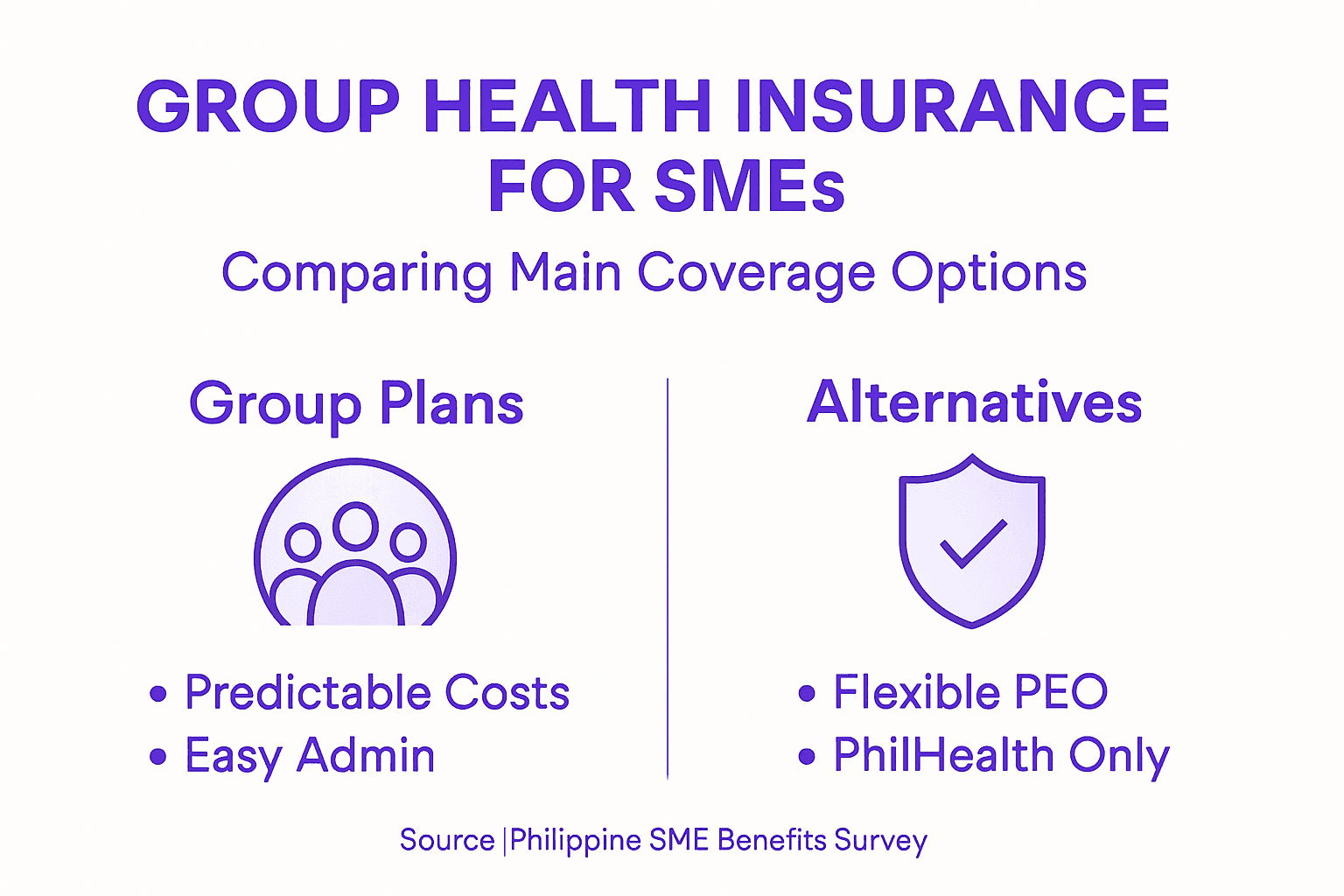
The main alternatives to traditional group health insurance fall into several categories. Individual Coverage Health Reimbursement Arrangements, level-funded plans, and Professional Employer Organizations offer financial flexibility and administrative relief with potential cost savings, particularly for SMEs with smaller or geographically diverse workforces. Each operates differently and suits different business situations. Understanding these options requires examining both their mechanics and their practical implications for your team.
Individual Coverage Health Reimbursement Arrangements (ICHRAs) flip the traditional model. Instead of you purchasing a group plan, you give employees money to buy individual health insurance on their own. You reimburse them for premiums they’ve selected. This works well if your workforce values choice and you want to avoid managing group enrollment. The downside: employees might choose cheaper plans with worse coverage, leaving them underprotected. Tax advantages exist but require careful administration. For stable, full-time workforces, this creates unnecessary complexity.
Level-funded plans sit between fully-insured and self-funded options. You pay predictable monthly fees to an administrator who then covers claims. If claims run lower than expected, you get refunds. If claims exceed the funding level, insurance kicks in. This appeals to employers wanting cost predictability without absorbing unlimited claim risk. The catch: it requires larger employee populations to work smoothly. For SMEs with 30-50 employees, the math might favor this. For smaller teams, group HMOs often cost less.
Professional Employer Organizations (PEOs) handle HR and benefits administration entirely. They become the technical employer for tax purposes while you manage the day-to-day work. PEOs negotiate group health plans on behalf of their client roster, giving small companies access to better rates than they could negotiate alone. This eliminates internal HR burden. However, you lose some control over benefits design and pay PEO fees on top of health insurance costs. For resource-constrained SMEs, this can simplify operations tremendously.
Association Health Plans (AHPs) pool multiple small employers together to negotiate better rates. AHPs provide an alternative to traditional group health insurance by pooling risk among similar groups to reduce costs. This appeals to SMEs in the same industry or region wanting better negotiating power. Regulatory requirements vary, and quality can differ significantly. Some AHPs offer genuine value; others create administrative nightmares. Research thoroughly before committing.
PhilHealth-only approach means relying solely on government coverage without supplemental health insurance. This minimizes your direct costs. However, PhilHealth coverage has significant gaps. Your employees face waiting periods, limited inpatient benefits, and exclusions for certain procedures. When your team member needs a procedure PhilHealth won’t cover, who pays? This creates unpredictable costs and employee resentment.
Here’s how they compare to traditional group HMOs:
| Aspect | Group HMO | ICHRA | Level-Funded | PEO | AHP |
|---|---|---|---|---|---|
| Administrative burden | Medium | High | Medium | Low | Medium |
| Cost predictability | High | Variable | High | Medium | Medium |
| Employee choice | Limited | High | Limited | Medium | Limited |
| Best for SMEs | Most situations | Small teams wanting flexibility | 40+ employees | Resource-constrained SMEs | Industry clusters |
For most Philippine SMEs in tech and hospitality, traditional group HMOs offer the best balance of affordability, simplicity, and employee protection.
The comparison reveals why group HMOs dominate the SME market. They’re simple to administer. Costs are predictable. Employees understand the coverage. Networks are established. Claims processing is straightforward. You don’t need special expertise to manage them. For growing companies in tech and hospitality, this simplicity matters tremendously when you’re focused on core business rather than benefits administration.
PEOs make sense if you’re overwhelmed with HR tasks and the PEO fee seems worthwhile. ICHRAs work if your workforce genuinely prefers choice and you have compliance resources. Level-funded plans make sense only if you’re large enough to support their mechanics. AHPs require research to verify legitimacy and value. PhilHealth-only approaches sacrifice employee protection for cost savings.
Pro tip: When comparing alternatives, calculate the total cost including administrative time, fees, and actual employee out-of-pocket expenses rather than looking at premium costs alone—the cheapest option often becomes expensive when you factor in hidden costs and employee turnover.
Empower Your SME with Tailored Group Health Insurance Today
Managing healthcare costs while offering comprehensive coverage is a challenge every SME faces, especially when balancing budget constraints with employee wellbeing. The article highlights critical pain points such as unpredictable premium increases, coverage limitations for pre-existing conditions, and the administrative burden of managing group health plans. SMEs in tech and hospitality sectors need a solution that simplifies benefits management and ensures complete protection for their workforce from day one.
At HMO Plans, we understand these challenges and provide a comprehensive group health insurance option designed specifically for Philippine SMEs. Our partnership with Purple Cow and Etiqa delivers 100 percent coverage for pre-existing and special conditions, along with cashless access to premier hospitals nationwide including the Big 9 Hospitals and dedicated clinic networks. Unlike other plans, we offer flexible customization with add-ons such as dental, annual physical exams, and life insurance so your coverage grows with your team. By choosing HMO Plans, you gain reliable, cost-effective protection that eases your administrative load and supports sustainable business growth.
Discover how you can simplify health benefits while boosting employee morale. Explore our solutions for SMEs that need dependable group health insurance coverage.
Protect your team with confidence. Visit HMO Plans now to get started and secure your company’s future with expert-backed health coverage tailored exactly for your business needs.
Frequently Asked Questions
What is group health insurance for SMEs?
Group health insurance for SMEs is an employer-sponsored health coverage that provides comprehensive medical benefits to all employees under a single policy, rather than having each employee find their individual coverage.
What are the benefits of offering group health insurance to employees?
Offering group health insurance helps attract and retain talent, provides predictable healthcare costs, encourages preventive care, and reduces absenteeism. It also signals to employees that their wellbeing is valued.
How do the costs of group health insurance compare to individual plans?
Group health insurance typically offers better rates and comprehensive coverage than individual plans, as insurers can pool risk across a larger collective workforce, leading to more manageable and predictable costs for employers.
Are pre-existing conditions covered by group health insurance?
Yes, quality group health insurance plans usually cover pre-existing conditions from the enrollment date, which is a significant advantage over many individual plans that may impose waiting periods or exclusions for these conditions.
Recommended
- HMO Health Insurance for Small and Medium Enterprises in the Philippines
- Beyond PhilHealth: How SMEs Can Maximize Health Investments for Better ROI
- Onboarding New Employees with Better Health Benefits: A Winning Hiring Strategy for SMEs
- Life & Accident Insurance: Protecting Your Team’s Future
- Seguro médico empresa: Cobertura global para expatriados - Unparalleled Global Benefits
