

Dialysis HMO Coverage in the Philippines: ₱6,350, LOA & SME Options
Yes, PhilHealth covers hemodialysis at ₱6,350 per session, and most HMOs cover dialysis too, but usually with session caps or Maximum Benefit Limit conditions rather than unlimited access. Confirm your PhilHealth eligibility first, then request a Letter of Authorization (LOA) from your HMO well before your next session. Waiting until treatment day to sort out paperwork is the single biggest reason dialysis patients get stuck with unexpected bills.
TL;DR:
- PhilHealth’s dialysis benefit is now ₱6,350 per session, providing up to around ₱1 million annually for stage 5 CKD patients, but coverage depends on session count and facility billing.
- Most HMOs cap dialysis sessions at a small number per year or draw from the Maximum Benefit Limit, often excluding long-term treatment beyond these caps.
- Securing a pre-treatment Letter of Authorization is crucial, as some hospitals require a new LOA for each session, risking delays and out-of-pocket expenses without proper planning.
- Patients should verify PhilHealth eligibility, facility accreditation, and LOA scope before each cycle to avoid coverage gaps, especially during pre-existing condition exclusion periods.
- External programs like PCSO assistance, hospital charity funds, and NGO grants can help bridge coverage gaps during HMO disputes or policy exclusions.
Table of Contents
- Dialysis HMO Coverage Starts With Understanding PhilHealth’s Base Benefit
- How HMOs Typically Handle Dialysis Coverage: Caps, MBL, and Pre-Existing Rules
- Getting Cashless Dialysis Approved: The LOA Process Step by Step
- What Dialysis Actually Costs You After PhilHealth and HMO Benefits Combine
- Why HMO Dialysis Claims Get Denied and How to Fight Back
- A Pre-Session Checklist That Prevents Coverage Gaps
- Where to Turn When PhilHealth and HMO Coverage Fall Short
- How Hmoplans Approaches Dialysis Coverage for SME Teams
- Hmoplans Removes the Session-Cap Guesswork for Employers
- Where to Verify Rates and File Complaints
- Sources
Dialysis HMO Coverage Starts With Understanding PhilHealth’s Base Benefit
Before any HMO benefit kicks in, PhilHealth sets the floor. As of October 9, 2024, PhilHealth raised its hemodialysis benefit to ₱6,350 per session, up from the previous rate that dialysis centers and patients had complained was too low to keep pace with actual treatment costs. That single adjustment matters more than most patients realize, because HMOs typically calculate their own payout as a supplement to whatever PhilHealth already covers, not as a replacement for it.
Statistic Callout: With the 2024 rate hike, PhilHealth’s expanded benefit structure provides up to roughly ₱1 million in annual financial protection for stage 5 chronic kidney disease (CKD5) patients, according to PhilHealth Circular No. 2024-0023. That works out to substantial coverage across a full year of thrice-weekly sessions, though the exact amount a patient receives still depends on how many sessions they undergo and which package the treating facility bills.
To actually receive this benefit, a patient generally needs to meet PhilHealth’s eligibility criteria for CKD5, which typically includes:
- An active PhilHealth membership with premiums paid up to date, either through employment, voluntary, or sponsored membership.
- A diagnosis of end-stage renal disease (CKD stage 5) confirmed by a nephrologist, since PhilHealth’s dialysis package is specifically built around this classification.
- Treatment at a PhilHealth-accredited dialysis facility, since claims filed from non-accredited centers will not be processed regardless of diagnosis.
- Complete PhilHealth claim forms submitted by the hospital or dialysis center, since most facilities file directly rather than requiring the patient to reimburse out of pocket.
Here’s what many patients miss: PhilHealth’s rate applies per session, not as a lump annual grant. If a patient undergoes the standard thrice-weekly hemodialysis schedule, that adds up to roughly 156 sessions a year. At ₱6,350 per session, the arithmetic gets close to PhilHealth’s annual protection ceiling fast, which is why HMO coverage on top of PhilHealth matters so much for anyone facing long-term dialysis rather than a short course of treatment.
Hospitals typically apply the PhilHealth benefit automatically at billing, deducting it from the total charge before presenting the balance to the HMO or the patient. That means your out-of-pocket exposure is really the gap between the total dialysis package price, the PhilHealth deduction, and whatever your HMO picks up. Getting clarity on that third piece is where most of the confusion, and most of the financial risk, actually lives.
How HMOs Typically Handle Dialysis Coverage: Caps, MBL, and Pre-Existing Rules
HMO dialysis coverage in the Philippines is not standardized the way PhilHealth’s benefit is. Each insurer, and often each specific plan tier within an insurer, sets its own rules for how many sessions it will pay for and how that spending interacts with the policy’s overall Maximum Benefit Limit.
Standard individual and family HMO plans frequently cap dialysis coverage at a fixed number of sessions per contract year rather than treating it as an open-ended draw against the MBL. Some standard plans in the market cap coverage at as few as 7 sessions annually, which sounds generous until you realize a dialysis patient on a standard schedule needs well over 100 sessions a year. That gap is exactly why patients on long-term dialysis need to look past the marketing summary of a plan and read the actual special procedures schedule in the policy contract.
Two structural details decide how much protection you actually get:
- Session caps versus MBL draw. Some plans list dialysis as a “special procedure” with its own sub-limit, separate from and much smaller than the overall MBL, while others let dialysis draw against the full MBL like any other covered treatment.
- PhilHealth-integrated versus PhilHealth-independent design. Plan documents show real variation here: some HMOs require patients to file PhilHealth forms first and only pay the balance, while others operate with what’s called PhilHealth independence, meaning the HMO’s benefit stands on its own regardless of PhilHealth status.
- Pre-existing-condition waiting periods. Because chronic kidney disease is almost always diagnosed before a patient applies for HMO coverage, many contracts treat it as pre-existing and either exclude it outright in year one or phase in coverage starting in the second policy year.
That last point deserves special attention, because it’s where dialysis patients most often get blindsided. A patient diagnosed with CKD5 who then shops for an individual HMO plan may find dialysis excluded entirely for the first 12 months, or covered only up to a small sub-limit until the pre-existing waiting period lapses. Group HMO plans arranged through an employer often handle this differently, sometimes covering pre-existing conditions from day one, which is a major reason CKD patients value employer-sponsored coverage so highly.
Pro Tip: Before enrolling in any HMO plan, ask specifically for the “special procedures” section of the benefit schedule, not just the general marketing brochure. That section, not the headline coverage summary, is where dialysis session limits and pre-existing exclusions actually live.
If you’re comparing plans through an employer’s benefits program, it’s worth reviewing concrete examples of how HMO coverage is structured across different providers, since session caps and MBL rules vary enough between insurers that a side-by-side comparison saves real money over a year of treatment.
Getting Cashless Dialysis Approved: The LOA Process Step by Step
Cashless access, meaning the hospital bills your HMO directly instead of you paying and filing for reimbursement, depends entirely on securing a Letter of Authorization before treatment. Miss this step and you’re paying out of pocket first, then hoping reimbursement comes through later.
Here’s the process most HMOs and hospitals in the Philippines follow:
- Get a medical referral from your nephrologist confirming the dialysis order, frequency, and diagnosis. Hospitals will not initiate an LOA request without this.
- Present your HMO card and a valid government ID at the hospital’s HMO or billing desk, along with your PhilHealth member data record if this is a new facility.
- Have the hospital submit the LOA request to your HMO, typically through a dedicated coordinator or online portal, specifying whether the request covers a single session or a full treatment cycle.
- Wait for LOA processing, which commonly takes 24 to 48 hours depending on the HMO and how complete the submitted documents are.
- Confirm the LOA’s scope before your session by asking whether it authorizes one visit or multiple sessions across a defined cycle, since this single detail determines whether you’ll need to repeat this entire process before your next appointment.
That last step is where a lot of dialysis patients lose time and money without realizing it. Some hospitals require a fresh LOA for every single scheduled session, while others accept a cycle-based LOA covering an entire month or treatment course at once. A patient who assumes their LOA covers the whole month, when the hospital’s actual practice is per-session authorization, can show up for a Wednesday session only to find no valid approval on file.
Pro Tip: Ask your HMO coordinator directly: “Is this LOA per-session or per-cycle?” Get the answer in writing, even if it’s just a screenshot of a chat confirmation. That single question prevents more treatment interruptions than any other step in the process.
Because dialysis is recurring and time-sensitive, in a way that a one-off surgery or diagnostic test isn’t, it pays to negotiate a standing cycle-based LOA arrangement with your HMO wherever the insurer allows it. A detailed breakdown of the LOA and pre-authorization workflow is worth reviewing in full if this is your first time navigating cashless HMO access, since the general pre-authorization rules for dialysis mirror those for most other scheduled treatments.
What Dialysis Actually Costs You After PhilHealth and HMO Benefits Combine
The real question every patient and every HR manager eventually asks is simple: what’s the actual bill after everyone else has paid their share? The honest answer is that it depends heavily on which of three common scenarios you fall into.
- Scenario one: Full coverage overlap. PhilHealth pays ₱6,350 per session, and your HMO covers the remaining balance up to the dialysis package price, with no patient contribution beyond minor incidentals. This is the best-case outcome and typically applies to comprehensive group plans without tight session caps.
- Scenario two: Partial HMO coverage with session cap exhaustion. PhilHealth covers its portion every session, but once you exceed your HMO’s annual session cap (say, 7 or 20 sessions), you’re paying the full package price out of pocket for every session beyond that limit.
- Scenario three: Pre-existing exclusion in year one. PhilHealth still pays its share, but the HMO pays nothing toward dialysis because CKD5 was diagnosed before the policy started, leaving the patient to cover the entire gap themselves during the exclusion period.
To put a number on scenario two: if a dialysis package at a private facility runs roughly ₱4,000 to ₱5,000 beyond what PhilHealth covers, and your HMO caps out at 20 sessions a year against a schedule of 156 annual sessions, you’re personally absorbing that gap for 136 sessions. That can total well over ₱500,000 annually once the session cap runs out, even with PhilHealth’s improved rate factored in.
Statistic Callout: PhilHealth’s ₱6,350 per-session rate and roughly ₱1 million in annual protection sound substantial in isolation, but for a patient on a full thrice-weekly schedule, that ceiling can be reached well before year-end, especially if the treating facility’s package price runs above the PhilHealth rate.
Before starting or continuing treatment at a new facility, ask the hospital’s billing office for a written cost estimate that itemizes the PhilHealth deduction, the HMO’s covered amount, and your projected balance. Pair that with an LOA that specifically lists what’s authorized, not just a generic approval slip. If your employer’s group plan pricing is unclear, reviewing typical HMO cost structures for employees helps put your session cap and MBL numbers in context against what similar SMEs are paying for comparable coverage.
Why HMO Dialysis Claims Get Denied and How to Fight Back
Denials rarely happen because dialysis itself isn’t covered. They happen because of a specific contractual carve-out or a documentation gap that could have been caught before the claim was filed.
The most common culprits include:
- Pre-existing-condition exclusions applied to CKD5 diagnosed before the policy’s effective date, sometimes for the entire first policy year.
- Missing or expired medical referrals, since an outdated referral from a prior nephrologist visit can trigger an automatic claim rejection.
- Incomplete PhilHealth forms, which stall the HMO’s portion of the claim because most HMOs process their payout only after confirming PhilHealth’s deduction has been applied correctly.
- Treatment at a non-accredited dialysis center, even inside a hospital that is otherwise fully accredited by the HMO, since facility-level accreditation for the dialysis unit specifically doesn’t automatically follow from the hospital’s general accreditation status.
- LOA scope mismatches, where a session was performed outside the dates or session count the original LOA authorized.
If a claim gets denied, the appeal process moves faster with the right paperwork assembled up front. Gather a nephrologist’s letter stating medical necessity, a full treatment timeline, itemized hospital bills for the disputed sessions, and copies of every LOA and HMO correspondence related to the claim. These four documents together materially strengthen an appeal, because they close the exact gaps HMOs cite most often when rejecting dialysis claims. For unresolved disputes, the Insurance Commission accepts consumer complaints against HMOs operating in the Philippines and can escalate patterns of unfair denial.
A Pre-Session Checklist That Prevents Coverage Gaps
Most dialysis coverage problems are preventable with a five-minute check before treatment, not a dispute after the bill arrives. Patients and HR benefits administrators handling group plans should run through the same list every time a new dialysis cycle starts.
- Confirm PhilHealth eligibility status and premium payment currency before the first session of any new cycle, since a lapsed membership silently removes the ₱6,350 per-session benefit from the billing equation.
- Verify the specific dialysis center’s accreditation with both PhilHealth and the HMO directly, not just the hospital’s general accreditation, since these are separate approvals that don’t automatically transfer.
- Request the LOA at least two to three days ahead of the scheduled session, confirming explicitly whether it’s a single-session or cycle-based authorization.
- Collect a written, itemized cost estimate from the hospital’s billing office showing the PhilHealth deduction, HMO coverage amount, and projected patient balance before treatment begins.
- Keep a dedicated folder, physical or digital, of every LOA, referral, and PhilHealth form tied to the treatment, since this becomes essential if an appeal is ever needed.
Pro Tip: HR teams managing group HMO plans for employees with chronic kidney disease should build this checklist into onboarding paperwork for affected employees, rather than leaving each session’s authorization to chance. A single missed LOA can mean a skipped dialysis session, which carries real medical risk beyond the financial one.
Where to Turn When PhilHealth and HMO Coverage Fall Short
Even with PhilHealth’s improved rate and solid HMO coverage, some patients still face gaps, particularly during pre-existing exclusion periods or after session caps run out. The Philippines has a handful of established programs built specifically to bridge that gap.
- PCSO Individual Medical Assistance Program provides financial help to patients who need support for medical procedures, dialysis included, and the application guidance is posted directly on PCSO’s website. Most applicants need a valid prescription or medical certificate, an itemized cost estimate, and proof of financial need.
- Hospital social work offices at most major medical centers maintain charity funds or subsidized rate programs for dialysis patients who demonstrate financial hardship, and a referral from the treating nephrologist usually speeds up the intake process.
- Dialysis center-specific subsidy programs exist at some private and NGO-affiliated centers, often funded through partnerships with kidney foundations, and are worth asking about directly at the billing or social services desk.
- NGO and foundation grants focused on kidney disease sometimes offer either direct financial assistance or subsidized treatment slots, particularly for patients actively appealing a denied HMO claim.
These options work best as a bridge, not a substitute. If you’re mid-appeal with your HMO or waiting out a pre-existing exclusion period, applying for PCSO assistance or a hospital charity subsidy can keep treatment uninterrupted while the coverage dispute gets resolved.
How Hmoplans Approaches Dialysis Coverage for SME Teams
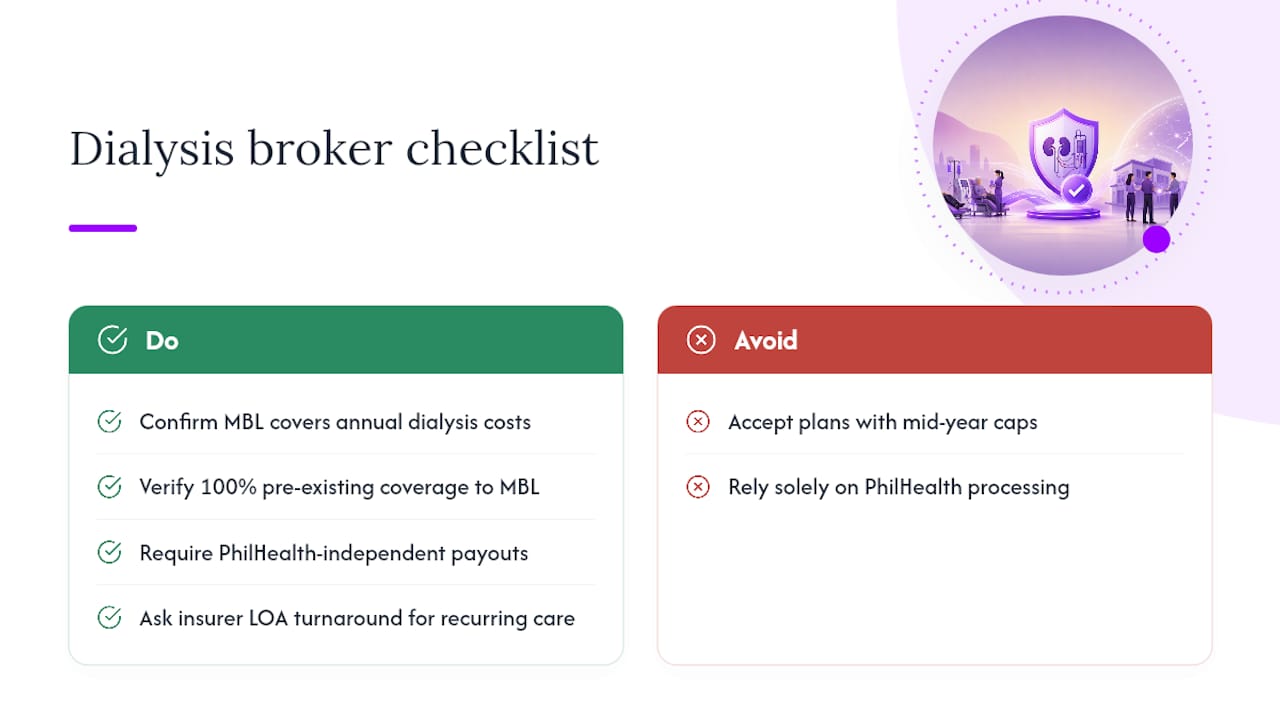
Employees managing chronic kidney disease need group coverage that doesn’t quietly cap out mid year. Hmoplans, underwritten through Purple Cow and Etiqa, covers pre-existing and congenital conditions at 100% up to the plan’s Maximum Benefit Limit, which changes the equation for an employee already diagnosed with CKD5 before enrollment.
For HR teams building a plan around an employee on dialysis, the questions worth asking a broker include how the MBL is sized relative to expected annual dialysis costs, whether the plan offers PhilHealth independence so HMO payouts don’t depend on PhilHealth processing delays, and how quickly the insurer processes LOA requests for recurring treatment. A plan with a high MBL and clear LOA support turns dialysis from a recurring financial threat into a predictable, budgeted benefit line.
— Eumir
Hmoplans Removes the Session-Cap Guesswork for Employers
If the session caps and pre-existing exclusions covered above sound like exactly the traps you’re trying to avoid for an employee on dialysis, that’s the gap Hmoplans was built to close.
HR teams arranging coverage for a CKD employee should come prepared with the employee’s current dialysis schedule, their existing PhilHealth status, and any prior HMO denial history, since that information helps size the right MBL and confirm PhilHealth-independence terms during setup. Hmoplans also gives your team cashless access to accredited hospitals and dialysis centers nationwide, so LOA requests move through a structured, predictable process rather than a scramble before every session. Review the full plan features and add-on options to see how MBL sizing and PhilHealth independence work together, or head to the Hmoplans homepage to request a quote tailored to your team’s specific health needs.
Where to Verify Rates and File Complaints
Dialysis rates and coverage rules change, so verify details directly before relying on any figure quoted in this guide. PhilHealth publishes its per-session rate and eligibility rules through official circulars, most recently Circular No. 2024-0023 covering the current ₱6,350 rate. The Insurance Commission handles HMO regulatory oversight and accepts consumer complaints when an insurer denies a claim without clear contractual basis. For financial assistance beyond insurance, the PCSO Individual Medical Assistance Program page lists current application requirements and processing steps.
Sources
- Philippine News Agency: PhilHealth raises dialysis benefit to PHP6,350 per session
- PhilHealth dialysis coverage: key changes you need to know — SunStar (Philippines)
- Unihealth Southwoods Hospital — HMO insurance guide
- Insurance Commission (Philippines)
