

Group HMO Cost in the Philippines: What SMEs Should Budget
Budget a moderate amount per employee per year for a typical SME group HMO plan in the Philippines, with basic outpatient-heavy schemes running lower, and comprehensive plans with higher Maximum Benefit Limits (MBL) costing more. Published retail prices you see online rarely match what you’ll actually pay as a group. Your next move is simple: request quotes from at least three providers using one standard employee roster so you’re comparing real numbers, not marketing prices.
TL;DR:
- Actual group HMO quotes depend heavily on your roster’s age, gender, and dependent composition, which can significantly alter the premium compared to published prices.
- Benefits such as Maximum Benefit Limit levels, room tiers, and hospital network access are the main factors driving premium differences, with higher limits and private rooms costing more.
- Procurement typically takes four to eight weeks from request to activation, with larger or more complex groups requiring more negotiation and documentation time.
- Insurers favor standardized benefit packages across departments rather than customized benefits per employee to simplify renewal negotiations and cost control.
Table of Contents
- What Group HMO Cost in the Philippines Actually Looks Like
- What Drives Group HMO Premiums?
- How to Budget Per Employee: Sample Calculations
- What’s Included and What Costs Extra
- How to Request Accurate, Comparable Group HMO Quotes
- Why Hmoplans Is a Practical Option for SMEs
- The Real Cost Breakdown: Fees You Might Not See Coming
- How Long Does It Take to Get a Group HMO Active?
- An Editorial Take on Group HMO Pricing in the Philippines
- Get a Group HMO Quote Built Around Your Actual Team
- Sources
What Group HMO Cost in the Philippines Actually Looks Like
Search for HMO prices in the Philippines and you’ll find published cards that look tempting. Maxicare’s PRIMA Consult card starts at ₱999, with higher-tier diagnostic cards running up to ₱19,999. MediCard lists individual plans like Health Plus at ₱1,545 per year and My MediCard at ₱3,600 per year, with full HMO tiers stretching from roughly ₱10,739 up to ₱66,943 depending on hospital access and benefit limits.
These numbers are real, but they describe individual retail purchases, not what an insurer quotes for your team.
Statistic Callout: Corporate HMO packages are generally structured to deliver better per-person rates than individual plans, but group pricing is almost always quote-only and depends entirely on your roster’s age mix, benefit design, and hospital preferences.
For SME budgeting purposes, three practical bands tend to hold up across the market:
- Basic outpatient-leaning plans: lower cost per employee annually
- Mid-tier plans with standard MBL and ward or semi-private rooms: moderate cost per employee annually
- Comprehensive plans with higher MBL and private or VIP room access: higher cost per employee annually
Treat these as planning ranges. Your actual quote will move based on the factors covered next.
What Drives Group HMO Premiums?
Insurers price group HMOs on a handful of concrete variables, and understanding them lets you control cost instead of just reacting to it.
- Age and gender mix. A roster skewed toward employees over 40, or one with many female employees of childbearing age, typically pushes premiums higher than a younger, more balanced group.
- MBL and room tier. Your Maximum Benefit Limit and whether employees get ward, semi-private, or private/VIP rooms are the two biggest levers on price, since higher benefit limits and exclusive hospital access can cost multiple times more than standard tiers.
- Network access. Plans that include the Big 9 Hospitals or premium clinic networks cost more than plans limited to a smaller panel.
- Claims history. Renewing groups with heavy prior claims often see experience-based rate adjustments.
- Waiting periods and pre-existing condition rules. Some insurers delay coverage for pre-existing conditions, while certain SME-focused plans structure this differently, which changes both cost and risk exposure.
- Administrative fees, broker commissions, and riders. These sit on top of the base premium and vary by provider.
Pro Tip: Standardize your plan tiers across departments instead of customizing benefits per employee. Insurers price consistency more favorably than a patchwork of individual exceptions, and it makes your renewal negotiation simpler too.
How to Budget Per Employee: Sample Calculations
Here’s how the math typically plays out across three common SME setups.
- Scenario A: Low-cost outpatient-heavy plan. Typical MBL and ward-tier room, principal-only. Expect lower to moderate cost per employee annually.
- Scenario B: Mid-tier full HMO, moderate MBL. Semi-private room, standard hospital network, principal-only. This typically lands at a moderate cost per employee annually.
- Scenario C: Comprehensive plan, high MBL. Private or VIP room access, broader network including premium hospitals. Budget higher cost per employee annually.
Two contribution models change how this hits your books.
Statistic Callout: Adding one dependent, such as a spouse or child, typically increases the principal’s premium significantly, since corporate plans generally price dependents at group rates but still add materially to total employer liability. Age loading for employees over 50 can push that same dependent addition even higher.
One more variable worth modeling: PhilHealth benefits typically offset a portion of hospitalization costs before your HMO pays out, which can meaningfully reduce your net claims exposure if your policy layers properly on top of it. For a deeper walkthrough of these numbers, see our SME pricing guide.
What’s Included and What Costs Extra
Every group HMO plan, regardless of tier, generally covers inpatient hospitalization, outpatient consultations, emergency care, basic diagnostics, and a defined MBL with a set room and board tier. That’s your baseline.
Add-ons are where employers customize spend, and where cost quietly climbs if you’re not careful:
- Dental packages: usually charged per head, often adding ₱500 to ₱1,500 annually per employee.
- Annual physical exams: typically a flat fee per employee, sometimes bundled into mid-tier plans already.
- Life and accident insurance riders: priced separately, often a percentage of base premium.
- Outpatient riders and teleconsult access: increasingly popular, usually charged per head rather than as a percentage.
Selective, voluntary add-ons that employees opt into and partly fund tend to deliver better return than blanket riders applied to everyone regardless of need. Match the add-on to what your workforce actually uses. A tech team with young, healthy employees may value teleconsult over dental; a hospitality team with high physical demands may lean the other way.
How to Request Accurate, Comparable Group HMO Quotes
Getting quotes you can actually compare starts with giving every insurer the same inputs.
- Prepare a full employee roster: ages, sex, dependents, and any available claims history from a prior provider.
- List your preferred hospitals: especially if certain branches or the Big 9 Hospitals matter to your team.
- Ask about MBL tiers, room categories, waiting periods, and pre-existing condition rules for each proposal.
- Request LOA (letter of authorization) turnaround times and out-of-network reimbursement terms in writing, since these details determine how fast your employees actually get treated.
- Request quotes in a consistent format: MBL, room tier, inpatient/outpatient limits, copays, network list, and premium per principal plus common dependent configurations.
Pro Tip: Watch for vague exclusion clauses and unclear pre-existing condition language in proposals. If a broker can’t explain a clause in one sentence, ask them to put it in writing before you sign.
For more on how hospital networks affect your quote, our network guide for SME owners breaks down which tiers matter most.
Why Hmoplans Is a Practical Option for SMEs
Hmoplans builds comprehensive health insurance specifically for Philippine SMEs, backed by Purple Cow and Etiqa as underwriters. Coverage includes cashless access to a nationwide network including the Big 9 Hospitals and Healthway Clinics, with 24/7 support and full inpatient, outpatient, and emergency care built in.
No waiting period gymnastics, no fine print designed to delay a claim.
You can also customize coverage with dental, annual physical exams, and life and accident insurance, so your budget goes toward benefits your team will actually use, not a one-size package that overshoots for some employees and underdelivers for others.
The Real Cost Breakdown: Fees You Might Not See Coming
The quoted premium is rarely your only expense. A few line items regularly surprise employers who budget only off the headline per-employee rate.

Documentary stamp tax and VAT apply to insurance premiums in the Philippines, and some brokers quote pre-tax figures that jump once the final invoice arrives. Always ask whether the number in front of you is inclusive of applicable taxes.
Enrollment and processing fees show up during onboarding, particularly when a group has irregular headcounts or frequent staff turnover requiring mid-year additions and deletions. Some insurers charge per-transaction fees for adding a new hire outside the annual enrollment window.
Broker commissions are usually baked into the premium rather than itemized separately, but they still affect what you’re paying versus what a direct provider relationship might cost.
Reinstatement and late renewal penalties apply if your company misses a payment deadline or lapses coverage, even briefly, between contract years.
Out-of-network reimbursement processing can carry its own administrative cost or a lower reimbursement percentage than in-network cashless claims, which matters if your team frequently uses hospitals outside the core panel.
Add-on activation fees sometimes apply when riders like dental or life insurance are added mid-contract rather than at initial signing.
None of these line items are hidden in the sense of being concealed. They’re simply easy to miss when comparing headline premiums across proposals. Ask every insurer for an all-in annual cost per employee, taxes and fees included, before you sign anything. For a closer look at how these costs interact with your company’s tax position, our CFO guide to HMO tax treatment is worth a read before budget season.
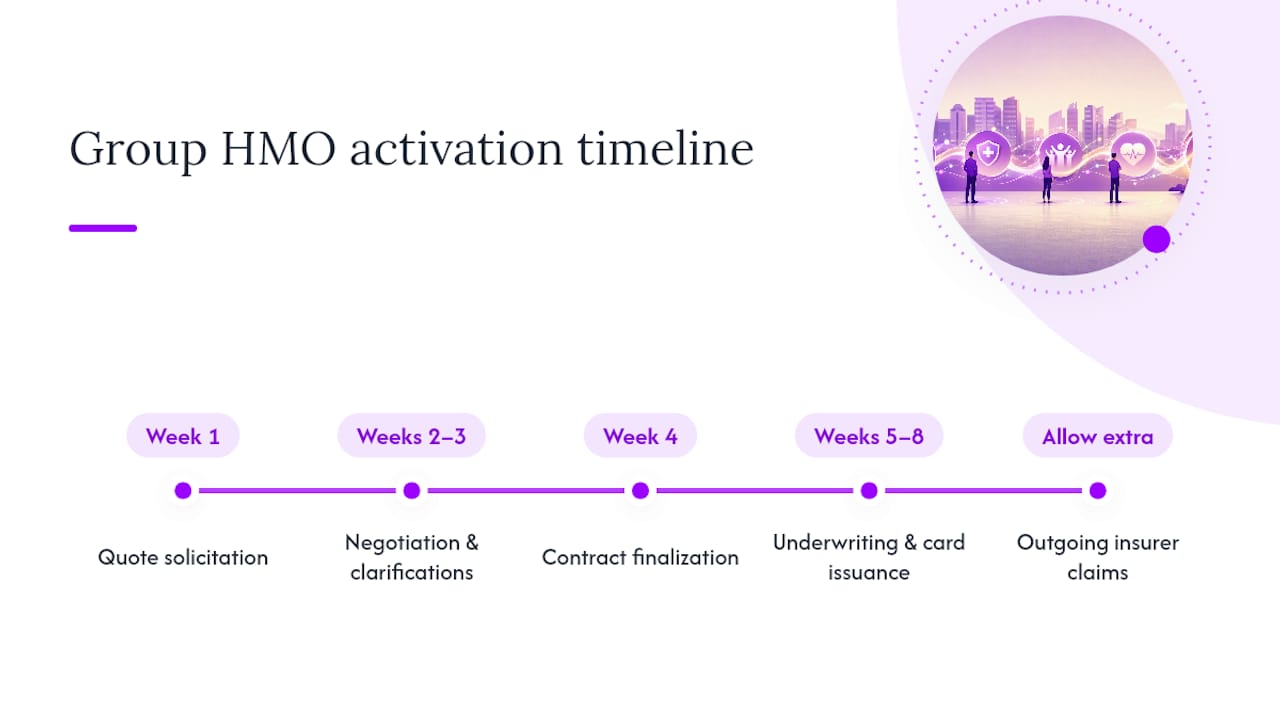
How Long Does It Take to Get a Group HMO Active?
Procurement timelines for group HMO plans in the Philippines typically run four to eight weeks from initial request to active coverage, though this varies by company size and how prepared your documentation is.
Week one is quote solicitation. You send your employee roster, preferred hospital list, and benefit requirements to two or three providers. Expect initial proposals back within five to ten business days.
Weeks two and three involve negotiation and clarification. This is when you push back on MBL tiers, ask about pre-existing condition treatment, and request the all-in cost breakdown covered above. Larger companies with more complex rosters, multiple departments, varied dependent counts, often need this stage to run longer.
Week four is contract finalization and documentation. You’ll sign the group policy agreement, submit final enrollment forms, and confirm payment terms.
Weeks five through eight cover underwriting review and card issuance. Insurers process the roster, issue member ID cards or digital access credentials, and activate the policy. Some providers offer interim coverage letters so employees can access care before physical cards arrive.
Smaller companies with straightforward rosters, under 50 employees with minimal dependent variation, sometimes compress this to three to four weeks. Companies switching from an existing provider should also budget time for the outgoing insurer’s final claims processing, since overlapping coverage gaps are a common and avoidable mistake.
An Editorial Take on Group HMO Pricing in the Philippines
Most online pricing guides treat HMO shopping like retail shopping, comparing headline card prices and calling it done. That approach fails SMEs specifically, because the number that matters, your actual group quote, doesn’t exist until an insurer sees your roster.
The bigger blind spot is that conventional advice treats age and dependent mix as afterthoughts. They’re not. A 40-person company with five employees over 50 and heavy dependent enrollment will pay a materially different premium than a 40-person company skewed young and single, even with identical MBL and room tiers. If you’re budgeting off a published price card without accounting for your own roster’s shape, you’re planning against a number that was never yours to begin with.
What should you prioritize first? Get your roster data clean and complete before you request a single quote. Ages, dependents, claims history if you have it.
— Eumir
Get a Group HMO Quote Built Around Your Actual Team
Hmoplans works directly with Philippine SMEs to build group HMO coverage around your roster, not a generic template.
Unlike the retail card comparisons flooding search results, a direct quote from Hmoplans reflects your actual employee ages, dependent counts, and hospital preferences from day one, so there’s no gap between the number you budgeted and the number you’re billed. If you’re ready to move past estimates, request a quote through Hmoplans and get pricing built specifically for your company, or review the full feature breakdown to see which add-ons make sense for your team before your next enrollment window opens.
This article is general information, not a substitute for advice from a qualified financial advisor. Consult a qualified financial professional about your own circumstances before acting on anything here.
