

How HMO benefits boost employee retention in Philippine SMEs
Salary increases alone won’t keep your best employees from leaving. Research shows that 64% of employees prioritize health benefits alongside salary, with comprehensive HMO coverage increasing retention by 59%. For Philippine SMEs facing rising turnover rates, understanding how Health Maintenance Organization benefits influence employee loyalty isn’t optional anymore. This guide reveals how HMOs create financial security, reduce absenteeism, and signal genuine employer care, plus the legal protections and practical strategies you need to maximize their retention impact.
Table of Contents
- Key takeaways
- Understanding the impact of HMO benefits on employee loyalty
- Legal protections for employee HMO benefits and implications for SMEs
- Challenges and best practices in managing HMO benefits for retention
- Maximizing employee retention: integrating HMOs with broader health benefits
- Explore better HMO plans tailored for Philippine SMEs
- Frequently asked questions
Key Takeaways
| Point | Details |
|---|---|
| Financial security boosts loyalty | Comprehensive HMO coverage reduces financial anxiety and increases employee retention by making healthcare costs predictable. |
| Absenteeism reduction | Early intervention and preventive care from HMOs keep staff healthier and on the job, lowering sick days. |
| Legal protections | The non diminution rule in Philippine labor law prevents unilateral downgrades of benefits once granted, protecting HMO coverage as a contractual right. |
| PhilHealth integration | Combining HMO with PhilHealth broadens coverage and reduces care gaps for employees. |
| Wellness programs boost retention | Wellness initiatives linked to HMOs add about ten percent to retention by supporting long term health and engagement. |
Understanding the impact of HMO benefits on employee loyalty
Health Maintenance Organizations function as prepaid health plans that give employees cashless access to medical services through accredited provider networks. In the Philippine employment landscape, HMO health insurance for SMEs has evolved from a luxury perk to an expected component of competitive compensation packages. The shift reflects changing employee priorities, especially among younger workers who value health security as much as take-home pay.
Data reveals that health benefits increase employee loyalty by 44%, making them one of the most powerful retention tools available to SMEs. This loyalty stems from the financial protection HMOs provide against unexpected medical expenses. When employees know they can access quality healthcare without depleting savings, they experience reduced financial anxiety and greater job satisfaction. That psychological security translates directly into longer tenure and stronger organizational commitment.
The retention mechanism works through multiple channels:
- Financial security reduces stress that drives employees to seek higher-paying positions elsewhere
- Immediate access to healthcare prevents minor health issues from becoming major productivity problems
- Comprehensive coverage demonstrates employer investment in employee wellbeing beyond minimum legal requirements
- Family coverage options extend the benefit’s value perception significantly
HMOs also reduce absenteeism by enabling early intervention and preventive care. Employees with health coverage seek medical attention sooner, preventing conditions from worsening and requiring extended time off. This proactive healthcare access keeps teams functioning at full capacity while simultaneously building goodwill between employer and employee.
“When our team received HMO coverage that included dependents, the change in morale was immediate. People felt genuinely valued, not just as workers but as whole persons with families to protect.”
Beyond basic medical coverage, wellness programs integrated with HMOs boost retention by approximately 10%. These programs, including annual physical exams, mental health support, and preventive screenings, position the employer as a partner in long-term employee health rather than just a paycheck source. That partnership mentality creates emotional bonds that salary alone cannot replicate.
Pro Tip: Survey your team about which HMO benefits matter most to them. You might discover that dental coverage or mental health services carry more retention weight than you assumed, allowing you to customize plans for maximum impact.
Legal protections for employee HMO benefits and implications for SMEs
Philippine labor law provides robust protection for employee benefits through the non-diminution principle. Labor Code Art. 100 prohibits unilateral reduction of benefits once they’ve been granted, treating HMO coverage as a contractual right rather than a discretionary perk. This legal framework means you cannot simply downgrade or eliminate HMO benefits without employee consent or demonstrable equivalent value replacement.
The non-diminution rule applies regardless of whether benefits appear in written contracts or exist as established company practice. If your SME has provided HMO coverage consistently, employees gain a legally protected expectation of continued coverage at equivalent levels. Courts have repeatedly upheld this principle, viewing benefit reductions as potential constructive dismissal when they materially affect employment terms.
When circumstances require changing HMO providers, the law demands that replacement coverage maintain equivalent value. Equivalent value doesn’t mean identical networks or procedures, but the overall benefit package must reasonably match what employees previously received. Switching from a plan with Big 9 hospital access to one without comparable facilities, for example, likely violates non-diminution protections even if maximum benefit limits remain the same.
SMEs face several risks when mishandling HMO benefit changes:
- Employees can file complaints with the Department of Labor and Employment for benefit diminution
- Unilateral reductions may constitute grounds for constructive dismissal claims
- Legal disputes damage employer reputation and make future recruitment harder
- Settlements and penalties can exceed the cost savings from downgrading coverage
Documentation becomes critical when legitimate business reasons require benefit adjustments. You must maintain clear records showing how replacement benefits equal or exceed previous value. This might include comparing maximum benefit limits, provider network quality, coverage scope, and out-of-pocket cost structures. Transparent communication with employees about changes, supported by written equivalence analyses, significantly reduces legal exposure.
Pro Tip: Before switching HMO health insurance for SMEs, create a side-by-side comparison document showing how new coverage matches or improves upon current benefits. Share this with employees before implementation and keep signed acknowledgments in personnel files.
The legal framework ultimately serves retention by creating benefit stability. Employees who trust that their health coverage won’t disappear during budget cuts feel more secure in their positions. That security, backed by legal protections, makes your SME a safer employment choice compared to competitors who might view benefits as expendable during challenging periods.
Challenges and best practices in managing HMO benefits for retention
Even well-intentioned HMO programs can undermine retention when operational issues frustrate employees. Research on HMO user experiences in the Philippines reveals that delays in approval processes, limited provider networks, and unexpected out-of-pocket expenses consistently reduce satisfaction. These friction points transform a valuable benefit into a source of stress, potentially driving employees toward employers with smoother healthcare access.

The gap between promised benefits and actual user experience creates retention risks. An employee who struggles to get approval for a specialist visit or discovers their preferred hospital isn’t in-network questions whether the HMO truly delivers value. Repeated negative experiences can outweigh the financial protection the plan provides, especially when employees compare notes with peers at other companies who face fewer obstacles accessing care.
Common challenges and practical solutions:
| Challenge | SME solution |
|---|---|
| Approval delays for procedures | Partner with HMO providers offering digital pre-authorization and 24-hour response guarantees |
| Limited provider network access | Prioritize plans including Big 9 hospitals and multiple clinic options per area |
| Unexpected out-of-pocket costs | Choose plans with clear coverage limits and reimbursement processes, educate employees upfront |
| Confusing claims procedures | Provide simple step-by-step guides and designate an internal benefits coordinator |
| Poor customer service from HMO | Evaluate provider responsiveness during selection, include service quality in annual reviews |
Proactive management prevents these issues from escalating into retention problems. Regular plan reviews, ideally annually, ensure your HMO coverage evolves with employee needs and provider performance. These reviews should examine utilization data, employee feedback, claim denial rates, and provider network adequacy. When patterns emerge showing specific pain points, you can address them before they drive turnover.
Communication plays an equally critical role in HMO satisfaction. Many employee frustrations stem from misunderstanding coverage limits or proper utilization procedures rather than actual plan deficiencies. Comprehensive onboarding for new hires, annual refresher sessions, and readily accessible privacy policy for HMO plans documentation help employees maximize their benefits. When employees know how to navigate the system effectively, satisfaction increases even with identical coverage.
Best practices for retention-focused HMO management:
- Conduct anonymous surveys every six months specifically about healthcare benefit satisfaction
- Track metrics like claim approval rates, average processing times, and employee service complaints
- Maintain relationships with multiple HMO providers to enable competitive comparisons during renewal
- Respond empathetically and quickly when employees report coverage issues
- Share success stories of employees who received excellent care through the HMO to build positive perception
Pro Tip: Create a simple feedback channel, like a dedicated email address or monthly office hours, where employees can report HMO issues confidentially. Early identification of problems lets you intervene with providers before frustration builds and affects retention.
The year-end health plan review process should involve employee representatives who can voice team concerns and priorities. This collaborative approach ensures your HMO investment aligns with actual needs rather than assumptions. Some SMEs discover that employees would trade higher maximum benefit limits for broader provider networks, or prefer adding dental coverage over increasing inpatient room allowances.
Real-world examples demonstrate the retention impact of responsive HMO management. One salon group boosted staff retention by switching to a provider with better clinic access near their locations and adding dependent coverage. The changes addressed specific pain points employees had raised, showing that management listened and acted on feedback. That responsiveness built loyalty beyond the benefits themselves.
Maximizing employee retention: integrating HMOs with broader health benefits
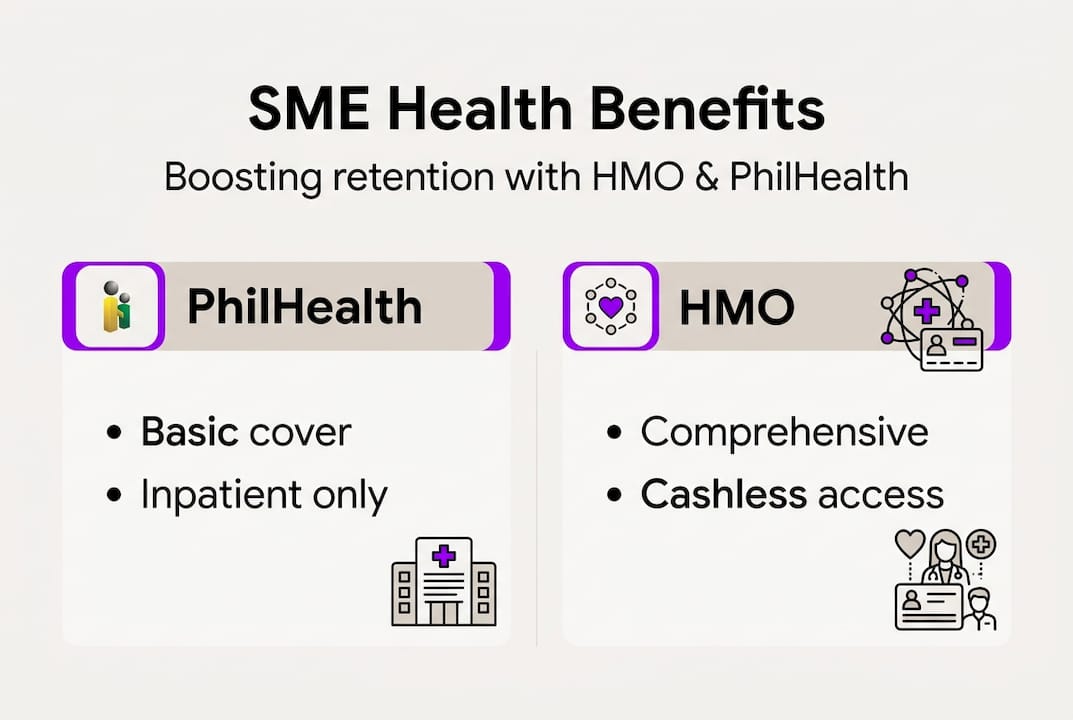
HMO coverage delivers maximum retention value when integrated with PhilHealth rather than viewed as a standalone benefit. The two systems complement each other, with PhilHealth providing baseline coverage while HMOs fill gaps and accelerate access. Employees who understand this complementary relationship perceive greater total benefit value, strengthening their connection to your organization.
| Coverage aspect | PhilHealth | HMO |
|---|---|---|
| Coverage scope | Basic inpatient, limited outpatient, catastrophic cases | Comprehensive inpatient, extensive outpatient, preventive care |
| Access speed | Slower processing, queues common | Immediate cashless access at accredited facilities |
| Out-of-pocket costs | Significant copays and balance billing | Minimal to zero within coverage limits |
| Provider choice | Any accredited facility | Limited to network providers |
| Annual limits | Government-set benefit packages | Contractual maximum benefit limits |
This comparison reveals why maximizing SME health investment requires both systems working together. PhilHealth handles scenarios where HMO limits are exhausted or services fall outside network coverage. Meanwhile, HMO coverage provides the convenience and comprehensive access that employees value daily. The combination creates a safety net that feels both broad and responsive.
However, even comprehensive health benefits cannot single-handedly prevent turnover in today’s competitive labor market. Filipino employee turnover is projected at 20% for 2026, driven by multiple factors beyond compensation and benefits. Career stagnation, poor management relationships, lack of recognition, and limited growth opportunities push employees to leave despite excellent health coverage. Your retention strategy must address these broader needs while leveraging HMO benefits as one component of a compelling employee value proposition.
Holistic retention strategies that maximize HMO impact:
- Position health benefits as part of total rewards communication, showing the full monetary value employees receive beyond salary
- Connect HMO coverage to career development by emphasizing how health security enables employees to focus on growth and learning
- Integrate wellness programs with professional development, such as stress management training or fitness challenges that build team cohesion
- Use health benefit quality as a recruitment differentiator when onboarding new employees, setting positive expectations from day one
- Create a culture where using health benefits is normalized and encouraged, removing stigma around taking time for medical appointments or mental health support
- Regularly highlight how your health benefits exceed industry standards or legal minimums, reinforcing the competitive advantage of staying with your company
The psychological impact of comprehensive health coverage extends beyond immediate medical needs. Employees with strong health benefits report lower financial stress, which correlates with better job performance and engagement. When people aren’t worried about affording healthcare for themselves or their families, they bring more mental energy and focus to work. This reduced stress contributes to the positive workplace culture that retains talent.
Strategic benefit design considers life stage needs across your workforce. Younger employees might prioritize outpatient coverage and mental health services, while those with families value dependent coverage and pediatric care access. Flexible HMO options that let employees choose add-ons like dental coverage or higher limits for specific services increase perceived personalization. When benefits feel tailored rather than generic, employees recognize genuine employer investment in their individual wellbeing.
The retention equation ultimately balances multiple factors where health benefits play a significant but not solitary role. SMEs that combine excellent HMO coverage with clear career paths, respectful management, competitive compensation, and positive culture create an environment where employees choose to stay even when recruited elsewhere. Health benefits become the foundation of security upon which other retention elements build, rather than a standalone solution expected to compensate for deficiencies in other areas.
Explore better HMO plans tailored for Philippine SMEs
Finding HMO coverage that truly supports retention requires providers who understand SME constraints and employee expectations. Better HMO plans for SMEs combine comprehensive coverage with straightforward terms and responsive service, eliminating the complexity that frustrates both employers and employees.
Key features that maximize retention value include:
- Affordable premiums scaled for small team budgets without sacrificing coverage quality
- Wide provider networks encompassing Big 9 hospitals and convenient clinic locations
- Simplified claims processes with digital platforms for quick approvals and reimbursements
- Flexible customization through add-ons like dental services and annual physical exams
- 100% coverage for pre-existing conditions up to maximum benefit limits
SMEs across industries report measurable retention improvements after upgrading their health benefits. The investment in quality HMO coverage pays returns through reduced turnover costs, improved productivity, and stronger employer branding in competitive talent markets.
Explore comprehensive HMO plan features designed specifically for Philippine SME needs, or connect with member services to discuss how tailored health benefits can strengthen your retention strategy. Better health coverage isn’t an expense, it’s an investment in workforce stability that delivers returns far exceeding premium costs.
Frequently asked questions
What is the role of HMO in employee retention?
HMO benefits enhance retention by providing accessible healthcare that reduces financial stress and demonstrates employer commitment to employee wellbeing. Comprehensive health coverage increases loyalty by 44% and retention by 59%, making it one of the most effective tools for keeping talent. The financial security and convenience HMOs provide create psychological safety that strengthens organizational attachment beyond what salary alone can achieve.
How do Philippine labor laws affect HMO benefits for employees?
Labor Code Art. 100 prohibits reducing HMO benefits once granted, requiring employers to maintain equivalent value in any replacement coverage. This non-diminution principle treats health benefits as contractual rights rather than discretionary perks. Violations can lead to labor complaints, constructive dismissal claims, and significant legal penalties that exceed any cost savings from benefit reductions.
Can HMO benefits alone guarantee employee retention?
HMO benefits significantly boost retention but cannot single-handedly prevent turnover amid 20% projected Filipino turnover rates for 2026. Employees leave for multiple reasons including career stagnation, poor management, and lack of recognition that health benefits cannot address. Maximum retention requires combining excellent HMO coverage with competitive compensation, growth opportunities, and positive workplace culture.
What are common challenges employees face with HMO plans?
Users report frustrations with approval delays, limited provider networks, and unexpected out-of-pocket expenses that reduce satisfaction despite comprehensive coverage. These operational issues can transform valuable benefits into stress sources that undermine retention. Proactive management through regular plan reviews, clear communication, and responsive problem-solving helps mitigate these challenges and maintain the retention value of HMO investments.
Recommended
- Eumir
- The Better HMO Plans for SMEs | Purple Cow | Blog | Rai dela Cruz | Best HMO Plans Philippines - Purple Cow
- HMO Health Insurance for Small and Medium Enterprises in the Philippines
- 2025 Health Trends for SMEs in the Philippines: Key Strategies for Smarter Benefits
- Employee Retention Solutions, Lower Turnover | OpenElevator
