

Does HMO Orthodontics Coverage Exist for Braces in the Philippines?
Short answer: most standard HMOs in the Philippines do not cover orthodontic treatments like braces, clear aligners, or retainers. PhilHealth doesn’t cover them either. That’s the baseline you should assume until your own policy proves otherwise, and exceptions do exist for documented medical necessity or if your employer purchased a premium dental add-on that specifically lists orthodontics.
Before you write off your plan entirely, do three things this week:
- Pull your plan’s exclusions list and dental rider wording (HR or your HMO portal has this).
- Ask your HR or HMO coordinator whether a Letter of Authorization (LOA) or pre-authorization applies to orthodontic consults.
- Request the accredited clinic list so you know where a cashless visit is even possible.
Those three steps take less time than a single dental consult and will tell you exactly where you stand.
Key Takeaways
Standard HMOs and PhilHealth in the Philippines exclude orthodontic treatment from routine coverage, leaving medical necessity documentation and employer add-ons as the two realistic paths to any partial coverage.
| Point | Details |
|---|---|
| Default coverage excludes braces | Assume no coverage until your plan’s exclusions list and dental rider prove otherwise. |
| PhilHealth caps at ₱1,000/year | The preventive package covers cleanings and sealants only, never orthodontics. |
| Medical necessity needs strong documentation | Cleft palate or severe malocclusion cases require an orthodontist’s letter, photos, and X-rays. |
| LOA absence is a red flag | If your HMO has no LOA process for orthodontics, the benefit likely doesn’t exist in your plan. |
| Employer add-ons close the gap | HMO Plans’ optional dental riders give SMEs a structured way to extend coverage beyond PhilHealth’s limits. |
Table of Contents
- What HMO dental plans usually cover, and why braces rarely make the list
- PhilHealth dental benefits vs private HMO coverage: what each one actually pays
- Can orthodontic treatment ever qualify as medically necessary?
- How to get a definitive answer from your HMO before you commit to treatment
- Paying for braces when your HMO says no
- What braces actually cost in the Philippines
- How HMO Plans by Purple Cow approaches dental benefits for SME teams
- Where to verify these rules yourself
- What SME owners get wrong about dental benefits
- Give your team dental clarity, not just dental coverage
- Frequently Asked Questions
- Sources
What HMO dental plans usually cover, and why braces rarely make the list
Dental HMO coverage in the Philippines is built around prevention and minor repair, not major reconstruction. Insurers price these plans assuming most claims will be cheap, quick, and predictable. Orthodontics breaks that model completely, since a single case can run months or years and cost far more than a whole year of routine dental visits combined, as seen when exploring how to maximize dental insurance cosmetic dentistry benefits effectively.
Here’s what a typical dental HMO benefit actually pays for:
- Oral consultations and check-ups, usually unlimited or capped at two per year.
- Prophylaxis or professional cleaning, generally once or twice annually.
- Simple fillings for cavities that haven’t reached the nerve.
- Simple tooth extractions, meaning straightforward removals without surgery.
- Select dental X-rays needed to diagnose the above.
And here’s what almost every plan excludes, according to dental HMO summaries from Ngipenhub: braces, clear aligners, and retainers; dental implants; crowns and bridges; most root canal treatments; and cosmetic procedures like veneers or whitening. Notice the pattern. Everything on the excluded list is either a long-term treatment, a major restorative procedure, or something insurers classify as elective rather than essential.
This is also where the Letter of Authorization matters. Even for a covered service, most accredited clinics won’t proceed on a cashless basis without an LOA from your HMO first. For an excluded service like orthodontics, no LOA exists to request, because there’s nothing in the policy to authorize. That’s usually your fastest signal that braces sit outside your Maximum Benefit Limit entirely rather than sharing a pool with your other dental benefits. You can read more about how typical HMO coverage works in the Philippines if you want the fuller picture beyond dental.
PhilHealth dental benefits vs private HMO coverage: what each one actually pays
PhilHealth’s oral health package is a preventive benefit, not an orthodontic one. The government insurer pays up to ₱1,000 per patient per year, broken down into ₱300 for a first visit covering exam, cleaning, and fluoride treatment, another ₱300 for a second visit, and ₱200 per tooth for sealants, capped at two teeth. That’s the entire annual allotment.
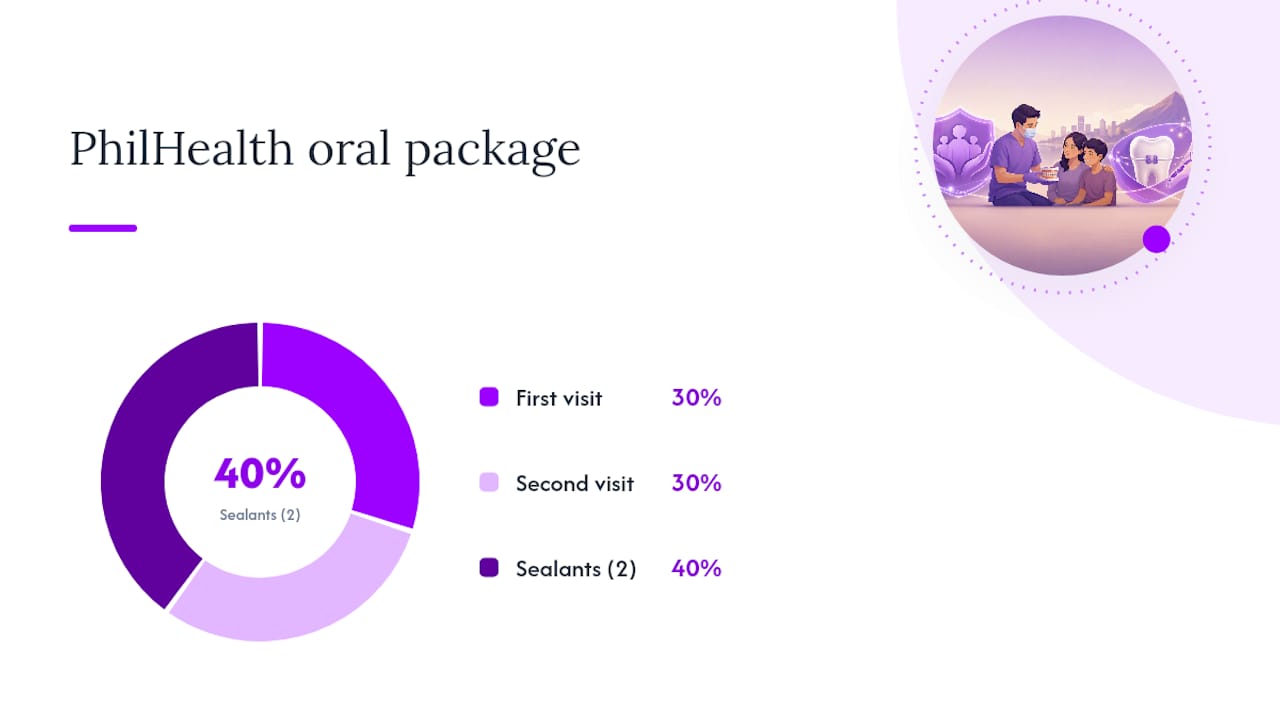
PhilHealth explicitly does not cover orthodontics, root canals, or non-emergency extractions. DOH statements accompanying the benefit expansion confirm the package was designed to widen access to preventive care, not to subsidize corrective or cosmetic dental work.
So how should you actually use these two systems together? The smart approach is division of labor:
- Use PhilHealth for your annual cleaning, exam, and fluoride visit since it’s essentially free money you’re already entitled to.
- Use your private HMO dental benefit for fillings, simple extractions, and anything else on its covered list.
- Budget separately, and outside both systems, for orthodontics.
Stacking PhilHealth and a private HMO trims your out-of-pocket spending on routine care to nearly zero. It does nothing for braces. Treat the two benefits as complementary tools for maintenance, not as a combined fund you can somehow direct toward orthodontic treatment.
Can orthodontic treatment ever qualify as medically necessary?
Coverage for braces isn’t a flat no in every case. Insurers do sometimes approve orthodontic treatment when it’s tied to a functional problem rather than appearance, though approval is conservative and full coverage remains uncommon even then.
The cases most likely to qualify include:
- Cleft palate or cleft lip repair requiring orthodontic correction as part of reconstructive treatment.
- Severe malocclusion that measurably interferes with chewing, swallowing, or speech.
- Jaw alignment issues stemming from trauma or a diagnosed skeletal condition.
If you believe your situation fits one of these categories, your claim needs paperwork that leaves no room for doubt. Insurers typically want a written letter from your orthodontist explaining the functional impairment, diagnostic photos, X-rays or cephalometric images, a full treatment plan, and a cost estimate. A vague note that says “patient would benefit from braces” won’t move a claims reviewer. A report tying crooked teeth to documented feeding or speech difficulty has a real shot.
Even with strong documentation, insurers tend to evaluate these claims case by case and conservatively, and partial reimbursement is more common than full coverage.
Pro Tip: Ask your orthodontist to write the referral letter in clinical language that names the functional impact directly, “impaired mastication” or “speech articulation deficit” carries more weight with a claims desk than “cosmetic concern” or “crowded teeth.”
How to get a definitive answer from your HMO before you commit to treatment
Guessing wastes money. Here’s the sequence that gets you a real answer instead of a runaround:
- Pull your plan’s Schedule of Benefits and read the exclusions section line by line, specifically looking for the words “orthodontic,” “braces,” or “aligners.”
- Contact your HR department or HMO account officer and ask directly whether your dental rider includes any orthodontic benefit, even a partial one.
- Request the LOA and pre-authorization process for dental claims, along with the current list of accredited dental clinics.
- If you’re pursuing a medical-necessity claim, submit your orthodontist’s diagnostic documents to your HMO’s claims desk before starting treatment, not after.
Waiting periods for new HMO enrollees commonly apply to major dental and elective procedures, so a plan you just joined this quarter may reject anything beyond emergency care regardless of what’s eventually allowed. LOA turnaround for standard dental visits is usually quick, often same day or next business day, but a medical-necessity orthodontic review can take considerably longer since it typically requires a specialist’s sign-off rather than a routine desk approval.
Watch for a specific red flag: if your HMO’s customer service can’t tell you an LOA process exists for orthodontics at all, that’s a stronger signal than any exclusions list. It usually means the benefit was never built into your plan.
Pro Tip: Request a sample LOA timeline and the accredited-dentist list before your first diagnostic appointment, not after. Some clinics charge upfront diagnostic fees that your HMO won’t reimburse if the visit turns out to fall outside your coverage, and you want that answer before you’re in the chair.
For the full mechanics of LOAs and waiting periods across HMO plans generally, this guide on how to use your HMO in the Philippines breaks down each step in more detail.
Paying for braces when your HMO says no
If your plan and PhilHealth both come back with a no, you still have workable options. Most orthodontic patients in the Philippines are paying out-of-pocket already, and clinics have built financing structures around that reality.
- Clinic installment plans are the norm rather than the exception, typically requiring a deposit at the first adjustment visit followed by monthly payments spread across 12 to 24 months.
- Some clinics offer a discount for paying the full treatment cost upfront instead of financing it.
- If your employer offers a dental allowance or a premium HMO add-on with partial orthodontic benefits, ask HR how to submit for reimbursement and what documentation they need.
- Credit card installment plans through your bank can sometimes beat a clinic’s in-house financing rate, worth comparing before you sign anything.
- Negotiate the full package upfront, meaning diagnostics, retainers, and follow-up adjustment visits bundled into one quoted price rather than a per-visit fee that creeps upward over two years.
Clinics generally have more flexibility to negotiate than insurers do, since installment plans and payment schedules are a routine part of how orthodontic practices manage cash flow. Ask before you assume the sticker price is fixed.
What braces actually cost in the Philippines
Budgeting for orthodontic treatment starts with realistic numbers, and prices vary more by clinic and case complexity than by brand of bracket.
Traditional metal braces tend to sit at the lower end of the price range and remain the most common option nationwide. Ceramic or tooth-colored brackets cost more for the cosmetic upgrade but function the same way. Clear aligner systems sit at the higher end, priced for convenience and near invisibility rather than superior results in most straightforward cases.
Four factors drive the final quote more than anything else:
- Case complexity, since a simple crowding correction costs less than a case requiring extractions or jaw work.
- Clinic location and reputation, with metro-area specialists typically pricing above provincial general dentists.
- Treatment duration, since longer cases mean more adjustment visits billed over time.
- Whether retainers and post-treatment diagnostics are bundled into the quote or billed separately at the end.
Given that PhilHealth’s entire annual dental benefit caps at ₱1,000, it’s worth seeing that figure next to any orthodontic quote you receive. It puts in perspective just how far outside routine dental coverage braces actually sit. Get every clinic’s estimate in writing, itemized by phase, before you commit. Verbal quotes have a way of growing once treatment starts.
How HMO Plans by Purple Cow approaches dental benefits for SME teams
If you’re an SME owner or HR lead reading this because employees keep asking about braces, the fix usually isn’t hunting for a plan that magically covers orthodontics. It’s building a smarter dental benefit structure around what your team actually needs.
HMO Plans, underwritten with Purple Cow and Etiqa, offers optional dental HMO add-ons that SMEs can layer onto a base health plan rather than leaving dental as an afterthought. Employees get cashless access across accredited networks including the Big 9 Hospitals and Healthway Clinics, plus out-of-network reimbursement when the nearest accredited provider isn’t convenient.
- Optional dental add-ons that extend beyond the standard preventive package.
- Cashless claims processing at accredited facilities, reducing upfront costs for staff.
- Support navigating documentation for medical-necessity claims, including LOA coordination.
- Coverage structured around SME budgets rather than one-size-fits-all enterprise pricing.
Employers who add a dental rider aren’t promising employees free braces, they’re removing the guesswork around routine dental costs so orthodontic conversations become a financing question instead of a coverage mystery.
HR teams evaluating this should start with the dental coverage enrollment guide to see how add-ons get structured and reimbursed.
Where to verify these rules yourself
Confirm the details above before making treatment decisions, since policy wording and benefit caps can change year to year.
- PhilHealth’s oral health benefit rollout for the official preventive package breakdown.
- ClinicFinderPH’s dental benefits guide for a plain-language exclusions summary.
- HMO Plans’ home page for SME add-on details and enrollment.
What SME owners get wrong about dental benefits
The mistake I see most often isn’t ignorance about orthodontics being excluded, it’s assuming that fact settles the conversation. It doesn’t. Employees still ask, HR still fields the same question every quarter, and the real gap isn’t coverage, it’s clarity. Most SMEs never actually read their dental rider closely enough to tell staff a straight answer.
Conventional advice tells employees to “check with HR,” which usually just relocates the confusion instead of resolving it. The better move is for HR to build a one-page dental FAQ once, covering what’s included, what an LOA requires, and where orthodontics genuinely stands, then stop fielding the same question individually.
For employers, the priority isn’t chasing a plan that magically covers braces. It’s choosing a dental add-on structure transparent enough that employees stop guessing, and flexible enough to support the rare medical-necessity case when one comes up. That’s a benefits design problem, not an insurance loophole waiting to be found.
Give your team dental clarity, not just dental coverage
Employees asking about braces coverage usually just want a straight answer, and most SME dental riders on the market bury that answer in fine print nobody hands out until a claim gets denied. Hmoplans builds its optional dental add-ons to sit clearly inside your existing group HMO plan, so HR can tell staff exactly what’s covered, what requires an LOA, and where the accredited clinics are, without digging through a policy binder every time someone asks.
Because HMO Plans is underwritten with Purple Cow and Etiqa, your team gets cashless access to networks like the Big 9 Hospitals and Healthway Clinics alongside whatever dental rider you choose, plus out-of-network reimbursement when convenience matters more than proximity to an accredited provider. That combination gives SME employers a dental benefit employees actually understand, rather than one they discover the limits of mid-treatment.
If you’re ready to see how a dental add-on fits your current group plan, check the features page for specifics on what’s included, or reach out through the HMO Plans site to get a quote scoped to your team’s size and budget.
Frequently Asked Questions
Does HMO orthodontics coverage exist for adults or only children in the Philippines? Age generally isn’t the deciding factor. Whether an insurer considers orthodontics is tied to medical necessity documentation, not the patient’s age, so an adult with a qualifying functional issue has the same narrow path to partial coverage as a child would.
Will my HMO cover braces if a dentist says I need them for jaw pain? Jaw pain alone rarely triggers coverage. You need a documented functional diagnosis, such as malocclusion affecting chewing or speech, backed by your orthodontist’s written report and diagnostic imaging, before an insurer will even review a medical-necessity claim.
Can I use PhilHealth’s dental benefit toward the cost of braces? No. PhilHealth’s preventive oral health package caps at ₱1,000 per year and covers only exams, cleaning, fluoride, and limited sealants. It cannot be applied toward orthodontic treatment under any circumstance.
How long does an LOA approval take for dental claims? Standard covered dental visits usually get LOA approval within a day or two. Medical-necessity orthodontic reviews take considerably longer since they typically require a specialist’s evaluation rather than a routine administrative check.
Should my SME add a dental rider even if it won’t cover orthodontics? Yes, since routine dental costs, cleanings, fillings, extractions, add up for employees over a year, and a dental rider covers those predictably. It won’t solve braces coverage, but it removes the bulk of routine dental spending from your team’s pocket.
This article is general information, not a substitute for advice from a qualified financial advisor. Consult a qualified financial professional about your own circumstances before acting on anything here.
Sources
- PhilHealth dental benefits 2026 (ClinicFinderPH)
- PNA reporting on PhilHealth dental benefit (press coverage of DOH/PhilHealth changes)
Recommended
- How to Use Your HMO in the Philippines: LOA, Pre-Authorization & Waiting Periods Explained
- Is HMO Tax-Deductible in the Philippines? An Executive & CFO Guide (2026)
- How Much Does HMO Cost Per Employee in the Philippines? 2026 SME Pricing Guide
- HMO Tax-Deductible in the Philippines? An Executive & CFO Guide (2026)
