

Why Offer Mental Health Coverage to Your Employees
TL;DR:
- Offering mental health coverage improves employee retention, reduces disability claims, and increases productivity. Clear communication, accessible services, and workplace culture encourage actual utilization of benefits. For SMEs, investing in mental health support is essential for workforce stability and value.
Mental health coverage is defined as employer-sponsored insurance that pays for therapy, psychiatric care, medication management, and inpatient behavioral health services. For SMEs, the question of why offer mental health coverage is no longer a philosophical one. 69% of all employees consider mental health benefits critical when making job decisions. That number jumps to 83% for workers aged 18–34. Ignoring those figures means losing your best candidates to employers who take mental health seriously.
Why offer mental health coverage: the business case
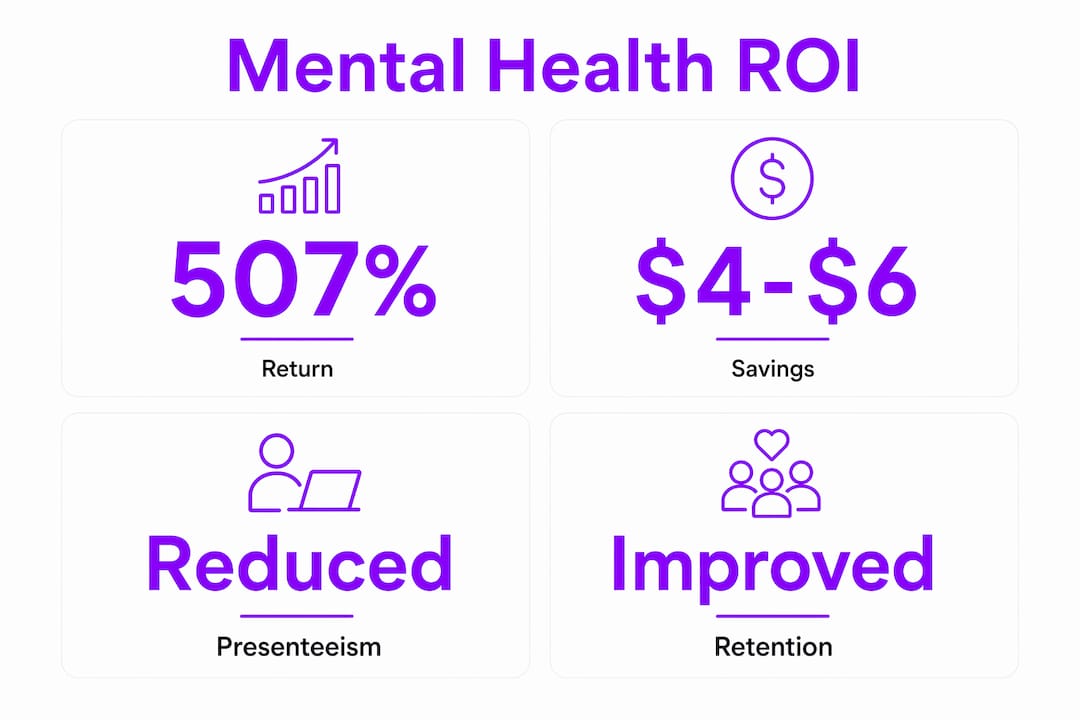
The most direct answer is financial. Behavioral health programs can return up to 507% on investment, saving $4 to $6 for every $1 spent. That return comes from three measurable sources: fewer disability claims, fewer emergency room visits, and higher daily productivity.
Most HR managers focus on absenteeism when measuring health costs. The bigger drain is presenteeism. Untreated mental health issues make presenteeism the leading hidden driver of lost productivity. An employee who shows up but cannot concentrate costs more than one who takes a sick day. The cost is invisible in medical claims, which is exactly why it goes unaddressed for so long.
Mental health coverage also directly affects your ability to hire and keep good people. When a candidate compares two job offers, benefits packages carry real weight. Offering meaningful mental health support signals that your company treats employees as whole people, not just output units. That reputation compounds over time through referrals, Glassdoor reviews, and word of mouth within professional networks.
Here is what strong mental health coverage delivers in concrete terms:
- Lower turnover costs. Replacing a mid-level employee costs roughly half their annual salary in recruiting and training. Retention improvements from mental health benefits pay for the coverage many times over.
- Reduced long-term disability durations. Effective mental health programs lower medical claims and shorten disability leave, keeping your workforce stable.
- Better engagement scores. Employees who feel supported report higher job satisfaction and stronger commitment to their teams.
- Fewer crisis escalations. Early intervention through therapy and counseling prevents minor stress from becoming a medical leave event.
Pro Tip: Track your presenteeism rate alongside absenteeism. If you only measure sick days, you are missing the larger productivity loss hiding in plain sight.
How do mental health parity laws affect employer responsibilities?
Parity laws require that employer-sponsored health plans cover mental health services on equal terms with medical and surgical benefits. Coverage cannot impose stricter visit limits, higher copays, or more burdensome prior authorization requirements for mental health care than for physical health care.
For SMEs, this means compliance is the floor, not the ceiling. A plan that technically meets parity requirements but buries mental health benefits in fine print still exposes you to legal scrutiny. Legal parity scrutiny is increasing, and regulators now evaluate whether access is real, not just whether coverage exists on paper.
Standard services that parity-compliant plans must include are:
- Individual and group therapy sessions
- Psychiatric evaluation and ongoing care
- Prescription medication management for mental health conditions
- Inpatient and outpatient behavioral health treatment
- Crisis intervention and emergency mental health services
The American Medical Association’s Mental Health Parity Index frames parity as a business imperative, not a compliance checkbox. Improper implementation leads to low utilization and little measurable benefit. The practical implication for HR managers is clear: design your plan so employees can actually use it, not just so it passes an audit.
What barriers stop employees from using mental health benefits?
Offering coverage and delivering usable support are two different things. A credibility gap exists when benefits are listed in a handbook but employees cannot find a provider, cannot afford the copay, or do not feel safe admitting they need help. That gap directly undermines the return on your investment.
The four most common barriers employees face are:
- Provider availability. Many plans have narrow networks with long wait times. An employee who calls three therapists and gets no appointment within two weeks will stop trying.
- Out-of-pocket cost. Even with coverage, copays and deductibles deter employees from seeking care, especially for ongoing therapy.
- Scheduling difficulty. Standard office hours conflict with work schedules. Without evening or weekend options, employees skip appointments.
- Stigma. Employees fear being seen as weak or unstable. Without a culture that normalizes mental health care, utilization stays low regardless of what the plan covers.
These barriers reduce utilization and limit the effectiveness of even well-designed coverage. The financial and human cost falls back on the employer through turnover, disability claims, and lost productivity.
Presenteeism is the clearest example of this dynamic. An employee managing untreated anxiety or depression comes to work every day but operates at a fraction of their capacity. The cost never shows up in a claims report. It shows up in missed deadlines, team friction, and eventually a resignation letter.
Pro Tip: Survey your employees anonymously about their experience using mental health benefits. If utilization is below 20%, your plan has a usability problem, not a coverage problem.
How can SMEs implement mental health coverage that employees actually use?
The importance of mental health benefits is only realized when employees trust the system enough to use it. Implementation determines whether your investment pays off or sits idle.

Start with communication. Most employees do not know what their mental health benefits cover or how to access them. A single open enrollment email is not enough. Repeat the message in team meetings, Slack channels, manager one-on-ones, and onboarding packets. Use plain language, not insurance terminology.
Combine virtual and in-person care options. Telehealth removes the scheduling and stigma barriers that stop employees from booking their first appointment. Offering both formats means employees choose the path that works for them, which increases the chance they follow through.
Train your managers. A manager who can say “I know we have counseling available, and I want you to use it if you need it” does more for utilization than any benefits brochure. Managers are the first point of contact when an employee is struggling. They need to know what resources exist and feel comfortable mentioning them without overstepping.
Measure outcomes regularly. Track utilization rates, employee satisfaction scores, and disability claim frequency. Compare those numbers year over year. If utilization is flat, the problem is access or awareness, not employee need. Adjust your communication strategy or your provider network before the next renewal cycle.
Extend coverage to dependents. An employee whose child or spouse is struggling with mental health will be distracted at work regardless of their own coverage. Plans that include dependent mental health benefits address the full picture of what affects your workforce.
Communicating benefits effectively to employees is a skill that HR managers must build deliberately. The best plan in the market fails if employees do not know it exists.
Key Takeaways
Mental health coverage delivers measurable business value only when it is accessible, communicated clearly, and supported by a workplace culture that treats mental health as a normal part of employee well-being.
| Point | Details |
|---|---|
| Financial ROI is real | Behavioral health programs return up to 507%, saving $4 to $6 per $1 invested. |
| Parity laws set the floor | Coverage must match medical benefits in access and cost, not just exist on paper. |
| Usability beats availability | A credibility gap forms when employees cannot find providers or feel unsafe using benefits. |
| Presenteeism is the hidden cost | Untreated mental health issues cost more through lost productivity than through absenteeism. |
| Communication drives utilization | Repeated, stigma-free messaging across multiple channels is what turns coverage into actual care. |
Mental health coverage is the investment SMEs cannot afford to skip
I have talked with enough HR managers at small companies to know the common objection: “We offer it, so it’s covered.” That thinking is exactly where the money gets lost. Offering a benefit and delivering a benefit are not the same thing. The gap between those two is where your best employees quietly burn out and start looking elsewhere.
The ROI data is not abstract. When employees get early support for depression or anxiety, they stay in their roles longer, take fewer sick days, and cost less in medical claims over time. That is not a wellness talking point. That is a workforce continuity argument that belongs in your budget conversation.
What I find most underestimated is culture. A plan with excellent coverage still fails if your managers treat mental health conversations as HR problems to avoid. The companies that see real returns from their mental health benefits are the ones where leadership talks openly about stress, models help-seeking behavior, and removes the shame from asking for support. That costs nothing extra. It just requires intention.
For SMEs specifically, the stakes are higher than at large corporations. You have fewer people, so each person’s output matters more. One employee on extended leave due to untreated burnout can disrupt an entire team. Proactive mental health support is not a luxury for companies with 20 or 50 employees. It is a risk management decision.
— Eumir
How Hmoplans supports SMEs with mental health coverage
SMEs in the Philippines now have a direct path to comprehensive HMO coverage through Hmoplans, powered by Purple Cow and underwritten by Etiqa. Plans include access to the Big 9 Hospitals and Healthway Clinics, cashless care, and 24/7 nationwide coverage with no complicated exclusion language.
Hmoplans covers pre-existing and congenital conditions up to the Maximum Benefit Limit, with optional add-ons for dental care, annual physical exams, and life and accident insurance. For HR managers who want to offer mental health support at work without navigating a maze of fine print, Hmoplans delivers straightforward, cost-effective plans built specifically for teams like yours. Reach out to Hmoplans to get a plan that your employees will actually use.
FAQ
Why does mental health coverage matter for small businesses?
Mental health coverage reduces turnover, lowers disability claims, and improves daily productivity. Behavioral health programs return up to 507% on investment, making them one of the highest-value benefits an SME can offer.
Are employers legally required to offer mental health benefits?
Employer-sponsored health plans must comply with parity laws, meaning mental health coverage cannot be more restrictive than medical or surgical benefits. This includes therapy, psychiatric care, and inpatient behavioral health treatment.
What is the biggest reason employees do not use mental health benefits?
The credibility gap is the most common barrier. Employees either cannot find available providers, face high out-of-pocket costs, or feel stigma prevents them from seeking care, even when coverage technically exists.
How can HR managers increase mental health benefit utilization?
Repeat benefit communications across multiple channels, offer telehealth options to remove scheduling barriers, and train managers to mention resources directly. Utilization rises when employees trust the system and know how to access it.
Does mental health coverage affect employee retention?
Yes. 69% of employees and 83% of workers aged 18–34 say mental health benefits influence their job decisions. Offering meaningful coverage directly improves your ability to attract and keep qualified employees.
