
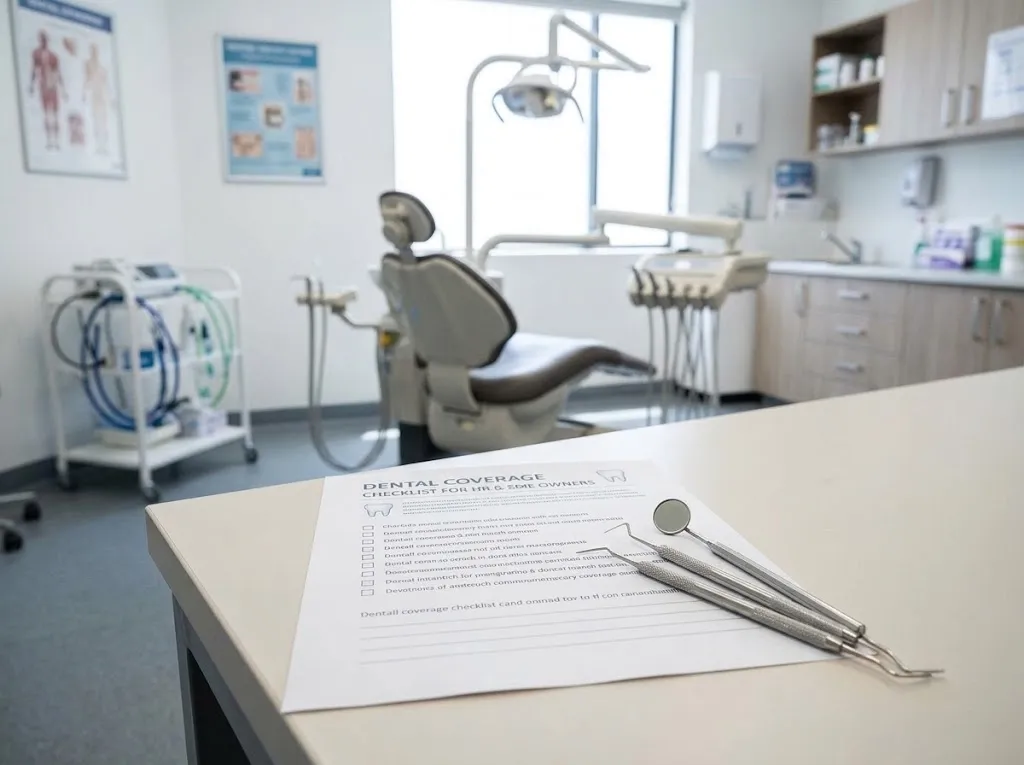
Dental Coverage Checklist for HR and SME Owners
TL;DR:
- HR must verify plan type, waiting periods, and coverage limits before buying group dental plans. Checking documents like SBC, sample EOB, and network directories ensures transparency and avoids eligibility surprises. Model different cost scenarios to evaluate the true value of the plan for employees.
When buying group dental coverage, HR must verify ten things immediately: plan type (PPO vs. DHMO), waiting periods, annual maximum, covered services and frequency limits, in-network vs. out-of-network rules, deductibles and coinsurance, missing-tooth clauses, prior authorization requirements, EOB transparency, and coordination of benefits. Request the Summary of Benefits and Coverage (SBC), a network directory filtered by plan name, and a sample Explanation of Benefits (EOB) before signing anything.
Quick dental coverage checklist:
- [ ] Plan type confirmed (PPO or DHMO) and trade-offs understood
- [ ] Waiting periods documented for basic and major services
- [ ] Annual maximum amount and reset date confirmed
- [ ] Preventive, basic, major, and orthodontia coverage percentages verified
- [ ] In-network dentist directory received and spot-checked by phone
- [ ] Deductible, coinsurance, and copay structure reviewed
- [ ] Missing-tooth clause and pre-existing exclusions identified
- [ ] Prior authorization process and turnaround time confirmed
- [ ] Sample EOB and claims-turnaround SLA received
- [ ] Coordination of benefits rules documented for dual-coverage employees
Table of Contents
- Why a dental coverage checklist matters for HR
- Detailed dental benefits checklist: item-by-item checks and red flags
- How to estimate total cost and employee value
- Vendor questions and documents to request before you buy
- Pre-deployment tests: what to run before rolling the plan out
- Common pitfalls and red flags HR should avoid
- Printable one-page dental benefits checklist
- Key Takeaways
- A benefits manager’s view on buying dental coverage
- Useful authoritative sources to consult
- Hmoplans makes dental add-ons straightforward for SMEs
Why a dental coverage checklist matters for HR
A checklist prevents eligibility surprises and unplanned out-of-pocket costs before they become employee complaints or payroll headaches. Dental insurance is a defined-benefit product: the annual maximum caps what the insurer pays in a plan year, and once employees hit that ceiling, every additional dollar comes out of their pocket. Annual maximums typically range within a commonly observed band, which means a single crown or root canal can exhaust the benefit entirely.
The American Dental Association recommends using preventive benefits (two cleanings and exams per year, typically covered at 100%) as soon as coverage begins. Employees who skip preventive care often face higher-cost procedures later, which accelerates how quickly they hit the annual maximum.
For U.S.-based employers, federal compliance adds another layer. ACA rules govern pediatric dental benefits on Marketplace plans, and COBRA continuation coverage must be offered when employees lose group dental eligibility. Skipping due diligence on these points creates legal exposure, not just HR friction.
Detailed dental benefits checklist: item-by-item checks and red flags
1. Plan type: PPO vs. DHMO
PPOs offer flexibility and out-of-network options; DHMOs have lower premiums but require in-network use. Ask the carrier: “What is the network size in our employees’ zip codes, and does the plan allow any out-of-network reimbursement?”

2. Waiting periods
Waiting periods commonly occur for several months for major services. A long wait paired with a low annual maximum is a red flag. Ask: “What is the waiting period for basic and major services, and can it be waived for employees transitioning from a prior plan?”
3. Annual maximum
Confirm the dollar amount and whether it resets on a calendar year or plan year. An annual maximum around a mid-thousand-dollar range is typical; a significantly lower maximum offers thin protection for employees expecting restorative work.
4. Covered services and frequency limits
Verify typical coverage percentages for preventive, basic, major, and orthodontia services, noting that preventive services often have the highest coverage and orthodontia may have lifetime maximum limits and age restrictions. Confirm frequency limits on cleanings, X-rays, and crown replacements.
5. In-network vs. out-of-network rules
Online directories are often 6–12 months out of date. Always verify network participation by calling the dental office directly and quoting the exact plan name.
6. Deductibles, coinsurance, and copays
Get the individual and family deductible amounts, whether the deductible applies to preventive services, and the coinsurance split for each service category.
7. Missing-tooth clause
Plans may refuse to cover replacement of teeth lost before the policy effective date. This clause catches employees off guard when they need implants or bridges. Ask: “Does the plan include a missing-tooth clause, and can a rider be added to cover pre-existing tooth loss?”
8. Prior authorization
Pre-determination is recommended for procedures typically exceeding $200–$500 and reduces billing surprises by providing an EOB estimate before work begins. Ask for the carrier’s pre-authorization turnaround time in writing.
9. EOB transparency and claims turnaround
Request a sample EOB and the claims-turnaround SLA. A carrier that cannot provide a sample EOB is a red flag. Standard turnaround is 30 days or fewer for clean claims.
10. Coordination of benefits (COB)
For employees covered under a spouse’s plan, confirm how the carrier handles COB. Ask: “Is your plan primary or secondary by default, and how is the COB calculation applied to the annual maximum?”
Red flags that warrant escalation or rejection:
- Zero access to sample EOBs before enrollment
- 12-month waiting period for basic services combined with a sub-$1,000 annual maximum
- Missing-tooth clause with no rider option
- Network directory not filterable by exact plan name
- No written claims-turnaround SLA
Pro Tip: Call two or three dentist offices in your employees’ area, give them the exact plan name (not just the carrier name), and ask if they are currently accepting new patients under that specific plan. Directories list contracted providers, not available ones.
How to estimate total cost and employee value
Choosing a plan on premium alone misses the full picture. Model three scenarios before committing.
| Scenario | Annual Premium (Employer) | Employee Deductible | Expected Procedures | Employee Out-of-Pocket | Annual Max Hit? |
|---|---|---|---|---|---|
| Low use | — | — | 2 cleanings, 1 exam | ~— | No |
| Moderate use | — | — | Cleanings + 1 filling | — | No |
| High use | — | — | Crown + root canal | — | Yes |
Spreadsheet skeleton (copy into Excel or Google Sheets):
- Column A: Employee name or ID
- Column B: Monthly premium (employer share)
- Column C: Annual premium total (B × 12)
- Column D: Deductible amount
- Column E: Expected procedures and estimated cost
- Column F: Plan coinsurance (employee share %)
- Column G: Estimated employee out-of-pocket (D + [E × F])
- Column H: Annual maximum
- Column I: Gap (G minus H, if positive = employee exposure above max)
Pro Tip: For employees who need multi-stage major work (implant placement plus crown, or phased periodontal treatment), schedule the first stage before December 31 and the second stage in January. This splits the cost across two plan years and effectively doubles the insurer’s contribution.
Vendor questions and documents to request before you buy
Ask for these documents before any selection decision. A carrier that hesitates to provide them is telling you something.
Document checklist:
- Summary of Benefits and Coverage (SBC) — reveals covered services, exclusions, and cost-sharing structure
- Provider directory filtered by exact plan name — confirms actual network access in your employees’ locations
- Sample Explanation of Benefits — shows how claims are processed and what employees will receive after treatment
- Sample member ID card — confirms plan name appears exactly as listed in the network directory
- Claims-turnaround SLA — documents the carrier’s processing commitment in writing
- Prior-authorization turnaround time — critical for major procedures; request this separately from the SLA
Sample email to send to carriers:
Pre-deployment tests: what to run before rolling the plan out
Test before you launch to avoid eligibility surprises on day one. Run these steps during the two weeks before the effective date.
- Eligibility verification test. Submit two or three sample employee records through the carrier’s real-time eligibility portal. Confirm active status, effective date, and plan name match exactly.
- Provider directory spot-check. Call two dentist offices listed in the directory. Quote the exact plan name and ask if they are accepting new patients under that plan.
- Pre-authorization simulation. Submit a dummy pre-authorization request for a crown (a common major procedure). Confirm the carrier responds within their stated SLA.
- EOB walkthrough. Ask the carrier to walk your HR team through a sample EOB line by line. Confirm your team can explain it to employees.
- COB test. If any employees have dual coverage, verify the COB calculation with the carrier using a sample scenario.
Acceptance criteria: All five tests pass before the plan goes live. If the provider directory spot-check fails (dentist does not recognize the plan name), escalate to the carrier account manager immediately.
Pro Tip: Document every test with a date, the name of the carrier representative you spoke with, and a reference number. This record protects you if disputes arise after launch.
Common pitfalls and red flags HR should avoid
These are the high-risk items that should prompt escalation or automatic rejection.
- Focusing only on premium. A lower premium often means a lower annual maximum or longer waiting periods. Model total cost across all three scenarios above before deciding.
- Ignoring the annual maximum. Employees expecting major work will exhaust a $1,000 maximum quickly. Negotiate a higher cap or add a supplemental rider for budget-friendly alternatives that reduce out-of-pocket risk.
- Overlooking waiting periods. A 12-month wait for basic services is unusual and should be negotiated down or rejected. Shorter or zero-wait plans increase employee satisfaction significantly.
- Failing to verify in-network status by phone. Directory listings go stale. Always call.
- Missing the missing-tooth clause. Review the policy certificate for pre-existing tooth loss exclusions and negotiate a rider if replacements are likely for your workforce.
- Assuming preventive equals full coverage. Some low-premium plans charge copays even for cleanings. Read the SBC carefully.
Mitigation steps:
- Require a sample EOB and SLA before signing.
- Negotiate a shorter waiting period in writing, especially for basic services.
- Add a supplemental dental rider if the base annual maximum is below $1,500.
- Confirm the exact plan name appears on the member ID card and matches the network directory.
Printable one-page dental benefits checklist
Copy this list for vendor evaluation meetings or carrier calls.
- [ ] Plan type — PPO or DHMO confirmed; trade-offs documented
- [ ] Waiting periods — basic and major service wait times in writing
- [ ] Annual maximum — dollar amount and reset date confirmed
- [ ] Covered services — preventive, basic, major, ortho percentages verified
- [ ] Frequency limits — cleanings, X-rays, crown replacements noted
- [ ] Network access — directory received; two offices verified by phone
- [ ] Deductible and coinsurance — individual and family amounts confirmed
- [ ] Missing-tooth clause — reviewed; rider option confirmed if needed
- [ ] Prior authorization — process and turnaround time in writing
- [ ] EOB and SLA — sample EOB received; claims SLA documented
- [ ] COB rules — dual-coverage calculation confirmed
- [ ] Decision — Plan approved / Rejected / Pending negotiation
Before you sign: Confirm you have the SBC, a network directory filtered by exact plan name, a sample EOB, a sample ID card, and a written claims-turnaround SLA. These five documents are your procurement record and your first line of defense against eligibility surprises after launch.
Key Takeaways
A complete dental coverage checklist covers plan type, waiting periods, annual maximum, covered services, network access, cost-sharing, exclusions, prior authorization, EOB transparency, and coordination of benefits — evaluated together, not in isolation.
| Point | Details |
|---|---|
| Annual maximum is the key risk driver | An annual maximum around a mid-thousand-dollar range is typical; model high-use scenarios before selecting. |
| Verify network by phone, not directory | Online directories are often 6–12 months out of date; call dentist offices using the exact plan name. |
| Waiting periods need negotiation | Major-service waits of 6–12 months are common; negotiate shorter periods or waivers for transitioning employees. |
| Request five documents before signing | SBC, network directory, sample EOB, sample ID card, and claims-turnaround SLA are non-negotiable procurement artifacts. |
| Hmoplans dental add-on | Hmoplans offers dental HMO as an optional add-on to group health plans for SMEs, with flexible customization and no complicated terms. |
A benefits manager’s view on buying dental coverage
The most underestimated lever in dental plan negotiations is the waiting period, not the premium. Most HR teams accept a 6–12 month wait for major services as standard, but carriers will often shorten it to 3 months or waive it entirely for groups transitioning from a comparable plan. Ask for it in writing during the proposal stage, before you have any leverage.
The second lever is the sample EOB. Carriers that resist providing one before enrollment are signaling that their claims processing is opaque. An EOB that employees cannot understand generates billing disputes, HR tickets, and provider friction. Require a walkthrough of a sample EOB as part of your vendor evaluation, not as an afterthought.
Third, build a simple eligibility verification habit before every enrollment cycle. Confirm active status, remaining annual maximum, and frequency limits for each covered employee. This takes minutes per person and eliminates the most common source of day-one surprises. Pair this with clear employee benefits communication so your team knows exactly what they have before they sit in the dentist’s chair.
Useful authoritative sources to consult
These sources back the technical claims in this guide and should be cross-referenced during vendor evaluation.
- American Dental Association — Dental Benefits: Authoritative overview of PPO and DHMO plan structures; use when evaluating plan-type trade-offs with carriers.
- Cleveland Clinic — Dental Insurance Basics: Clear explanation of annual maximums and defined-benefit structure; share with employees during enrollment communications.
- MouthHealthy (ADA) — Choosing the Right Dental Plan: Total-cost modeling guidance; use when building your three-scenario spreadsheet.
- Guardian Life — Waiting Periods: Benchmark data on waiting-period norms; cite when negotiating shorter waits with carriers.
- Delta Dental — Pre-Determination of Benefits: Explains pre-authorization workflows; use when requesting prior-auth SLAs from vendors.
- Delta Dental NJ — Missing Tooth Clause: Defines the exclusion clearly; use when reviewing policy certificates for pre-existing tooth loss.
- ToothCostGuide — How to Use Dental Insurance: Practical guidance on verifying network status by phone and maximizing preventive benefits.
- Gentle Dental — Key Features of a Great Dental Insurance Plan: Confirms the five documents HR should request; use as a vendor-document checklist reference.
Keep copies of the SBC, sample EOB, and network directory on file as procurement artifacts. They are your evidence if a coverage dispute arises after launch. For provider credential verification, Anetco Dental offers practical resources for confirming provider qualifications and network participation.
Hmoplans makes dental add-ons straightforward for SMEs
Group dental coverage in the U.S. market is complex, but your employees’ overall health benefits package does not have to be. Hmoplans offers dental HMO as a flexible optional add-on to its group health plans for SMEs, with no complicated terms, 100% coverage for pre-existing conditions up to the Maximum Benefit Limit, and cashless access to accredited clinics nationwide.
For SME owners and HR teams who want a single, well-structured benefits package that includes dental without managing multiple carriers, Hmoplans is built for exactly that. The dental benefits add-on integrates with the core HMO plan, so your team gets one card, one portal, and one point of contact for claims and eligibility questions. Ready to see what fits your headcount and budget? Get a group plan quote and have a plan document in hand within days.
