

Why dental coverage matters for Philippine SMEs
TL;DR:
- Over 70% of Filipino adults suffer from dental caries, leading to health and productivity issues. Providing dental coverage can reduce absenteeism, improve employee retention, and serve as a competitive talent advantage. Early investment in dental benefits offers long-term cost savings and enhances workplace wellness.
More than 72% of Filipino adults suffer from dental caries, yet the majority never seek treatment because they simply cannot afford it. For SME owners and HR managers, this is not a distant public health statistic. It is sitting right inside your office, showing up as missed deadlines, sick days, and quiet resignations. Most businesses treat dental coverage as a nice perk reserved for big corporations with bigger budgets. This article will show you exactly why that assumption is costing you more than you think, and how offering the right dental benefits can reshape your workforce health, your hiring power, and your bottom line.
Table of Contents
- The real state of dental health for Filipino workers
- How dental coverage transforms business outcomes and productivity
- Dental coverage as an SME talent advantage
- Planning and implementing effective dental coverage
- Why most SMEs miss the real value of dental coverage
- Unlock better talent and health with the right dental coverage partner
- Frequently asked questions
Key Takeaways
| Point | Details |
|---|---|
| Dental health crisis | Most Filipino workers are affected by poor oral health, impacting their work and the business bottom line. |
| Competitive hiring edge | Offering dental coverage helps SMEs win and retain talent compared to rivals with only basic government health benefits. |
| Cost savings over time | Preventive dental care lowers business expenses by reducing advanced treatment claims and absenteeism. |
| Implementation matters | Careful planning and employee communication make dental benefits investment pay off for SMEs. |
The real state of dental health for Filipino workers
With the urgency established, let’s examine what these statistics mean for your enterprise.
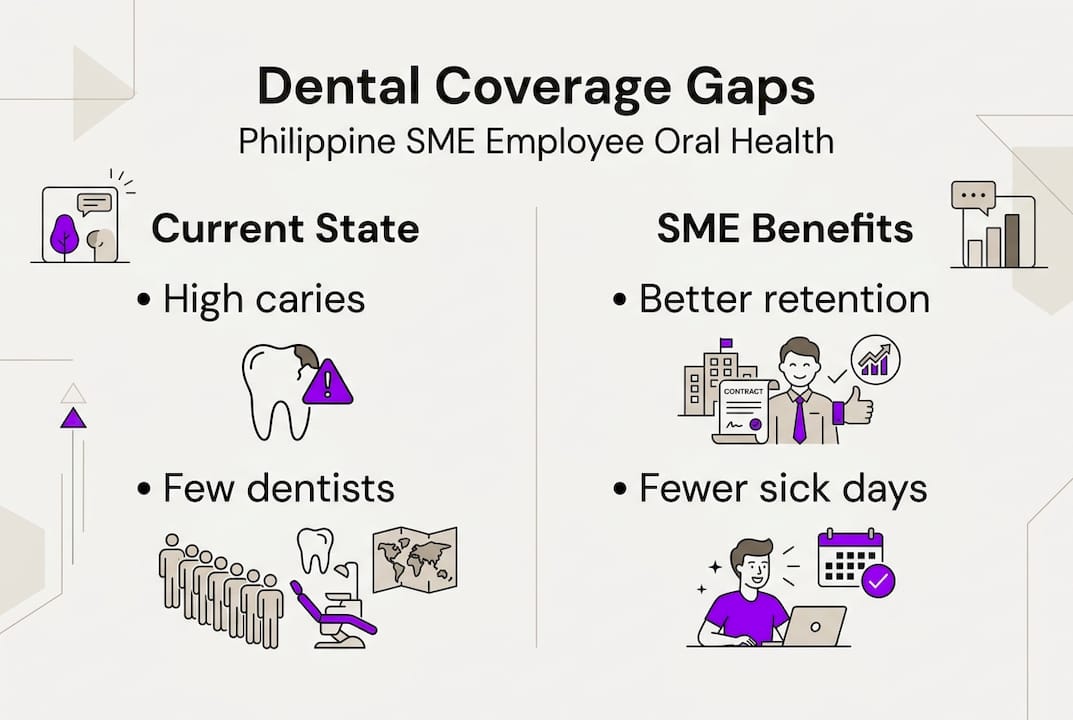
The numbers are startling. Dental caries prevalence among Filipino adults ranges from 72% to 87%, and the country’s dentist-to-population ratio sits at roughly 1 per 53,000 people. That means access to basic dental care is already a serious structural problem before you even factor in affordability.
For most Filipino workers, dental treatment is paid entirely out of pocket. A single tooth extraction can cost PHP 500 to PHP 2,000 at a private clinic. A root canal easily runs PHP 5,000 to PHP 12,000. When workers are already stretching every peso, these costs mean they delay treatment for months, sometimes years. By the time they seek help, a simple cavity has become an infection requiring multiple procedures and multiple days off work.
This pattern has direct consequences for your business:
- Absenteeism: Toothaches, dental infections, and post-procedure recovery drive unplanned absences. Unlike a cold, dental pain rarely resolves on its own without treatment.
- Presenteeism: Workers who show up in pain but cannot focus are arguably more costly than those who stay home. Poor concentration, irritability, and slow output are all symptoms of untreated dental pain.
- Morale and team dynamics: Chronic pain wears people down. It affects mood, communication, and the energy employees bring to collaborative work.
- Long-term health linkage: Oral health is connected to cardiovascular disease, diabetes complications, and respiratory infections. Poor dental health can escalate into more serious conditions, increasing overall medical claims costs.
The workplace wellness impact of untreated dental issues ripples far beyond the individual employee. HR managers who monitor attendance and productivity patterns often overlook oral health as a root cause, focusing instead on visible sick day trends without tracing them back to their origin.
“Oral health is integral to overall health. Failing to address it in the workplace creates a hidden drain on productivity, morale, and operational continuity.”
| Dental Health Indicator | Philippine Statistic |
|---|---|
| Adult dental caries prevalence | 72% to 87% |
| Dentist-to-population ratio | 1 per 53,000 |
| Workers with dental insurance | Less than 15% (private sector) |
| Average cost of root canal (private clinic) | PHP 5,000 to PHP 12,000 |
The table above makes one thing clear: the gap between dental need and access is enormous, and your employees are sitting right in the middle of it.
How dental coverage transforms business outcomes and productivity
Understanding ROI is crucial, but it’s also important to see how coverage translates to hiring power and employee satisfaction.
There is a strong evidence base for the financial logic of employer-provided dental coverage. A subsidized oral health package in the Philippines is cost-effective at ICER of PHP 75,636 per Disability-Adjusted Life Year (DALY) averted, delivering better value than out-of-pocket payments for the same conditions. In plain terms: every peso invested in preventive dental care saves your organization significantly more than it costs, because prevention is always cheaper than emergency treatment.
Here is how that plays out in practice for SMEs:
- Fewer emergency absences: Employees with dental coverage get regular checkups, catch problems early, and rarely need to take multiple days off for emergency extractions or infections.
- Lower overall claims costs: Preventive cleanings and early cavity treatments are far less expensive than the hospitalization that can follow an untreated dental infection that spreads to the jaw or bloodstream.
- Stronger recruitment results: When candidates compare job offers, benefits packages are weighed carefully. A role that includes dental coverage immediately stands out against one that offers only the mandatory minimum.
- Higher employee retention: Workers who feel cared for by their employer stay longer. Replacing a mid-level employee can cost six to nine months of their salary in recruiting, onboarding, and lost productivity. Dental coverage is a fraction of that cost.
- Improved workplace culture: Benefits communicate values. When you invest in employee health, people notice. It signals that your organization sees them as people, not just labor inputs.
Pro Tip: Don’t wait until employees start complaining about dental pain. Build dental coverage into your benefits package before it becomes a retention crisis. Reactive benefits design almost always costs more than proactive planning.
The employee care and cost savings that come from dental coverage are most visible after the first year of implementation, when you can compare absenteeism data and claims trends. Many SMEs that have introduced dental HMO add-ons report noticeably lower unplanned sick leave within 12 months.
In the Philippine context, HMO dental coverage typically runs between PHP 10,000 and PHP 30,000 per employee per year depending on the level of services included. When you set that against the cost of just one unplanned absence, one emergency dental hospitalization, or one failed hire, the math becomes hard to argue with.

The productivity multiplier is real. Research consistently shows that employees with access to preventive dental benefits report higher job satisfaction and take fewer sick days annually compared to those without any dental coverage. For an SME with 20 to 50 employees, even a 5% reduction in absenteeism translates to dozens of recovered workdays each year.
| Coverage Type | Annual Cost per Employee | Key Benefit |
|---|---|---|
| No dental coverage | PHP 0 upfront | Emergency treatment costs borne by employee |
| Basic dental HMO | PHP 10,000 to PHP 15,000 | Cleanings, fillings, extractions covered |
| Comprehensive dental HMO | PHP 18,000 to PHP 30,000 | Orthodontics, root canals, periodontal care |
Dental coverage as an SME talent advantage
With the competitive landscape clear, here’s how to design a dental benefits strategy that fits your organization.
Most SMEs in the Philippines default to the legally mandated minimum: PhilHealth enrollment. PhilHealth covers some hospitalization and outpatient procedures, but it provides virtually no dedicated dental coverage beyond emergency tooth extractions under specific conditions. That means for day-to-day oral health needs, your employees are entirely on their own.
This is exactly where private dental HMO coverage becomes a differentiator. As research confirms, private dental HMO benefits give SMEs a genuine competitive edge in attracting talent that PhilHealth simply cannot provide.
Here is how the two options compare:
| Feature | PhilHealth | Dental HMO |
|---|---|---|
| Dental cleanings | Not covered | Covered |
| Fillings and extractions | Emergency only | Covered |
| Root canals | Not covered | Covered (comprehensive plans) |
| Orthodontics | Not covered | Covered (select plans) |
| Preventive checkups | Not covered | Covered |
| Employee out-of-pocket cost | High | Low to none |
Understanding the PhilHealth vs HMO distinction is the first step toward a smarter benefits strategy. PhilHealth is your legal floor. Dental HMO is your competitive ceiling.
Younger workers, particularly Millennials and Gen Z employees who now make up the majority of the Philippine workforce, rank health benefits among their top three factors when evaluating job offers. They are often more informed about their health needs and more willing to walk away from employers who offer only the bare minimum. Dental coverage signals that you are a serious employer who invests in long-term employee wellbeing, not just someone looking for the cheapest compliant option.
Consider these advantages when positioning dental coverage as a recruiting tool:
- Job postings that list dental benefits receive more qualified applicants in competitive industries like tech, BPO, and healthcare.
- Onboarding conversations become easier when new hires see a real benefits package, setting a positive tone from day one.
- Referral hiring increases because employees who feel well taken care of are more likely to recommend your company to their networks.
Pro Tip: When recruiting for roles where two or three candidates are equally qualified, your dental and health benefits package can be the deciding factor. Use it deliberately. Mention it early in the hiring conversation, not as an afterthought.
Learning more about adding dental HMO benefits to your existing package is a practical first step if you currently only offer PhilHealth and want to start standing out in the talent market.
Planning and implementing effective dental coverage
With your plan in place, consider this perspective on why most SMEs overlook the true value of dental coverage and how you can do better.
Selecting and rolling out dental coverage is not complicated, but it does require intentional planning. Many SMEs make avoidable mistakes that reduce the effectiveness of their investment. Here is how to get it right.
Steps to implement dental coverage effectively:
- Assess your team’s current needs: Survey your employees anonymously. Ask about their most recent dental visit, their biggest dental health concerns, and what coverage they feel they need most. This data helps you choose the right plan level.
- Compare plan structures carefully: Look beyond the premium price. Review what is actually covered, which clinics are accredited, and whether the plan covers dependents. A cheaper plan with limited access will go unused.
- Choose a provider with strong SME support: Large corporate HMO providers often prioritize big accounts. Look for providers with dedicated SME service teams who understand your scale and budget constraints.
- Communicate the benefit clearly at launch: Many employees do not fully understand how to use their dental HMO. Host a brief orientation, share a simple one-page guide, and make sure your HR team can answer basic questions.
- Track usage after the first quarter: Low utilization is a red flag. If employees are not using the coverage, they may not understand how it works. Follow up with reminders and testimonials from early users.
Research shows that subsidized oral health packages carry a higher initial budget outlay but consistently reduce long-term costs through prevention of advanced, expensive treatments. This is a pattern you will see in your own organization if you implement thoughtfully and give it time.
Avoid these common pitfalls:
- Choosing the cheapest plan without checking network coverage: If your employees cannot access accredited clinics near their homes or offices, they will not use the benefit.
- Skipping employee education: The most robust plan delivers zero value if employees do not know how to activate and use it.
- Failing to review the plan annually: Your team’s needs change. A plan that worked for a 10-person startup may not serve a 40-person growing company as well.
If your current package feels outdated, upgrading your dental HMO does not have to be disruptive. Many providers allow mid-year reviews and adjustments, especially for SME clients with growing teams.
Why most SMEs miss the real value of dental coverage
Here is an uncomfortable truth: most Filipino SME owners see dental coverage as a bonus they might add someday, when the company gets bigger, when revenue improves, when there is more budget to spare. This framing is fundamentally backwards.
Dental coverage is not a reward you give employees after you succeed. It is part of the infrastructure that helps you succeed. The real-world dental HMO outcomes we see across industries consistently point to the same pattern: companies that invest in dental benefits early experience lower turnover, faster hiring cycles, and measurably better employee engagement within 12 to 18 months.
The conventional wisdom treats dental coverage as a cost line item. The smarter view treats it as a performance lever. Think about what it actually costs your business when a skilled employee resigns because they received a better offer that included dental coverage, or when a top candidate declines your offer for the same reason. Those losses are rarely traced back to the missing benefit, but they are real.
Evidence confirms that most SMEs underestimate dental coverage as both a differentiator and a genuine cost-saving investment. The businesses that figure this out earlier build stronger teams, stronger cultures, and stronger employer brands, all from a decision that costs less per year than a single unplanned emergency medical claim.
The lesson from SMEs that have gotten this right is simple: don’t wait for pain to be a problem. Build health into the foundation of your business, and the returns will follow.
Unlock better talent and health with the right dental coverage partner
If this article has made one thing clear, it’s that dental coverage is not optional for SMEs that want to compete, retain talent, and manage costs intelligently.
HMO Plans, powered by Purple Cow and underwritten by Etiqa, offers custom HMO plans for SMEs that include dental HMO as a flexible add-on, so you can design a benefits package that actually fits your team and your budget. There are no complicated terms, no buried exclusions, and no frustrating claim processes. You get straightforward coverage with real support from a team that understands what SMEs in the Philippines actually need. Explore the full HMO features and find out how easy it is to give your team the dental coverage they deserve, and your business the competitive edge it needs.
Frequently asked questions
Is dental coverage required for SMEs in the Philippines?
Dental coverage is not currently required by law for SMEs; only PhilHealth enrollment is mandatory for employers. Private dental benefits are entirely voluntary but increasingly important for competitive hiring.
How much does dental HMO coverage typically cost per employee?
You should budget between PHP 10,000 and PHP 30,000 per employee per year for dental-inclusive HMO plans, depending on the coverage level and provider.
Does dental coverage really reduce business costs in the long run?
Yes, subsidized dental programs consistently lower long-term organizational costs by preventing expensive advanced treatments and reducing absenteeism caused by untreated dental conditions.
What’s the key difference between PhilHealth and dental HMO benefits?
PhilHealth provides mandatory basic health coverage with almost no routine dental benefits, while dental HMO plans cover preventive and restorative care that makes a measurable difference in employee health and talent retention.
