

3 Quick Checks and Scripts to Verify HMO Accredited Doctors in the Philippines
Whether your doctor is covered depends on the HMO’s contracted provider network, not just on whether that doctor holds a PhilHealth accreditation. Those are two different systems, and mixing them up is the single biggest reason members get billed for consultations they thought were cashless. Before you book, check your HMO’s provider portal or call the hospital’s HMO counter directly.
TL;DR:
- Confirm your doctor’s HMO network status every time by checking online directories, calling customer service, and verifying at the hospital’s HMO counter.
- Accreditation for PhilHealth and HMO networks are separate; being licensed with PhilHealth does not guarantee HMO coverage, which is negotiated independently.
- Reimbursement for out-of-network doctors requires proper documentation like receipts and may involve additional approval steps, depending on your plan.
- HMO accreditation renewal varies by provider but usually involves ongoing documentation and performance reviews, making last year’s status unreliable for today’s coverage.
- Denials often result from rate disagreements, documentation issues, or network capacity, not necessarily the doctor’s competence.
Table of Contents
- What “Doctor Accreditation HMO Philippines” Actually Means
- How to Confirm HMO Doctor Registration Before You Book
- What to Do If Your Doctor Isn’t in the HMO Network
- Member Tips to Avoid Coverage Surprises
- How Long Accreditation Takes and What It Costs
- Compliance Standards Doctors Must Meet for Accreditation
- Why HMO Accreditation Criteria Differ Across Providers
- How Accreditation Status Affects Your Coverage and Reimbursement
- Common Reasons an HMO Denies Doctor Accreditation
- What Renewal Looks Like After Initial Accreditation
- How Hmoplans Helps Members Find Accredited Doctors
- Get an HMO Plan That Makes Provider Access Simple
- Official Resources to Check Now
- Sources
- FAQ
What “Doctor Accreditation HMO Philippines” Actually Means
The phrase covers two separate approval systems that Philippine members often confuse into one. Getting them straight is the fastest way to stop guessing whether a visit will be covered.
The first is PhilHealth accreditation. Any health care professional, or HCProf, who wants to bill PhilHealth must hold a valid Professional Regulation Commission license, then submit a Provider Data Record and a signed Performance Commitment through PhilHealth’s own systems, as laid out in PhilHealth Circular No. 2022-0029. This accreditation determines whether a doctor can claim PhilHealth benefits on a patient’s behalf. It says nothing about private HMO coverage.
The second is HMO network accreditation, which is a private, commercial arrangement. Each HMO negotiates its own contracts with doctors, clinics, and hospitals, and builds a separate, proprietary list of who it will pay for cashless service. A physician can be fully PhilHealth accredited and still be completely outside your HMO’s network, and the reverse happens too: some specialists join HMO panels without ever billing PhilHealth for certain services.
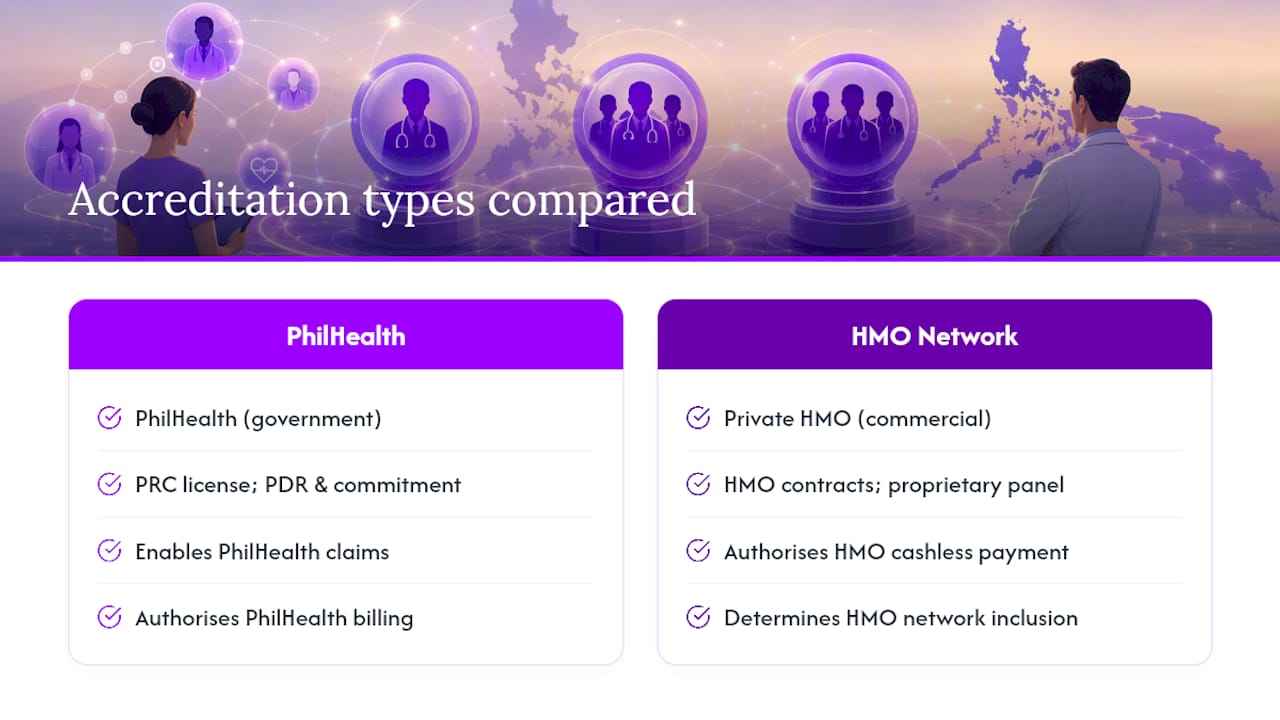
PhilHealth has pushed its side of this toward full digital tracking, leveraging healthcare SEO services to increase patient findability. Providers now register and manage credentials through the HCP Portal, using an electronic accreditation ID instead of paper certificates. HMOs have followed the same pattern with their own member portals and provider directories, which get updated far more often than most people realize. That is precisely why a doctor’s status is never something to assume. It is something to confirm, every time, through the specific HMO’s own channel.
How to Confirm HMO Doctor Registration Before You Book
Confirming HMO doctor registration in the Philippines takes three quick checks, and skipping any one of them is how members end up paying out of pocket for a visit they expected to be cashless.
- Check the HMO’s provider directory first. Log into your HMO’s member portal or app and search the accredited-provider list by doctor name, specialty, and facility. Most major HMOs also publish this list on the hospital’s own HMO coordinator page, so cross-check both if you have the option.
- Call HMO customer service to confirm. Give them your member ID, the doctor’s full name, the facility, and your planned visit date. Ask for a confirmation reference number or a screenshot of the accredited status. This becomes your paper trail if anything gets disputed later.
- Confirm again at the hospital’s HMO counter. Provider lists shift between what your HMO’s app shows and what the hospital’s front desk has on file that week. A quick call or visit to the hospital’s HMO coordinator before your appointment catches that gap.
While you have someone on the line, ask the right questions, not just “is this doctor covered.” Find out whether the visit is cashless or reimbursable, whether a Letter of Authorization or pre-authorization is required before the consultation, what payment methods apply to any balance, and whether the doctor’s clinic schedule that day actually accepts HMO cases. Some accredited doctors only accept HMO patients on specific days or time slots.
Emergency situations work differently. Most HMOs relax strict pre-authorization rules for genuine emergencies, allowing treatment first and paperwork after, but the definition of “emergency” varies by HMO contract. Confirm this rule for your specific plan before you need it, not during a crisis.
Pro Tip: Screenshot your HMO portal’s “accredited” confirmation the same day you book. Provider lists have been known to update within 48 hours, and a dated screenshot is worth more than a memory of what the app said last week.
What to Do If Your Doctor Isn’t in the HMO Network
Members can typically request accreditation of a personal doctor by contacting their HMO’s account manager directly, or through HR if the plan is a group policy through an employer. HR often has more leverage here because HMOs weigh group accounts differently than individual requests.
Once submitted, the HMO evaluates the doctor much like any new provider application. Expect them to ask for the physician’s PRC license, specialty certification, clinic or hospital affiliation, and willingness to accept the HMO’s negotiated rates and billing terms. The doctor has to agree to the contract, not just the member requesting it.
Three outcomes are typical: approval and addition to the network, conditional approval pending more documentation, or denial if the doctor’s rates or terms don’t align with the HMO’s standard contract. Timelines vary by HMO, but this is not usually a same-week process.
In the meantime, ask whether your plan allows reimbursement for out-of-network visits. Most plans that offer this require an official receipt, a detailed statement of account, and sometimes a referral or medical certificate, submitted within a set filing window. Read the pre-authorization and LOA rules for your specific plan before assuming reimbursement applies.
Member Tips to Avoid Coverage Surprises
A little discipline before an appointment saves a lot of frustration at the billing counter. Here’s what actually protects you:
- Verify the doctor’s status within 24 to 72 hours of your appointment, not weeks in advance, since directories change without much notice.
- Keep your confirmation reference number or screenshot until the visit is fully settled and billed.
- Ask specifically whether the doctor’s clinic accepts your health card directly or requires you to pay first and file a claim.
- Bring your member ID and your confirmation evidence to the hospital, even if you already confirmed by phone.
- If your appointment gets rescheduled, confirm coverage again. A schedule change can land on a day the doctor doesn’t accept HMO cases.
Checking which hospitals carry the strongest HMO partnerships before you need care also narrows your search when a specialist referral comes up unexpectedly.
Pro Tip: Save your HMO’s hotline and your hospital’s HMO coordinator extension in your phone under one contact. When you’re standing at a billing counter, you don’t want to be googling numbers.
How Long Accreditation Takes and What It Costs
PhilHealth’s HCProf accreditation runs on a calendar-year cycle, with renewal documentation and windows spelled out in PhilHealth’s advisory guidance for the current accreditation year. Providers who let their accreditation lapse have to reapply rather than simply renew, which can take longer than a straightforward renewal filed on time.
HMO network accreditation runs on a separate, private timeline set entirely by each HMO. There’s no single published fee schedule or universal processing window across the industry, since these are commercial contracts negotiated individually between the HMO and each doctor or facility. Some HMOs move quickly on a well-documented, established physician; others take longer when the doctor is new to HMO billing altogether or when specialty credentialing requires extra review.
What stays consistent is the documentation load. A doctor pursuing HMO accreditation typically has to provide a valid PRC license, proof of hospital or clinic affiliation, specialty board certification where applicable, and a signed agreement to the HMO’s rate schedule and billing procedures. Facilities usually submit similar paperwork on the doctor’s behalf when a whole clinic or hospital group joins a network at once.
For members, the practical takeaway isn’t the fee structure behind the scenes. It’s that a “pending” or “in review” status on a doctor you’re hoping to see means you should not assume coverage yet. Ask the HMO for a firm date, or plan your visit around a doctor who is already confirmed active.
Compliance Standards Doctors Must Meet for Accreditation
PhilHealth’s most recent update to accreditation rules, Circular PC2026-0007, refreshed the assessment tools and quality indicators used to evaluate HCProfs, tightening how performance gets tracked after initial accreditation is granted. This isn’t a one-time checkbox exercise anymore. It’s ongoing monitoring.
At minimum, a doctor pursuing either PhilHealth or HMO accreditation needs an active, unrestricted PRC license and, where relevant, specialty board certification recognized by the appropriate medical society. Beyond licensing, HMOs generally evaluate hospital or clinic affiliation, malpractice history, and whether the doctor’s existing patient volume and schedule can realistically absorb HMO referrals without long wait times.
Quality and performance indicators matter more than most members realize. PhilHealth’s updated framework ties ongoing accreditation status to performance assessment, meaning a doctor who accumulates complaints, billing irregularities, or poor outcome patterns can face review even after being accredited. HMOs run similar internal quality checks, though the specific metrics and thresholds are proprietary to each plan and rarely published.
For members, the standard worth remembering is simple: accreditation is a baseline, not a guarantee of permanence. A doctor accepted into a network today can be reviewed, flagged, or removed later if performance standards slip, which is one more reason a same-day verification habit protects you better than trusting a directory you checked last year.
Why HMO Accreditation Criteria Differ Across Providers
Every HMO licensed to operate in the Philippines builds its own network under its own commercial terms, and the insurance regulator’s industry report lists the full set of licensed HMOs operating as of Q4 2025. That regulatory approval to operate as an HMO is separate from, and doesn’t determine, which individual doctors any one HMO chooses to accredit into its network.
Larger HMOs with bigger member bases often negotiate wider hospital and specialist networks, since volume gives them more leverage with providers. Smaller or newer HMOs may concentrate their networks around a narrower set of partner hospitals, particularly in Metro Manila, while offering thinner coverage in provincial areas. Neither structure is inherently better; it changes what “accredited” means depending on which plan you hold.
Rate negotiation also varies. Some HMOs pay providers a fixed case rate regardless of complexity, while others use fee-for-service billing with negotiated caps per procedure. A doctor who finds one HMO’s rate structure workable may decline another’s, which is exactly why the same physician can be in one HMO’s network and absent from another’s, even at the identical hospital.
This is the practical reason a member switching jobs, and therefore switching HMOs, often has to reverify every doctor they’ve used before, even ones seen regularly under a previous plan. The hospital hasn’t changed. The HMO’s contract with that specific doctor has.
How Accreditation Status Affects Your Coverage and Reimbursement
Accreditation status is the line between a cashless visit and an out-of-pocket bill, and it changes what paperwork you’ll need afterward. When a doctor is actively accredited in your HMO’s network, most plans let you present your health card at the point of service, skip upfront payment, and let the HMO settle the bill directly with the provider, often after a Letter of Authorization is issued.
When the doctor is not in the network, your options narrow to two paths. Either you pay out of pocket and file for reimbursement, if your specific plan allows it, or you choose a different, accredited doctor at the same facility, if one is available for your specialty. Reimbursement claims typically require an original receipt, an itemized statement, and sometimes a referral letter, submitted within your HMO’s filing deadline, which is usually measured in days to a few weeks after treatment.
Partial accreditation gaps also happen. A doctor might be accredited for outpatient consultations but not for inpatient procedures at the same hospital, or accredited at one hospital branch but not another under the same name. This is why the “what to ask” checklist from earlier in this guide matters as much as the accreditation check itself. Status alone doesn’t tell you the full scope of what’s covered; the specific service and setting do.
Common Reasons an HMO Denies Doctor Accreditation
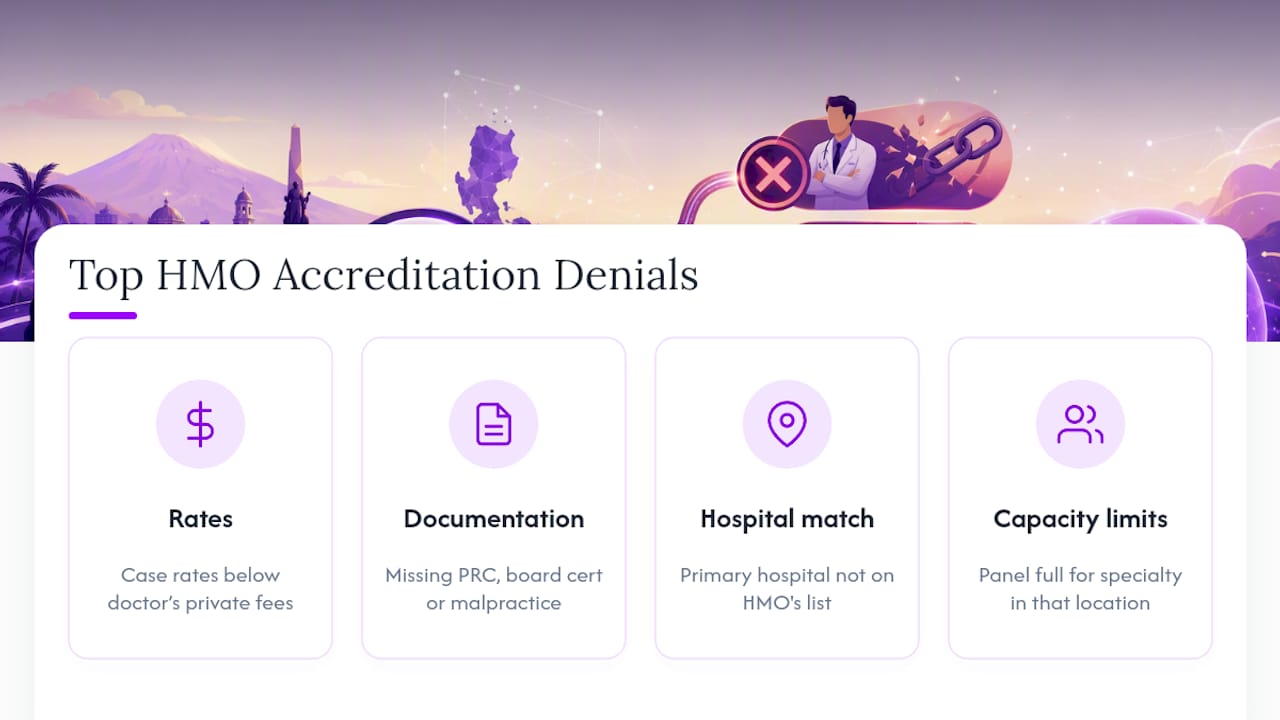
Denials happen more often than members assume, and most trace back to a handful of recurring issues rather than anything dramatic. Rate disagreement tops the list: many independent specialists decline HMO panel membership because the negotiated case rates fall below what they charge self-pay or PhilHealth-only patients, making the volume tradeoff unattractive.
Documentation gaps cause a large share of the rest. A doctor missing a current PRC license renewal, incomplete specialty board certification, or an unresolved malpractice complaint will typically get flagged during HMO review, sometimes without the doctor even realizing an application was pending. Hospital affiliation mismatches cause similar friction. If a physician’s primary hospital isn’t on the HMO’s approved facility list, accrediting the doctor alone often doesn’t solve the member’s actual problem, since the HMO may still decline to cover procedures performed at that facility.
Capacity is a quieter but real factor. Some HMOs limit how many providers they’ll accredit per specialty within a given city or hospital, particularly for high-demand specialties like cardiology or oncology, to keep their negotiated volumes sustainable. A qualified, licensed doctor can be denied simply because the HMO’s panel in that specialty and location is already full.
For members, the practical lesson is that a denial or non-listing rarely reflects anything about the doctor’s competence. It almost always reflects a business negotiation that didn’t close, which is exactly why asking your HMO to escalate a request, rather than assuming it’s a dead end, is worth the effort.
What Renewal Looks Like After Initial Accreditation
Accreditation isn’t a one-and-done credential for either system. On the PhilHealth side, HCProfs renew on a set calendar-year cycle, resubmitting updated documentation and confirming their Performance Commitment stays current, per PhilHealth’s renewal guidance. Miss the renewal window and a provider can lose accredited status entirely, forcing a fresh application rather than a simple update.
HMO network renewal works on each HMO’s own schedule, but the pattern is similar: periodic resubmission of licenses, updated hospital affiliations, and continued performance review. The updated quality indicators referenced in PhilHealth Circular PC2026-0007 reflect a broader industry shift toward ongoing monitoring rather than a credential granted once and left untouched.
This monitoring is exactly why provider directories move around so often, and why a doctor accredited last year isn’t guaranteed to still be accredited today. It also explains why HMOs increasingly push registration and verification through digital portals like PhilHealth’s HCP Portal, which includes step-by-step instructional resources for providers managing their own credentials online. For members, the renewal cycle behind the scenes translates into one simple habit worth repeating: never treat last year’s confirmation as this year’s answer.
How Hmoplans Helps Members Find Accredited Doctors
Some HMO providers are designed to address common frustrations from SME employees, such as uncertainty about doctor coverage until billing. Typically, these plans offer cashless access to accredited hospitals and clinics nationwide, including premier facilities, aiming to provide a clear network to reduce guesswork.
When questions come up, members reach a dedicated account officer or use our digital platform to check coverage directly, rather than piecing it together from an outdated printout. That escalation path matters most when a member’s usual doctor isn’t yet in-network. It gives HR and employees a clear next step instead of a dead end.
Get an HMO Plan That Makes Provider Access Simple
Chasing down whether a doctor is accredited shouldn’t feel like detective work every time an employee needs care. Hmoplans built its group plans around that exact pain point: a network designed so your team spends less time verifying and more time actually getting seen.

Some group HMO plans offer cashless access across accredited hospital and clinic networks, including premier facilities. They provide 24/7 nationwide coverage for inpatient, outpatient, and emergency care. These plans can often be supplemented with optional add-ons like dental services, annual physical exams, and life and accident insurance. Digital platforms typically allow members to check coverage and providers directly without needing to call.
If your company is comparing plans or just wants to confirm which doctors and hospitals your current provider actually covers, visit our Purple Cow Premium features page or reach out to our team to review your group’s provider network before your next renewal date.
Official Resources to Check Now
For rules on HCProf accreditation, check PhilHealth’s circulars and HCP Portal. For the licensed-HMO list and industry data, consult the insurance regulator’s HMO industry report. For your own doctor, your HMO’s member portal or hospital HMO coordinator remains the fastest, most current source.
FAQ
Which HMOs Are Accredited to Operate in the Philippines?
HMOs operate under a license from the Philippines’ insurance regulator, and the regulator’s industry performance report publishes the current list of licensed companies along with aggregate industry data. Check that report directly for the most accurate, up-to-date list, since new licenses and changes can happen between updates.
What Are the Top HMOs in the Philippines in 2026?
There’s no single official ranking published by regulators; rankings you’ll see online typically come from membership size, hospital network breadth, or claims volume tracked by individual publishers. For a verified list of which companies are actually licensed to operate, the insurance regulator’s industry annex is the authoritative source rather than any single ranking list.
Is a Specific Telehealth Provider Accredited by My HMO?
Telehealth accreditation works the same way as in-person doctor accreditation: it depends on whether that specific platform or provider has a contract with your specific HMO, not on general market presence. Confirm directly through your HMO’s member portal or customer service line before assuming any telehealth service is covered under your plan.
How Do I Know if My Doctor Accepts My HMO?
Check your HMO’s provider directory in its member portal or app first, then confirm by phone with HMO customer service using your member ID and the doctor’s name. Finish by calling the hospital’s HMO coordinator directly, since provider lists between the HMO’s app and the hospital’s front desk can differ by the day.
What Happens if My Doctor Isn’t in My HMO’s Network?
You can ask your HMO’s account manager, or your company’s HR for group plans, to request accreditation for that doctor, though approval depends on the HMO’s evaluation and the doctor’s agreement to their contract terms. In the meantime, check whether your plan allows reimbursement for out-of-network visits with proper receipts and documentation.
