

Hospital Admission With HMO: Your Complete Philippines Guide
TL;DR:
- Hospital admission with HMO in the Philippines requires prior verification, necessary documents, and coordination with providers to prevent unexpected bills. Presenting valid IDs, a Letter of Authorization, and both your HMO and PhilHealth cards at admission is essential for coverage. Understanding coverage limits, hospital networks, and timely communication ensures a smooth hospital stay and minimizes out-of-pocket expenses.
Hospital admission with HMO is defined as the process of entering a Philippine hospital for inpatient care while using your Health Maintenance Organization plan to cover costs, subject to your plan’s network, tier, and Maximum Benefit Limit (MBL). Getting this process right determines whether your HMO pays the bill or you do. This guide to hospital admission with HMO walks you through every step, from gathering documents to coordinating PhilHealth benefits, so you leave the hospital without a surprise bill. Key players in this process include your HMO provider, PhilHealth, and the hospital’s admissions office, and each one has a specific role you need to understand before you check in.
What are the essential HMO admission requirements and documents?

The three documents every HMO patient needs at admission are a valid HMO card, a government-issued ID, and a Letter of Authorization (LOA) for any planned procedure. Missing even one of these can delay your admission or shift the bill entirely to you.
The Letter of Authorization explained
An LOA is a formal written approval from your HMO provider confirming it will cover a specific procedure or hospital stay. LOA processing typically takes 1–5 business days, so you cannot request it the morning of your scheduled surgery. Your attending physician usually initiates the request by submitting a clinical summary or referral to your HMO. Submit the approved LOA to the hospital ideally within 24 hours of admission for coverage to apply without interruption.
Verifying your coverage before you arrive
Verifying your specific HMO plan coverage and hospital accreditation by calling the HMO hotline or checking the provider app is required before every admission, not optional. A hospital displaying an HMO accreditation sign does not mean every plan or every service is covered there. Your plan tier determines which hospitals and room categories you can access. Confirming this before admission prevents the most common and costly surprise in the Philippine hospital system.
Here is a checklist of what to prepare before your admission date:
- Valid HMO membership card (check expiry date)
- Government-issued photo ID (passport, driver’s license, or national ID)
- Approved LOA from your HMO provider for planned procedures
- PhilHealth card or Member Data Record (MDR)
- Physician’s referral or clinical abstract if required by your HMO
- Contact number of your HMO’s 24/7 hotline
Pro Tip: Request your LOA at least five business days before a scheduled procedure. If your doctor submits the clinical summary late, follow up directly with your HMO hotline to avoid delays.
How does the hospital admission process work with HMO coverage?
The hospital admission process with HMO coverage follows a different path depending on whether your admission is planned or emergency. Understanding both paths prevents confusion when you are already under stress.
Planned vs. emergency admissions
Planned admissions require pre-authorization through the LOA process. Emergency admissions allow you to check in first, but you must notify your HMO provider within 24–48 hours of arrival. Most HMO providers have a dedicated emergency hotline for this purpose. Failing to notify them in time can result in your claim being denied or reclassified as a non-covered event.
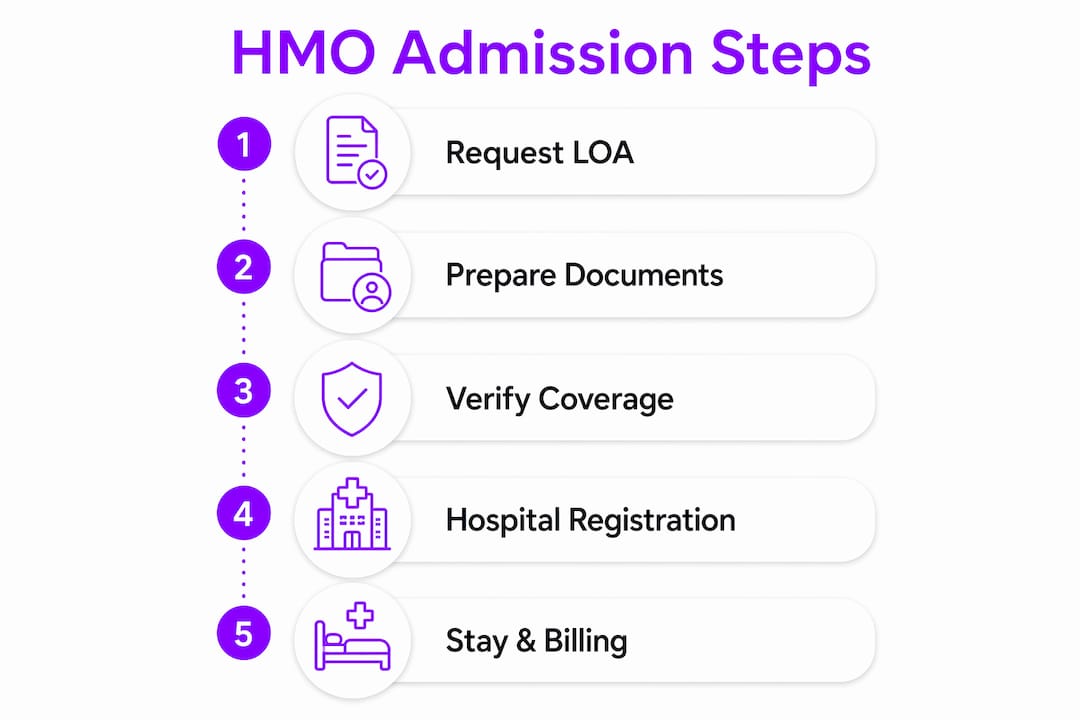
Step-by-step admission process
- Pre-admission coordination. Call your HMO hotline to confirm hospital accreditation, room category entitlement, and coverage for the planned procedure. Request the LOA if not yet obtained.
- Hospital registration. Present your HMO card, valid ID, LOA, and PhilHealth card at the admissions desk. The hospital’s billing department verifies your coverage directly with your HMO provider.
- Coverage verification. Pre-admission assessments or phone interviews are often conducted to confirm insurance coverage details and possible out-of-pocket costs. This step protects you from unexpected charges during your stay.
- Room assignment. Your plan tier determines your room category. Lower-tier plans typically cover ward or semi-private rooms. Private or deluxe room access is often limited to Platinum or Executive plan tiers, with upgrades requiring out-of-pocket payment.
- Deposit arrangement. HMO-approved patients typically pay deposits only for non-covered costs or upgrades. Patients without confirmed insurance coverage may need to pay a full deposit upfront.
- Billing during stay. The hospital tracks all charges and submits them to your HMO. Covered items are billed directly. Non-covered items are flagged for your personal payment at discharge.
- Discharge and claim filing. Review your Statement of Account before signing. Confirm which charges your HMO covered and which require your payment. Keep all receipts for reimbursement claims on out-of-network expenses.
| Step | Action required | Who is responsible |
|---|---|---|
| Pre-admission coordination | Confirm coverage, request LOA | Patient and physician |
| Hospital registration | Submit HMO card, ID, LOA, PhilHealth card | Patient |
| Coverage verification | Verify plan benefits and room tier | Hospital billing and HMO |
| Room assignment | Assign room based on plan tier | Hospital admissions |
| Deposit arrangement | Pay deposit for non-covered items only | Patient |
| Discharge | Review and settle final bill | Patient and hospital billing |
Pro Tip: Ask the hospital’s billing department for a preliminary cost estimate on your first day. This gives you time to call your HMO and clarify any gray areas before the bill grows.
How do PhilHealth and HMO insurance coordinate during hospital admissions?
PhilHealth applies first during hospital billing, using fixed case rates based on your diagnosis. This is not optional or negotiable. The hospital deducts the PhilHealth case rate from your total bill, then charges the remaining balance to your HMO up to your MBL.
Presenting both your PhilHealth and HMO cards at admission is required. Failing to coordinate these benefits results in higher out-of-pocket costs because the hospital cannot retroactively apply PhilHealth deductions after billing has been finalized. This dual-coverage system is designed to protect you. When both benefits are applied correctly, your personal expenses drop significantly.
Once your MBL is exhausted, all remaining charges become your personal responsibility. Plan accordingly if your condition requires a long hospital stay or multiple procedures. Patients with chronic conditions should track their MBL usage throughout the year, not just during a single admission.
| Coverage type | How it applies | Billing order |
|---|---|---|
| PhilHealth | Fixed case rate by diagnosis | First |
| HMO | Remaining balance up to MBL | Second |
| Patient (out-of-pocket) | Costs beyond MBL or non-covered items | Last |
Understanding the PhilHealth and HMO interaction at the billing level is one of the most practical things you can do before any hospital admission. Most patients learn this only after receiving a larger-than-expected bill.
What common pitfalls should you avoid when using your HMO for hospital admission?
The most expensive mistake HMO patients make is assuming that accreditation equals coverage. A hospital’s HMO accreditation sign does not guarantee coverage for all services or plan tiers. Your specific plan must be verified against the specific hospital and the specific procedure before you arrive.
Switching HMO providers results in a coverage gap of 5–30 days, with waiting periods of 6–12 months for pre-existing conditions. If you recently changed employers or switched plans, confirm your active coverage dates before scheduling any procedure. Patients who plan admissions during a coverage gap pay the full bill themselves.
Here are the most common pitfalls and how to avoid them:
- Skipping LOA requests for planned procedures. Always request the LOA at least five business days in advance. Last-minute requests are frequently denied or delayed.
- Choosing a hospital outside your plan’s network. Confirm hospital accreditation for your specific plan tier, not just the HMO brand.
- Forgetting to present your PhilHealth card. PhilHealth must be applied first. Skipping this step increases your out-of-pocket costs.
- Ignoring room category limits. Requesting a private room when your plan covers only semi-private means you pay the difference daily.
- Not calling the HMO hotline during emergencies. Most plans require notification within 24–48 hours of emergency admission. Missing this window risks claim denial.
- Overlooking waiting periods after switching plans. Coverage gaps and waiting periods for pre-existing conditions are real and common.
Pro Tip: Save your HMO provider’s 24/7 hotline number in your phone before you ever need it. In an emergency, you will not have time to search for it.
What should you expect during your hospital stay under an HMO?
Your HMO covers room and board, nursing care, physician fees, prescribed medications, and approved procedures up to your MBL. The key phrase is “approved procedures.” Anything not pre-authorized or outside your plan’s coverage list becomes a personal expense.
Room upgrades are available at most hospitals but come at a daily cost difference that your HMO will not cover. Understand your HMO room category entitlement before admission so you can budget for any upgrade you want. A semi-private room upgrade to private can add thousands of pesos per day to your bill.
What to prepare for a smooth hospital stay and discharge:
- Keep a personal log of all procedures, medications, and physician visits during your stay
- Ask the nurse’s station for a daily charge summary to track your running bill
- Confirm with the billing department which items are being charged to your HMO and which are personal
- Request your discharge papers and Statement of Account at least one day before your planned discharge date
- For out-of-network reimbursements, collect all official receipts and medical records before leaving the hospital
- Follow up with your HMO provider within the required filing period, typically 30–90 days after discharge
Key takeaways
Using your HMO for hospital admission requires early LOA requests, dual-card presentation at registration, and active verification of your plan’s network and room tier before you arrive.
| Point | Details |
|---|---|
| Request your LOA early | LOA processing takes 1–5 business days; late requests delay or block coverage. |
| Present both cards at admission | PhilHealth applies first, then HMO covers the remaining balance up to your MBL. |
| Verify coverage before arrival | Accreditation signs do not guarantee your specific plan covers the hospital or procedure. |
| Know your room tier | Lower-tier plans cover ward or semi-private rooms; private rooms require out-of-pocket upgrades. |
| Track your MBL | Costs beyond your Maximum Benefit Limit become personal expenses regardless of plan. |
What I’ve learned from watching patients navigate HMO admissions
Most people treat their HMO card like a magic swipe card. They assume it works everywhere, covers everything, and requires no preparation. That assumption costs them money every single time.
The patients who come out of a hospital stay without a financial shock are the ones who called their HMO hotline before they needed it. They requested the LOA the moment their doctor recommended a procedure. They confirmed their room tier and chose a hospital within their network. They presented both their PhilHealth and HMO cards at the admissions desk without being asked.
The Philippine HMO market has grown significantly, and plans have become more flexible. Providers like Purple Cow now offer 100% coverage for pre-existing conditions up to the MBL, which removes one of the biggest historical pain points. But even the best plan fails you if you do not follow the admission procedures correctly.
My honest advice: treat your HMO like a tool that requires setup, not a safety net that catches you automatically. The setup is the LOA, the verification call, and the dual-card presentation. Do those three things, and your HMO will work exactly as promised.
— Eumir
How Hmoplans makes hospital admissions less stressful
Hospital admissions are stressful enough without worrying about whether your plan covers the room, the procedure, or the hospital. Hmoplans, powered by Purple Cow, gives SME members access to the Big 9 Hospitals and Healthway Clinics, with 100% coverage for pre-existing conditions up to the MBL and no complicated exclusion clauses to decode.

Purple Cow’s member support team handles LOA coordination and coverage verification so you are not navigating that process alone. Whether you need cashless inpatient care, out-of-network reimbursement, or a plan that works alongside PhilHealth, Hmoplans has a structure built for it. Explore the full plan features and coverage options or visit Hmoplans to find the right plan for your team before the next admission becomes an emergency.
FAQ
What documents do I need for HMO hospital admission?
You need your valid HMO card, a government-issued ID, an approved Letter of Authorization for planned procedures, and your PhilHealth card. Missing any of these can delay admission or shift costs to you.
How long does it take to get an LOA from my HMO?
LOA processing takes 1–5 business days, so you should request it as soon as your doctor recommends a procedure or surgery. Submit the approved LOA to the hospital within 24 hours of admission.
Does my HMO cover emergency hospital admissions?
Yes, most HMO plans cover emergency admissions, but you must notify your HMO provider within 24–48 hours of arrival. Failing to call within that window risks claim denial even for covered procedures.
Which gets applied first, PhilHealth or HMO?
PhilHealth applies first using a fixed case rate based on your diagnosis. Your HMO then covers the remaining balance up to your Maximum Benefit Limit. Always present both cards at the admissions desk.
What happens when my HMO Maximum Benefit Limit runs out?
All costs beyond your MBL become your personal responsibility. Track your MBL usage throughout the year, especially if you have a chronic condition that requires multiple hospital admissions.
