

6 Documents to Get Domestic Partner HMO Coverage in the Philippines
Yes, domestic partners can get HMO coverage in the Philippines, but nothing about it is automatic. Coverage depends entirely on what the employer’s group HMO contract allows and what the HMO’s underwriting team accepts as proof. There’s no national law that requires an insurer to treat a live-in partner the same as a spouse. In practice, most HMOs that do extend this benefit rely on one document above all others: a notarized affidavit of cohabitation, backed by a short stack of supporting paperwork.
TL;DR:
- Domestic partner HMO coverage depends solely on the employer’s contracted benefits and is not mandated by Philippine law or national regulation.
- Verification typically requires a notarized affidavit of cohabitation, government-issued IDs, proof of shared residence and finances, plus employer attestation.
- Eligibility and benefit limits, including age caps and coverage classes, vary widely across plans, so thorough review of the policy schedule is essential.
- The approval process involves submitting a complete set of documents to HR, who then forwards them for underwriting review, usually taking two to four weeks.
- Denials are often due to missing or incomplete paperwork rather than discrimination, making proper documentation the key to successful enrollment.
Table of Contents
- Domestic Partner HMO Coverage: Who Actually Qualifies
- What Documents Prove a Domestic Partnership to HR and the HMO
- How to Actually Enroll a Domestic Partner in Your HMO
- Know Your Limits Before You Assume You’re Covered
- An HR Checklist for Covering Domestic Partners the Right Way
- What to Do If Your HMO or Employer Says No
- Why Documentation, Not Discrimination, Usually Stalls These Claims
- Give Your Team a Domestic Partner Benefit Without the Guesswork
- Where to Verify These Rules Yourself
- Sources
Domestic Partner HMO Coverage: Who Actually Qualifies
The Philippines has no statute that puts domestic partners on the same footing as legal spouses for health benefits. What governs eligibility instead is the group’s HMO agreement, the contract your employer signed with its insurer. Insurance Commission Circular CL2017-19 requires that agreement to spell out eligibility requirements and a schedule of benefits, but it doesn’t mandate which dependent classes an employer has to include. That decision sits with the employer and the underwriter, not with the government.
This means two SMEs in the same industry can have completely different rules. One company’s HMO plan might list “legal spouse and children only.” Another might include a broader “domestic partner” or “extended dependent” category that covers common-law and same-sex partners under the same terms as a spouse. Neither approach breaks any law. The difference comes down to what got negotiated when the policy was drafted.
Where employers do extend the benefit, a few patterns show up consistently:
- The principal (the employee) must be an active, enrolled member of the group plan.
- The partner must typically show some proof of cohabitation and financial interdependence, usually for a minimum period defined by the HMO or employer.
- Some policies apply an age cap on dependents, similar to how child dependents are often capped for HMO purposes rather than PhilHealth’s own dependent age rules.
- A handful of plans place domestic partners in a separate benefit class with a different Maximum Benefit Limit (MBL) than a legal spouse would receive.
Same-sex partners are generally handled the same way as common-law heterosexual partners in Philippine HMO practice: through the affidavit route rather than through marriage documentation, since same-sex marriage isn’t legally recognized in the country. Employers with clear nondiscrimination policies tend to apply the same documentary standard to every domestic partner, regardless of gender, which is the fairest and most defensible approach from an HR standpoint. Local reporting on inclusivity-driven benefits shows more Philippine employers adding this coverage voluntarily, though standards still vary a lot from one company to the next.
An HMO can legitimately refuse to enroll a domestic partner if the group policy simply doesn’t include that dependent class, if the underwriter flags incomplete documentation, or if the partner falls outside an age or benefit-class limit written into the contract. None of that is discrimination in a legal sense. It’s a contract limitation, and it’s exactly why reading your own HMO eligibility clauses before assuming coverage exists saves everyone a headache later.
What Documents Prove a Domestic Partnership to HR and the HMO
Getting a domestic partner approved comes down to paperwork that tells a consistent story: you live together, you support each other financially, and your employer is willing to attest to it. Here’s the order most HR teams and HMOs actually want to see:
- Notarized affidavit of cohabitation. This is the anchor document. It should state both partners’ full names, the shared address, the date cohabitation began, a clear statement that the partner is being nominated as an HMO dependent, and signatures notarized to make it a public document. RESPICIO & CO.'s commentary on affidavits of cohabitation notes that this affidavit functions as the practical substitute for a marriage certificate in dependent-enrollment contexts, and having two witnesses sign strengthens it further.
- Government-issued IDs for both partners. A passport, driver’s license, or UMID confirms identity and matches the names on the affidavit.
- One residential document. A lease agreement, a utility bill, or a barangay certificate showing both names at the same address backs up the cohabitation claim.
- One financial document. A joint bank statement, a shared credit card statement, or proof of joint expense sharing demonstrates the financial interdependence most underwriters look for. Redact account numbers before submitting.
- Employer attestation letter. HR should issue a short, signed letter or memo confirming the employee’s status and formally authorizing the HMO to process the nomination. This single document often does more to speed up approval than anything else in the file.
- Supplementary evidence, if requested. Photos, travel records, or joint insurance beneficiary designations can help if the HMO’s underwriting team asks for more context, though most approvals don’t require this step.
Pro Tip: Keep a single PDF folder with all six documents named clearly (affidavit, IDs, residential proof, financial proof, attestation) and send that whole packet at once. HR teams process complete submissions far faster than files that trickle in one document at a time.
One caution worth flagging: whatever you hand over, financial statements especially, share only what’s needed to prove the relationship. Black out account numbers, balances beyond what’s relevant, and any information the HMO didn’t specifically ask for. Nobody at HR needs to see your full transaction history to confirm you split a utility bill.

How to Actually Enroll a Domestic Partner in Your HMO
Once your documents are ready, the enrollment process runs through three parties: you, HR, and the HMO’s underwriting desk. Here’s the sequence that plays out in most Philippine SMEs.
- Check the schedule of benefits first. Before preparing anything, confirm your group’s HMO agreement actually recognizes a “domestic partner” or “extended dependent” category. This is usually a single line item in the benefits document, and skipping this step is the most common reason employees waste weeks preparing paperwork for a benefit that isn’t offered.
- Assemble your documents. Pull together the affidavit of cohabitation and supporting proof described above, then fill out whatever internal nomination or enrollment form HR provides.
- Submit to HR, not directly to the HMO. HR reviews the packet, completes its own employer attestation section, and forwards everything to the HMO together. HR typically needs to confirm your employment status, your enrollment date, and the effective date you’re requesting for your partner’s coverage.
- Wait for underwriting review. The HMO checks the documents against its own eligibility rules. A sample benefits schedule from a Philippine HMO provider shows how detailed these eligibility clauses can get, right down to age caps and dependent hierarchy. Approval sometimes comes with a waiting period before certain benefits activate.
Operationally, most SME group HMO submissions take about two to four weeks from the day HR forwards a complete file to the day coverage becomes active, based on standard underwriting timelines for group plans. Incomplete submissions or affidavits missing key details (dates, addresses, a clear dependent-nomination statement) are what stretch that timeline into months.
Follow up with HR in writing about ten business days after submission if you haven’t heard anything. A short email asking for a status update and confirming the packet was received protects you if something got lost in the shuffle, and it gives you a paper trail if you need to escalate later.
Know Your Limits Before You Assume You’re Covered
Every HMO policy has a Maximum Benefit Limit, the total amount the plan will pay out per member per year, and it applies to domestic partners the same way it applies to any other dependent. That figure, along with inner limits for specific procedures like room and board caps or surgical allowances, lives in your schedule of benefits, and it’s worth reading before you assume a procedure is fully covered.
A few things to check before you count on coverage for a specific situation:
- MBL and inner limits. Confirm the annual cap and whether specific procedures have their own sub-limit separate from the overall MBL.
- Waiting periods and exclusions. Maternity benefits, cosmetic procedures, and experimental treatments are commonly excluded or subject to a waiting period, and these rules apply to domestic partners exactly as they apply to legal dependents.
- Coordination of benefits. If your partner happens to be enrolled under two HMO principal accounts, whether through two employers or a personal plan on top of a group plan, that doesn’t mean double reimbursement. Claims are coordinated so the total payout never exceeds the actual medical expense.
- Pre-existing conditions. Some group policies limit or exclude pre-existing conditions for newly added dependents, which matters a lot if your partner is managing something chronic.
International plans handle similar exclusions in comparable ways. A useful comparison point is how expat insurance providers structure their exclusion lists, which follow the same logic Philippine HMOs use: named exclusions, waiting periods, and clear coordination language written directly into the policy. If your partner has a pregnancy on the horizon or a chronic condition already being treated, ask HR to get written confirmation from the HMO before you assume anything, rather than finding out at claim time.
An HR Checklist for Covering Domestic Partners the Right Way
If you’re the one managing benefits at an SME, the fastest way to remove friction from this process is building it into policy language before an employee ever asks. A few things worth putting in writing:
- Define “domestic partner” or “extended dependent” clearly in the benefits handbook, including the minimum cohabitation period and required proof.
- List the exact documents you’ll accept: affidavit of cohabitation, one residential proof, one financial proof, valid IDs.
- Set a standard effective date policy (for example, coverage begins the first day of the month following approval).
- Add a confidentiality clause covering how submitted documents are stored and who can access them.
- Include a nondiscrimination statement confirming the same standard applies to common-law and same-sex partners alike.
Pro Tip: Create a one-page employer attestation template in advance rather than drafting a new letter every time someone submits a request. A standing template that HR can just fill in and sign cuts days off your average approval time.
Configurable group HMO products let employers set dependent categories and pre-existing condition rules once at the contract level, rather than negotiating exceptions case by case every time an employee asks.
What to Do If Your HMO or Employer Says No
If a domestic partner nomination gets denied, don’t treat that as final. Ask for the denial in writing along with the exact policy clause the HMO cited. Then submit any missing documentation and formally request reassessment through HR. If the denial still doesn’t hold up against your policy’s own written eligibility terms, you can file a complaint with the Insurance Commission, which regulates HMO product obligations under CL2017-19. Workplace discrimination concerns belong with the Department of Labor or legal counsel, not the HMO itself.
Why Documentation, Not Discrimination, Usually Stalls These Claims
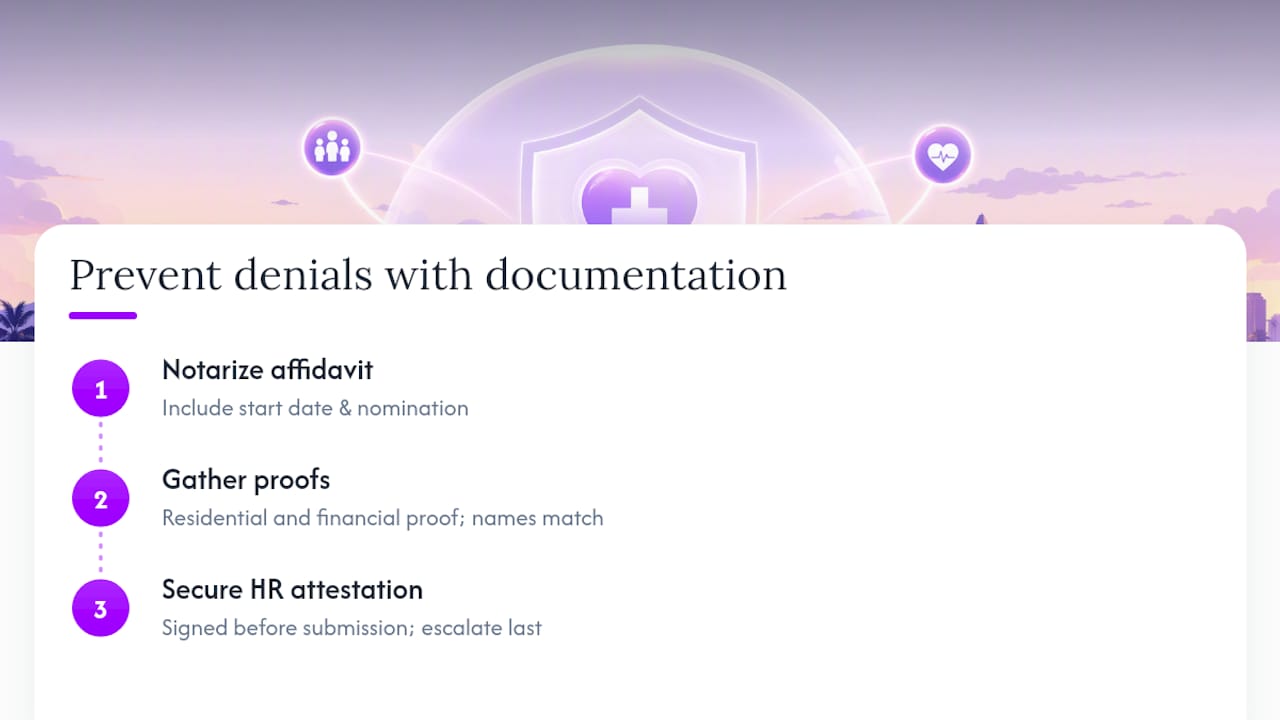
Most denials I’ve seen discussed in Philippine HR circles trace back to paperwork, not prejudice. An affidavit missing a cohabitation start date, a supporting document that doesn’t match the address on file, an employer attestation that never got signed. These are fixable problems, not verdicts on whether your relationship counts.
If you’re preparing to enroll a partner, do three things: get the affidavit notarized with specific dates and a clear dependent-nomination statement, gather one residential and one financial proof that match the names exactly, and get HR’s attestation letter signed before you submit anything. Work the HR channel fully before escalating. The Insurance Commission complaint route exists, but it should be your last step, not your first.
— Eumir
Give Your Team a Domestic Partner Benefit Without the Guesswork
Building domestic partner eligibility into a group HMO contract doesn’t have to mean months of back-and-forth with an underwriter. Hmoplans structures SME group plans with configurable dependent categories from the start, so employers can define who qualifies, what documents are required, and how pre-existing conditions are handled, all written into the contract once instead of negotiated exception by exception.
If your company is ready to offer this benefit without drafting policy language from scratch, check out Hmoplans’s plan features or request a quote through the Hmoplans homepage to see how a configurable group plan fits your team.
Where to Verify These Rules Yourself
- Insurance Commission Circular CL2017-19: the regulatory source for mandatory HMO contract provisions and eligibility disclosure requirements.
- RESPICIO & CO.'s affidavit of cohabitation guide: practical detail on drafting an affidavit same-sex and common-law partners can use.
Sources
- Insurance Commission Circular CL2017-19 (Philippines)
- Affidavit of Cohabitation for Same-Sex Partners Seeking HMO Dependent Coverage — RESPICIO & CO.
