

Negotiated Healthcare Rates: What You Actually Pay
A negotiated rate is the contractually agreed dollar amount an insurer will pay an in-network provider for a covered service. It is also called the allowed amount, and it sets the ceiling for what you owe on covered in-network care. According to the Healthcare, your cost-sharing (deductible, coinsurance, copay) is calculated on this negotiated figure, not on whatever the provider originally billed.
Three things to know right now:
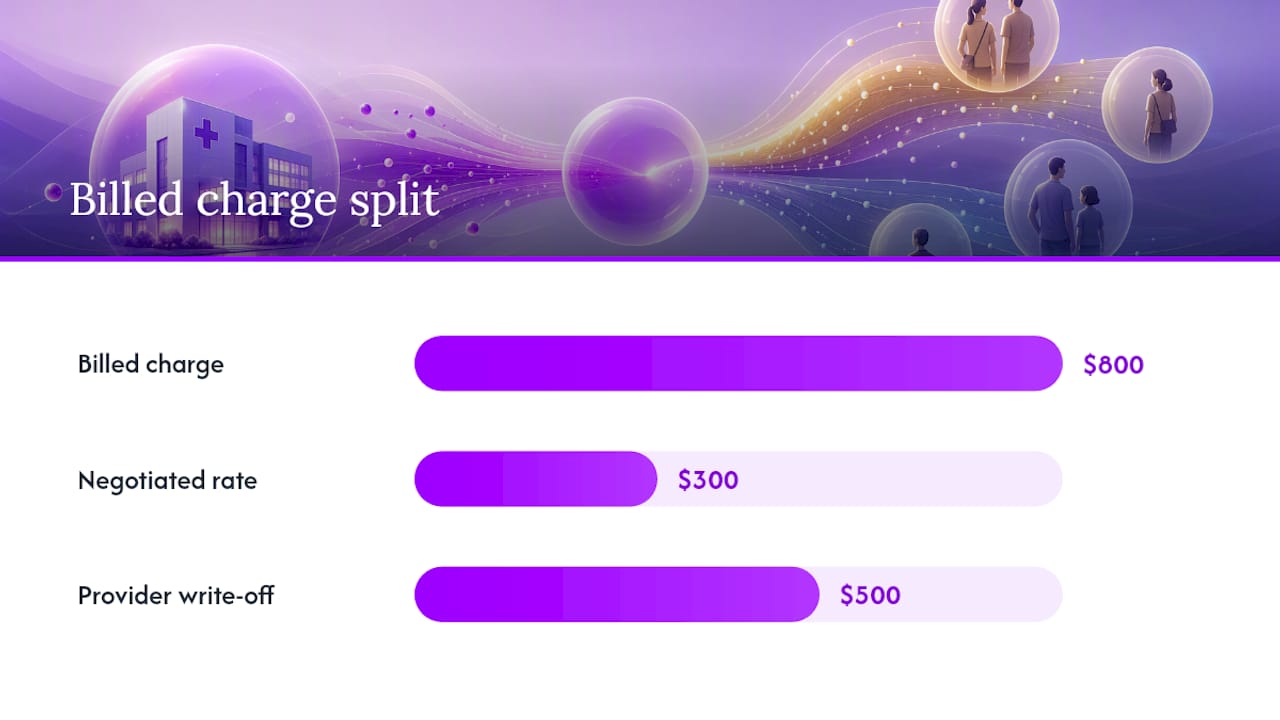
- Your bill is based on the negotiated rate, not the sticker price. When a provider bills $800 and the negotiated rate is $300, your plan pays its share of $300. The $500 difference is written off.
- You can look up rates before you receive care. The federal Transparency in Coverage (TiC) rule requires insurers to publish negotiated rates, and your insurer’s cost-estimator tool is the fastest place to start.
- Your employer or HR team may have better data than you do. Large employers and brokers can access machine-readable rate files and benchmarking tools that translate raw pricing data into plan design decisions.
The Centers for Medicare & Medicaid Services (CMS) and the Department of Health and Human Services (HHS) oversee these disclosure rules. Healthcare.gov is the fastest public reference for plain-English definitions.
Key Takeaways
Negotiated rates set the ceiling for what you owe on covered in-network services, and knowing how to find and use them is the most direct way to control your healthcare costs.
| Point | Details |
|---|---|
| Negotiated rate is the ceiling | Your cost-sharing is calculated on the allowed amount, not the provider’s billed charge. |
| Rates vary widely by market | Two providers doing the same procedure in the same city can differ by 30–40% or more. |
| TiC data is public but complex | Machine-readable files require employer, broker, or aggregator tools to be practically useful. |
| Use the cost-estimator first | Your insurer’s online tool is the fastest way to find your plan’s negotiated rate before care. |
| Employers have growing leverage | TiC benchmarking data lets employers push for better rates at contract renewal. |
Table of Contents
- How are negotiated rates set in healthcare?
- What is the difference between a billed charge, negotiated rate, and allowed amount?
- How do negotiated rates affect your deductible, coinsurance, and out-of-pocket max?
- Where can you find your plan’s negotiated rates?
- Why do negotiated rates vary so much across providers?
- What did the Transparency in Coverage rule actually change?
- What employers and individuals should do first
- Thinking about your team’s coverage?
- Sources
How are negotiated rates set in healthcare?
Negotiated rates come from private contracts between insurers (also called payers) and providers. The insurer’s network contracting team sits across the table from a hospital’s CFO or a physician group’s contracting office. For self-funded employer plans, a third-party administrator (TPA) often handles negotiations on the employer’s behalf.
Several levers move the final number:
- Volume and steering: An insurer that can direct a large patient volume to a specific hospital system has real bargaining power. Providers accept lower per-unit rates in exchange for predictable volume.
- Service mix: A provider that offers rare specialty services (transplant programs, Level I trauma) negotiates from a stronger position than a general practitioner.
- Reference pricing: Some payers set a benchmark (often a percentage of Medicare rates) and pay that amount regardless of billed charges. Providers that want in-network status must accept it.
- Bundled payments: Instead of separate fees for each service in an episode of care, a single bundled rate covers the whole episode. This shifts efficiency risk to the provider.
- Quality metrics: Value-based contracts tie a portion of payment to outcomes data, readmission rates, or adherence to clinical guidelines.
Research published in PMC confirms that negotiation is multidimensional: providers who present data on predictable, guideline-driven care patterns often secure better contract terms. It is not purely a price conversation. Relationship management, preparation, and knowing your alternatives all shape the outcome.
Pro Tip: If you are an employer with a self-funded plan, ask your TPA or broker whether your current contracts are priced as a percent-of-Medicare or as a case rate. Percent-of-Medicare contracts are easier to benchmark against public data and often reveal where you are overpaying.
A separate PMC study on integrative bargaining in healthcare found that training in negotiation skills produces measurably better contract outcomes for health systems, reinforcing that the quality of the negotiation process itself matters as much as market position.
What is the difference between a billed charge, negotiated rate, and allowed amount?
These three terms describe the same service at three different price points, and confusing them is one of the most common reasons people misread an Explanation of Benefits (EOB).
| Term | What it means | Who sets it |
|---|---|---|
| Billed charge | The provider’s list price for a service | The provider |
| Negotiated rate / allowed amount | The contracted price the insurer will pay for in-network care | Insurer-provider contract |
| Out-of-network allowed amount | What the insurer will pay for out-of-network care (often lower or absent) | Insurer’s out-of-network policy |
According to Payorology’s glossary, a payer-specific negotiated rate is the exact dollar amount a health insurer has contractually agreed to pay a given provider for a defined service. That specificity matters: the same CPT code can carry a different negotiated rate at every hospital in your city, depending on which insurer you have.
How the write-off works, step by step:
- Provider performs a service and bills $800 (billed charge).
- Your insurer’s contract sets the negotiated rate at $300 (allowed amount).
- The provider is contractually required to write off the $500 difference. They cannot bill you for it on covered in-network services.
- Your plan applies your deductible or coinsurance to the $300 negotiated rate.
- If you have a $200 deductible remaining, you pay $200. The plan pays the remaining $100.
Out-of-network care changes this math entirely. Without a contract, there is no negotiated rate. The insurer may pay a set amount, and the provider can bill you for the rest. That gap is called balance billing, and it can be substantial. Federal surprise billing protections (the No Surprises Act) limit balance billing in specific situations, such as emergency care and certain out-of-network services at in-network facilities, but they do not cover all out-of-network scenarios.
How do negotiated rates affect your deductible, coinsurance, and out-of-pocket max?
The negotiated rate is the number your plan’s cost-sharing math runs on. Two short scenarios show how this plays out.
Scenario A: In-network care before your deductible is met
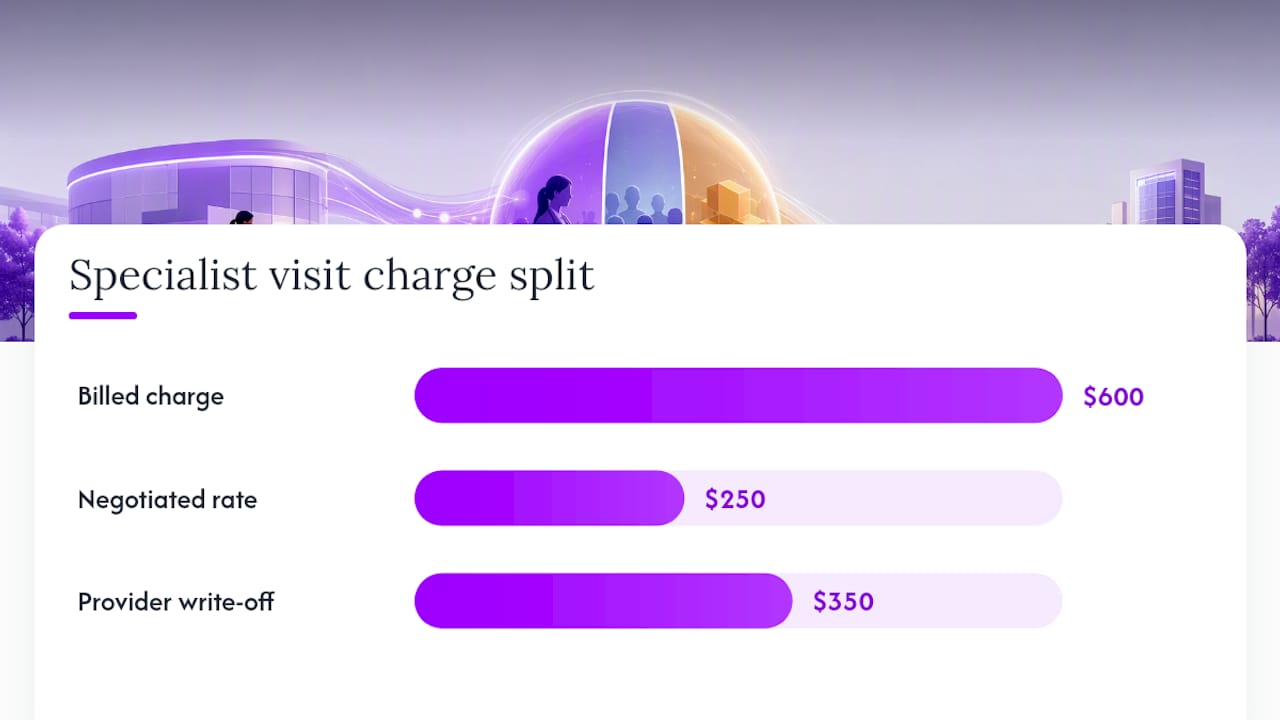
You visit an in-network specialist. The billed charge is $600. The negotiated rate is $250. Your plan has a $1,500 deductible, and you have not yet met it.
- You owe $250 (the full negotiated rate, applied to your deductible).
- $250 counts toward your $1,500 deductible.
- The $350 difference between the billed charge and the negotiated rate is written off. You never see it.
Scenario B: In-network care after your deductible is met, with 20% coinsurance
Same specialist visit. Negotiated rate is still $250. Your deductible is now satisfied.
- Your plan pays 80% of $250 = $200.
- You pay 20% of $250 = $50.
- Your $50 coinsurance payment counts toward your out-of-pocket maximum.
Once you hit your out-of-pocket maximum for the year, the plan covers 100% of the negotiated rate for covered in-network services. The negotiated rate remains the ceiling throughout.
What to do if you are billed incorrectly:
- Request an itemized bill and compare it to your Explanation of Benefits.
- Confirm the provider is in-network for your specific plan (not just your insurer’s broader network).
- Contact your insurer’s member services line to dispute a charge that exceeds the negotiated rate.
- For emergency or surprise bills, file a complaint through your state insurance commissioner or use the federal No Surprises Act dispute process.
Pro Tip: Always verify in-network status directly with your insurer before a scheduled procedure, not just with the provider’s front desk. A provider may accept your insurer but not your specific plan tier.
Where can you find your plan’s negotiated rates?
Finding the actual negotiated rate for a specific service takes a few steps, but the tools exist. Here is a practical checklist:
- Use your insurer’s cost-estimator tool. Most major insurers offer a member portal with a cost-estimator that shows your estimated out-of-pocket cost based on your plan’s negotiated rate and your current deductible status. This is the fastest starting point for most consumers.
- Call member services. If the online tool does not cover your specific procedure or provider, call the number on your insurance card. Ask for the negotiated rate for the CPT code your provider plans to use.
- Ask your employer’s HR team or TPA. If you are on an employer-sponsored plan, your HR department or the plan’s TPA may have access to more detailed pricing data than the member portal shows.
- Request a Good Faith Estimate from your provider. Under the No Surprises Act, uninsured and self-pay patients can request a Good Faith Estimate before scheduled care. Insured patients can also ask providers for an estimate, though the formal Good Faith Estimate requirement applies primarily to uninsured individuals.
- Check the TiC machine-readable files (MRFs) via a third-party tool. Insurers are required to publish these files publicly, but they are large and technically formatted. Tools built by benefits analytics firms or your broker can translate them into readable comparisons.
The TiC rule requires insurers and group health plans to publish in-network negotiated rates in machine-readable files. As NPR reported, opaque pricing has long made it difficult for consumers to interpret what they actually owe. The TiC rule was designed to address that, though the raw files remain a challenge for individuals to use directly.
- Insurer cost-estimator tools are the most consumer-friendly option.
- HR teams and TPAs can access plan-level data that members cannot.
- Brokers and benefits consultants can run benchmarking reports using TiC data.
- Comparing medical insurance plans across carriers becomes much more precise when you use negotiated-rate benchmarks rather than premium alone.
Pro Tip: When calling member services, ask specifically for the “allowed amount” for your procedure’s CPT code at the specific facility you plan to use. That single number tells you the most you will owe before cost-sharing kicks in.
Why do negotiated rates vary so much across providers?
Two providers performing the same procedure in the same city can have negotiated rates that differ by 30–40% or more, according to Trilliant Health’s market analysis. That variation is not random. Several structural factors drive it:
- Market concentration: In markets where one hospital system controls most of the beds, that system negotiates from a position of strength. Insurers cannot exclude them without losing members, so rates stay high.
- Hospital ownership of physician practices: When a hospital acquires a physician group, the group’s services often get billed at hospital facility rates, which are typically higher than independent practice rates for the same service.
- Academic medical centers: Teaching hospitals carry higher overhead and often higher negotiated rates, even for routine services.
- Payer mix: Providers with a high share of commercially insured patients have more to gain from favorable contract terms and negotiate accordingly.
- Negotiation data access: Providers and insurers with better market intelligence consistently secure better terms. Healthcare pricing strategy research from HFMA shows that transparency rules are compressing unit rates where providers are visibly above market averages.
The Trilliant Health 2025 price transparency report documents how employers are now using public pricing data to demand better benefit design and improved negotiated rates from plans. That shift is real: employers who benchmark their contracts against TiC data can identify where they are paying above-market rates and push back at renewal.
What did the Transparency in Coverage rule actually change?
The Transparency in Coverage rule, enforced by CMS and HHS, requires insurers and group health plans to publish two categories of data: in-network negotiated rates in machine-readable files, and personalized cost-sharing estimates for members. CMS hospital price transparency requirements run parallel to TiC, requiring hospitals to post payer-specific negotiated rates in a consumer-friendly format.
What TiC changed in practice:
- Negotiated rates that were previously confidential are now technically public.
- Employers and brokers can download MRFs and benchmark their plan’s rates against competitors.
- Insurers must provide members with an online cost-estimator covering most items and services.
What TiC did not fix:
- MRFs are enormous files, often gigabytes in size, structured for data engineers rather than consumers.
- File formats and provider identifier conventions vary across insurers, making direct comparisons difficult without normalization.
- Not all plans have built consumer-friendly tools that surface MRF data in a readable way.
The practical value of TiC for individual consumers is limited unless employers, brokers, or data aggregators convert machine-readable files into usable tools. The rule created transparency in principle; the market is still building the infrastructure to make it useful in practice. Employers and brokers are the primary beneficiaries today, and their leverage is growing as more analytics tools emerge.
The TiC negotiated rate file guidance from the Department of Labor confirms that MRFs are intended for data users, not individual members. For most consumers, the insurer’s cost-estimator tool remains the most accessible entry point.
What employers and individuals should do first
The most underused insight in healthcare pricing is this: the negotiated rate is already public, but almost nobody uses it. Employers who treat TiC data as a passive compliance exercise are leaving real money on the table. Those who bring benchmarking data to their broker before renewal, and ask pointed questions about why their plan’s rates for specific CPT codes are above market, consistently get better terms.
For individuals, the single most protective habit is asking for a cost estimate before any scheduled procedure, not after. Your insurer’s cost-estimator tool takes two minutes and can prevent a four-figure surprise. If you are managing benefits for a team, reviewing your health plan annually with rate benchmarking built into the process is the clearest path to a plan that actually delivers value.
Negotiation in healthcare is not just a provider-insurer dynamic. Integrative bargaining research shows that organizations that invest in negotiation skills and data access get better outcomes. That applies to employers purchasing group coverage just as much as it applies to hospital contracting teams. If you want a practical starting point for negotiating HMO rates as an SME, the same principles apply: know your data, know your alternatives, and ask specific questions.
Thinking about your team’s coverage?
If you are an employer evaluating health plan options, understanding negotiated rates is the foundation of a plan that protects your team without overpaying. Hmoplans offers comprehensive HMO plan features built for SMEs, with transparent coverage terms and access to accredited facilities. See what a well-structured plan looks like before your next renewal.

Sources
These primary sources are the most reliable references for negotiated-rate data, rule text, and consumer tools.
- Healthcare
- Transparency in Coverage negotiated rate file | U.S. Department of Labor (EBSA)
- Hospital price transparency | CMS
- How to Negotiate With Health Care Plans - PMC
- 2025 price transparency report | Trilliant Health
- Payer-specific negotiated rate - Payorology
- New Trilliant Health report exposes widespread price variation in U.S. healthcare | HLTH
Raw TiC machine-readable files are most useful to employers, brokers, and analytics vendors who can normalize and map the data. Individual consumers get the most practical value from insurer cost-estimator tools and HR or broker-generated reports built on that underlying data.
