

What Is Capitation in HMO? A Clear Payment Guide
Capitation in an HMO is a fixed payment made to a provider for each enrolled member, paid in advance for a set period, regardless of how much care that member actually uses. The Centers for Medicare & Medicaid Services defines this as pre-payment, typically expressed as a per member per month (PMPM) amount. If a health plan pays a primary care physician a fixed PMPM amount for enrolled patients, that provider receives a set payment every month regardless of how often those patients visit. The defining consequence: financial risk moves from the insurer to the provider. The American College of Physicians notes this shift changes provider incentives fundamentally, rewarding population health over visit volume.
For patients, this means your primary care doctor has a built-in reason to keep you healthy rather than schedule unnecessary appointments.
Table of Contents
- How does capitation work inside an HMO contract?
- What are the main types of capitation?
- Why do HMOs use capitation, and what are the trade-offs?
- How are capitation rates calculated in the U.S.?
- Capitation vs. fee-for-service: what actually changes?
- Where does capitation actually show up in the U.S.?
- What does capitation mean for you as a patient?
- What should you check in a capitated arrangement?
- Key Takeaways
- Why understanding your payment model matters
- Authoritative sources and further reading
How does capitation work inside an HMO contract?
The payment flows from the health plan directly to the provider or provider group, usually on the first of each month, before any care is delivered. The contract names three core parties: the health plan (payer), the primary care provider (PCP) or medical group, and the enrolled member population.
A standard primary care capitation contract typically covers:
- Routine office visits and preventive screenings
- Basic diagnostic tests ordered by the PCP
- Care coordination and chronic disease management
- Non-billable services like care management and social work referrals, which CMS notes become financially viable under pre-payment because the fixed revenue supports them
What is commonly carved out: specialist visits, inpatient hospital stays, high-cost drugs, and emergency care. Those services are either paid fee-for-service or covered under a separate capitated arrangement.
To protect against financial volatility, contracts often include withholds (a percentage of the PMPM held back until year-end), risk pools shared across a provider group, and stop-loss reinsurance that caps losses when a single patient generates catastrophic costs.

What are the main types of capitation?
Not every capitation arrangement covers the same scope of services. The type determines how much financial risk a provider actually carries.
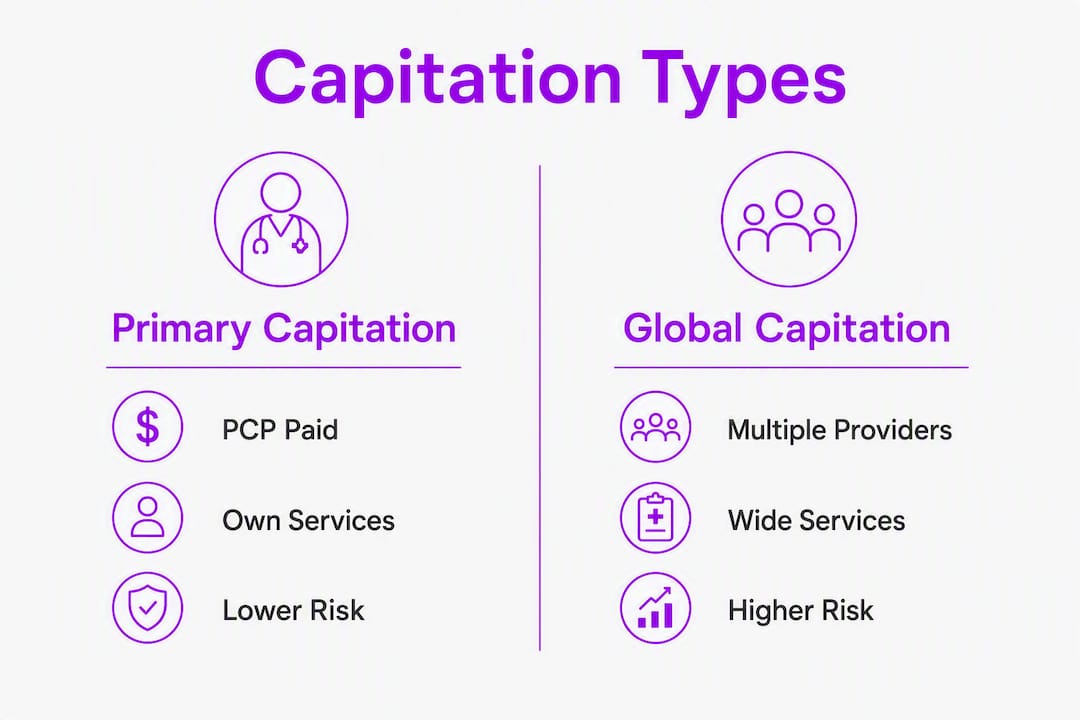
| Type | Who gets paid | Services covered | Risk level |
|---|---|---|---|
| Primary capitation | PCP only | PCP’s own services | Low to moderate |
| Secondary (subcapitation) | Specialist or downstream provider | Specific specialty services | Moderate |
| Global (full-risk) capitation | Provider organization | Nearly all care for the member | High |
| Partial/hybrid | PCP + FFS for specialty/inpatient | Primary care capitated; rest FFS | Moderate |
The Urban Institute distinguishes primary capitation, where the PCP is paid only for their own services, from global capitation, where a provider organization assumes full financial responsibility for the member’s entire care. Global capitation is the highest-stakes arrangement and is typically reserved for large, well-capitalized medical groups or integrated delivery systems.
Hybrid models are the most common in commercial HMOs today. The PCP receives a capitated PMPM for primary care, while specialists and inpatient stays are reimbursed fee-for-service or through subcapitation agreements.
Why do HMOs use capitation, and what are the trade-offs?
HMOs favor capitation because it converts unpredictable claims spending into a fixed, budgetable cost. For the payer, this simplifies financial planning and creates a direct incentive for providers to invest upstream in prevention rather than downstream in expensive acute care.
“Capitation intentionally shifts financial risk to providers so they are rewarded for keeping populations healthy rather than for delivering high volumes of billable services.” — American College of Physicians
Provider advantages: Stable, predictable monthly revenue. Freedom to offer preventive care services and care management programs that fee-for-service would never reimburse. Reduced billing and coding overhead for capitated services.
Provider challenges: The provider now bears the cost risk. A panel with several high-utilization patients can quickly erode the monthly payment. Smaller practices face the steepest exposure, since one catastrophic case can distort the entire budget.

The under-utilization risk: When providers bear financial risk, there is a documented incentive to limit referrals or delay care. The ACP specifically flags this and recommends utilization monitoring and quality measurement as the primary safeguards. CMS echoes this, requiring quality metrics and audits in its Innovation Center models.
How are capitation rates calculated in the U.S.?
Rates are not arbitrary. Actuaries build them from local cost data, expected utilization patterns, and the demographic and clinical profile of the enrolled population.
Key factors in rate-setting:
- Local cost data: What primary care services actually cost in a given market, adjusted for regional wage and practice-cost differences
- Expected utilization: How often members in the target population are projected to use covered services, based on historical claims
- Risk adjustment: Members with higher expected costs (older age, chronic conditions, complex diagnoses) generate higher risk scores, which Medicaid.gov’s rate guidance confirms are used to compensate providers appropriately
- Trend factors: Annual adjustments for medical cost inflation
- Geographic loadings: Urban vs. rural cost differentials
Statistic callout: Medicaid capitation rates vary significantly by state and population segment. The 2025–2026 Medicaid rate guide confirms rates are actuarially developed using local costs and expected utilization, with risk adjustment applied to account for population health status.
Withholds and risk pools add another layer. A plan may hold back a portion of the PMPM and release it at year-end based on quality scores or financial performance. This creates a performance incentive layered on top of the base capitation rate.
Capitation vs. fee-for-service: what actually changes?
The payment model shapes everything from how your doctor thinks about your care to how your employer budgets for health benefits.
| Dimension | Capitation | Fee-for-service |
|---|---|---|
| Payment unit | Fixed PMPM per enrolled member | Per service or procedure delivered |
| Who bears financial risk | Provider | Payer (insurer or employer) |
| Provider incentive | Efficiency, prevention, population health | Volume of billable services |
| Common settings | HMOs, Medicaid managed care, Medicare Advantage | Specialist care, traditional indemnity plans |
| Hybrid arrangements | Partial capitation with FFS carve-outs | PPOs with capitated physician group elements |
Some PPO contracts embed capitated payments to physician groups even when marketed as fee-for-service plans, so the distinction is not always visible to the patient or employer.
Where does capitation actually show up in the U.S.?
Capitation is not a niche concept. It operates at scale across several major U.S. programs.
- Medicaid managed care: Most states contract with managed care organizations (MCOs) that receive capitated payments from the state Medicaid agency. The MCO then subcapitates or pays providers from that fixed budget. Rate-setting is governed by federal actuarial soundness standards.
- Medicare Advantage: CMS pays Medicare Advantage plans a risk-adjusted capitated rate per enrolled beneficiary. Plans then design their own provider payment arrangements, many of which include capitation to primary care groups.
- Commercial HMOs: Employer-sponsored group HMOs commonly use primary care capitation. The employer pays a premium to the health plan; the plan pays PCPs a PMPM for their enrolled employee population.
- CMS Innovation Center models: Programs like the Primary Care First model use pre-payment and capitation-adjacent structures to stabilize practice revenue and support whole-person care, consistent with CMS’s framing of pre-payment as a tool for care transformation.
What does capitation mean for you as a patient?
Your out-of-pocket costs and coverage rules come from your insurance contract, not from whether your doctor is paid by capitation or fee-for-service. But the payment model does shape your day-to-day experience in real ways.
Under an HMO capitation model, your PCP acts as a gatekeeper. Referrals to specialists typically require PCP authorization, and some services need prior authorization from the plan. This structure can strengthen your relationship with a primary care doctor who coordinates all your care, which research consistently links to better chronic disease management and preventive care outcomes.
The risk for patients is delayed specialist access if a provider is financially motivated to limit referrals. Quality monitoring and utilization audits by the plan are the main protections against this.
Pro Tip: Ask your plan or HR team three specific questions: How is my PCP compensated (capitation or FFS)? Are specialist referrals subject to prior authorization, and what is the typical turnaround? What quality metrics does the plan track and publish for provider panels?
What should you check in a capitated arrangement?
Whether you are an employer buying group coverage or an employee enrolled in an HMO, a few oversight signals tell you whether the capitation model is being managed responsibly.
Green flags:
- The plan publishes utilization reports and quality scorecards
- Your PCP can explain the referral process clearly and in writing
- The plan has a formal appeals process for denied referrals or prior authorizations
- Stop-loss reinsurance is in place for the provider group, reducing the incentive to ration care
Red flags:
- Sudden, unexplained denial of referrals with no written reason
- Unusually high withhold rates with no clear quality-based release criteria
- No published quality metrics or utilization data for the provider panel
- Provider reluctance to discuss how they are paid
Peer-reviewed research confirms that smaller provider panels face disproportionate financial volatility under capitation, which can translate into tighter gatekeeping. Larger, well-resourced groups with stop-loss coverage are generally better positioned to absorb cost variance without restricting care.
Practical questions to ask during plan procurement or open enrollment:
- Does the plan audit providers for under-provision of care?
- What is the withhold rate, and what triggers its release?
- How are specialist referrals tracked and monitored?
- What is the plan’s grievance and appeals timeline?
Key Takeaways
Capitation in an HMO is a fixed PMPM payment that shifts financial risk from the insurer to the provider, changing incentives from volume to population health.
| Point | Details |
|---|---|
| Core definition | A fixed PMPM payment to a provider for each enrolled member, paid in advance regardless of services used. |
| Risk transfer | Financial risk moves from the health plan to the provider, incentivizing prevention over high-volume care. |
| Types vary by scope | Primary, secondary, global, and hybrid capitation differ in which services are covered and how much risk the provider carries. |
| Rates are actuarially set | Local costs, utilization data, and risk adjustment scores determine the PMPM; withholds and stop-loss add performance layers. |
| Patient action step | Ask your plan or HR team how your PCP is paid and what quality metrics the plan tracks and publishes. |
Why understanding your payment model matters
Most patients and even many HR managers never think to ask how their doctor gets paid. That is a gap worth closing. The payment model is not just a billing detail — it shapes what care gets offered, how quickly referrals move, and whether your provider has the financial room to invest in care management that fee-for-service would never support.
Capitation, done well, can fund exactly the kind of whole-person primary care that keeps employees healthier and reduces long-term claims costs. Done poorly, with inadequate risk adjustment or no quality monitoring, it creates pressure to ration care. The difference almost always comes down to how the contract is structured and whether the plan enforces quality standards.
For employers choosing group coverage, the right question is not just “what does the premium cost?” It is “how does this plan pay its providers, and what safeguards prevent under-utilization?” Reviewing your plan documents for referral rules, prior authorization requirements, and quality reporting is a practical first step. If you want a plan structure that is transparent about coverage and built for SME needs, exploring your HMO plan options is a good place to start.
Authoritative sources and further reading
These are the primary sources used throughout this article. Each is publicly available and represents authoritative guidance on capitation in the U.S. health system.
- CMS: Capitation and Pre-payment — The federal definition and policy rationale for capitation and pre-payment in CMS Innovation Center models. Start here for the official U.S. government framing.
- American College of Physicians: Understanding Capitation — ACP’s guidance on provider incentives, withholds, and quality monitoring under capitation. Highly relevant for clinicians and anyone evaluating provider contracts.
- Medicaid.gov: 2025–2026 Medicaid Rate Guide — Federal guidance on actuarially sound rate-setting for Medicaid managed care capitation. The authoritative source for understanding how Medicaid capitation rates are built and adjusted.
- Urban Institute: Primary Care Capitation — Policy analysis distinguishing primary from global capitation and examining scope-of-service trade-offs.
- PMC: Risk and Variation with Small Capitation Panels — Peer-reviewed research on financial volatility for small provider panels under capitation, supporting the case for stop-loss reinsurance and panel-size management.
