

How to Negotiate HMO Rates for SMEs: 2026 Guide
TL;DR:
- Early preparation and benchmarking against the Medicare Physician Fee Schedule are essential for successful HMO rate negotiations.
- Focusing on contract clauses beyond premiums, such as retroactive denial windows and auto-renewals, helps control total costs.
HMO rate negotiation is the process of securing favorable premium rates and contract terms from health insurers through data-driven proposals and structured timelines. Most HR managers treat it as a once-a-year formality. The ones who get the best deals treat it as a year-round discipline. Knowing how to negotiate HMO rates means benchmarking offers against the Medicare Physician Fee Schedule, auditing your utilization data, and pushing back on contract clauses that quietly inflate your total cost. This guide gives you the exact framework to do all three.
How to negotiate HMO rates: why preparation is everything
The single biggest mistake SMEs make is starting too late. Negotiations should begin 12 months before contract renewal, involving 50–100 interaction points across the entire process. That number surprises most HR managers. It means a successful renewal is not one conversation. It is a structured campaign.
Starting early gives you time to gather the data insurers respect: utilization reports, claims history, billing records, and employee demographic trends. Without this data, your negotiation is a request. With it, it is a proposal backed by evidence.
Here is the preparation sequence that works:
- Pull your utilization data 12 months out. Request claims reports from your current insurer. Identify your top cost drivers by diagnosis category and service type.
- Map every contract due for renewal. List renewal dates, current rates, and any auto-renewal clauses that could lock you in without a renegotiation window.
- Build a clause playbook. Document every non-rate term in your current contract. Flag unilateral amendment rights, evergreen clauses, and retroactive denial windows.
- Set internal deadlines. Give yourself a 90-day buffer before the insurer’s deadline to finalize your counter-proposal.
- Identify your walkaway point. Know the maximum rate increase you will accept before you explore other plan options.
Pro Tip: A clause playbook and rolling renewal cadence improve your leverage on every future negotiation, not just the current one. Build it once, update it annually.
The HMO plan renewal process is predictable once you map it. The HR managers who win are the ones who treat the calendar as a negotiation tool.

How do you benchmark proposed HMO rates against market standards?
Benchmarking is the foundation of any credible rate negotiation. Without a reference point, you cannot tell a fair offer from an inflated one.
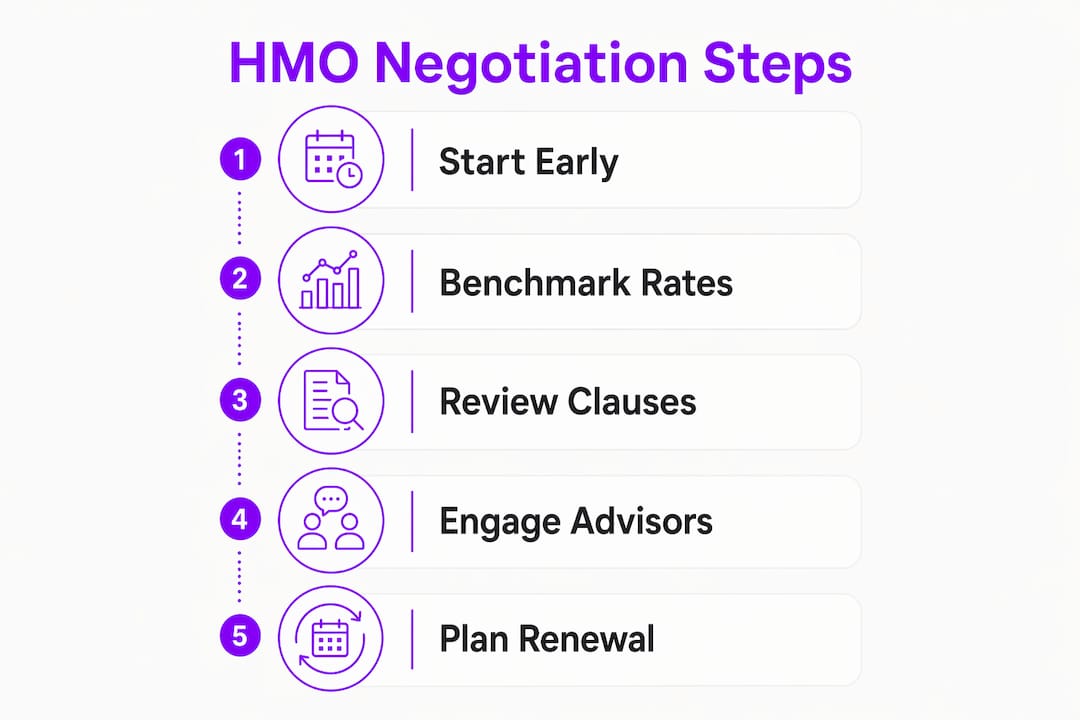
The Medicare Physician Fee Schedule is the standard baseline for evaluating HMO contract rates. Rates below 90% of Medicare are considered non-viable without significant concessions from the insurer. That threshold gives you a concrete floor to argue from. If a proposed rate sits below it, you have documented grounds to push back.
Beyond Medicare, use these benchmarks to build your comparison:
- Industry specialty society surveys. Professional associations publish annual rate surveys by specialty and region. These give you market context beyond the Medicare baseline.
- Your own historical rates. Year-over-year rate increases above general medical inflation are a red flag worth challenging.
- Administrative cost ratios. High administrative costs can negate savings from a low-premium plan. Factor in referral management friction, prior authorization denial rates, and claims processing delays.
The table below shows how to structure your rate comparison across key evaluation criteria:
| Evaluation criterion | What to measure | Red flag threshold |
|---|---|---|
| Base premium rate | % of Medicare Physician Fee Schedule | Below 90% of Medicare |
| Administrative burden | Prior authorization denial rate | Above industry average |
| Claims processing speed | Average days to payment | Over 30 days |
| Network adequacy | % of preferred providers in network | Below 80% of your employee needs |
| Rate escalation clause | Annual increase cap | Uncapped or above medical CPI |
HMOs use PCP gatekeeping and closed-network discounts to structurally lower premiums compared to PPO plans. That structural advantage is real, but it only holds if the network is adequate and administrative friction stays low.
Pro Tip: Request a rate decomposition by service category before you sign anything. Blended rates can hide below-market performance in specific segments, making an average-looking offer look better than it actually is.
What contract clauses affect your total HMO cost beyond premiums?
The premium rate is the headline number. The contract clauses are where the real cost lives. HR managers who focus only on negotiating HMO costs at the premium level routinely overpay through unfavorable contract language.
These are the clauses that matter most:
- Unilateral amendment clauses. These allow the insurer to change contract terms mid-term without your consent. Push for a mutual amendment requirement with a 90-day notice period.
- Evergreen auto-renewal clauses. If you miss the opt-out window, you are locked into current rates for another full term. Your clause playbook should flag every renewal date 12 months in advance.
- Retroactive denial lookback windows. Insurers can recoup payments for claims they later deem non-compliant. Negotiating contract language on retroactive-denial lookback limits your exposure significantly. Push for a 12-month maximum lookback period.
- Prior authorization carve-outs. Broad prior authorization requirements create administrative friction that costs your HR team time and your employees delayed care. Negotiate carve-outs for routine services.
- Termination provisions. Confirm you have the right to terminate for cause with a defined notice period. Contracts that require 180-day notice with no cause provision trap you in bad agreements.
- Appeal rights. Verify that your contract includes a formal internal and external appeal process for denied claims.
Negotiating non-rate contract clauses can reduce administrative overhead by 20–40%. That figure represents real money for an SME managing a lean HR team.
Pro Tip: Review your HMO contract terms with a legal or compliance advisor before signing. A single overlooked clause can cost more than the premium savings you negotiated.
What negotiation tactics actually work with HMO insurers?
Effective negotiation with insurers is not about being aggressive. It is about being organized, specific, and credible. Insurers respond to data, not frustration.
- Package your leverage in a formal memo. Concise three-page memos with benchmarks and data get stronger insurer responses than informal requests. Lead with your utilization data, your benchmark comparison, and your specific counter-proposal.
- Set a clear response deadline. Give the insurer 15 business days to respond in writing. Deadlines signal seriousness and prevent the negotiation from drifting.
- Separate negotiations by product line. Forcing separate rate tables per product prevents insurers from bundling and masking underperforming contracts. Negotiate your HMO rates independently from any PPO or supplemental products.
- Know your walkaway point before the first meeting. Define the maximum rate increase and minimum contract terms you will accept. Document them internally before negotiations begin.
- Maintain good faith throughout. Insurers have long memories. Aggressive tactics that burn relationships cost you on the next renewal cycle.
“Assertive, data-backed communication with clear deadlines improves negotiation outcomes significantly. The goal is to be the most prepared party in the room, not the loudest.”
The 2026 HMO strategy planning process starts with knowing what questions to ask before the insurer sets the agenda. HR managers who define their priorities first control the negotiation frame.
Maximizing HMO benefits for SMEs requires treating the contract as a living document, not a one-time transaction. Schedule a mid-year review to track whether the insurer is meeting its performance commitments.
Key Takeaways
Negotiating HMO rates successfully requires starting 12 months early, benchmarking against the Medicare Physician Fee Schedule, and addressing contract clauses with the same rigor you apply to premium rates.
| Point | Details |
|---|---|
| Start 12 months early | Negotiations involve 50–100 touch points; late starts eliminate your leverage. |
| Benchmark against Medicare | Rates below 90% of the Medicare Physician Fee Schedule are non-viable without concessions. |
| Decompose blended rates | Request separate rate tables by product line to expose below-market segments. |
| Negotiate contract clauses | Non-rate terms like retroactive denial windows and prior authorization scope directly affect total cost. |
| Use formal, data-backed proposals | Three-page memos with benchmarks and clear deadlines generate stronger insurer responses. |
What I’ve learned about HMO negotiation that most guides skip
Most articles on negotiating HMO costs focus entirely on the premium number. I’ve found that fixation is the most expensive mistake SME owners make.
The clause playbook concept changed how I think about renewals entirely. Before I started maintaining one, I missed an evergreen auto-renewal clause that locked a client into a stale rate for 12 months. That single oversight cost more than the savings we had negotiated the year before. The clause playbook is not optional. It is the foundation.
The other thing I see SMEs consistently underestimate is the true net cost of a plan. A low premium with high prior authorization friction, slow claims processing, and a broad retroactive denial window is not a good deal. It is a delayed cost. The administrative burden of HMO plans shows up in HR staff time, employee complaints, and cash flow gaps. Factor all of it in before you celebrate a rate win.
My honest advice: be assertive, be specific, and be prepared to walk away. Insurers respect organized buyers. The HR managers who get the best deals are the ones who show up with data, a formal proposal, and a clear deadline. Not the ones who ask nicely and hope for the best.
— Eumir
Hmoplans makes HMO negotiation simpler for Philippine SMEs
Negotiating HMO rates is easier when your plan is already built for SME needs. Hmoplans, powered by Purple Cow and underwritten by Etiqa, offers SME-focused HMO plans designed with transparent terms, 100% coverage for pre-existing and congenital conditions up to the Maximum Benefit Limit, and access to premier facilities including the Big 9 Hospitals and Healthway Clinics.

Hmoplans eliminates the complicated contract language that makes renewal negotiations so difficult for lean HR teams. Their plan features include flexible add-ons, PhilHealth independence options, and digital healthcare access. If you want a plan that is straightforward to manage and built to hold its value at renewal, Hmoplans is worth a close look.
FAQ
When should I start negotiating my HMO contract renewal?
Start 12 months before your renewal date. The full negotiation process typically involves 50–100 interaction points, and late starts eliminate your ability to push back effectively.
What is the Medicare Physician Fee Schedule and why does it matter?
The Medicare Physician Fee Schedule is the standard benchmark for evaluating HMO contract rates. Rates below 90% of Medicare are generally considered non-viable without significant concessions from the insurer.
What non-rate contract clauses should I prioritize in HMO negotiations?
Focus on retroactive denial lookback windows, unilateral amendment rights, evergreen auto-renewal clauses, and prior authorization scope. Negotiating these terms can reduce administrative overhead by 20–40%.
How do I know if a blended HMO rate is hiding a bad deal?
Request a rate decomposition by product line and service category. Blended rates can mask below-market performance in specific segments, making an average offer appear more competitive than it is.
What makes a strong HMO negotiation proposal?
A concise three-page memo that includes your utilization data, a benchmark comparison against the Medicare Physician Fee Schedule, and a specific counter-proposal with a clear response deadline gets the strongest insurer response.
