

Philippine Manufacturers: SME HMO That Covers Preexisting Conditions
A tailored SME corporate HMO is the strongest way for Philippine manufacturers to protect factory workers and control claims cost. Before signing anything, pull together your employee roster and two years of claims history, then request a tailored quote.
TL;DR:
- A tailored SME HMO offers comprehensive coverage for pre-existing conditions and rapid outpatient access, reducing absenteeism and improving worker retention.
- Confirm the plan covers 24/7 emergency care, is networked near provincial plants, and handles work-related injuries in coordination with PhilHealth.
- Funding options shift with company size, with fully insured plans suited for smaller factories and self-funded or pooled models for larger or growing manufacturers.
- Premium costs are strongly influenced by workforce age, claims history, benefit levels, and regional hospital rates, making cost comparison essential.
- Proper enrollment and claims processes require clear coordination with HR, payroll, and provider timelines to ensure coverage validity from day one.
Table of Contents
- Why a Tailored SME HMO Fits Manufacturing Companies
- What Coverage Features Should Manufacturing HR Evaluate First?
- Which Funding Model Suits Your Factory’s Size?
- What Drives HMO Pricing, and How Do You Budget Per Employee?
- How Does Enrollment and Claims Administration Work?
- A Practitioner’s Take on Buying HMO the Right Way
- Get an HMO Plans Quote Built for Your Factory
- Sources
Why a Tailored SME HMO Fits Manufacturing Companies
Manufacturing workforces don’t look like office staff on a benefits spreadsheet. You’ve got rotating shifts, machine operators exposed to repetitive strain and burns, and production lines that can’t stop because someone needs a same-day doctor’s note. A generic HMO built for a call center or a retail chain misses most of that.
HMO Plans’ Purple Cow was designed around SME realities rather than enterprise assumptions. The plan’s core structure commits to covering pre-existing and congenital conditions at 100% up to the MBL, gives employees cashless entry into accredited hospitals and clinics, and includes access to the Big 9 hospitals along with Healthway clinics for routine and urgent visits alike. For a factory floor where an existing condition like hypertension or diabetes is common among long-tenured workers, that pre-existing coverage commitment removes a huge source of employee anxiety and HR headache.
Three business outcomes typically follow when manufacturers move from patchy or no coverage to a structured SME HMO:
- Lower unplanned absenteeism, since workers get same-day outpatient access instead of missing shifts to queue at public hospitals.
- Better retention among skilled machine operators and supervisors, who tend to weigh health benefits heavily when comparing job offers in industrial zones.
- More predictable annual budgeting, because a fixed per-employee premium replaces ad hoc reimbursements for injuries and illness.
Pro Tip: Ask HR to track sick-leave patterns for three months before your renewal. If absences cluster around dependent care or chronic conditions, that data becomes leverage when negotiating add-ons like dental or expanded outpatient limits.
Funding structure, more than benefit specifics, tends to be what actually drives total cost for a manufacturer’s health plan. Client-reported feedback from HMO Plans spans tech, hospitality, and healthcare employers, and the plan’s add-on menu (dental, annual physicals, life and accident insurance) lets a factory owner start lean and expand coverage as headcount grows.
What Coverage Features Should Manufacturing HR Evaluate First?
Factory environments create risk profiles that a standard office HMO checklist doesn’t capture. Before you sign a proposal, run it against these priorities.
- Shift-friendly access. Confirm the plan covers 24/7 emergency care, not just weekday clinic hours. A worker injured on a graveyard shift needs the same cashless access as one hurt at 2 p.m.
- Workplace injury coordination. Ask how the HMO coordinates with PhilHealth for work-related injuries and whether the insurer requires an incident report before approving cashless treatment.
- Outpatient and inpatient balance. Production workers use outpatient services (minor injuries, checkups) far more than inpatient care. Make sure outpatient limits aren’t an afterthought next to inpatient room-and-board figures.
- Dependent and maternity provisions. Many production-line employees are raising young families; dependent coverage and maternity benefits often decide whether a worker stays or leaves for a competitor’s benefits package.
- Network breadth beyond Metro Manila. If your plant sits in Laguna, Cebu, or Cavite, confirm the network includes accredited hospitals near the facility, not just in the capital.
- Waiting periods and pre-existing condition handling. Some providers exclude pre-existing conditions for the first six to twelve months. Get this in writing, not verbally promised.
Red flags worth walking away from: vague language around “case-to-case” pre-existing approval, no listed provincial hospitals near your plant, and vendors who can’t produce a written claims turnaround time.
Which Funding Model Suits Your Factory’s Size?
Every manufacturer eventually asks the same question: should we buy a standard fully insured HMO, or is there a cheaper structure once we hit a certain headcount? Funding structure typically determines total cost more than any single benefit line item, which is why it deserves attention before you compare deductibles or room limits.
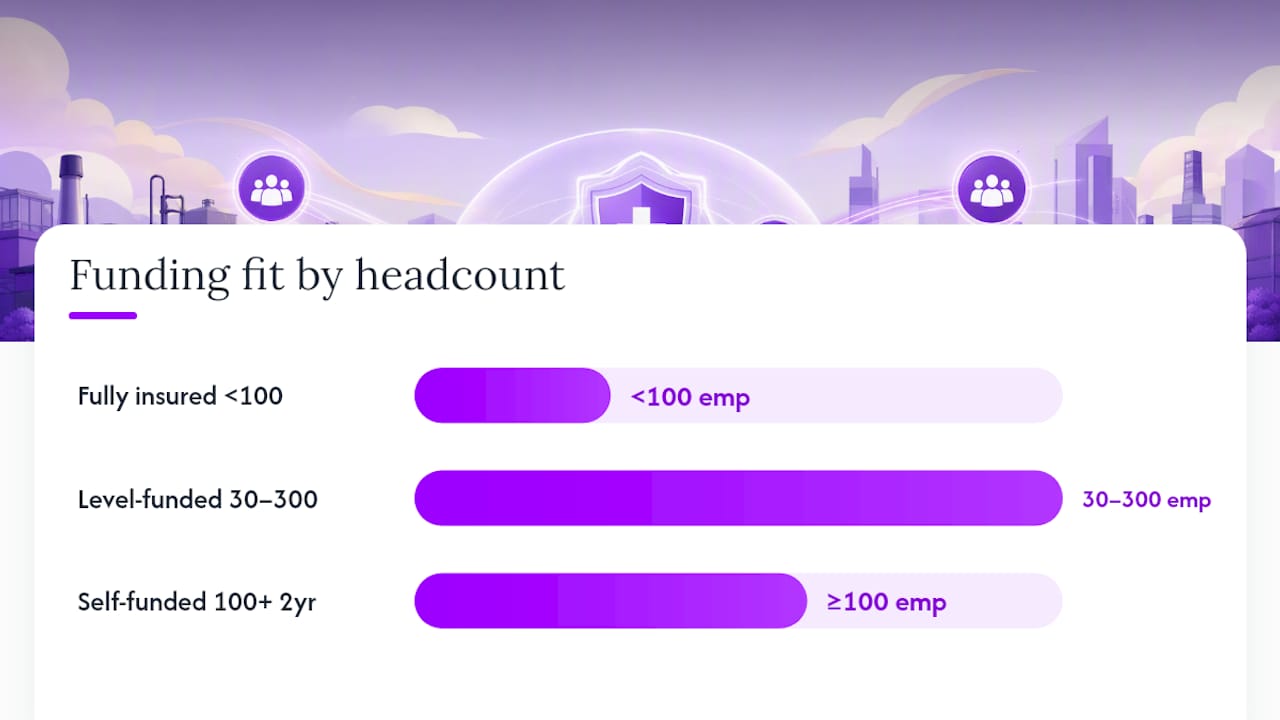
Fully insured works best for smaller factories, generally under 100 employees, where HR has limited bandwidth to manage claims administration and wants predictable monthly premiums with no exposure to bad claims years.
Level-funded or self-funded structures become worth exploring once headcount and claims history support them. Guidance from health plan design specialists puts level-funded in reach around 30 to 300 employees, while credible self-funding generally requires 100 or more enrolled lives and at least two years of stable claims history; without that data, self-funding just shifts volatility onto your balance sheet.
Group captives or pooled buying pool several employers’ claims to increase negotiating leverage, a model illustrated by manufacturing benefits trusts in other markets. Philippine SMEs rarely reach the scale for a true captive alone, but growth-stage manufacturers should ask HMO Plans whether industry pooling options exist as headcount rises.
Before any funding conversation with a vendor, prepare:
- Two to three years of claims history broken down by facility.
- Current headcount and projected hiring for the next 12 months.
- A summary of your highest-cost claim categories.
What Drives HMO Pricing, and How Do You Budget Per Employee?
Premiums for the same headcount can vary widely between two manufacturers, and the gap almost always traces back to a handful of factors rather than the insurer’s margin.
- Age mix of the workforce. Older production crews with more tenure typically cost more to insure than a younger assembly line.
- Claims history. A plant with a rough injury record or high chronic-condition prevalence will see that reflected in renewal pricing.
- Benefit richness. Higher room-and-board limits, broader outpatient caps, and add-ons like dental or life and accident insurance all raise the per-employee rate.
- Dependent enrollment. Plans covering spouses and children cost more per employee than employee-only coverage.
- Regional hospital rates. A plant near premium hospitals in Metro Manila or Cebu City may see higher unit costs than one served by provincial facilities.
PhilHealth coordination also matters here. Because PhilHealth covers a portion of hospitalization costs, a well-structured HMO fills the gap rather than duplicating it, which keeps net employer cost lower than buying HMO coverage as a total replacement. For current benchmark ranges specific to Philippine SMEs, HMO Plans maintains a detailed per-employee pricing guide worth reviewing before you request quotes, along with practical cost-cutting tactics that don’t sacrifice coverage depth.
When comparing vendor quotes, ask each one for the same five figures: base premium per employee, dependent rider cost, add-on pricing, MBL, and any loading applied for claims history. Quotes that dodge one of these deserve a follow-up call.
How Does Enrollment and Claims Administration Work?
Getting a plan approved is only half the job. Implementation determines whether workers actually get covered on time.
- Submit your data. HR provides the employee roster, dependent information, and effective date requests, typically 30 to 45 days before your intended start date.
- Confirm waiting periods. Most plans activate standard benefits immediately but may stagger dental or optical add-ons; get exact dates in writing.
- Align with payroll. If you’re using an EOR or payroll provider, confirm whether HMO enrollment begins on the employee’s payroll start date or after a full cycle; mismatches here create real coverage gaps.
- Understand claims flow. Cashless claims at accredited hospitals need only a valid ID and letter of authorization; reimbursement claims for out-of-network care require receipts and a completed claim form, and HR often becomes the point person for disputed reimbursements.
- Check billing cadence. Some EOR providers bundle HMO as an optional pass-through cost on top of a flat monthly admin fee, so confirm exactly how and when premiums get billed against payroll.
A Practitioner’s Take on Buying HMO the Right Way
Most manufacturers overspend by negotiating benefit line items instead of fixing the funding structure underneath them. Chasing a lower copay while ignoring whether fully insured still makes sense at your headcount is solving the wrong problem.
Here’s a workable 30/60/90 plan. In the first 30 days, pull two years of claims by facility and diagnosis category; that granularity exposes hidden cost drivers your renewal notice never shows. By day 60, request quotes from at least two providers using identical data, and press each on pre-existing condition handling and provincial network reach. By day 90, finalize enrollment with clear payroll coordination dates. Watch for any vendor unwilling to break down claims by facility. That reluctance alone tells you something.
— Eumir
Get an HMO Plans Quote Built for Your Factory
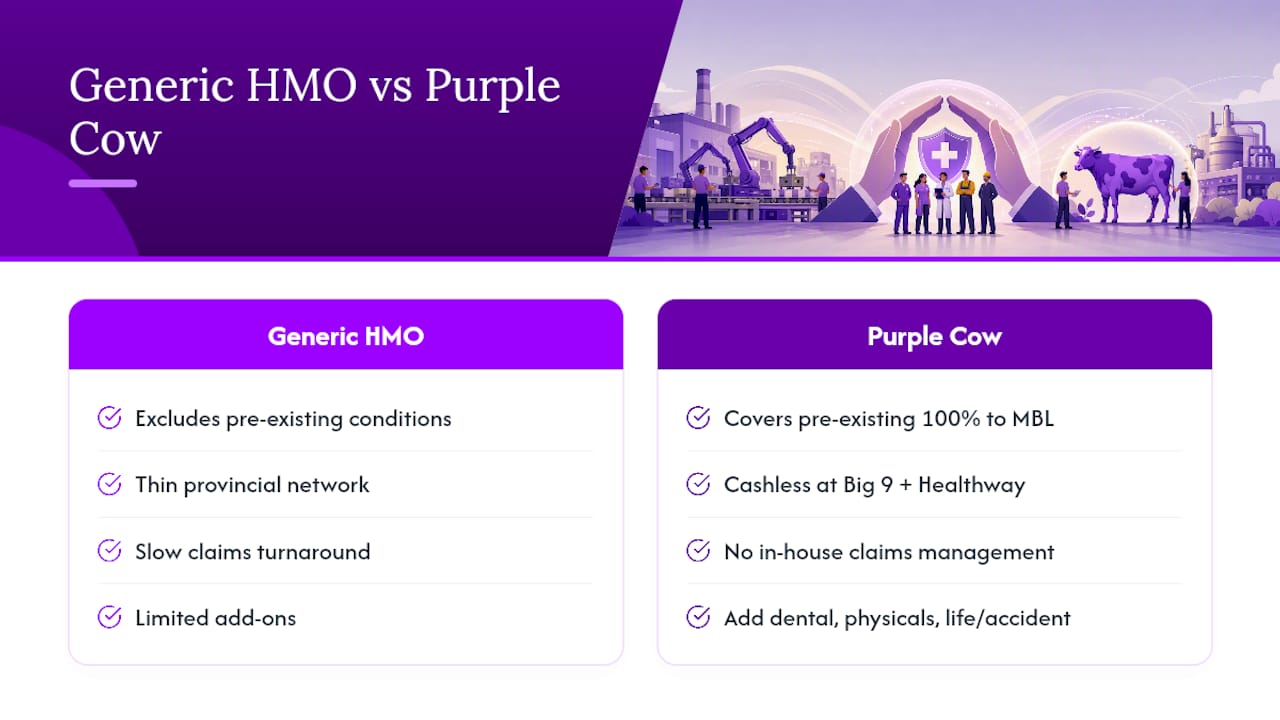
Hmoplans built its SME plans around the exact gaps manufacturers hit with generic corporate HMOs: pre-existing condition exclusions, thin provincial networks, and slow claims turnaround on the factory floor. The Purple Cow plan covers pre-existing and congenital conditions at 100% up to the Maximum Benefit Limit, gives cashless access across the Big 9 hospitals and Healthway clinics nationwide, and lets you add dental, annual physicals, or life and accident coverage as your workforce grows.
It fits manufacturers with roughly 20 to 300 employees who need real provincial hospital access and don’t want to manage a self-funded claims process in-house. If your team is also building out non-insurance wellness perks, pairing HMO coverage with programs like employee wellness initiatives can round out the package.
To request a quote, prepare your current employee roster, two years of claims history if available, and your payroll cycle dates. Head to Hmoplans to start the conversation with an HMO expert who understands manufacturing risk.
This article is general information, not a substitute for advice from a qualified financial advisor. Consult a qualified financial professional about your own circumstances before acting on anything here.
