

5 Contract Checks to Secure HMO Vaccine Coverage for Philippine SMEs
Group HMO plans in the Philippines do not automatically guarantee vaccine coverage. Most plans cover the administration fee for certain vaccines, but the vaccine product itself often falls outside standard benefits unless your contract specifically names it. The Philippine Insurance Commission has confirmed there is no uniform rule on this, which means your Schedule of Benefits and Service Agreement are the only documents that actually decide what your employees get.
TL;DR:
- Most HMO plans only cover the administration fee for vaccines, leaving the vaccine product cost usually negotiable and often outside standard benefits.
- Coverage for vaccines depends on the specific contract language, with some plans including basic vaccines and others requiring additional riders or employer procurement.
- Confirm vaccine coverage by reviewing the Schedule of Benefits and Service Agreement carefully, especially for explicit vaccine listings and adverse-reaction clauses.
- SMEs must negotiate vaccine benefits explicitly, including vaccine language and adverse-reaction coverage, as these are not automatically included in standard plans.
- Operational success requires clear contract language, advance approval, and structured communication to avoid out-of-pocket costs and claim delays during workplace vaccination events.
Table of Contents
- What Does HMO Vaccine Coverage Actually Include?
- How Do You Verify Vaccine Coverage in Your HMO Contract?
- Which Options Let You Add Preventive Vaccination Benefits?
- What Does a Vaccination Rollout Look Like Operationally?
- An Editor’s View on Negotiating Vaccine Benefits
- Get Vaccine Coverage Terms Written Into Your HMO Plan
- Sources
What Does HMO Vaccine Coverage Actually Include?
Vaccine coverage under a Philippine group HMO plan usually splits into two separate line items: the cost of administering the shot and the cost of the vaccine product itself. Many insurers cover the first and leave the second up to negotiation. Market reporting on Philippine health cards shows this pattern consistently. Plans that advertise “vaccine benefits” frequently mean the clinical visit, the nurse’s time, and the injection procedure. The vial itself, especially for some vaccines, often requires either an add-on rider or employer procurement.
Some plans bundle basic preventive vaccines, like tetanus shots for workplace injuries, into standard outpatient benefits. Influenza shots tend to appear as seasonal add-ons rather than year-round inclusions. Sample benefit summaries from HMO providers show preventive items capped at fixed annual amounts, which can seem generous until divided across a full headcount.
Coverage for dependents depends entirely on plan tier. A plan that extends benefits to spouses and children might exclude vaccines from the dependent package even when it covers the principal member. Waiting periods vary by contract and can delay preventive benefit activation for new hires.
Adverse reactions and complications from a vaccine are the biggest blind spot. Unless the Service Agreement explicitly names complication coverage, a bad reaction to a shot your company organized might not be covered at all.
- Administration fees are commonly covered; coverage of the vaccine product cost varies and is often excluded.
- Tetanus and select workplace-related vaccines appear more often than flu shots in base plans.
- Dependent coverage and waiting periods vary depending on the plan tier and insurer.
- Adverse-reaction coverage usually requires separate negotiation.
How Do You Verify Vaccine Coverage in Your HMO Contract?
Reading a benefits brochure is not the same as reading a contract. Marketing materials say “vaccine coverage included.” Contracts say something narrower, and that narrower version is what an adjuster will use to approve or deny a claim. HR teams need a systematic pass through both documents before assuming anything.
- Search the Schedule of Benefits for explicit vaccine listings. Generic phrases like “preventive care” without a named vaccine, dosage limit, or peso cap usually mean the benefit is discretionary, not guaranteed.
- Check whether the language says “administration” or “product.” These are different financial commitments, and insurers rarely use them interchangeably by accident.
- Look for sub-limits and annual caps. A vaccine benefit worth 1,000 pesos per employee per year covers almost nothing once you account for flu shot pricing.
- Confirm waiting periods against your hiring calendar. If your busiest hiring season falls right before flu season, a 60-day wait could leave new hires exposed.
- Request the Service Agreement’s adverse-reaction clause in writing. If it is silent on complications, treat that silence as exclusion, not oversight.
Before renewal, ask your account manager for three documents: a sample Letter of Authorization template, examples of prior-year vaccination claims from similarly sized groups, and written confirmation of the claims procedure for vaccine-related visits. Insurers that sell group plans on a quote basis, as most major providers do, expect this kind of due diligence from serious buyers.
Pro Tip: Ask the insurer to initial or stamp the specific clause covering vaccine administration in your Service Agreement. A verbal assurance from a sales representative means nothing during a claims dispute; a marked contract clause does.
Which Options Let You Add Preventive Vaccination Benefits?
SMEs that want guaranteed vaccine coverage generally have to negotiate for it rather than assume it comes standard. The good news is that the Philippine market has several workable structures, and none of them require a massive premium increase to implement.
Pricing models typically fall into two camps: admin-only bundles, where the insurer covers the injection process and your company supplies or reimburses the vaccine cost, or full bundles, where both are included but usually at a higher per-employee rate. Larger groups generally get better leverage. Companies with more employees may negotiate scale discounts that smaller teams cannot.
Delivery models vary by insurer relationship and internal capacity:
- Insurer-run clinic days, where the HMO brings a mobile team on-site.
- Manufacturer partnerships, such as the Sanofi and PhilCare collaboration promoting workplace flu vaccination to cut absenteeism.
- Third-party medical providers contracted directly by your company.
- Vouchers redeemable at accredited clinics, useful for distributed or remote teams.
Budgeting requires separating two cost drivers: the per-dose product price and the administration fee, since insurers often quote them independently. A useful exercise is modeling costs at different employee count tiers, such as small, medium, and large, as discount breakpoints often occur at increasing group sizes. For the accounting side, HR should also confirm how these expenses are classified. Guidance on HMO tax treatment can help finance teams determine whether vaccine spending qualifies as a deductible benefit expense.
What Does a Vaccination Rollout Look Like Operationally?
Running a workplace vaccination event without confirming HMO mechanics first is how companies end up eating costs they expected the insurer to cover. The sequence below keeps claims clean and employees protected.
- Confirm contract language naming vaccine administration as a cashless benefit, not a reimbursable one, if you want to avoid employees fronting cash.
- Choose a delivery model based on headcount and site access, whether that’s an insurer clinic day or a third-party provider.
- Secure the LOA and provider list in advance. A signed Letter of Authorization naming the vaccine as covered makes on-site events run faster and cuts out-of-pocket friction for staff.
- Communicate dates and eligibility to employees, including dependent rules if they apply.
- Verify membership and collect consent forms at the event itself, along with documentation the insurer will need for claims.
- Plan for adverse events with a clear emergency response path, since complication coverage depends on what you negotiated beforehand.
- Submit claims promptly and reconcile against the insurer’s records within the same billing cycle.
- Keep records of attendance, consent, and claim status for at least one full policy year.
Pro Tip: Assign one HR staff member as the single point of contact for insurer coordination during the event. Split communication between two or more people is the most common reason claims get delayed after a group vaccination day.
An Editor’s View on Negotiating Vaccine Benefits
Preventive vaccination is one of the cheapest levers an SME has for reducing lost workdays, and the Sanofi–PhilCare push toward workplace vaccination shows insurers already see the commercial logic in it. What most HR teams get wrong is treating “vaccine coverage” as a checkbox instead of a negotiated outcome. It isn’t automatic. It’s line-item language you have to ask for by name.
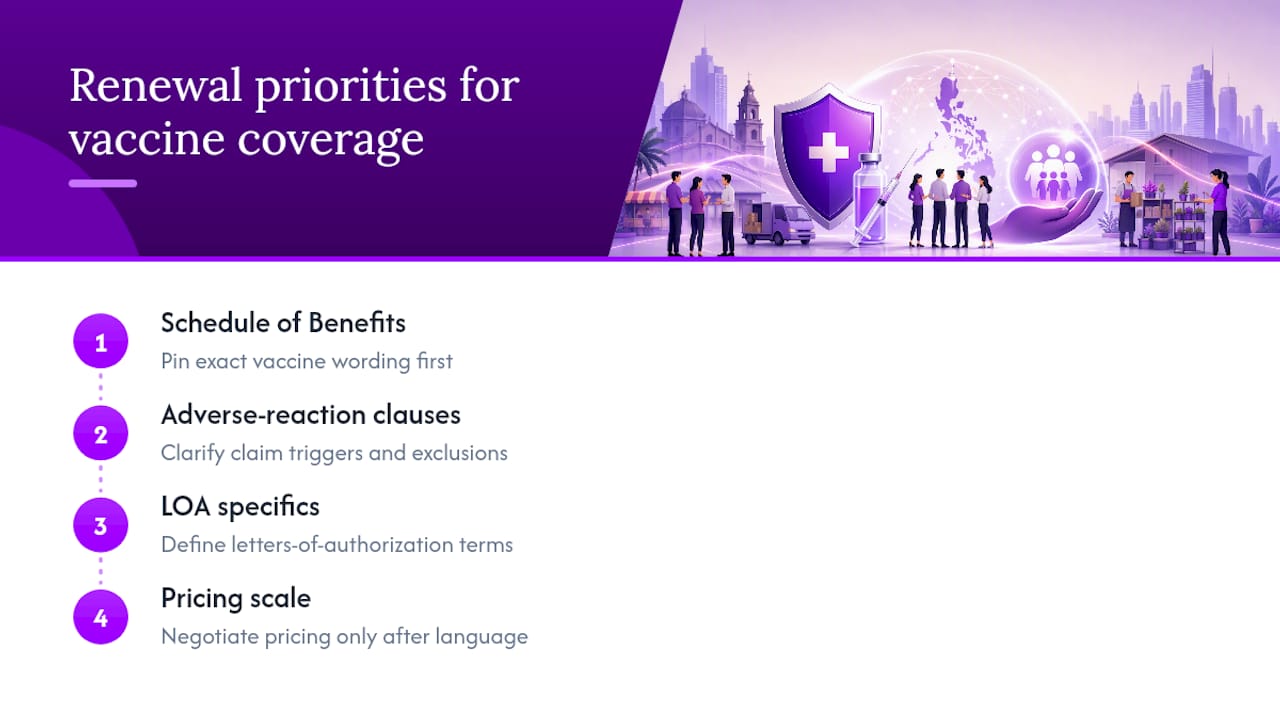
My priority order for any renewal conversation: pin down Schedule of Benefits wording first, adverse-reaction clauses second, LOA specifics third, and pricing scale last. Get the language right before you get the discount. A cheap plan with vague vaccine terms costs more the first time an employee has a bad reaction and the claim gets denied. Plans built around SME flexibility, including 100% coverage for pre-existing and congenital conditions up to the Maximum Benefit Limit, tend to fit smaller companies better precisely because they reduce this kind of contractual ambiguity elsewhere in the policy.
— Eumir
Get Vaccine Coverage Terms Written Into Your HMO Plan
Some group HMO providers offer SMEs the option to negotiate explicit vaccine terms instead of relying on broad interpretations of preventive care at claims time. Because Hmoplans, backed by Purple Cow and Etiqa, builds plans around SME flexibility rather than one-size templates, you can request vaccine administration language, adverse-reaction terms, and optional add-ons like dental coverage and annual physical exams as part of the same proposal.

Before requesting a quote, prepare three things: your current headcount by tier, any prior vaccination claim history, and a list of the specific vaccines you want named in the contract. Hmoplans’ member services team can walk you through LOA mechanics and cashless processing so your next workplace vaccination event doesn’t depend on guesswork. Reach out through the features page to start that proposal.
