

Health Insurance Checklist for SMEs in the Philippines
TL;DR:
- A structured health insurance checklist helps Philippine SMEs make informed, compliant decisions before signing plans. It emphasizes understanding employee needs, budget limits, available options like HMO plans, and ongoing review procedures. Proper preparation and consistent compliance tracking prevent costly coverage gaps and improve employee satisfaction.
Running a small business in the Philippines means wearing every hat, and health insurance decisions often get made under pressure with incomplete information. A structured health insurance checklist for SMEs cuts through that noise by giving you a clear sequence of decisions to make before you sign anything. This article walks you through evaluation criteria, available plan types, a side-by-side comparison, and a practical checklist you can use right now to protect your team and stay compliant.
Table of Contents
- Key takeaways
- 1. Build your health insurance checklist for SMEs before comparing prices
- 2. Understand Philippine compliance requirements
- 3. Know the health insurance options available to Philippine SMEs
- 4. Compare plan features side by side
- 5. Gather and verify your employee data
- 6. Request quotes and analyze your options
- 7. Confirm your legal and compliance checklist
- 8. Communicate benefits clearly to your team
- 9. Track eligibility and enrollment deadlines continuously
- 10. Plan for renewals and annual reviews
- My honest take on how Philippine SMEs approach health insurance
- How Hmoplans makes the SME health insurance process simpler
- FAQ
Key takeaways
| Point | Details |
|---|---|
| Start with employee data | Gather accurate headcount and demographic data before comparing any plans. |
| Know your budget floor | Most employers cover 70 to 80% of employee premiums; set your contribution range early. |
| Check compliance requirements | Philippine regulations and local mandates shape which plans are even legally valid for your workforce. |
| HMO plans dominate locally | HMO coverage is the most practical and widely accepted option for SMEs operating in the Philippines. |
| Review plans annually | Coverage needs change as your team grows; schedule a formal renewal review every year. |
1. Build your health insurance checklist for SMEs before comparing prices
Most SME owners in the Philippines open the health insurance process by asking one question: “How much does it cost?” That is the wrong first question. Prioritize understanding coverage needs and contribution limits before you let price drive the decision. Price without context is just a number.
Start by mapping your employee demographics. The age range, family status, and health history of your workforce directly determine what coverage tiers make sense. A team of 10 people in their late 20s has very different needs from a mixed-age team of 40 with dependents.
Next, set your contribution budget honestly. Employers typically cover 70 to 80% of employee-only premiums in common practice, though no Philippine law sets a mandatory minimum for most SME sizes. Knowing your ceiling before you shop prevents you from falling in love with plans you cannot sustain.
Also review any regional provider network requirements. If your employees work across Metro Manila, Cebu, and Davao, a plan with limited provincial coverage will generate complaints fast. Check the HMO provider network scope before shortlisting any plan.
Pro Tip: Create a one-page employee census with birth year, employment type (full-time or part-time), and current PhilHealth status before your first broker conversation. This single document cuts quote preparation time significantly.
2. Understand Philippine compliance requirements
Health insurance compliance in the Philippines is not optional, and the rules have teeth. PhilHealth contributions are mandatory for all employees, and most legitimate HMO plans are structured to supplement PhilHealth rather than replace it. You need to understand how these two layers interact before choosing a supplemental plan.
Consistent tracking of full-time and part-time status is one of the most overlooked compliance requirements. SMEs approaching 50 employees face additional scrutiny and potential penalties if their benefit structures do not meet coverage standards. Many SME owners near that threshold assume they are still in the “small business” category when their legal obligations have already changed.
Employee notification requirements also matter. You are required to provide clear written documentation of what your plan covers, how to file claims, and who qualifies. Failing to communicate this is a compliance gap even if the plan itself is adequate.
3. Know the health insurance options available to Philippine SMEs
There is no shortage of plan types, but not all of them are practical for SMEs operating locally. Here is a clear breakdown.
Group HMO Plans are the most common and most practical option for Philippine SMEs. Employees access accredited hospitals and clinics through a cashless system, which removes the burden of out-of-pocket payments and reimbursement claims for routine care. The HMO health insurance for SMEs model fits well because it bundles inpatient, outpatient, and emergency services under one premium.

Traditional Group Health Insurance works differently. It typically involves reimbursement for covered expenses rather than cashless access. Administrative overhead is higher, and employees bear more upfront costs while waiting for reimbursement.
Health Reimbursement Arrangements (HRAs) offer flexibility by letting employees choose their own individual coverage while the employer reimburses a fixed amount tax-free. QSEHRA and ICHRA models give SMEs more control over their total spend and are worth understanding, though Philippine-specific implementation requires careful legal review.
Pro Tip: If you want to offer multiple coverage options, providing at least two plan types significantly improves employee satisfaction by accommodating different health needs and budget preferences without dramatically increasing your administrative burden.
4. Compare plan features side by side
Before committing to any plan, put the key features next to each other in a structured format. This table covers the most critical comparison points for Philippine SMEs.
| Feature | Group HMO Plan | Traditional Group Plan | Health Reimbursement Arrangement |
|---|---|---|---|
| Premium structure | Fixed monthly per head | Fixed monthly per head | Employer-defined reimbursement cap |
| Access model | Cashless at accredited clinics | Fee-for-service with reimbursement | Employee chooses own coverage |
| Pre-existing conditions | Varies by provider | Often excluded or limited | Depends on individual plan chosen |
| Administrative complexity | Low to medium | Medium to high | Medium (requires documentation tracking) |
| Employee flexibility | Low (network-bound) | Medium | High |
| PhilHealth integration | Designed to supplement PhilHealth | Can overlap or conflict | Requires careful coordination |
| Best for | SMEs wanting simple, predictable cost | Companies needing broad customization | SMEs with widely varied employee needs |
The right column for your business depends entirely on your employee count, budget, and how much administrative work your HR function can realistically absorb.
5. Gather and verify your employee data
A quote is only as accurate as the data you submit. Before requesting any proposals, collect a complete employee census that includes each person’s full name, date of birth, and employment classification. This is the starting point for any legitimate SME health insurance checklist.
Verify employment types carefully. Applying waiting periods consistently across full-time and part-time employees is a compliance requirement that many SMEs mishandle. If you enroll a new hire before their waiting period ends, you create a liability. If you forget to enroll them after it ends, you create a different one.
Also confirm current PhilHealth enrollment status for every employee. An HMO plan layered on top of active PhilHealth coverage works differently from one where an employee has lapsed contributions. Get this information in writing before any plan goes live.
6. Request quotes and analyze your options
Once your census is ready, request quotes from at least three providers. Do not rely on a single quote. Pricing varies more than most SME owners expect, and some providers significantly discount their rates for groups of 20 or more.
When analyzing quotes, look beyond the headline premium. Check the Maximum Benefit Limit (MBL) per employee per year, the room and board allowance, and whether the plan includes outpatient coverage or only inpatient care. A lower premium with no outpatient coverage usually costs more in the long run because employees pay out of pocket for the visits they actually make most often.
Ask each provider directly how they handle pre-existing conditions. Some plans exclude them entirely for the first year. Others cover them from day one up to the MBL. That difference matters enormously for a team with any history of chronic conditions.
7. Confirm your legal and compliance checklist
Before signing any contract, run through these legal checkpoints.
- Confirm the plan supplements PhilHealth and does not create conflicting coverage terms
- Verify the insurer or HMO provider is accredited by the Insurance Commission of the Philippines
- Check that your employer contribution percentage is documented in your employment contracts or CBA
- Review whether the plan covers dependents and under what conditions
- Confirm the plan’s effective date aligns with your enrollment period
Essential health coverage for SMEs must meet baseline regulatory standards to count as a genuine employee benefit under Philippine labor law. A plan that looks good on paper but lacks Insurance Commission accreditation is a liability, not an asset.
8. Communicate benefits clearly to your team
Buying a good plan and failing to explain it is almost as bad as buying a poor one. Employees who do not understand their coverage either underuse it or misuse it, both of which hurt your return on investment.
Create a one-page benefit summary for every enrolled employee. Include the plan name, how to access a doctor, what services are covered at no out-of-pocket cost, and who to call with questions. Do not hand someone a 40-page policy booklet and consider the job done.
Consider a short group orientation when the plan launches. Fifteen minutes answering live questions prevents months of confusion and HR inquiries.
9. Track eligibility and enrollment deadlines continuously
Health insurance administration is not a once-a-year task. New hires, departing employees, and qualifying life events all trigger enrollment changes that must be processed on time. Missing a deadline can leave an employee uncovered during a medical event, which creates both a legal and a human problem.
Build a simple tracking system, even if it is just a shared spreadsheet, that logs each employee’s enrollment date, waiting period end date, and next review date. Tracking eligibility proactively is one of the most practical steps any SME can take to stay in compliance year-round.
Pro Tip: Set a calendar reminder 60 days before your annual renewal date. That gives you enough time to collect updated employee data, request new quotes, and make a genuine comparison rather than auto-renewing out of convenience.
10. Plan for renewals and annual reviews
The plan you choose today may not serve your business in three years. Companies grow, workforces change, and health insurance products evolve. Schedule a formal annual review as part of your HR calendar, not as a reaction to a renewal notice.
During each review, compare your current plan against affordable HMO options available at renewal time. Ask your provider for a utilization report showing which services your employees used most. That data tells you whether your coverage is appropriately matched to your team’s actual needs or whether you are paying for benefits nobody uses while underserving the ones they do.
My honest take on how Philippine SMEs approach health insurance
I have seen the same pattern repeat across dozens of SMEs, and it is worth naming directly. The majority of business owners I have spoken with selected their first employee health plan by going with the cheapest quote from a provider someone recommended at a networking event. No census. No compliance check. No comparison. Just a monthly premium that felt manageable.
That approach works fine until it does not. The first time an employee faces a major hospitalization and discovers their plan has a coverage gap, the trust damage is real and lasting. I have watched retention problems trace back directly to benefits dissatisfaction, and the cost of turnover almost always exceeds what better coverage would have cost.
What I find works is treating the initial plan selection as a proper project, not an errand. Assign someone specific responsibility, give them a deadline, and use a checklist. The businesses that do this tend to choose plans that fit better and spend less time managing problems downstream.
The other thing I will say plainly: the compliance piece is genuinely underestimated. Many SME owners believe PhilHealth enrollment is sufficient and that supplemental HMO coverage is optional. Technically they may be correct at certain employee counts. But the eligibility tracking requirements for HMO plans carry their own obligations, and the businesses that treat those requirements casually are the ones that face disputes during claims. Get familiar with what your plan actually requires of you as an employer, not just what it promises to your employees.
— Eumir
How Hmoplans makes the SME health insurance process simpler
If you have worked through this checklist and you want a provider built for exactly this situation, Hmoplans offers HMO plans through Purple Cow specifically designed for Philippine SMEs.
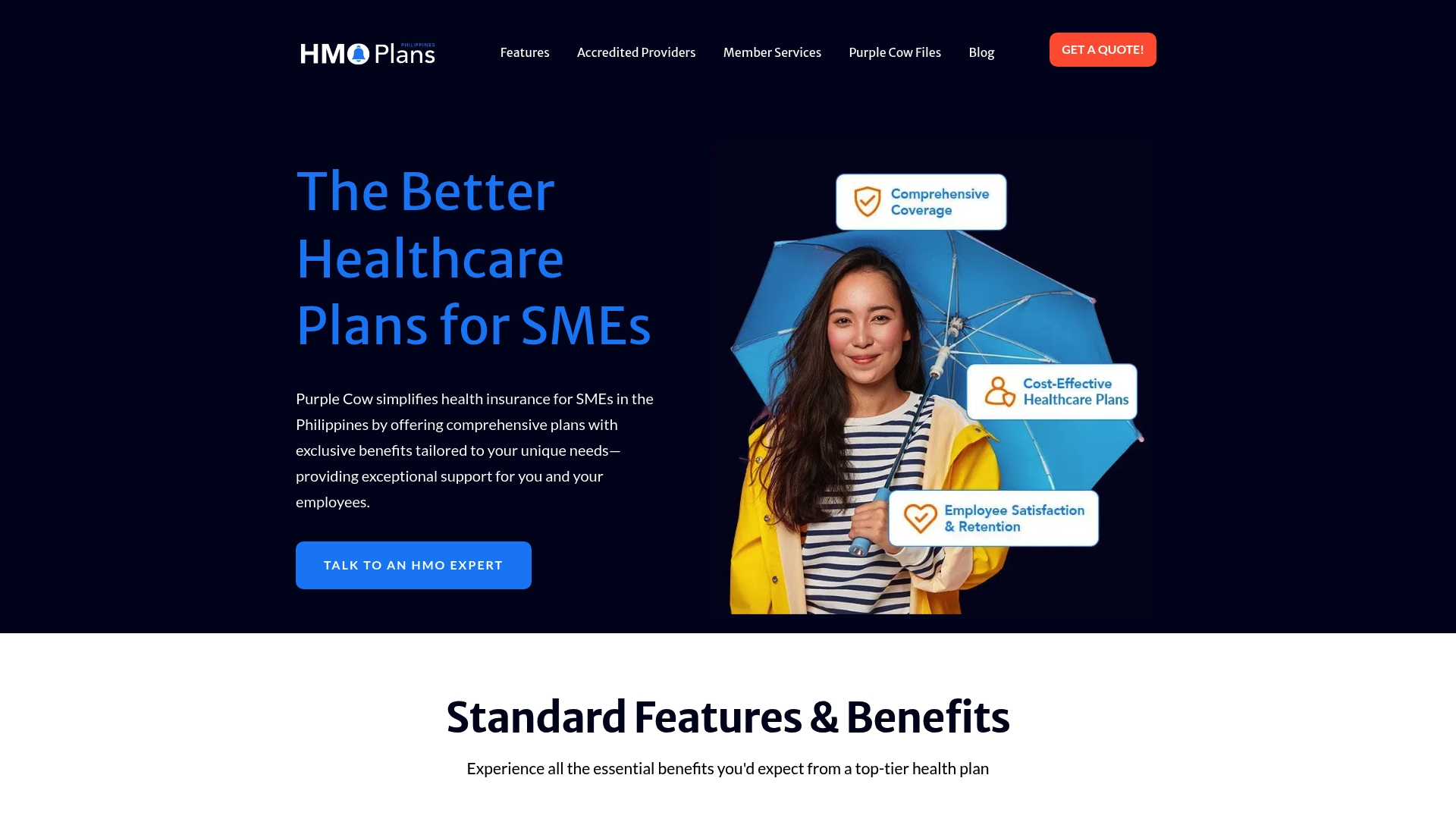
Purple Cow’s plans include 100% coverage for pre-existing conditions, congenital conditions, and special procedures up to the Maximum Benefit Limit, with no complicated exclusion clauses to decode. You get cashless access to the Big 9 Hospitals and Healthway Clinics, 24/7 nationwide coverage, and optional add-ons for dental, annual physical exams, and life and accident insurance. The enrollment and compliance support is built in, so your HR team is not figuring out eligibility rules alone. Getting started is straightforward: get a custom quote tailored to your team size and coverage needs, and see exactly what your employees would receive under a Purple Cow plan.
FAQ
What is the first step in an SME health insurance checklist?
Start by collecting a complete employee census with birth years and employment classifications before requesting any quotes. This data determines which plans you qualify for and prevents pricing surprises.
Are HMO plans mandatory for SMEs in the Philippines?
HMO coverage is not legally mandated beyond PhilHealth for most SME sizes, but it is the most widely used supplemental coverage option because of its cashless access model and predictable employer costs.
How much should an SME budget for employee health insurance?
Employers commonly cover 70 to 80% of employee-only premiums as standard practice. Set your per-head monthly budget before comparing plans to avoid evaluating options you cannot sustain.
How often should SMEs review their health insurance plan?
Review your plan annually, at minimum 60 days before renewal. Use your provider’s utilization report to confirm whether your current coverage matches how your employees actually use their benefits.
What compliance risks do growing SMEs face with health insurance?
SMEs approaching 50 employees face the highest compliance exposure. Inconsistent eligibility tracking across full-time and part-time workers is the most common source of coverage disputes and regulatory issues at that threshold.
