

Risk Pooling in Health Insurance: What You Need to Know
Risk pooling in health insurance is the practice of combining the medical costs of a diverse group of people so that no single individual bears the full financial weight of a serious illness. Healthy members and sick members pay into the same pool, and the collective premiums cover everyone’s claims. The result: predictable costs for insurers and more affordable coverage for you.
Here is what makes the concept work in practice:
- Shared risk: When costs spread across a large, mixed group, the financial impact of any one person’s high medical bills shrinks for everyone else.
- Premium stability: Insurers calculate premiums based on the average expected cost of the entire pool, not just the sickest members.
- Group diversity: A pool that includes people of varying ages, health conditions, and risk levels is more predictable than one skewed toward high-cost enrollees.
- ACA alignment: The Affordable Care Act requires a single risk pool for all ACA-compliant individual market plans within a state, preventing insurers from separating healthy and unhealthy enrollees.
- Public and private applications: Risk pools exist in employer-sponsored group plans, ACA marketplaces, Medicare, and Medicaid, each with different rules governing who participates.
The Center on Health Insurance Reforms at Georgetown University describes risk pooling as the process through which a group’s composition is determined and expected costs are shared. Get that composition right, and the whole market benefits.
How risk pooling in health insurance actually works
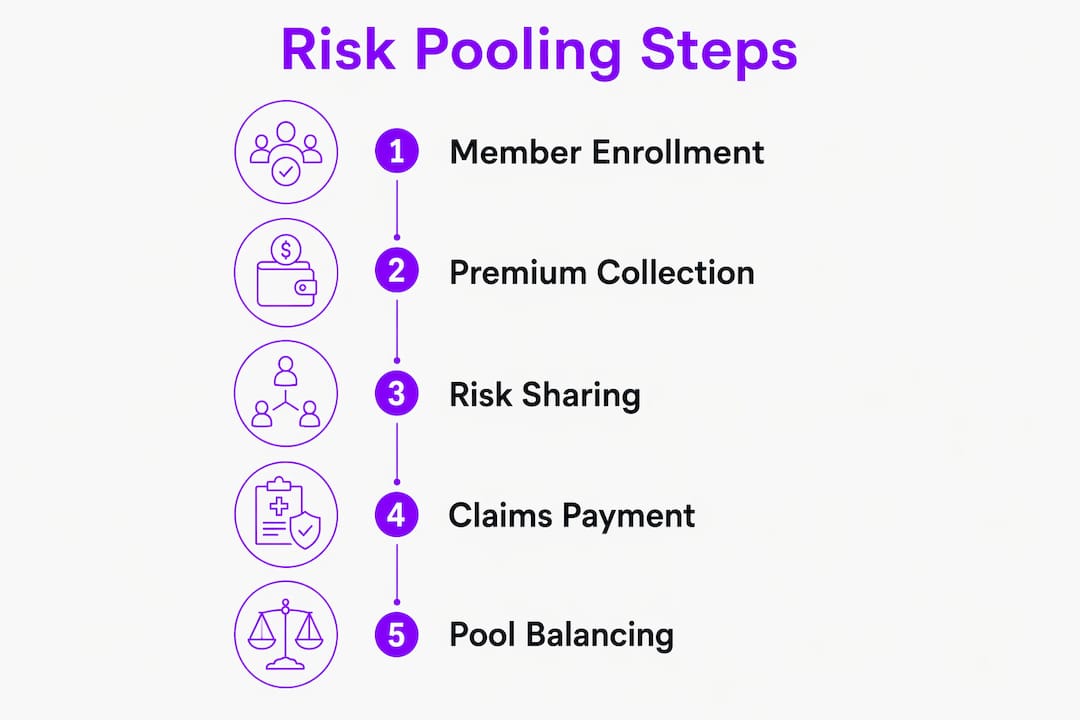
Insurers pool risks by enrolling a defined group of people under a single plan, then setting premiums based on the projected average healthcare cost of that entire group. Every member pays into the pool regardless of whether they file a claim that year.
Pool size and diversity both matter, but not equally. Larger pools tend to be more stable, yet a large pool filled mostly with high-cost enrollees will still produce high premiums. What drives affordability is the balance between healthy and sick members, not headcount alone.
- Predictable budgeting: Spreading the cost of large, unexpected claims across many members improves financial stability for both insurers and the people they cover.
- Average cost calculation: Premiums reflect the mean expected claim across all enrollees, so one member’s $200,000 surgery does not translate directly into a $200,000 bill for that person.
- Pool composition effect: A plan that attracts mostly young, healthy people will have low average costs. One that skews toward older or chronically ill enrollees will see higher average costs and, consequently, higher premiums.
- Employer group plans: Group health insurance policies through an employer naturally create a broader pool because enrollment is tied to employment, not individual health status.
Pro Tip: If you are evaluating group coverage for your team, ask the insurer how they calculate pool averages and whether your group joins a larger shared pool. That single question tells you a lot about premium stability.
Why adverse selection threatens the stability of risk pools
Adverse selection is the single biggest structural threat to any voluntary insurance market. It occurs when a risk pool disproportionately attracts unhealthy individuals, driving up average costs and pushing premiums higher. As premiums rise, healthier people drop coverage because it no longer feels worth the price. That exit makes the pool even sicker and more expensive, triggering another round of increases.
“Attracting younger, healthier individuals to the risk pool is critical to preventing premium spirals caused by adverse selection. Broader, diverse enrollment results in more affordable and stable premiums for all members.” — American Academy of Actuaries
This cycle, often called a premium spiral, can destabilize an entire insurance market if left unchecked. The consequences reach beyond price: when healthy people exit, the remaining enrollees face coverage gaps, reduced insurer participation, and in extreme cases, full market collapse in a given region.
- Voluntary enrollment problem: People who know they need care are more motivated to buy coverage than those who feel healthy, creating an inherently unbalanced pool.
- Premium spiral: Rising costs push out healthy members, which raises costs further, which pushes out more healthy members.
- Market destabilization: Insurers may exit markets where adverse selection makes profitable pricing impossible.
- Affordability loss: Sicker, lower-income people end up paying the highest share of a shrinking pool’s costs.
Risk segmentation policies that allow insurers to separate healthy from unhealthy enrollees may look attractive to healthy individuals in the short term. Over time, they concentrate risk among the sick and make coverage unaffordable for the people who need it most.
How the ACA reshaped risk pooling and reduced adverse selection
The Affordable Care Act introduced the most significant structural changes to health insurance risk sharing in U.S. history. Its single risk pool requirement means every ACA-compliant individual market plan in a state draws from the same enrolled population, so insurers cannot cherry-pick healthier groups.
Several ACA provisions work together to keep pools broad and balanced:
- Premium tax credits: Subsidies make coverage affordable for lower-income enrollees, including younger, healthier people who might otherwise skip insurance.
- Open enrollment periods: Defined windows for signing up limit the ability of people to wait until they are sick before buying coverage.
- Pre-existing condition protections: Insurers cannot deny coverage or charge more based on health history, which removes a key incentive for adverse selection.
- Risk adjustment program: A permanent program transfers funds from plans with lower-risk enrollees to plans with higher-risk enrollees, reducing the financial incentive for insurers to avoid sick people.
- Reinsurance: A transitional reinsurance program covered high-cost individuals in the early years of the ACA marketplaces, protecting insurers from catastrophic claims and stabilizing premiums.
Risk adjustment and risk sharing programs reduce insurer incentives to avoid high-cost enrollees, which directly supports the ACA’s pre-existing condition protections. Without these mechanisms, even a well-intentioned coverage mandate would struggle to keep markets stable.
What current and proposed policy changes mean for risk pools
Federal policy shifts since 2020 have put real pressure on the size and health of ACA risk pools. Cuts to Medicaid funding and the potential expiration of enhanced premium tax credits would reduce risk pool size and push premiums higher, with projected increases in the uninsured population reaching 10 million by 2034.
The effects are not evenly distributed. Low-income and chronically ill enrollees bear the heaviest burden when pools shrink, because they are the least able to absorb premium increases or go without coverage.
- Smaller pools: Fewer enrollees mean less risk distribution, so each high-cost claim represents a larger share of total pool costs.
- Adverse selection acceleration: When healthy people lose subsidies and drop coverage, the remaining pool skews sicker, pushing premiums up further.
- Noncompliant plans: If rules loosen to allow plans that do not meet ACA benefit and rating standards, split risk pools emerge. Risk adjustment cannot function effectively across pools with different benefit structures, destabilizing premiums for ACA-compliant coverage.
- Market exit risk: Insurers facing unpredictable, high-cost pools may reduce participation in certain states or counties, limiting consumer choice.
Policy choices that deter healthy individuals from enrolling shrink risk pools and amplify market instability. The math is straightforward: fewer healthy members means higher average costs for everyone who stays.
What types of risk pools exist in health insurance?
Not all risk pools operate the same way. The rules governing who joins a pool and how premiums are calculated vary significantly across market segments.

Community rating sets premiums based on the health costs of an entire community or geographic area, regardless of an individual’s personal health history. The ACA uses modified community rating, allowing variation only by age, tobacco use, geography, and family size. Everyone in the same rating area pays from the same pool.
Experience rating ties premiums to the actual claims history of a specific group, most commonly an employer’s workforce. A company whose employees filed high claims last year will pay higher premiums next year. Large self-insured employers often use this approach because their pool is big enough to make their own claims history statistically meaningful.
Adjusted community rating blends both approaches, using community-level data as a baseline but adjusting for group-specific factors like age distribution. Many small-group employer plans operate under this model.
The choice of rating method directly shapes who bears the cost of illness. Community rating spreads risk broadly; experience rating concentrates it within the group that generated the claims.
How mandates, subsidies, and other tools encourage broad participation
A risk pool only works if enough healthy people join. Without deliberate mechanisms to attract broad enrollment, voluntary markets tend toward adverse selection. The U.S. has used several tools to address this.
Individual mandate: The ACA’s original individual mandate required most Americans to carry health coverage or pay a tax penalty. The federal penalty dropped to $0 in 2019, though several states maintain their own mandates. The mandate’s primary function was to push healthy people into the pool before they needed care.
Premium subsidies: Enhanced premium tax credits, expanded through the Inflation Reduction Act, make coverage affordable for a wider income range. Lower premiums attract healthier enrollees who might otherwise decide coverage is not worth the cost.
Employer-sponsored coverage: Group health insurance policies through employers automatically enroll large numbers of workers, including healthy ones who would not seek coverage independently. This is why employer pools tend to be more balanced than individual market pools.
Medicaid expansion: By extending Medicaid eligibility to more low-income adults, states that expanded coverage brought millions of people, including relatively healthy younger adults, into a public risk pool.
Auto-enrollment: Some proposals and state programs automatically enroll eligible individuals and require them to opt out rather than opt in, which consistently produces higher participation rates.
Challenges that make balanced risk pools hard to maintain
Even well-designed pools face ongoing pressure from factors that concentrate risk among a smaller, sicker group.

Chronic conditions: People with diabetes, heart disease, or cancer generate claims that far exceed average pool costs. As the U.S. population ages and chronic disease rates rise, maintaining a balanced pool requires proportionally more healthy enrollees to offset these costs.
Health disparities: Racial and socioeconomic health gaps mean that certain communities carry higher average health burdens. When coverage gaps or affordability barriers keep lower-income or minority populations out of mainstream risk pools, those individuals lose protection and the pools lose the diversity that stabilizes them.
Geographic concentration: Rural areas often have older, sicker populations and fewer insurers willing to participate. A small pool in a rural county with limited insurer competition faces both adverse selection and reduced risk-spreading capacity.
High-cost claimants: A single enrollee with a catastrophic illness can significantly affect premiums in a small pool. Reinsurance programs exist specifically to absorb these outlier costs, but their effectiveness depends on adequate funding and consistent rules.
Fragmentation: When the market splits into multiple pools with different rules, such as short-term plans alongside ACA-compliant plans, healthier people migrate to cheaper noncompliant options. The ACA-compliant pool is left with a disproportionately sick population and higher premiums.
Public vs. private risk pooling models: how they compare
The U.S. runs parallel risk pooling systems across public and private markets, each with distinct structures and trade-offs.
Medicare pools virtually all Americans aged 65 and older into a single federal program. Because enrollment is near-universal for that age group, adverse selection is minimal. Medicare Part A is funded through payroll taxes, spreading risk across the entire working population.
Medicaid pools low-income individuals and families, with states and the federal government sharing costs. Medicaid expansion under the ACA brought in a broader, somewhat healthier population of low-income adults, improving pool balance in expansion states.
ACA marketplaces pool individual market enrollees within each state under a single risk pool requirement. Federal risk adjustment transfers funds between insurers to compensate for differences in enrollee health status.
Employer-sponsored plans pool workers and their dependents within a company or industry. Large employers often self-insure, bearing their own risk but using stop-loss insurance to cap exposure to catastrophic claims.
Small-group markets pool employees of small businesses. These pools are smaller and more vulnerable to adverse selection, which is why the ACA extended community rating and guaranteed issue protections to the small-group market.
Each model reflects a different balance between broad risk sharing and targeted coverage. Public programs tend to achieve broader pools through mandatory or near-universal participation; private markets rely on incentives and regulations to achieve similar results.
How risk pooling shapes insurer competition and market stability
The structure of risk pools directly determines whether insurance markets attract multiple competing insurers or consolidate around a single dominant player.
When risk adjustment works well, insurers compete on price, network quality, and service rather than on their ability to attract only healthy enrollees. That competition benefits you as a consumer: more plan options, better networks, and pressure on premiums. When risk adjustment fails or pools fragment, insurers compete by avoiding sick people, which produces the opposite outcome.
Market stability also depends on predictability. Risk pooling allows more predictable budgeting by spreading the cost of large, unexpected claims across many group members. Insurers who can forecast costs accurately set premiums more precisely, reducing the likelihood of sudden large increases that drive healthy members out.
Thin markets with only one or two insurers tend to appear in counties where adverse selection has made participation financially unattractive. Restoring competition in those markets requires either policy intervention to rebalance the pool or reinsurance support to reduce insurer exposure to high-cost claims.
Thinking about group coverage for your team?

Understanding how risk pooling works is the first step toward choosing coverage that actually protects your people. At Hmoplans, we design group health plans built around the principles of shared risk and broad coverage, so your team gets real protection without complicated exclusions.
Our plans include 100% coverage for pre-existing conditions up to the Maximum Benefit Limit, cashless access to accredited hospitals, and flexible add-ons tailored to your SME’s needs. Learn more about pre-existing condition coverage and how it connects to the risk pooling principles covered here.
Talk to an Hmoplans expert today and see how the right group plan can work for your business.
Key Takeaways
Risk pooling in health insurance stabilizes premiums by spreading costs across a diverse group, but pool balance, policy design, and broad participation all determine whether that stability holds.
| Point | Details |
|---|---|
| Pool diversity beats pool size | A large pool skewed toward sick enrollees still produces high premiums; healthy-to-sick balance drives affordability. |
| Adverse selection is the core threat | When healthy people exit a pool, premiums rise for those who remain, accelerating a spiral that can destabilize markets. |
| ACA single risk pool requirement | The ACA mandates one risk pool per state for ACA-compliant plans, preventing insurers from separating healthy and unhealthy enrollees. |
| Policy changes shrink pools | Cuts to Medicaid and premium subsidies are projected to increase the uninsured population by 10 million by 2034, concentrating risk among sicker enrollees. |
| Broad participation is the fix | Mandates, subsidies, and employer-sponsored enrollment all serve the same goal: keeping enough healthy people in the pool to offset high-cost claims. |
