

Why Offer Insurance Upgrades: Benefits and Timing Guide
Offering insurance upgrades is one of the most practical steps you can take to keep your coverage aligned with real life. Medical costs rise every year, families grow, businesses hire, and the policy you bought three years ago may leave you exposed today. The core reasons to upgrade are straightforward:
- Rising healthcare costs erode the value of fixed coverage limits over time
- Life changes such as marriage, childbirth, or a new hire create new financial exposures
- Outdated policies often exclude modern treatments like robotic surgery or home care
- Tax advantages tied to higher premiums can reduce your overall tax burden
- Underinsurance risk leaves you paying large out-of-pocket bills when a claim hits
Each of these factors compounds the other. A family that added a child, moved to a new city, and saw their employer grow by ten people in one year faces a very different risk profile than they did at enrollment. Reviewing and upgrading coverage is how you close that gap before a claim forces the issue.
1. Why offer insurance upgrades: key reasons to act now
Medical inflation is the single biggest driver pushing people toward policy enhancements. Medical inflation in India has been rising faster than the global average, and the United States has experienced similar upward pressure on healthcare costs for years. A coverage limit that felt generous at enrollment can become inadequate within a few renewal cycles.
Beyond inflation, lifestyle and health changes create new coverage gaps that basic policies were never designed to fill:
- Chronic illness diagnoses such as diabetes or heart disease require long-term, high-cost treatment that quickly exhausts a low sum insured
- Family expansion adds dependents whose needs, from neonatal care to pediatric specialists, demand higher limits
- Business growth brings new exposures; hiring employees, for example, raises employment-related liability risks that a solo-operator policy does not cover
- Access to advanced treatments like robotic surgeries, organ donor procedures, and home care is often locked behind upgraded plans, not basic ones
- Outdated riders may cap room rent or exclude critical illness, leaving real gaps in protection
Pro Tip: Review your current policy’s sum insured against your last two years of medical expenses. If actual costs came within 30% of your limit, an upgrade is overdue.
Employers face a parallel set of pressures. Upgrading benefits packages improves workforce satisfaction and helps retain talent in a competitive labor market. For small and medium businesses, that retention advantage can be the difference between a stable team and constant turnover.

2. When is the right time to consider an insurance upgrade?
Timing matters as much as the decision itself. Clients are most receptive to upgrades during renewal periods or after major life events, when they are already thinking about their coverage. Catching that window makes the conversation easier and the decision faster.
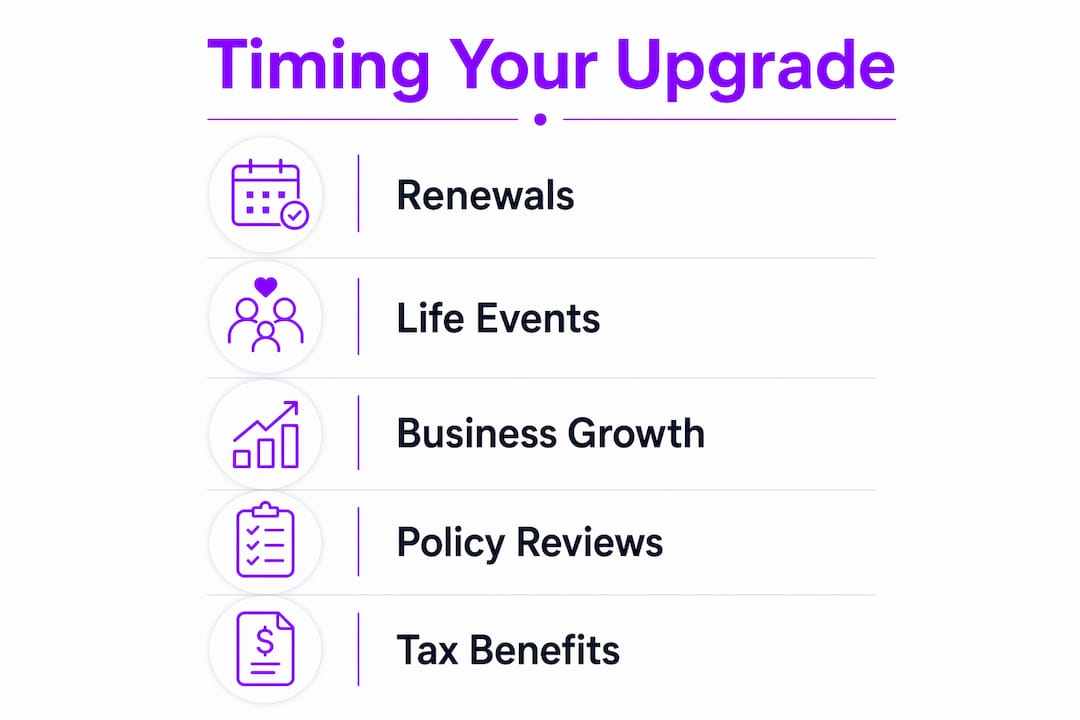
The clearest triggers fall into two categories:
Life and personal milestones:
- Common life milestones prompting review include marriage, adding dependents, purchasing a home, new health diagnoses, and aging when health risks typically increase.
Business and employment events:
Typical business events to consider upgrades include hiring employees, changing jobs, policy renewals, expanding operations, and completing financial or tax planning reviews.
The annual renewal cycle deserves special attention. Proactive coverage reviews at renewal identify gaps created by changes in your risk profile over the past year. Many people skip this step and only discover the gap when a claim is denied. Scheduling a review 60 days before renewal gives you time to compare options without pressure.
For employers, Q1 is often the best window to address health plan gaps, since new hires from the holiday season are onboarding and budget cycles are fresh.
3. What benefits do you actually gain from upgrading your policy?
The tangible gains from policy enhancements go well beyond a higher coverage number on paper. Upgraded health insurance provides access to broader benefits including coverage for robotic surgeries, organ donors, and home care, along with a higher sum insured that matches today’s actual costs.
Here is what a well-chosen upgrade typically delivers:
- Higher sum insured so a single hospitalization does not wipe out your savings
- Lower out-of-pocket costs through reduced deductibles, co-pays, and sub-limits
- Rider additions such as critical illness cover, maternity benefits, and hospital cash allowance that fill specific gaps without replacing the entire policy
- Cashless hospitalization at a wider network of accredited facilities
- Lifetime renewability so coverage does not lapse when you need it most, in later years
- Policy portability that lets you move to a better plan without losing waiting-period continuity
Coverage gaps do not announce themselves until a claim is filed. Out-of-pocket spending accounts for about 47% of total health expenses in India, posing significant financial risks without adequate insurance. Upgrading before a health event, not after, is what keeps that number from becoming your personal reality.
Tax benefits add another layer of value. Upgrading your premium can lead to higher deductions under tax provisions tied to health insurance, reducing your net cost. In some regions, certain property insurance upgrades have led to average premium discounts, demonstrating that upgrades do not always result in higher overall costs.
4. How to decide if it’s time to upgrade: key considerations
The decision to upgrade comes down to a gap analysis between what you have and what you actually need. Start with your current risk profile and work outward from there.
- Assess your personal or business risk changes over the past 12 months: new dependents, new employees, new assets, or new health conditions all shift your exposure
- Evaluate coverage adequacy by comparing your current sum insured against realistic treatment costs in your area for the conditions most likely to affect you
- Compare cost versus benefit honestly; a modest premium increase that eliminates a large deductible often saves money over a two-year horizon
- Check eligibility and timing since some upgrades require medical underwriting or pre-approval, and doing this at renewal avoids waiting periods
- Review updated policy language carefully because policy endorsements described as upgrades can sometimes introduce limitations, making professional legal review of updated terms worth the effort
Pro Tip: Ask your insurer or broker to run a side-by-side comparison of your current plan and the proposed upgrade, with specific dollar amounts for three realistic claim scenarios. Numbers make the decision obvious.
Documenting your coverage review and the reasoning behind any upgrade recommendation also protects you and your advisor against disputes later. For employers, this documentation is part of sound benefits governance. A quick annual health benefits check-up before year-end keeps your team covered and your records clean.
5. Strategic insights on upgrading insurance: timing and financial impact
The most effective upgrades are not reactive. They are planned around renewal cycles, life events, and financial strategy, not triggered by a denied claim.
“Ethical upselling is an extension of an agent’s role as risk advisor. Agents who ask questions at renewal about new risks and offer products to close coverage gaps are using ethical upselling in a strategic way to help policyholders reduce their exposure.” — American Agents Alliance
That framing shifts the conversation from sales to protection. When your advisor identifies a gap and recommends an upgrade, the goal is risk mitigation, not revenue. The best agents treat upgrades the way a doctor treats a follow-up appointment: a scheduled, proactive check rather than an emergency response.
From a financial planning perspective, the strategic case for upgrading rests on four pillars:
- Rate lock protection. Upgrading now can lock in current premiums before rising claim trends push rates higher. Guaranteed universal life plans are a clear example of this principle applied to long-term coverage.
- Tax efficiency. Higher premiums tied to expanded coverage often qualify for larger deductions, reducing the net annual cost of the upgrade.
- Retention and recruitment value. For employers, enhanced benefits packages directly support workforce stability, particularly in industries where talent competition is high.
- Avoiding the underinsurance penalty. The cost of being underinsured during a major claim, covering the gap out of pocket, almost always exceeds the cumulative premium difference of upgrading years earlier.
Timing upgrades around renewals or life events also increases receptivity. A client who just had a child or just hired their fifth employee is already thinking about protection. That is the right moment to review your coverage options and act.
6. What types of insurance upgrades are available to you?
Insurance upgrades are not one-size-fits-all. The right enhancement depends on what your current policy lacks and what your risk profile demands.
Sum insured increase. The most direct upgrade: raise your coverage limit at renewal. This is the first step for anyone whose current limit has not kept pace with actual healthcare costs.
Rider and add-on additions. Riders attach to your existing policy and fill specific gaps without replacing the whole plan. Common options include critical illness cover, maternity benefits, hospital cash allowance, room rent waivers, and personal accident cover. They cost less than a full policy replacement and target exactly the coverage you are missing.
Top-up and super top-up plans. These activate after your base policy limit is exhausted, providing a second layer of protection at a fraction of the cost of doubling your base coverage directly. Super top-ups are particularly cost-effective for families with predictable annual healthcare use.
Policy portability. If your current insurer’s upgraded options do not meet your needs, portability rules allow you to move to a better plan without losing continuity on waiting periods for pre-existing conditions.
Employer group plan enhancements. For businesses, upgrades can include adding dental HMO coverage, annual physical exams, or life and accident insurance to a group plan. These additions strengthen employee benefits packages and signal genuine investment in team wellbeing.
Endorsements and policy modifications. These are formal amendments to an existing policy, adding coverage for a new risk or raising a specific limit. Review endorsement language carefully, since wording changes can occasionally narrow coverage in one area while expanding it in another.
7. What happens when you don’t upgrade insurance when you need to?
Delaying a necessary upgrade is not a neutral decision. It is a choice to absorb the financial risk yourself, and the consequences tend to arrive at the worst possible moment.
Underinsurance during a major claim is the most direct risk. If your sum insured is $50,000 and your hospitalization costs $80,000, you pay the $30,000 difference out of pocket. That gap grows every year you defer an upgrade while medical costs rise.
Loss of upgrade eligibility is a less obvious but serious risk. Some upgrades require medical underwriting. If you develop a chronic condition before upgrading, that condition may be excluded from the enhanced coverage or trigger a premium loading that makes the upgrade far more expensive than it would have been a year earlier.
Outdated coverage for modern treatments. Basic policies written five or more years ago often exclude procedures that are now standard of care, including robotic-assisted surgery, home-based recovery programs, and certain biologics. Staying on an old plan means paying out of pocket for treatments your doctor recommends.
Employer talent risk. For businesses, a benefits package that has not kept pace with the market makes recruitment harder and retention worse. Employees notice when their coverage falls behind what peers at other companies receive.
Compounding premium increases. Waiting to upgrade does not freeze your premiums. Rates rise with age and claim trends regardless. Upgrading earlier locks in lower rates before those increases compound, making early action the more cost-effective path in most scenarios.
Key Takeaways
Upgrading your insurance coverage is a proactive financial decision that protects against rising medical costs, coverage gaps, and the compounding risk of underinsurance.
| Point | Details |
|---|---|
| Medical inflation drives urgency | Medical inflation is rising faster than the global average, eroding fixed coverage limits faster than most policyholders expect. |
| Best timing is renewal or life events | Clients are most receptive to upgrades at renewal or after major life changes like marriage, childbirth, or new hires. |
| Out-of-pocket risk is high without upgrades | Out-of-pocket spending accounts for about 47% of total health expenses in India, a gap upgrades directly reduce. |
| Rate lock is a financial advantage | Upgrading earlier locks in current premium rates before rising claim trends push costs higher. |
| Employers gain retention benefits | Enhanced benefits packages improve workforce satisfaction and support recruitment in competitive labor markets. |
Ready to upgrade your team’s coverage?
Hmoplans makes it straightforward for SMEs to upgrade health coverage without complicated terms or hidden exclusions. Whether you need a higher sum insured, dental add-ons, annual physical exams, or life and accident insurance for your team, Hmoplans has a plan built for your size and budget.
Explore your options at Hmoplans and talk to an HMO expert who can walk you through exactly what your current plan is missing and what an upgrade would cost.
