

Dependents Inclusion in HMO Plans: SME Guide 2026
TL;DR:
- Dependents under HMO plans, including children up to 26 and spouses, must be enrolled within specific timeframes and follow network rules. Employers should communicate these policies clearly to avoid coverage gaps, especially regarding provider selection and legal nondiscrimination requirements. Proper documentation, timely enrollment, and understanding network restrictions help ensure dependents receive guaranteed benefits without legal or financial issues.
Dependents inclusion in HMO plans is the formal policy that allows employees to add eligible family members, primarily spouses and children, to their employer-sponsored health coverage under defined eligibility rules. For HR managers and SME owners, getting this right matters more than most realize. A missed enrollment window, a misunderstood eligibility rule, or a network assignment error can leave an employee’s child without coverage at exactly the wrong moment. This guide covers who qualifies, how to add them correctly, what network rules apply, and what legal obligations your company must meet under the Affordable Care Act and the Americans with Disabilities Act.
Who qualifies as a dependent under HMO plans?
The most widely applied rule in employer-sponsored HMO plans is the ACA’s age-26 mandate. Under 45 CFR § 147.120, children must remain eligible for coverage until age 26 regardless of their marital status, financial independence, residency, or student enrollment status. This rule eliminates the guesswork that once plagued HR departments trying to determine whether a 24-year-old who graduated and moved out still qualified.
Spouses are the other primary dependent category. Most HMO plans cover legally married spouses without restriction, though some employer plans include a spousal surcharge if the spouse has access to coverage through their own employer. Domestic partners may qualify depending on the plan and applicable state law, so HR managers should verify this with their specific carrier.
Two common misconceptions are worth correcting directly. First, a dependent child does not need to live with the employee to qualify. Second, a child who is financially self-supporting still qualifies until age 26. The ACA prohibits plans from cutting off coverage before that age based on financial dependency or student status, which means internal HR policies that impose stricter cutoffs are legally non-compliant.
There is one important extension beyond age 26. Children with qualifying disabilities may remain on a parent’s HMO plan past that threshold, provided the disability existed before the child turned 26 and the plan allows continuation. HR managers should document these cases carefully and confirm the carrier’s specific requirements.
Key rule: Under the ACA, no employer-sponsored plan may restrict dependent coverage for children under 26 based on residency, financial status, student enrollment, or marital status. Any internal policy that does so creates compliance exposure.
Key eligibility categories at a glance:
- Spouses: Legally married partners; domestic partners subject to plan and state rules
- Children under 26: Biological, adopted, stepchildren, and foster children in most plans
- Disabled adult children: May continue past age 26 if disability predates the cutoff
- Grandchildren or other relatives: Generally not covered unless legally adopted or placed under legal guardianship
How and when to add dependents to your HMO plan
Adding dependents outside the annual open enrollment period requires a qualifying life event (QLE). Common QLEs include marriage, the birth or adoption of a child, loss of other coverage, and a dependent aging off another plan. Once a QLE occurs, most employer plans require action within 30 days, with coverage typically becoming effective on the first of the month after the application is received.
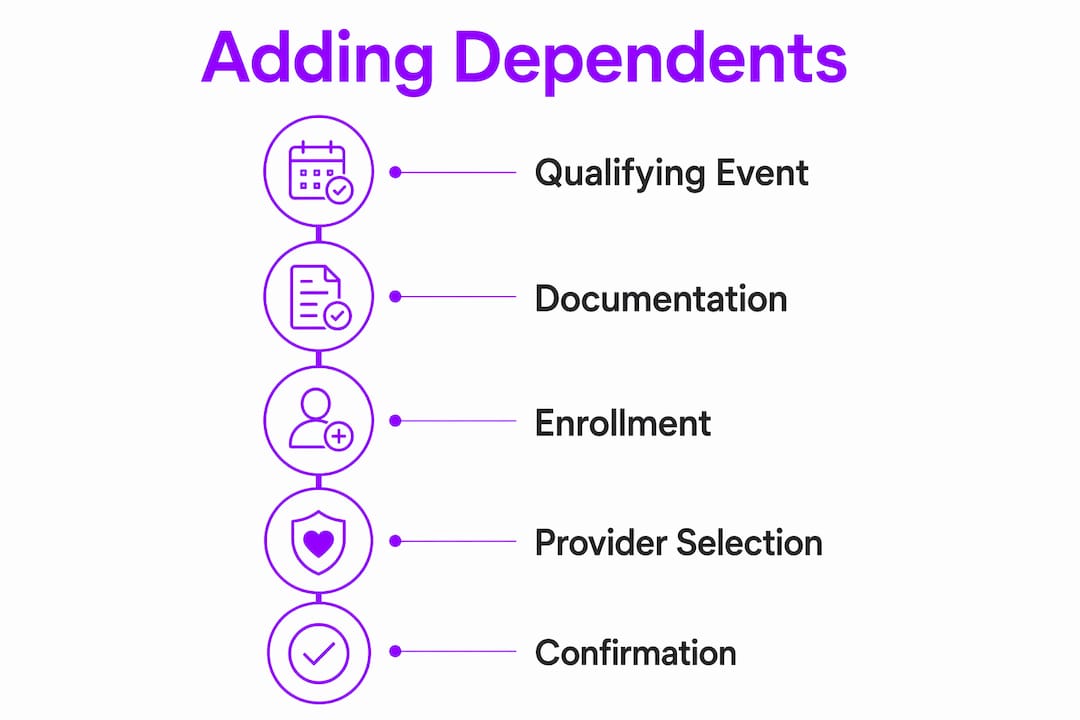
The 30-day window is not flexible in most cases. Missing it means waiting until the next open enrollment period, which could be months away. For an SME with a lean HR team, this is where things go wrong most often. The solution is a clear, written communication protocol that notifies employees of their enrollment window the moment a QLE is reported.
The documentation process follows a predictable sequence. HR portals at organizations like UNC HR block dependent changes until verification documents are submitted within the QLE window. Here is the standard sequence most carriers require:
- Employee reports the qualifying life event to HR or directly through the benefits portal
- HR confirms the event type and calculates the enrollment deadline
- Employee submits required documentation: marriage certificate for a spouse, birth certificate or adoption decree for a child
- HR or the carrier verifies documents and activates the dependent in the system
- Coverage effective date is confirmed, typically the first of the following month
- New ID cards or updated eligibility records are issued to the employee
Pro Tip: Set up an automated reminder in your HR system that triggers a 30-day countdown the moment an employee submits a QLE notification. Manual tracking is where deadlines get missed, especially in SMEs where one HR manager handles multiple functions.
One detail that surprises many HR managers: the effective date rule means a child born on the 28th of the month may not appear on the eligibility list until the following month’s processing cycle. Communicate this to employees upfront so they are not caught off guard at the pediatrician’s office.
Network rules and provider assignment for dependents

Dependents on HMO plans must use in-network providers to receive covered benefits. The Texas Department of Insurance states clearly that out-of-network care is paid at full cost by the member unless the situation qualifies as an emergency or falls under specific plan exceptions. This is the single most common source of unexpected bills for employees who assume their dependent’s coverage works like a PPO.
The provider assignment process adds another layer of complexity. Carriers like Blue Cross Blue Shield Illinois require dependents to select an IPA (Independent Practice Association) or provider site within 30 days of enrollment. If no selection is made, the carrier assigns a provider geographically. That automatic assignment may not be the most convenient or preferred option for the employee’s family.
| Scenario | Network rule | What HR should communicate |
|---|---|---|
| Routine care (in-network) | Covered at plan rates | Confirm provider is in-network before each visit |
| Emergency care (any provider) | Covered under No Surprises Act protections | Emergency care is always covered; follow up with carrier afterward |
| Out-of-network (non-emergency) | Full cost to member | Dependents must stay in-network for non-emergency care |
| Provider not yet assigned | Possible claim denial or delay | Complete provider selection within 30 days of enrollment |
A less-discussed problem is the eligibility list lag. New dependents may have ID cards before they appear on the carrier’s eligibility verification system, which providers check before treating patients. Processing delays at the start of a coverage period can cause a provider to show the dependent as unverified even when coverage is technically active. HR should give employees a direct carrier contact number to resolve these verification issues on the spot.
Pro Tip: When a dependent is newly added, give the employee a printed confirmation letter from the carrier alongside their ID card. Many providers will accept this as proof of coverage while the eligibility system catches up.
For SMEs operating in the Philippines, the HMO network structure follows similar in-network principles, with accredited hospitals and clinics forming the coverage boundary for all members, including dependents.
Legal protections and nondiscrimination in dependent coverage
The Americans with Disabilities Act’s association principle is the legal rule most HR managers have never heard of until they violate it. It prohibits employers from excluding dependent coverage based on a dependent’s disability if coverage is otherwise available to other employees’ dependents. In practice, this means you cannot design a benefits policy that denies or restricts HMO enrollment for an employee’s child because that child has a known medical condition.
HR policies that condition dependent eligibility on factors like disability status, marital status, or employment status create direct legal exposure. Uniform cost-sharing tiers are lawful, meaning you can charge more for a family plan than an individual plan. What is not lawful is singling out specific dependents for exclusion or higher costs based on their health status or disability.
Best practices for nondiscriminatory dependent coverage policy:
- Apply the same eligibility criteria to all dependents in the same category, regardless of health status
- Never condition enrollment on a dependent’s pre-existing condition, disability, or anticipated healthcare utilization
- Review plan documents annually to confirm language does not inadvertently create discriminatory conditions
- Train HR staff to recognize requests that could constitute ADA violations, such as a manager asking whether a new hire’s child “will cost the plan a lot”
The ACA adds its own layer here. Plans cannot impose lifetime or annual dollar limits on essential health benefits for dependents, and preventive care must be covered without cost-sharing. These protections apply to dependents the same way they apply to the primary insured employee.
Key takeaways
Dependents inclusion in HMO plans requires HR managers to apply the ACA age-26 rule, meet enrollment deadlines, manage network assignments, and maintain nondiscriminatory eligibility policies.
| Point | Details |
|---|---|
| ACA age-26 rule | Children must be covered until age 26 regardless of student, financial, or marital status. |
| 30-day enrollment window | Qualifying life events trigger a 30-day window; missing it means waiting for open enrollment. |
| Network assignment matters | Dependents must select an in-network provider or IPA within 30 days to avoid default geographic assignment. |
| ADA association principle | Employers cannot exclude or restrict dependent coverage based on a dependent’s disability. |
| Eligibility list lag | New dependents may face verification delays; HR should provide carrier contact details and written confirmation. |
What I’ve learned managing dependent enrollment for SMEs
After working through dependent enrollment processes across dozens of SME benefit setups, the pattern I see most often is not a legal violation or a carrier problem. It is a communication gap. Employees do not know they have 30 days. They do not know their child needs a provider assigned. They do not know that showing up at an out-of-network clinic means paying the full bill. By the time they find out, the damage is done and HR is fielding an angry call.
The fix is not complicated. A one-page dependent enrollment guide, written in plain language and handed to every new hire, eliminates most of these problems before they start. Include the QLE window, the documents required, the provider selection step, and the emergency care exception. That single document does more work than any policy manual.
The legal side deserves more attention than most SME HR teams give it. The ADA association principle is not theoretical. Carriers and plan documents sometimes contain language that, on close reading, conditions coverage in ways that create exposure. Reading your plan document with this specific question in mind, “Does any clause restrict coverage based on a dependent’s health status or disability?” is a 30-minute exercise that could prevent a significant compliance issue.
For SMEs in the Philippines, the HMO coverage options available through providers like Hmoplans make dependent inclusion more straightforward than many business owners expect. The key is knowing what to ask for before you sign.
— Eumir
How Hmoplans makes dependent coverage simple for SMEs
Managing dependents inclusion in HMO plans does not have to be a compliance headache. Hmoplans, powered by Purple Cow and underwritten by Etiqa, offers SME-focused HMO plans designed with flexible dependent coverage built in from the start.
With access to the Big 9 Hospitals, Healthway Clinics, and a nationwide accredited provider network, your employees’ dependents get real coverage without the fine print surprises. Hmoplans covers pre-existing and congenital conditions up to the Maximum Benefit Limit, which means no dependent gets left out based on health history. Explore the full plan features or get in touch through member services to find the right dependent coverage structure for your team.
FAQ
Who counts as a dependent under an HMO plan?
Dependents typically include spouses and children up to age 26 under ACA rules, regardless of the child’s student status, financial independence, or residency. Some plans also cover domestic partners and disabled adult children past age 26.
What documents are needed to add a dependent to an HMO?
A marriage certificate is required for a spouse, and a birth certificate or adoption decree is required for a child. Most carriers require these documents within 30 days of the qualifying life event.
Can a dependent see any doctor under an HMO plan?
No. Dependents must use in-network providers for covered care. Out-of-network visits for non-emergency care are paid at full cost by the member, as confirmed by the Texas Department of Insurance.
Can an employer deny HMO coverage to a dependent with a disability?
No. The ADA’s association principle prohibits employers from excluding or restricting dependent coverage based on a dependent’s disability if coverage is available to other employees’ dependents.
What happens if a dependent misses the provider selection window?
If a dependent does not select a provider or IPA within the required period, typically 30 days, the carrier assigns one automatically based on geographic location, which may not be the employee’s preferred choice.
