

Healthcare Access in Philippine SMEs: 2026 Guide
TL;DR:
- Healthcare access for Philippine SMEs means providing affordable group health coverage through HMO or group insurance plans. Most plans require 3–5 employees and cost between ₱999 and ₱45,000 annually per person, depending on coverage type and tier. Flexibility in plan design and active claims monitoring help control costs and improve employee retention.
Healthcare access in Philippine SMEs is defined as the ability of small and medium enterprises to provide structured, affordable group health coverage to their employees through corporate HMO plans or group insurance programs. This is distinct from individual health insurance. Group plans for SMEs now start at just 3–5 employees, which means even a small startup qualifies for institutional-grade coverage. The right plan does more than cover medical bills. It reduces employee turnover, protects business continuity, and positions your company as a serious employer in a competitive talent market.
What types of healthcare coverage are available for Philippine SMEs?
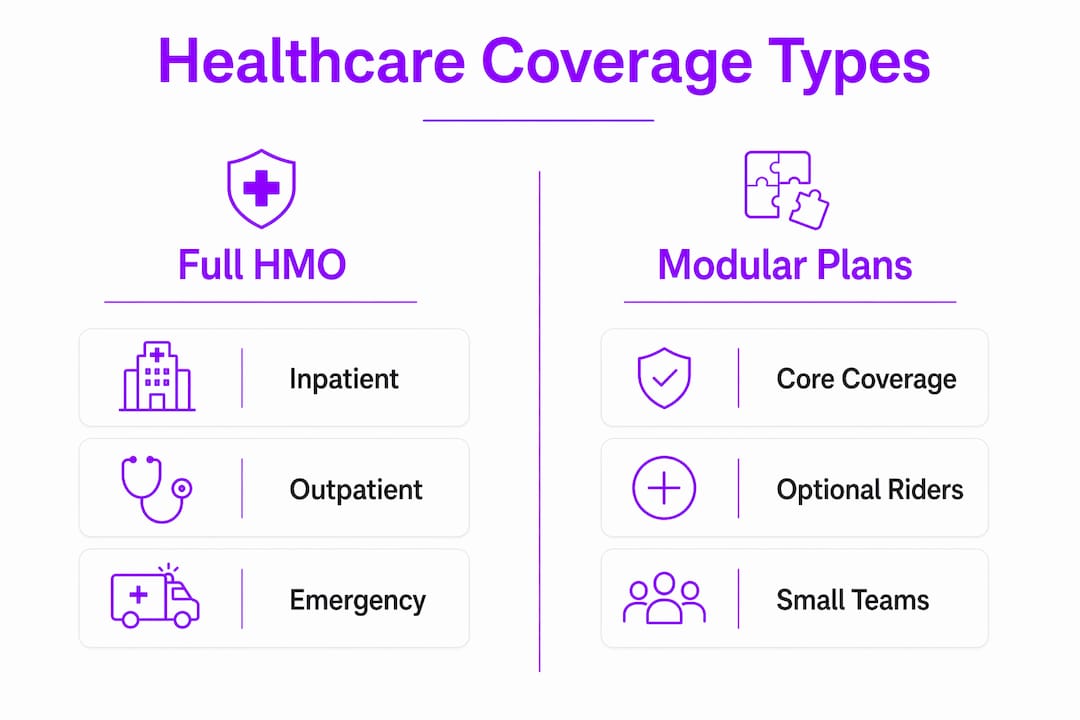
Philippine SME healthcare options fall into three broad categories: full inpatient and outpatient HMO plans, outpatient-only plans, and modular plans that let you build coverage around your budget.
Full HMO plans cover hospitalization, emergency care, outpatient consultations, laboratory tests, and room and board. These are the most common choice for SMEs that want one plan to handle everything. Most plans also extend coverage to dependents, including spouses and children, and cover dreaded and non-dreaded conditions for both principals and enrolled family members.
Outpatient-only plans are a practical entry point for micro-businesses or startups watching cash flow. These plans cover clinic visits, diagnostics, and prescriptions without the higher premium that comes with inpatient coverage. They work well as a base layer when paired with PhilHealth for hospitalization.
Modular plans are the most flexible structure available. Modular SME health plans let you cover all employees on a core plan, then add optional riders such as dental, executive check-ups, or maternity benefits for selected staff. This design prevents you from paying for benefits your workforce does not actually use.
- Full inpatient and outpatient HMO: covers hospitalization, emergency, outpatient, and room and board
- Outpatient-only plans: clinic visits, diagnostics, and prescriptions at lower annual premiums
- Modular plans: core coverage for all employees plus optional add-ons for specific groups
- Dependent coverage: spouses and children included, subject to plan terms
- Supplemental coverage: riders for dental, maternity, wellness, and life and accident insurance
Pro Tip: If your team is under 10 employees, start with a modular plan. Lock in core inpatient coverage for everyone, then add dental or outpatient riders only for roles where those benefits directly affect retention.
The minimum group size for most corporate HMO programs is 3–5 employees. That threshold is the gateway to group rates, which are significantly cheaper per person than individual health insurance policies.
How much does healthcare access typically cost for Philippine SMEs?
Cost is the first question every SME owner asks, and the answer depends on the plan tier and the coverage scope you choose.
Full inpatient and outpatient HMO coverage in the Philippines costs ₱11,000 to ₱45,000 per employee per year. That range reflects the difference between a basic plan with a modest Maximum Benefit Limit and a premium plan with access to top-tier hospitals. Outpatient-only plans start as low as ₱999 to ₱1,545 annually per person. That price point makes it possible for even the smallest businesses to offer something meaningful to their teams.

Group corporate rates are more cost-efficient per person than individual policies. The reason is simple: risk is spread across the group, so the insurer charges less per head. A business owner buying individual coverage for themselves pays full individual pricing. The same owner enrolling five employees in a group plan pays a lower per-person rate for everyone, including themselves.
| Plan type | Typical annual cost per employee | Best for |
|---|---|---|
| Outpatient-only | ₱999 to ₱1,545 | Micro-businesses, budget-first teams |
| Basic full HMO | ₱11,000 to ₱20,000 | Small teams needing core inpatient coverage |
| Mid-tier full HMO | ₱20,000 to ₱35,000 | Growing SMEs with retention goals |
| Premium full HMO | ₱35,000 to ₱45,000 | Competitive employers targeting top talent |
Pro Tip: Ask your provider for a claims-to-premium ratio report after year one. If your claims are consistently low, use that data to negotiate a better rate at renewal instead of accepting the default increase.
The SME healthcare options Philippines market rewards employers who shop actively. Providers compete on price for groups, especially in the 10–50 employee range where volume starts to matter.
What are the eligibility requirements and coverage inclusions for SME health plans?
Eligibility for corporate group health plans in the Philippines centers on one key threshold: minimum 3 to 5 employees required to qualify for group rates. This requirement is a bottleneck for micro-enterprises, but it is achievable for most registered SMEs.
Coverage inclusions have expanded significantly heading into 2026. Pre-existing conditions, which were once a standard exclusion, are now covered by several providers up to the plan’s Maximum Benefit Limit. Hmoplans, through its partnership with Purple Cow and Etiqa, offers 100% coverage for pre-existing conditions, congenital conditions, and special procedures, all up to the MBL. That commitment removes one of the most common reasons employees distrust their employer’s health plan.
Standard eligibility and coverage elements across most Philippine SME health plans include:
- Minimum group size: 3–5 employees for corporate plan eligibility
- Employee types covered: full-time and probationary employees; some plans extend to contractual staff
- Dependent coverage: spouses and children enrolled at additional premium
- Pre-existing conditions: covered by select providers up to the Maximum Benefit Limit
- Inpatient care: hospitalization, surgery, room and board, and emergency treatment
- Outpatient care: clinic consultations, diagnostics, and laboratory services
- Dental add-on: available as an optional rider on most modular plans
- Annual physical exam: optional add-on for executive or senior staff
- Digital access: telemedicine platforms and HR portals for claims and scheduling
- PhilHealth integration: most plans supplement PhilHealth rather than replace it; some offer PhilHealth-independent options
Access to premier facilities matters as much as the coverage terms. Hmoplans provides access to the Big 9 Hospitals and Healthway Clinics, plus out-of-network reimbursements for cases where employees need care outside the accredited network. That flexibility is a practical advantage for employees based outside Metro Manila.
How can SMEs manage healthcare benefits to balance cost and employee wellbeing?
The most effective approach to managing health services for local SMEs is shifting from reactive insurance to proactive benefits design. Reactive management means you buy a plan, pay premiums, and hope claims stay low. Proactive management means you actively shape the health behavior of your workforce to reduce claims before they happen.
Claims incidence rose by 30% in some SME sectors, which pushed employers to rethink their approach. That spike is not just a cost problem. It signals that employees are sicker, more stressed, or delaying care until conditions worsen. Wellness-linked benefits address the root cause rather than just the bill.
Here is a practical framework for sustainable SME healthcare benefits management:
- Audit your current plan. List every benefit included, identify which ones employees actually use, and flag coverage gaps. Most SME owners have never done this exercise.
- Switch to a modular structure. Cover all employees on a core inpatient plan, then add outpatient, dental, or maternity riders only where utilization data supports the cost.
- Add a wellness component. Providers with wellness programs help stabilize claims-to-premium ratios over time. Annual physical exams, for example, catch conditions early and reduce expensive late-stage claims.
- Communicate benefits clearly. Employees who understand their coverage use it correctly. Underutilization of preventive benefits is as costly as overuse of emergency services.
- Monitor your claims-to-premium ratio annually. A ratio above 80% signals that your current plan design is unsustainable. A ratio below 60% means you may be overpaying for coverage your team does not need.
- Review provider transparency. Choose a provider that shares claims data with you. Opaque providers make it impossible to manage costs intelligently.
Healthcare benefits viewed as workforce tools reduce costly employee turnover. In the Philippine talent market, where skilled workers compare benefits packages before accepting offers, a well-designed health plan is a direct retention investment.
Key Takeaways
Effective healthcare access in Philippine SMEs requires a group HMO plan with at least 3–5 employees, a modular structure that matches coverage to actual workforce needs, and active claims monitoring to keep costs predictable year over year.
| Point | Details |
|---|---|
| Minimum group size | Most corporate HMO plans require 3–5 employees to qualify for group rates. |
| Cost range | Full HMO coverage costs ₱11,000 to ₱45,000 per employee annually; outpatient-only starts at ₱999. |
| Modular plans save money | Core coverage for all staff plus optional riders prevents paying for unused benefits. |
| Pre-existing conditions | Select providers, including Hmoplans via Purple Cow, cover pre-existing conditions up to the MBL. |
| Wellness reduces claims | Providers with preventive programs stabilize claims ratios and reduce premium volatility over time. |
Why I think most Philippine SMEs are still leaving healthcare value on the table
After working with SME owners across tech, hospitality, and healthcare sectors, the pattern I see most often is not ignorance. It is inertia. Owners know their current plan is not ideal. They know better options exist. But 77% of SMB leaders are uncertain about switching from their current plans because they fear disruption. That fear is almost always bigger than the actual switching cost.
The misconception I hear most is that small teams cannot access quality coverage. The 3–5 employee minimum has been in place for years, yet owners with teams of 8 or 10 still believe they are too small for a corporate plan. They are not. They are leaving group pricing on the table every month they stay on individual policies.
The other shift I find underappreciated is the move toward modular plan design. SME owners who treat health insurance as a fixed, all-or-nothing product miss the flexibility that modern plans offer. You do not have to buy dental for everyone if only your senior staff value it. You do not have to pay for executive check-ups across the board. Build the plan around your actual workforce, not a generic template.
The challenges in SME healthcare access are real, but they are mostly structural, not financial. The cost is manageable. The eligibility thresholds are achievable. What holds most owners back is not knowing exactly what they qualify for and what it would cost to switch. Getting that answer takes one conversation with the right provider.
— Eumir
How Hmoplans helps Philippine SMEs access better health coverage
Philippine SME owners who want straightforward, affordable group health coverage without complicated terms have a direct option in Hmoplans. Powered by Purple Cow and underwritten by Etiqa, Hmoplans is built specifically for small and medium businesses that need real coverage without enterprise-level complexity.
Hmoplans covers pre-existing conditions, congenital conditions, and special procedures at 100% up to the Maximum Benefit Limit. That is not standard across the market. The plan includes cashless access to the Big 9 Hospitals and Healthway Clinics, 24/7 nationwide coverage, and out-of-network reimbursements for employees outside Metro Manila. Optional add-ons for dental, annual physical exams, and life and accident insurance let you customize your SME plan without overpaying for benefits your team does not use. Get in touch through hmoplans.ph to find the right plan for your team size and budget.
FAQ
What is the minimum number of employees for an SME health plan in the Philippines?
Most corporate HMO programs require a minimum of 3–5 employees to qualify for group rates. This threshold applies to most major providers in the Philippine market.
How much does a group HMO plan cost for a small business in the Philippines?
Full inpatient and outpatient HMO coverage costs ₱11,000 to ₱45,000 per employee per year. Outpatient-only plans start as low as ₱999 annually per person.
Are pre-existing conditions covered under Philippine SME health plans?
Coverage for pre-existing conditions varies by provider. Hmoplans, through Purple Cow, covers pre-existing and congenital conditions at 100% up to the Maximum Benefit Limit, which is not a universal standard in the market.
What is a modular health plan and why does it matter for SMEs?
A modular plan covers all employees on a core benefit, then allows optional riders for dental, maternity, or executive check-ups. This structure lets SMEs control healthcare costs without cutting essential coverage.
How can SMEs keep healthcare costs from rising year over year?
Monitoring your claims-to-premium ratio annually and choosing providers with wellness programs are the two most effective controls. Wellness-linked benefits reduce claims incidence over time, which stabilizes premiums at renewal.
