

Philippine SME HMO Overseas Emergencies: Avoid Six Figure Evacuations
Philippine HMOs typically cover emergency and urgent care abroad, but usually on a pay-and-claim basis unless your insurer has direct-billing agreements with the hospital. Medical evacuation, repatriation, and high-cost trauma cases often exceed what a standard HMO pays for, which is why supplemental travel medical insurance still matters for longer or riskier trips. Some HMO providers build emergency benefits into their SME group plans so you know your coverage before you book a flight.
TL;DR:
- Philippine HMOs usually cover emergency care abroad through reimbursement, not cashless or direct billing, making trip-specific travel insurance important.
- Evacuation and repatriation are generally limited in HMOs, often requiring supplemental travel insurance for high-cost or remote-location trips.
- Industry recommendations suggest at least $100,000 in emergency medical coverage and $200,000 in evacuation limits for international travel, especially to high-cost countries.
- Claims should be filed with detailed documentation within 30 to 90 days, including itemized bills, medical reports, and proof of payment, to avoid delays.
- Verifying hospital network status before treatment prevents unexpected out-of-pocket costs, as network affiliations are contractual and not always obvious.
Table of Contents
- What Does HMO Overseas Emergency Coverage Actually Include?
- HMO vs. Travel Medical Insurance: What’s the Real Difference?
- How Much Coverage Do You Actually Need for a Trip Abroad?
- What Should You Do Immediately After a Medical Emergency Abroad?
- What Documents Do You Need to File an Overseas Emergency Claim?
- How Do You Activate Emergency Assistance While You’re Overseas?
- What Won’t Your HMO Cover in an Emergency Abroad?
- How Do You Verify a Hospital Is Actually In-Network Before Treatment?
- Why Should SMEs Build Overseas Emergency Coverage Into Employee HMO Plans?
- Get Overseas Emergency Coverage Built Into Your SME’s HMO Plan
- Where to Verify Coverage Rules and Compare Travel Insurance Limits
- Sources
What Does HMO Overseas Emergency Coverage Actually Include?
Your HMO draws a hard line between emergency care and everything else. A ruptured appendix, a broken bone from a scooter accident, or a sudden allergic reaction abroad qualifies as an emergency. A routine dental cleaning you happened to schedule while on vacation does not, and neither does an elective consultation for a condition you already knew about before you left the Philippines.
That distinction changes how you pay. Most Philippine HMOs settle emergencies overseas through reimbursement: you pay the foreign hospital directly, then submit your documents once you’re home. Health Insurance in the Philippines from William Russell confirms this pay-and-claim pattern is standard unless your insurer has arranged direct billing with that specific hospital, which is rare outside a handful of partner networks in major cities.
A few practical realities to keep in mind:
- Cashless access almost always applies only inside your HMO’s accredited network, and that network is domestic.
- Reimbursement claims overseas usually require the same paperwork a Philippine hospital claim needs, plus proof of payment in the local currency.
- Some Philippine insurers advertise worldwide emergency assistance as a selling point, but the fine print on limits and exclusions still varies by product.
Read your plan’s emergency care benefits before you assume “24/7 coverage” means cashless coverage everywhere.
HMO vs. Travel Medical Insurance: What’s the Real Difference?
An HMO and a travel medical policy solve different problems, even when both use the word “emergency.” Your HMO is built for continuous care in the Philippines with occasional overseas emergency benefits bolted on. Travel medical insurance is built specifically for the trip, with evacuation and repatriation as its centerpiece rather than an afterthought.
- Evacuation and repatriation. Travel medical plans are designed around getting you home or to better care; most HMOs treat this as a limited add-on, if they cover it at all.
- Territory and limits. HMOs cap benefits against a Philippine cost baseline; travel insurance prices its limits against the destination country’s actual hospital costs, which run far higher in places like the United States or Japan.
- Assistance services. Dedicated travel insurers run 24/7 coordination desks that arrange local doctors, translators, and evacuation logistics, a service Squaremouth highlights as a core part of what you’re paying for.
- Pre-existing condition handling. Travel policies often exclude or heavily restrict pre-existing conditions unless declared and rated at purchase.
Buy supplemental travel medical insurance when your trip runs longer than two weeks, heads to a remote or high-cost destination, involves an older traveler, or includes adventure activities like diving or trekking.
How Much Coverage Do You Actually Need for a Trip Abroad?
Industry guidance recommends at least $100,000 in emergency medical coverage and $200,000 in medical evacuation coverage for international trips, according to Squaremouth’s travel insurance comparison data. That evacuation figure surprises most first-time buyers, but air ambulance transport from a remote region can run into six figures fast once you factor in a medical crew and specialized aircraft.
Evacuations aren’t something you arrange yourself. Your insurer’s assistance team decides whether transport is medically necessary, picks the receiving hospital, and coordinates the logistics. That’s why the evacuation limit usually needs to sit well above your routine hospital bill limit. An appendectomy overseas might cost a few thousand dollars; flying you from a rural clinic to a capital city hospital can cost far more than the surgery itself.
Where pre-existing conditions and high-cost claims come in:
- Standard travel policies frequently exclude pre-existing conditions unless you disclose and pay extra for a rider.
- Certain HMO plans extend coverage for pre-existing conditions, congenital conditions, and special procedures up to the plan’s Maximum Benefit Limit.
- That MBL structure matters most for SME groups with employees who have known conditions and still need to travel for work.
What Should You Do Immediately After a Medical Emergency Abroad?
The sequence you follow in the first hour after an emergency abroad often decides whether your claim gets paid smoothly or gets stuck for weeks.
- Call local emergency services first. Getting stabilized always outranks calling your insurer.
- Contact your insurer’s emergency assistance hotline as soon as you’re able, or have a companion do it. This is the number that coordinates everything from here.
- Ask the hospital for your identification and admission details in writing so your assistance team can verify you and start a file.
- If cashless treatment isn’t available, pay and keep every receipt, itemized where possible, not just a summary total.
- Photograph documents on the spot. Phones die, papers get lost, and a photo backup has saved more claims than people expect.
- Notify your HR department or HMO provider within 24 to 48 hours if you’re traveling for work, since delayed notification is one of the most common reasons claims stall later.
- Escalate to evacuation only through the assistance hotline, never by arranging private transport yourself, since insurers typically only reimburse evacuations they authorized or coordinated directly.
Pro Tip: Save your insurer’s emergency hotline number as a physical photo in your phone’s lock screen or a printed card in your wallet, not just in your contacts. If your phone is damaged or the battery dies, that number is the one thing you can’t afford to lose access to.
For employer-sponsored plans, HR should keep a standing protocol: designate one HR contact who knows how to reach the insurer’s assistance line after hours, because emergencies rarely happen during business hours.
What Documents Do You Need to File an Overseas Emergency Claim?
Claims examiners in the Philippines look for a specific paper trail, and missing even one piece can delay reimbursement for weeks.
- Itemized hospital bill showing each charge, not a lump-sum total
- Official medical report or diagnosis from the treating physician
- Physician’s notes describing the treatment given
- Proof of payment, such as a receipt or credit card statement
- Passport pages showing entry and exit stamps for the trip dates
- Ambulance or evacuation report if transport was involved
Claims most often get delayed or denied because the bill isn’t itemized, the diagnosis doesn’t clearly establish the condition as an emergency, or the traveler waited too long to file. Submit within your insurer’s stated window, usually 30 to 90 days depending on the plan, and follow up in writing if you haven’t heard back within two to three weeks. Reviewing a Philippine hospital admission guide before you travel helps you understand what “complete documentation” actually looks like from a claims examiner’s perspective.
How Do You Activate Emergency Assistance While You’re Overseas?
Every HMO and travel policy issues an emergency assistance number specifically for use outside the Philippines, and it’s usually different from your domestic customer service line. Save it before you leave, not after something goes wrong.
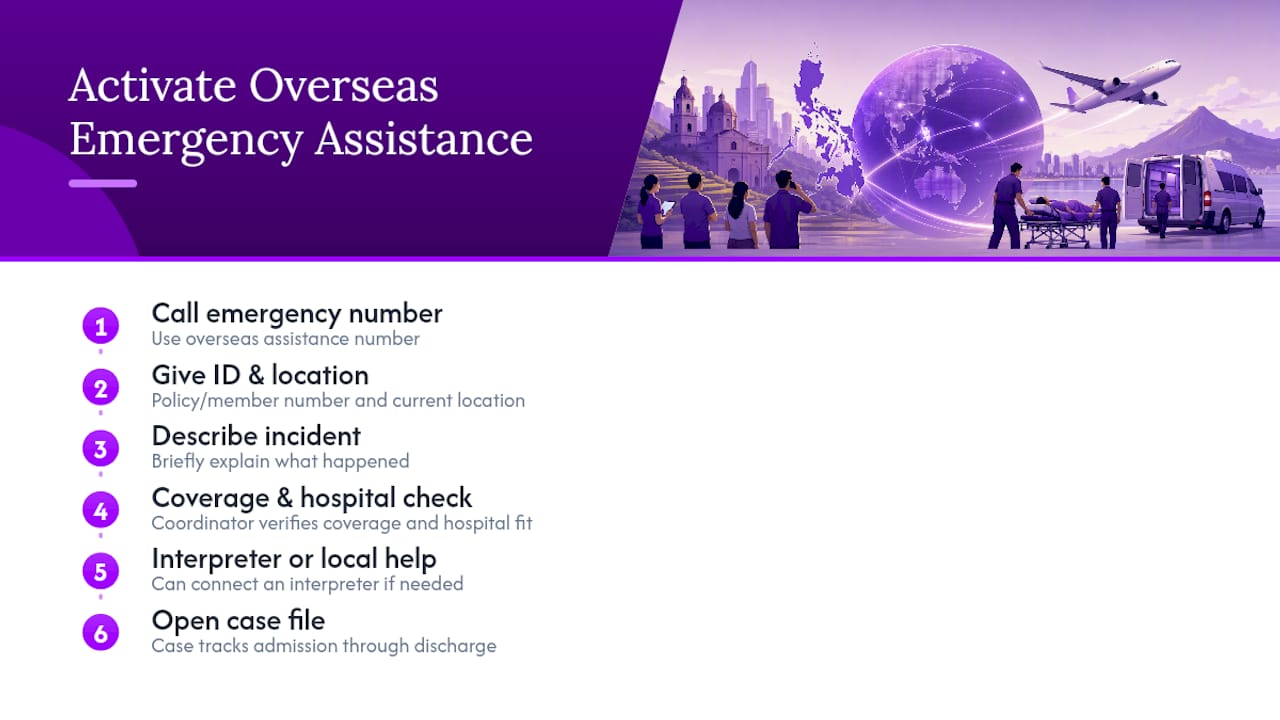
When you call, be ready to give your policy or member number, your current location, and a brief description of what happened. The assistance coordinator on the other end typically speaks English and can often connect you with a local interpreter if the hospital staff doesn’t. Their job is to verify your coverage, guide you toward a hospital that fits your network or reimbursement terms, and open a case file that tracks everything from admission to discharge.
If you’re traveling for work, tell the hospital and the assistance line that you’re covered under a group policy, and have your HR department’s contact details on hand. Many SME group plans list a secondary contact, either the HR administrator or a broker, who can confirm coverage details faster than the traveler can from a hospital bed.
Keep the call short and factual. Assistance teams triage dozens of cases and move faster when you lead with the essentials: who you are, where you are, and what happened. Follow up with the documentation steps covered earlier once the immediate crisis is handled. If the local hospital insists on upfront payment despite your call, that’s normal, not a sign your coverage failed. It simply means you’re heading toward a reimbursement claim rather than a cashless one.
What Won’t Your HMO Cover in an Emergency Abroad?
Exclusions catch more travelers off guard than any other part of overseas coverage. Routine or elective care almost never qualifies, even if a condition happens to flare up while you’re abroad. A pre-scheduled surgery, a follow-up consultation for a chronic issue, or a maintenance medication refill will typically fall outside emergency benefits entirely.
Evacuation is the exclusion that causes the most financial damage. Many standard HMO plans either exclude evacuation outright or cap it at a level nowhere near what an actual international air evacuation costs. That gap is precisely why travel medical insurance exists as a category, built to absorb the cost a domestic HMO was never priced to cover.
Watch for these common limitations:
- Geographic restrictions. Some plans exclude specific high-risk countries or regions entirely.
- Activity exclusions. Injuries from extreme sports, diving, or motorcycle riding are frequently carved out unless you’ve added a rider.
- Time limits. Coverage abroad often applies only for trips under a defined number of days, commonly 30 to 90.
- Documentation deadlines. Missing the filing window turns a valid claim into a denied one.
- War, civil unrest, and pandemic-related exclusions, which most policies list as standard carve-outs regardless of destination.
Read your certificate of coverage’s exclusions page before you travel, not after you’re holding a bill. The examples of HMO coverage in the Philippines guide breaks down how these limits typically appear across local plans.
How Do You Verify a Hospital Is Actually In-Network Before Treatment?
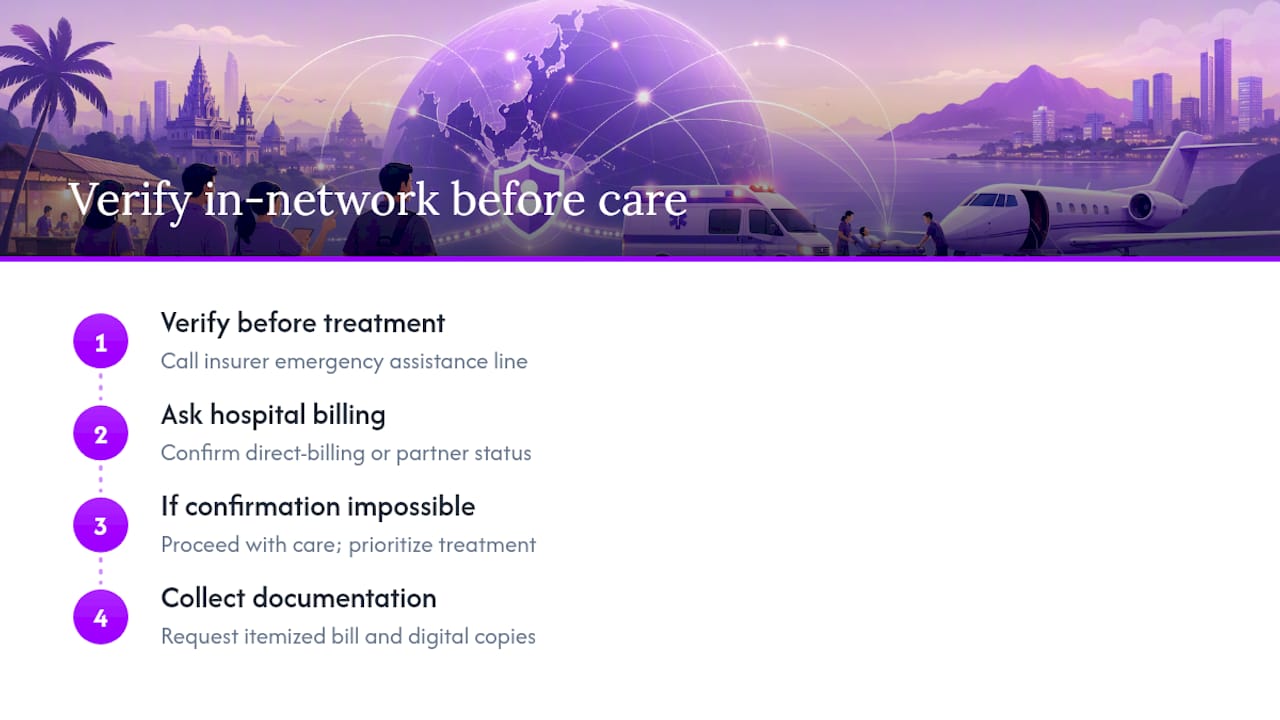
Verifying network status before treatment, not after, is the single habit that saves travelers the most money and stress. If you’re conscious and able to make a phone call before checking into a foreign hospital, do it. Call your insurer’s emergency assistance line and ask directly whether that specific hospital has a direct-billing or partner arrangement, or whether you’ll be paying out of pocket and filing for reimbursement.
Don’t assume a hospital is in-network just because it looks like a major international facility. Network affiliations are contractual, not reputational, and even well-known hospitals abroad may have no billing relationship with your Philippine insurer at all. Ask the hospital’s billing office directly whether they’ve dealt with your insurer before; staff at hospitals near international airports or in tourist-heavy areas often know this answer immediately because they see it often.
If there’s no way to confirm network status before treatment starts, and there frequently isn’t in a true emergency, don’t let that stop you from getting care. Get treated first, then work the reimbursement path once you’re stable. Ask for an itemized bill in English if possible, and request digital copies of every document before you’re discharged, since hospitals abroad don’t always mail records back to the Philippines afterward.
Why Should SMEs Build Overseas Emergency Coverage Into Employee HMO Plans?
When an employee gets hurt on a business trip, the company carries more than a medical bill. It carries the duty of care question, the reputational fallout if the response looks disorganized, and often the direct cost of an evacuation nobody budgeted for. Most SME owners underestimate how thin standard HMO coverage gets the moment an employee crosses a border.
HMO Plans lets SMEs customize their Purple Cow group policy with add-ons that address this gap directly, layering emergency assistance and evacuation-related benefits onto a base plan that already covers pre-existing conditions up to the Maximum Benefit Limit. Before your next employee travels for work, walk through a short checklist: confirm what your current plan actually pays for abroad, verify your emergency hotline number is documented somewhere HR can find at 2 a.m., and decide whether high-travel roles need a supplemental rider. Review options for structuring emergency benefits for traveling staff before the next trip gets booked, not after someone’s already at a foreign hospital.
— Eumir
Get Overseas Emergency Coverage Built Into Your SME’s HMO Plan
Hmoplans gives Philippine SMEs a group HMO plan with emergency benefits already built in, so you’re not scrambling to patch coverage gaps every time an employee books a flight.

Some plans allow optional add-ons like dental, annual physical exams, and life and accident insurance to round out coverage without requiring separate policies.
To request a quote, have your headcount, industry, and any known employee health conditions ready. That’s what determines your pricing and MBL structure. Start by reviewing the full plan features or head to the Hmoplans homepage to request a proposal tailored to your team’s travel exposure.
Where to Verify Coverage Rules and Compare Travel Insurance Limits
For regulatory questions or insurer complaints, the Insurance Commission of the Philippines is the official government body overseeing licensed insurers. Its contact page lists how to reach them directly. To benchmark evacuation and emergency medical limits against industry standards, review Squaremouth’s travel insurance comparison data. For a deeper look at how HMO claims work step by step, see the hospital admission guide for the Philippines.
This article is general information, not a substitute for advice from a qualified doctor. Consult a qualified healthcare professional about your own circumstances before acting on anything here.
Sources
- Compare Travel Medical Insurance Plans & Prices (2026) — Squaremouth
- Insurance Commission of the Philippines
- Health Insurance in the Philippines — William Russell
