

HMO Plan Renewal Process Explained for SMEs
TL;DR:
- Early planning, starting 90 to 120 days before the plan year begins, is essential for successful HMO renewal.
- Compliance, particularly COBRA notices and documentation updates, requires strict adherence to deadlines to avoid penalties and coverage gaps.
Renewal season catches more HR managers off guard than it should. The HMO plan renewal process explained in most carrier documents is full of jargon, vague timelines, and steps that assume you already know what you’re doing. Miss one deadline and you risk a coverage gap that leaves employees unprotected and your company exposed to penalties. This guide breaks down every stage of the renewal cycle in plain language: when to start, what compliance requires, how to communicate with your team, and what to do when things change mid-cycle.
Table of Contents
- Key takeaways
- Understanding the HMO plan renewal timeline
- Compliance requirements during HMO plan renewal
- Employee communication during open enrollment
- Handling changes and contingencies during renewal
- My honest take on navigating HMO renewals in SMEs
- How Hmoplans makes renewal easier for SMEs
- FAQ
Key takeaways
| Point | Details |
|---|---|
| Start 90 to 120 days early | Begin renewal planning well before your plan year starts to get competitive rates and avoid rushed decisions. |
| COBRA notices are time-sensitive | Employers must notify plan administrators within 30 days of qualifying events to prevent penalties and coverage gaps. |
| Employee communication drives outcomes | Clear, side-by-side plan comparisons reduce default enrollments and help employees make confident choices. |
| Update plan documents annually | ERISA requires updated Summary Plan Descriptions within 210 days after plan year-end to stay compliant. |
| Automate event tracking | Trigger-based alerts for terminations and qualifying events cut compliance risk and reduce administrative burden. |
Understanding the HMO plan renewal timeline
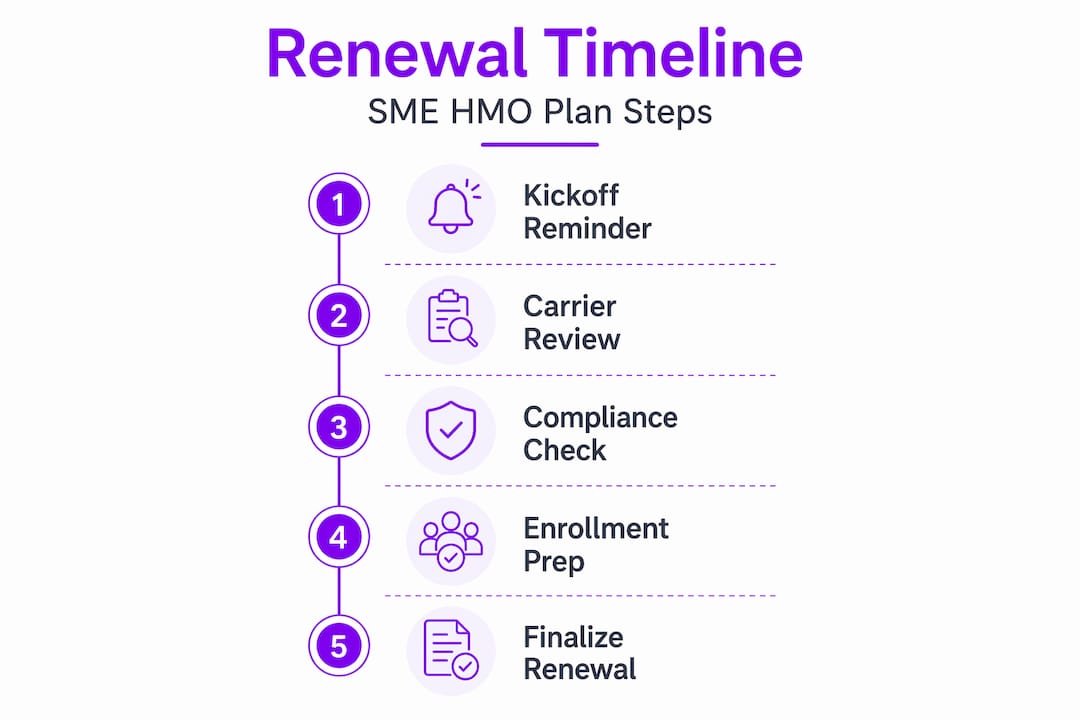
Most SMEs treat renewal as a 30-day scramble. In practice, understanding HMO plan renewal starts with accepting that the real work begins months earlier. Well-prepared HR teams start negotiations in August or September for a January plan year, giving themselves 90 to 120 days of runway. That window is not padding. It’s when you have actual leverage.
Here is the sequence that works:
- Days 90 to 120 before plan year start. Pull last year’s claims data, benchmark against market rates, and schedule carrier review meetings. This is when you can negotiate pricing rather than accept whatever is on the table.
- Days 60 to 90. Finalize plan design decisions, confirm any add-ons or benefit changes, and prepare employee communication materials. Changes to network access, copay structures, or coverage limits need to be documented before enrollment opens.
- Days 30 to 60. Open enrollment begins. Employers must run a fixed 31-day open enrollment period annually for employee health plan elections. Employees cannot change plans outside this window except through qualifying life events.
- Final 2 weeks. Chase down missing election forms, confirm dependent enrollments, and submit completed data to the carrier. Any errors here create headaches that follow you into the new plan year.
- Plan year start. New ID cards distributed, coverage active, and documentation filed.
SMEs operate differently from large enterprises in one key way: there is rarely a dedicated benefits team. The HR manager handling renewal is often also handling payroll, onboarding, and compliance. That is exactly why the step-by-step HMO enrollment guide approach matters so much. A clear checklist prevents things from falling through the cracks.
Pro Tip: Set a recurring calendar reminder for 120 days before your plan year start date. Label it “Renewal kickoff.” Treat it like a hard deadline, not a suggestion.
Compliance requirements during HMO plan renewal
Compliance is the part of the HMO renewal process that most SME owners underestimate. It is not just paperwork. Missed deadlines carry real financial consequences.
The most critical area is COBRA. When an employee loses coverage due to a qualifying event (termination, reduced hours, divorce, loss of dependent status), the clock starts immediately. Employers have 30 days to notify the plan administrator after the qualifying event occurs. The plan administrator then has 14 days to send the election notice to the affected individual.
Missing those deadlines is expensive. Penalties for late or missed COBRA notices can reach $110 per day per affected individual. In a small company where one bad termination process goes untracked, that accumulates fast. Employees themselves must make their COBRA election within 60 days of receiving notice and pay initial premiums within 45 days of election. When employers fail to send notices on time, they disrupt this entire chain.
Key compliance steps to track during renewal:
- Audit all qualifying events from the prior plan year and confirm proper notice was sent.
- Verify your plan administrator’s current contact information and notification process.
- Review your Summary Plan Description (SPD) for accuracy. ERISA requires distribution of updated SPDs within 210 days after plan year-end.
- Document all enrollment elections and keep records for a minimum of six years.
- Confirm that COBRA premium rates reflect the correct calculation. Employers can charge COBRA beneficiaries up to 102% of the applicable premium, including an administrative fee.
Missing a single COBRA notice is not just a compliance failure. It can leave a former employee without healthcare coverage during a critical transition, which creates both legal exposure and reputational damage for your company.
Pro Tip: Assign one person as the COBRA point of contact in your company. Every termination or qualifying event should automatically trigger a task for that person. No exceptions.
Employee communication during open enrollment
Here is what most HR guides on the procedure for HMO policy renewal get wrong: they focus entirely on the mechanics and say almost nothing about communication. The reality is that a perfectly executed administrative process can still fail if employees do not understand their options.
Clear decision support tools and side-by-side plan comparisons help employees make correct elections and reduce confusion during renewal. That means more than sending a PDF benefits guide that no one reads.
What actually works:
- Plain-language comparison sheets. Put the two or three plan options side by side with premium costs, deductibles, copays, and network size. Do not use carrier branding. Use employee-friendly language.
- A short FAQ document. Cover the questions you know will come up: “Can I keep my doctor?” “What happens if I miss the deadline?” “How does this affect my dependents?” A health benefits communication resource goes a long way toward reducing repetitive one-on-one questions.
- Multiple touchpoints. Send an initial announcement two weeks before enrollment opens. Send a mid-enrollment reminder. Send a final deadline notice three days before close. Three communications are the minimum, not the maximum.
- A live Q&A session. Even a 30-minute virtual meeting where employees can ask questions reduces anxiety and increases the quality of elections. Record it for employees who cannot attend.
- Default enrollment warnings. Make it explicitly clear that employees who do nothing may be auto-enrolled in the same plan from last year, which may no longer be the best fit. Passive enrollment often leads to employees staying on plans they have outgrown.
The goal is to make sure no employee reaches the enrollment deadline confused or uninformed. Default renewals driven by confusion are a silent problem in many SMEs.
Handling changes and contingencies during renewal
Even when you plan carefully, things change. Employees get married. Dependents age off coverage. Your company grows from 15 to 30 people. A carrier alters its provider network. Understanding HMO plan renewal also means knowing how to adapt when the plan itself changes around you.

The table below covers the most common change scenarios and how to handle each one:
| Change scenario | What you need to do |
|---|---|
| Adding a new employee mid-year | Enroll within the carrier’s specified eligibility window (usually 30 days of hire date) |
| Employee terminates during plan year | Trigger COBRA process immediately; notify plan administrator within 30 days |
| Employee adds a dependent (birth, marriage) | Qualifying life event allows election change outside open enrollment |
| Carrier changes provider network | Validate all PCPs against new network; notify affected employees in writing |
| Plan design modification | Issue a Summary of Material Modifications (SMM) to all enrolled employees |
| Carrier switch at renewal | Distribute updated SPD, new ID cards, and transition support before plan year start |
Network and PCP changes during renewal are a major source of employee dissatisfaction. Many employees assume their doctor stays in-network every year without checking. That assumption fails them when networks change. Your job is to run a proactive network validation before open enrollment opens, not after complaints start coming in.
Technology helps here. Automating event detection and deadline tracking massively reduces compliance risk and the administrative load on HR. If you are managing renewals on a shared spreadsheet, you are one missed row away from a real problem. A system that surfaces alerts when someone is terminated, when deadlines approach, or when enrollments are still pending pays for itself in avoided penalties.
For SMEs looking to customize HMO benefits for their employees, this contingency planning phase is also the right time to review whether your current plan structure still fits your team’s composition.
My honest take on navigating HMO renewals in SMEs
I have worked with enough SME HR teams to say this clearly: the companies that handle renewals well do not do it because they are smarter. They do it because they start earlier and treat the process like a project, not a task.
What I have seen trip up good HR managers repeatedly is underestimating how much COBRA tracking eats into bandwidth during renewal season. When terminations are happening at the same time enrollment is open, it is genuinely hard to keep both trains on the track. The teams that get it right are the ones who centralize trigger-based alerts for qualifying events well before renewal season arrives, not during it.
The other thing I would push back on is the idea that employee communication is a “nice to have.” I have watched companies spend weeks getting the plan design right and then send employees a single email the day enrollment opens. The result is predictable: employees make uninformed elections, then complain about coverage all year. Communication is not an afterthought. It is half the job.
View renewal not as paperwork, but as your annual chance to make sure your team is properly covered, informed, and set up to actually use their benefits well.
— Eumir
How Hmoplans makes renewal easier for SMEs
Renewal does not have to be the most stressful week on your HR calendar. Hmoplans, powered by Purple Cow, is built specifically for SMEs that want coverage that works without the administrative weight.
Purple Cow’s SME plan features include 100% coverage for pre-existing and congenital conditions up to the Maximum Benefit Limit, cashless access to the Big 9 Hospitals and Healthway Clinics, and flexible add-ons for dental, annual physical exams, and life insurance. There are no complicated exclusion clauses to decode at renewal time. Their member services team supports both HR managers and employees directly, reducing the volume of questions that land on your desk during open enrollment. If you are reassessing your renewal strategy and want a plan that is straightforward to manage year over year, explore what Hmoplans offers for SMEs like yours.
FAQ
What is the HMO plan renewal process?
The HMO plan renewal process is the annual cycle in which employers review, renegotiate, and re-enroll employees in health coverage for the next plan year. It includes compliance steps, employee communication, and carrier coordination, ideally starting 90 to 120 days before the plan year begins.
When should SMEs start the HMO renewal process?
SMEs should start renewal planning 90 to 120 days before the plan year start date. Beginning this early allows time for carrier benchmarking, negotiation, and employee communication without rushing.
What are the COBRA notice deadlines during renewal?
Employers must notify the plan administrator within 30 days of a qualifying event. The administrator then has 14 days to send the election notice, and employees have 60 days to elect continuation coverage.
What documents need to be updated at HMO plan renewal?
At minimum, employers should update the Summary Plan Description and issue a Summary of Material Modifications if any plan terms change. ERISA requires distribution of an updated SPD within 210 days after the plan year ends.
What happens if employees miss the open enrollment deadline?
Employees who miss open enrollment are typically locked into their current plan or may lose coverage until the next open enrollment period. The only exceptions are qualifying life events such as marriage, childbirth, or loss of other coverage.
