

Stop the 3–6 Session Gap: SME HR Demands for HMO Psychiatric Coverage
Psychiatrist consultations are commonly covered under Philippine HMO plans as specialist visits, but psychologist and talk-therapy sessions get inconsistent, plan-dependent treatment. Before you book anything, check your Evidence of Coverage (EOC) or Summary of Benefits, or call HR or member services directly to confirm what your specific plan actually pays for.
TL;DR:
- Many Philippine HMO plans primarily cover psychiatric consultations as specialist visits, but psychologist or counseling sessions are often limited, optional, or excluded altogether.
- Out-of-network providers usually do not qualify for cashless claims, and session caps or prior authorization requirements can restrict access even for covered treatments.
- Confirm the specific mental health services covered by reviewing your Evidence of Coverage, asking detailed questions, and obtaining written prior authorization before booking sessions.
- PhilHealth mainly covers inpatient psychiatric care, leaving outpatient therapy to private HMO benefits, which often vary widely and require careful plan review.
- Employers should request explicit, written psychiatric and psychology benefits during plan design to avoid gaps and ensure comprehensive coverage for employees.
Table of Contents
- What HMO Psychiatric Coverage Typically Includes
- Why Coverage Gaps and Session Caps Catch Members Off Guard
- How to Confirm Your Coverage Before You Book
- PhilHealth vs. Private HMO: Who Covers What
- What to Do If Your HMO Doesn’t Cover What You Need
- What SME Employers Should Request When Buying Group HMOs
- The Real Gap Isn’t the Law, It’s the Fine Print
- Get Psychiatric Coverage Written Into Your SME’s Group Plan
- Quick Resources to Check Before You Book
- Sources
What HMO Psychiatric Coverage Typically Includes
Psychiatrists are medical doctors, and HMOs generally classify their consultations as specialist visits, the same category as cardiologists or dermatologists. That classification matters. It’s the main reason psychiatric consultations tend to get covered more consistently than sessions with psychologists or licensed counselors, whose services often fall into a separate, less standardized benefit bucket.
Behavioral health benefits inside most HMO structures follow a predictable pattern: a referral from your primary care physician, prior authorization for anything beyond a basic consult, and sometimes a completely separate managed behavioral health network handling claims. This is common across HMO structures, not unique to any single Philippine insurer.
Here’s what members typically find written into their plans:
- Outpatient psychiatric consultations, usually capped at a set number of visits per year
- Inpatient psychiatric admission, almost always requiring prior authorization or a Letter of Authorization (LOA)
- Partial hospitalization or intensive outpatient programs, offered by some higher-tier plans but far from universal
- Prescription psychiatric medication, subject to the plan’s formulary
- Telepsychiatry, increasingly accepted and usually carrying the same authorization rules as an in-person visit
Statistic to know: Sample international Evidence of Coverage documents show telepsychiatry, inpatient psychiatric stays, and partial hospitalization programs listed as standard behavioral health benefits, though exact limits and authorization steps differ by contract, a pattern that holds true in the Philippine market as well.
Republic Act 11036, the Mental Health Act of 2018, requires the integration of mental health services into the broader healthcare system. It’s a landmark law, but it doesn’t force private HMOs to cover every type of provider or therapy modality. Treat it as important legal context, not a guarantee that your specific plan includes psychology sessions or extended counseling.
Why Coverage Gaps and Session Caps Catch Members Off Guard
Psychologist and counseling sessions are where most of the confusion lives. Some SME group plans include them as a standard benefit; others treat them as an optional add-on the employer has to purchase separately, and a fair number exclude them entirely. There’s no universal rule, which is exactly why guessing is risky.
Annual caps are another common surprise. Plans that do cover outpatient mental health services often set a limit on the number of sessions per year or a cap on behavioral health spending overall. Step therapy and prior authorization requirements can slow access further, since some plans require you to try a lower-cost intervention before approving specialist-level care.
Network restrictions cause their own headaches:
- Out-of-network psychiatrists or therapists are usually excluded from cashless coverage
- Emergency psychiatric admissions sometimes get an exception, but confirm this in writing rather than assuming
- Medications can still generate out-of-pocket costs even when the consultation itself is fully covered, particularly for brand-name drugs outside the formulary
Pro Tip: Ask specifically whether your plan’s “behavioral health” benefit includes psychologists by name. Some EOCs use “mental health” as an umbrella term that, on closer reading, applies only to psychiatric medical visits.
How to Confirm Your Coverage Before You Book
Don’t call your HMO with a vague question. Come prepared, and you’ll get a faster, more useful answer.
- Pull your EOC or Summary of Benefits and search for the terms “psychiatry,” “behavioral health,” “psychology,” and “mental health.” Note any session caps, dollar limits, or exclusions listed next to each term.
- Call HR or member services with specific questions: Is psychiatric consultation covered, and how many visits per year? Are psychologist sessions included or an add-on? Is an LOA required before the first visit? Can they provide a directory of in-network psychiatrists or therapists?
- Request the LOA or prior authorization as early as possible. Processing typically takes a few business days, so don’t wait until you’re in crisis to start the paperwork. The LOA and pre-authorization process generally mirrors what you’d file for any other specialist visit.
- If you need to appeal a denial, keep records of everything: your LOA reference number, the clinical notes from your provider, and the dates each step was submitted.
Two things to keep in mind:
- HR contacts often don’t know plan details off the top of their head, so give them time to check with the insurer
- Reviewing real examples of how HMO benefits get structured can help you recognize similar language in your own EOC
PhilHealth vs. Private HMO: Who Covers What
PhilHealth provides baseline inpatient psychiatric coverage and, for certain diagnoses, Z-benefit packages designed for catastrophic or high-cost conditions. Outpatient psychiatric consultations and ongoing talk therapy sit largely outside PhilHealth’s scope, which is exactly where a private HMO is supposed to fill the gap.
A well-structured HMO plan works alongside PhilHealth rather than replacing it:
- Cashless access at accredited hospitals reduces upfront out-of-pocket spending during inpatient psychiatric admission
- Reimbursement workflows can cover costs PhilHealth doesn’t touch, including many outpatient specialist visits
- Supplemental coverage beyond PhilHealth is often the specific reason employers add an HMO benefit in the first place
Keep this straight: RA 11036 mandates system-wide integration of mental health services, but it doesn’t rewrite the terms of your private contract. Confirm the actual plan language rather than assuming the law already guarantees the benefit.
What to Do If Your HMO Doesn’t Cover What You Need
If your plan comes up short on outpatient mental health coverage, you still have real options in the Philippines.
- Employee Assistance Programs often provide 3 to 6 free sessions per issue, useful for short-term support but rarely enough for ongoing treatment
- Teletherapy platforms fill the gap between EAP limits and full private therapy. Saya, available on the Apple App Store and on Google Play, is one Philippines-accessible option for members without outpatient psychology coverage
- Sliding-scale clinics, university hospitals, and the National Center for Mental Health offer lower-cost or public pathways for longer-term care
- Crisis situations call for hotlines or direct hospital admission. Don’t wait on prior authorization when someone is in immediate danger
Statistic to know: Guides on Philippine mental health access consistently note that many EAPs cap out around 3 to 6 sessions, which is why combining limited HMO or EAP resources with private financing or teletherapy tends to produce more consistent outpatient care.
What SME Employers Should Request When Buying Group HMOs
Employers frequently buy generic “mental health” language without specifying whether outpatient talk therapy or psychologist visits are actually included. That vagueness is where employees get burned later.
HMO Plans structures its SME offerings around customizable add-ons and cashless access to accredited facilities, which gives HR room to negotiate psychiatric benefits explicitly rather than hoping they’re bundled in.
- Ask for named session caps for both psychiatry and psychology, in writing
- Confirm whether pre-existing mental health conditions are covered up to the Maximum Benefit Limit
- Request the in-network provider directory before signing
Pro Tip: Document every promised benefit in your contract renewal paperwork, verbal assurances from a broker don’t hold up during a claims dispute.
The Real Gap Isn’t the Law, It’s the Fine Print
RA 11036 gets cited constantly as proof that mental health care is now protected in the Philippines. It’s a meaningful law, but treating it as a coverage guarantee is where employers and employees both go wrong. The Act mandates integration of mental health into the health system; it does not dictate what a private insurance contract must pay for. That distinction gets lost in most consumer-facing explainers, and it’s the single biggest source of frustration when someone finally tries to use their benefit and discovers psychology sessions were never actually included.
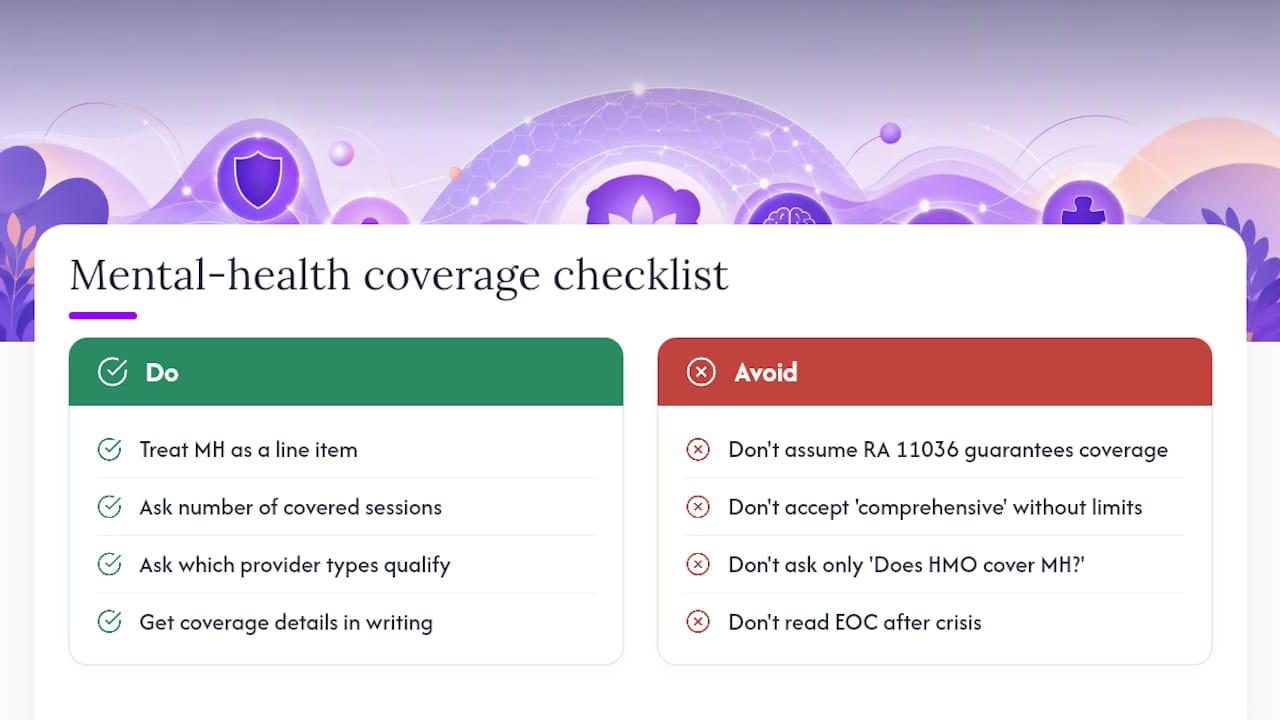
The conventional advice, “check if your HMO covers mental health,” is too vague to be useful. The better question is narrower: does this specific plan cover psychiatrists, psychologists, both, or neither, and what are the exact session limits? HR teams buying group plans should treat mental health coverage the way they’d treat dental or vision, as a line item to specify, not a phrase to assume is bundled in. Employees should read their EOC before they need it, not after a crisis.
If there’s one thing this topic deserves less patience for, it’s insurers and employers alike using “comprehensive mental health benefits” as marketing language while the fine print tells a much narrower story. Ask for the number of covered sessions. Ask which provider types qualify. Get it in writing.
— Eumir
Get Psychiatric Coverage Written Into Your SME’s Group Plan
Some health plan providers offer customizable add-ons on top of standard HMO benefits, allowing employers to request psychiatric and behavioral health coverage explicitly during plan design, rather than hoping it’s bundled into vague “mental health” language.

Coverage for pre-existing and congenital conditions up to the Maximum Benefit Limit is often part of some health plan structures, which may benefit employees with a documented psychiatric diagnosis. Some plans include cashless access to accredited hospitals and clinics, providing a clearer path to psychiatric care compared to generic plans.
To move forward, prepare your current headcount, budget range, and any specific benefits you want written in (session caps, provider types, add-on preferences), then reach out through the Hmoplans homepage or review full plan details on the features page before requesting a quote.
Quick Resources to Check Before You Book
- PhilHealth for inpatient psychiatric and Z-benefit coverage details
- RA 11036 guidance for legal background on mental health integration
- Saya on the App Store or Google Play for teletherapy access
This article is general information, not a substitute for advice from a qualified doctor. Consult a qualified healthcare professional about your own circumstances before acting on anything here.
