

Industry Terminology for Health Plans: Plain-Language Glossary
This guide defines the essential industry terminology for health plans so you can read plan documents, compare coverage options, and avoid common cost surprises. Whether you’re shopping on HealthCare.gov, reviewing an employer plan, or administering benefits for your team, the terms below are the ones that directly affect what you pay and what gets covered. The Affordable Care Act (ACA) standardized many of these definitions so consumers can compare plans on equal footing, and the Centers for Medicare & Medicaid Services (CMS) publishes the official Uniform Glossary as the authoritative reference.
Here are the terms you’ll encounter most often:
- Premium — your monthly payment to keep coverage active
- Deductible — what you pay out of pocket before the plan starts sharing costs
- Copayment (copay) — a fixed dollar amount per visit or service
- Coinsurance — your percentage share of costs after the deductible
- Out-of-pocket maximum — the most you’ll pay in a benefit year before the plan covers 100%
- In-network — providers who have a contract with your plan at negotiated rates
- Out-of-network — providers without a plan contract, usually at higher cost to you
- Balance billing — when an out-of-network provider bills you for the gap between their charge and the plan’s allowed amount
- HMO / PPO / EPO / POS — the four main plan network structures, each with different access and cost rules
- Prior authorization — advance approval from the plan before certain services or drugs are covered
- Formulary — the plan’s approved list of covered prescription drugs
- Summary of Benefits and Coverage (SBC) — the standardized document that shows how all these terms apply to your specific plan
Table of Contents
- What does common health plan terminology actually mean?
- What are the main health plan types and how do they differ?
- How do premium, deductible, and coinsurance work together?
- How do provider networks affect what you pay?
- What do enrollment windows, subsidies, and federal programs mean?
- How do claims, EOBs, and appeals work?
- What do pharmacy and prescription drug terms mean?
- How do you read your SBC and plan documents?
- What are the most common health plan misconceptions?
- Key Takeaways
- Why clear health plan language actually protects your money
- Trusted sources for health plan terminology
What does common health plan terminology actually mean?
The table below gives you a one-line definition for 24 of the most-used terms in U.S. health insurance. Full explanations appear in the sections that follow.
| Term | One-line definition |
|---|---|
| Actuarial value | The percentage of total covered costs a plan pays on average across all enrollees |
| Allowed amount | The maximum a plan will pay for a covered service from an in-network provider |
| Appeal | A formal request to reverse a plan’s denial of a claim or service |
| Balance billing | A bill from an out-of-network provider for the difference between their charge and the plan’s allowed amount |
| Benefit year | The benefit year during which your plan’s deductibles and limits reset |
| CHIP | Children’s Health Insurance Program — public coverage for children in families above Medicaid income limits |
| Coinsurance | Your share of costs (as a percentage) after you meet your deductible |
| COBRA | A federal law letting you continue employer coverage temporarily after leaving a job |
| Copayment | A fixed dollar amount you pay for a specific service, regardless of total cost |
| Deductible | The amount you pay for covered services before the plan begins sharing costs |
| EOB (Explanation of Benefits) | A statement from your insurer showing what was billed, what the plan paid, and what you owe |
| EPO | Exclusive Provider Organization — in-network only, no referrals required |
| Formulary | The plan’s approved list of covered prescription drugs, organized by cost tiers |
| Grievance | A complaint about a plan’s service, quality, or administrative process |
| HMO | Health Maintenance Organization — requires a PCP and referrals; in-network only |
| HSA | Health Savings Account — a tax-advantaged account paired with a high-deductible plan |
| In-network | Providers contracted with your plan at negotiated rates |
| Medicaid | A joint federal-state program providing free or low-cost coverage to eligible low-income individuals |
| Medicare | Federal health coverage primarily for adults 65 and older and certain people with disabilities |
| Out-of-pocket maximum | The most you’ll pay in a benefit year; after this, the plan covers 100% of covered services |
| PCP | Primary Care Provider — your main doctor and, in HMOs, the gatekeeper for specialist referrals |
| POS | Point of Service — an HMO-PPO hybrid allowing some out-of-network access with a referral |
| PPO | Preferred Provider Organization — flexible network access, no referral required |
| Premium | The monthly amount you (and often your employer) pay to maintain coverage |
| Prior authorization | Advance approval from the plan before certain services or drugs will be covered |
| SBC | Summary of Benefits and Coverage — the standardized plan summary you can request to compare plans |
| Step therapy | A protocol requiring you to try lower-cost drugs before the plan will cover a more expensive one |
| Subrogation | The plan’s right to recover payments from a third party after it pays a claim on your behalf |
What are the main health plan types and how do they differ?
Understanding plan types is the fastest way to narrow your options. Each structure makes a different trade-off between cost, access, and administrative requirements.
HMO (Health Maintenance Organization)
An HMO requires you to choose a primary care provider (PCP) who coordinates all your care. You need a referral from your PCP to see a specialist, and coverage is limited to in-network providers except in genuine emergencies. Premiums and out-of-pocket costs tend to be lower than other plan types, but your provider choices are more restricted.

PPO (Preferred Provider Organization)
A PPO gives you the flexibility to see any provider, in-network or out-of-network, without a referral. Out-of-network visits cost more, but the plan still pays a portion. PPOs typically carry higher premiums than HMOs in exchange for that flexibility.
EPO (Exclusive Provider Organization)
An EPO restricts coverage to in-network providers except in emergencies, similar to an HMO. The key difference: EPOs don’t require a PCP or referrals. You can go directly to any in-network specialist, but going out-of-network means paying the full bill yourself.
POS (Point of Service)
A POS plan is a hybrid. Like an HMO, it requires a PCP and referrals. Like a PPO, it allows some out-of-network access, though at a higher cost-sharing level. POS plans suit people who want a safety net for out-of-network care but are willing to work within a gatekeeper system most of the time.
HDHP (High-Deductible Health Plan)
An HDHP pairs a higher deductible with lower premiums. The IRS sets minimum deductible thresholds each year for a plan to qualify as an HDHP. The main advantage: HDHPs are the only plans that make you eligible to open a Health Savings Account (HSA), which lets you set aside pre-tax dollars for qualified medical expenses.
Catastrophic plan
Catastrophic plans are available to adults under 30 and certain people who qualify for a hardship exemption. They carry very low premiums but very high deductibles. The plan covers three primary care visits per year before the deductible, plus preventive services, but essentially functions as protection against worst-case medical events.
Conventional indemnity plan
An indemnity plan (also called a fee-for-service plan) lets you see any provider with no network restrictions. The plan reimburses a set percentage of the bill. These plans are rare today but still appear in some employer benefit packages.
Plan type comparison at a glance:
| Feature | HMO | PPO | EPO | POS | HDHP |
|---|---|---|---|---|---|
| Network flexibility | In-network only | In- and out-of-network | In-network only | In- and out-of-network | Varies by carrier |
| Referral required | Yes (PCP gatekeeper) | No | No | Yes (PCP gatekeeper) | No |
| Typical premium | Lower | Higher | Moderate | Moderate | Lower |
| Out-of-network coverage | Emergency only | Yes, at higher cost | Emergency only | Yes, at higher cost | Varies |
| HSA eligible | Generally no | No | No | No | Yes |
| Best fit | Cost-conscious, local care | Frequent travelers, specialists | Direct specialist access | Flexibility with some structure | Healthy, low utilizers |
Pro Tip: If you regularly see specialists or travel frequently for work, a PPO’s out-of-network flexibility is worth the higher premium. If your care is local and predictable, an HMO’s lower costs usually win. The single most important question to ask before enrolling: does your current specialist participate in this plan’s network?
How do premium, deductible, and coinsurance work together?
Cost-sharing is where most people get surprised. Here’s how the main terms interact during a single benefit year.
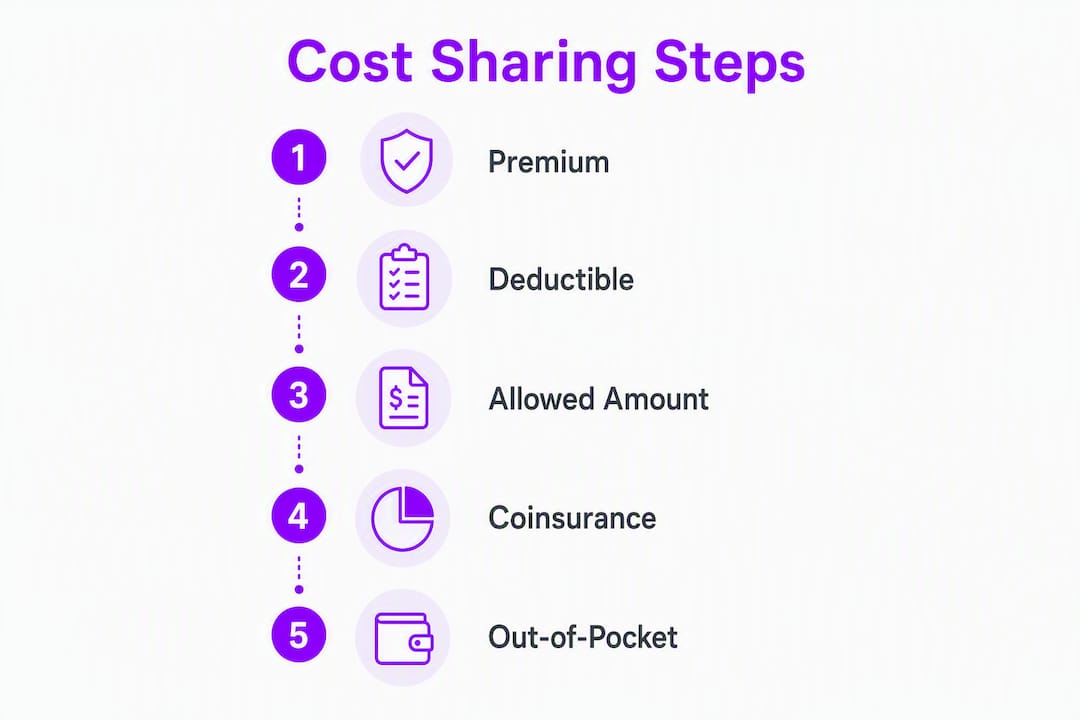
Premium is what you pay every month to keep your plan active, regardless of whether you use any medical services. In group plans, premiums are commonly split between employer and employee.
Deductible is the amount you pay out of pocket for covered services before the plan starts contributing. Under the ACA, preventive services are generally exempt from the deductible, meaning the plan covers them at no cost to you even if you haven’t met your deductible yet.
Allowed amount is the maximum your plan will pay for a specific service from an in-network provider. If a provider charges more than the allowed amount and is out-of-network, you may owe the difference.
Coinsurance is your percentage share of costs after the deductible. A plan with 20% coinsurance means the plan pays 80% and you pay 20% of the allowed amount for covered services.
Out-of-pocket maximum is the ceiling on what you’ll pay in a benefit year. Once you hit it, the plan covers 100% of covered in-network services for the rest of the year.
A short worked example: Say your plan has a deductible, coinsurance, and an out-of-pocket maximum. You have a procedure with an allowed amount of $3,000. You pay the first $1,500 (your deductible). The remaining $1,500 is subject to coinsurance: you pay 20%, which is $300. Your total for that claim is $1,800. Both the $1,500 deductible and the $300 coinsurance count toward your $5,000 out-of-pocket maximum.
Balance billing warning: When you use an out-of-network provider, the provider can bill you for the difference between their full charge and the plan’s allowed amount — a practice called balance billing. In-network providers have agreed to accept the allowed amount as payment in full and generally cannot balance bill you for covered services. Balance billing is one of the fastest ways to exceed your expected out-of-pocket spending, and it does not count toward your in-network out-of-pocket maximum in most plans.
The No Surprises Act, which took effect in 2022, provides federal protections against certain surprise bills from out-of-network providers at in-network facilities, but protections vary by situation. Always verify a provider’s network status before elective care.
How do provider networks affect what you pay?
Your plan’s network determines which providers you can see at the plan’s negotiated rates. The difference between in-network and out-of-network care can mean hundreds or thousands of dollars on a single claim.
Key network terms:
- In-network provider — a doctor, hospital, or facility that has a contract with your plan. You pay the negotiated rate, and cost-sharing applies at the plan’s standard level.
- Out-of-network provider — a provider without a plan contract. You typically pay more, and balance billing risk applies.
- Provider directory — the plan’s searchable list of in-network providers. Directories can be outdated, so always confirm directly with the provider.
- Preferred provider — in some PPO plans, a subset of in-network providers who meet additional quality or cost criteria and carry even lower cost-sharing.
- PCP (Primary Care Provider) — your main doctor for routine care. In HMOs and POS plans, the PCP acts as a gatekeeper: you need a referral from your PCP before the plan will cover specialist visits.
- Specialist — a physician with advanced training in a specific area (cardiology, orthopedics, etc.). In gatekeeper plans, knowing whether your plan uses a PCP referral system is critical for managing specialist access.
- Narrow network — a plan with a smaller, more selective provider list, often used to keep premiums lower. The trade-off is less choice.
- Tiered network — a network where providers are grouped into cost tiers; seeing a Tier 1 provider costs less than a Tier 2 or Tier 3 provider.
- Hospitalist — a physician who specializes in inpatient hospital care. You may not choose your hospitalist, and they may be out-of-network even at an in-network hospital.
- Urgent care center — a facility for non-emergency conditions that need prompt attention. Urgent care is typically cheaper than an ER visit and is usually in-network, but confirm before you go.
How to confirm a provider’s network status:
- Check the plan’s online provider directory using the provider’s NPI (National Provider Identifier) number for the most accurate result.
- Call the provider’s billing office directly and ask: “Do you participate in [plan name] as of today?” Get the representative’s name and the date.
- Call the number on the back of your insurance card and ask the insurer to confirm the provider’s status for your specific plan (not just the insurer’s broader network).
- After a visit, review your Explanation of Benefits (EOB) to confirm the claim was processed at in-network rates. If it wasn’t, contact your insurer immediately.
- For hospital-based care, ask the hospital which employed physicians (anesthesiologists, radiologists, pathologists) are in-network — these are common sources of surprise out-of-network bills.
What do enrollment windows, subsidies, and federal programs mean?
Enrollment timing and program eligibility directly affect whether you have coverage and what it costs. Missing a window can leave you uninsured for months.
Open enrollment is the annual period when you can enroll in, change, or drop a health plan. For Marketplace plans, the federal open enrollment window typically runs from November 1 through January 15, with coverage starting February 1 for enrollments completed by December 15 (January 1 start). Employer plan open enrollment dates vary by company. Check HealthCare.gov or your HR department for your specific dates.
Special Enrollment Period (SEP) is a window outside open enrollment triggered by a qualifying life event: losing job-based coverage, getting married, having a baby, or moving to a new coverage area. You typically have 60 days from the qualifying event to enroll.
Advance Premium Tax Credit (APTC) is a federal subsidy available through the Marketplace that reduces your monthly premium based on your estimated household income and family size. The credit is calculated against the benchmark Silver plan in your area. If your actual income differs from your estimate, you reconcile the difference when you file your federal tax return.
Employer-sponsored enrollment is the process of signing up for group coverage through your job. Premiums in group plans are often partially paid by the employer, and enrollment typically happens during a set window each year or when you first become eligible.
COBRA (Consolidated Omnibus Budget Reconciliation Act) lets you continue your employer’s group health coverage for a limited time after leaving a job, losing eligibility, or experiencing another qualifying event. You pay the full premium, including the portion your employer previously covered, plus an administrative fee. COBRA coverage is typically available for up to 18 months.
Medicare is the federal health insurance program primarily for adults 65 and older, and for certain younger people with disabilities or end-stage renal disease. It is administered by CMS and divided into parts: Part A (hospital), Part B (medical), Part C (Medicare Advantage), and Part D (prescription drugs).
Medicaid is a joint federal-state program providing free or low-cost coverage to eligible low-income individuals and families. Eligibility rules and benefits vary by state.
CHIP (Children’s Health Insurance Program) covers children in families whose income is too high for Medicaid but who cannot afford private coverage. Some states also extend CHIP to pregnant women.
Marketplace metal levels indicate how costs are split between you and the plan on average across all enrollees (actuarial value):
| Metal level | Actuarial value (approx.) | What it means in practice |
|---|---|---|
| Bronze | ~60% | Plan pays ~60% of covered costs; you pay ~40%. Lowest premiums, highest cost-sharing. |
| Silver | About 70% | Plan pays About 70%. Mid-range premiums; only level eligible for cost-sharing reductions (CSRs). |
| Gold | ~80% | Plan pays ~80%. Higher premiums, lower out-of-pocket costs per service. |
| Platinum | About 90% | Plan pays About 90%. Highest premiums, lowest cost-sharing. Best for high utilizers. |
Metal level percentages are sourced from California DOI and reflect federal actuarial value standards.
Enrollment timing matters: Missing open enrollment without a qualifying SEP event means you may go without coverage until the next open enrollment period. If you’re between jobs, COBRA or a Marketplace SEP enrollment can bridge the gap. Always confirm your coverage start date in writing before assuming you’re covered.
How do claims, EOBs, and appeals work?
A claim is a formal request you or your provider submits to the insurer asking for payment for a covered service. Most providers submit claims directly, but you may need to file your own for out-of-network reimbursements.
Key terms in the claims process:
- Explanation of Benefits (EOB) — a statement from your insurer (not a bill) that shows the billed amount, the allowed amount, what the plan paid, any adjustments, and your patient responsibility. Review every EOB against your actual bill.
- Coordination of Benefits (COB) — the process for determining which plan pays first when you’re covered by more than one health plan. The “primary” plan pays first; the “secondary” plan may cover some or all of the remainder.
- Subrogation — the plan’s legal right to recover money it paid on your behalf from a third party (for example, after a car accident where another driver is liable).
- Grievance — a formal complaint about the plan’s service, quality of care, or administrative process (distinct from an appeal, which challenges a coverage denial).
- Appeal — a formal request to reverse a plan’s denial of a claim, service, or prior authorization. You have the right to an internal appeal and, if that fails, an external review by an independent organization.
Key EOB line items to scan:
- Billed amount (what the provider charged)
- Allowed amount (what the plan agreed to pay)
- Plan paid (what the insurer actually paid)
- Patient responsibility (what you owe after plan payment and adjustments)
- Adjustment reason codes (why any portion was denied or reduced)
- Claim status (paid, pending, denied)
How to file an internal appeal and request external review:
- Request a written denial notice from your insurer. It must state the reason for denial and cite the specific plan provision used.
- Gather supporting documentation: your physician’s letter of medical necessity, relevant clinical records, and the plan’s own coverage criteria.
- Submit your internal appeal in writing within the plan’s deadline (typically 180 days from the denial notice for non-urgent claims).
- The plan must respond to an urgent care appeal within 72 hours and a standard appeal within 30 days for pre-service denials or 60 days for post-service denials.
- If the internal appeal is denied, request an external review. An independent review organization (IRO) will evaluate the case, and the plan must comply with the IRO’s decision.
- Keep copies of all correspondence, including dates, representative names, and reference numbers.
What do pharmacy and prescription drug terms mean?
Prescription drug costs are one of the most variable parts of a health plan, and the terminology directly affects what you pay at the pharmacy counter.
Formulary is the plan’s approved list of covered drugs. If your medication isn’t on the formulary, the plan may not cover it at all, or you may need to request an exception.
Drug tiers organize formulary drugs by cost. A typical structure looks like this: Tier 1 covers generic drugs at the lowest copay; Tier 2 covers preferred brand-name drugs at a moderate copay; Tier 3 covers non-preferred brands at a higher copay; Tier 4 or specialty tier covers high-cost specialty drugs, often with coinsurance rather than a flat copay.
Generic vs. brand vs. specialty drugs: A generic drug contains the same active ingredient as its brand-name counterpart and is typically far less expensive. A brand-name drug is the original manufacturer’s version. A specialty drug is a high-cost medication, often for complex conditions like rheumatoid arthritis or multiple sclerosis, that may require special handling or administration.
Prior authorization for drugs requires you or your prescriber to get advance approval before the plan will cover a specific medication. The plan reviews whether the drug is medically necessary and whether you’ve tried alternatives first.
Step therapy is a protocol that requires you to try a lower-cost drug (usually a generic or preferred brand) before the plan will approve coverage for a more expensive alternative. If the first-line drug fails or causes adverse effects, your doctor can document that and request the next step.
How to request prior authorization: Your prescribing physician typically initiates the prior authorization request by submitting clinical documentation to the insurer. If the request is denied, both you and your physician have the right to appeal. Ask your doctor’s office to submit a peer-to-peer review request, where your physician speaks directly with the plan’s medical reviewer. This step alone reverses a significant share of initial drug denials. If the appeal fails, ask your physician about a formulary exception or a manufacturer patient assistance program.
How do you read your SBC and plan documents?
The Summary of Benefits and Coverage (SBC) is the standardized, plan-specific document every insurer must provide. It’s your fastest tool for comparing plans and understanding exactly how terms like deductible and coinsurance apply to your policy. Always request it before enrolling.
What to scan on your SBC:
- Deductible — confirm the amount for in-network and out-of-network separately; family deductibles work differently from individual ones
- Out-of-pocket maximum — verify the cap for in-network services and whether out-of-network costs count toward it
- Copays and coinsurance by service type — check the specific amounts for primary care, specialist visits, urgent care, ER, and inpatient stays
- Prior authorization requirements — the SBC lists which services require advance approval; missing this step can result in a denied claim
- Drug formulary reference — the SBC points you to the plan’s formulary; pull the actual formulary document to check your specific medications
- Coverage examples — the SBC includes two standardized cost scenarios (having a baby, managing a chronic condition) that let you compare total estimated costs across plans
Questions to ask your plan administrator or HR:
- “Can you send me the full Evidence of Coverage or plan document, not just the SBC?”
- “Which services require prior authorization, and how do I request it?”
- “Is my current PCP and specialist in-network under this specific plan?”
- “Does the out-of-pocket maximum include prescription drug costs?”
- “What is the process for out-of-network reimbursement if I need emergency care?”
The SBC is a standardized summary, not the full legal contract. The plan’s Evidence of Coverage or policy document governs in any dispute. Always request the full policy document for definitive details on exclusions, limitations, and appeals procedures. For SME HR teams managing group plans, Hmoplans has a dedicated HMO terms glossary for HR teams that walks through how these concepts apply in a group plan context.
What are the most common health plan misconceptions?
Knowing the terminology is half the battle. The other half is knowing where common assumptions go wrong.
The most expensive misconception in health insurance: “I have insurance, so I’m covered.” Coverage is conditional. It depends on network status, prior authorization, formulary placement, and whether you’ve met your deductible. Each of those conditions can turn a covered service into an out-of-pocket expense if you don’t verify them in advance.
Myth vs. fact:
- Myth: Paying my premium means my plan covers everything. Fact: Your premium keeps the plan active. Deductibles, copays, coinsurance, and exclusions still apply to most services.
- Myth: In-network means no surprise bills. Fact: In-network facilities can employ out-of-network physicians (anesthesiologists, radiologists). Always ask about all providers involved in a procedure.
- Myth: Prior authorization means the claim will be paid. Fact: Prior authorization is an administrative check of medical necessity, not a guarantee of payment. Billing errors or eligibility issues can still result in a denial.
- Myth: The out-of-pocket maximum covers all my medical costs. Fact: Premiums, balance billing from out-of-network providers, and non-covered services don’t count toward your out-of-pocket maximum.
- Myth: Generic drugs are always covered at the lowest tier. Fact: Some generics are placed on higher tiers by specific plans. Always check your plan’s formulary for your exact medication.
- Myth: COBRA is free after losing a job. Fact: COBRA lets you keep your coverage, but you pay the full premium, including the portion your employer previously covered, plus an administrative fee.
Red-flag checklist before enrolling or using care:
- Narrow network with no out-of-network emergency exception clearly stated
- Vague or broad prior authorization requirements with no defined timeline for approval
- Out-of-network reimbursement language that sounds generous but caps the allowed amount at a very low percentage of billed charges
- No clear formulary or a formulary that changes mid-year without notice
- High out-of-pocket maximum that applies separately to medical and pharmacy costs
Before any non-emergency procedure, verify three things:
- The facility is in-network.
- Every physician involved (surgeon, anesthesiologist, assistant) is in-network.
- Prior authorization has been obtained and confirmed in writing.
For a deeper look at how emergency care rules interact with network requirements, Hmoplans covers the specifics in their guide on emergency care and HMO coverage.
Key Takeaways
Understanding health plan terminology is the foundation for making smarter coverage decisions, avoiding surprise costs, and using your benefits effectively throughout the year.
| Point | Details |
|---|---|
| Read your SBC first | The Summary of Benefits and Coverage shows exactly how deductibles, coinsurance, and limits apply to your specific plan. |
| Verify network status before care | Always confirm your provider is in-network directly with both the provider and the insurer before any elective service. |
| Know your deductible and out-of-pocket max | These two figures determine the most you’ll pay in a benefit year and how costs accumulate across claims. |
| Watch for balance billing | Out-of-network providers can bill you beyond the plan’s allowed amount; this does not count toward your in-network out-of-pocket maximum. |
| Prior authorization is not a payment guarantee | Approval confirms medical necessity review only; billing errors or eligibility issues can still result in a denied claim. |
Why clear health plan language actually protects your money
Plain language in health insurance isn’t a nicety. It’s a financial safeguard. The gap between what a term sounds like and what it legally means in a plan document is where most unexpected medical bills originate. A deductible that “resets annually” sounds simple until you realize your benefit year runs July to June, not January to December. “Covered service” sounds reassuring until you discover your plan requires prior authorization for that specific procedure.
The ACA’s standardized glossary was a genuine step forward. Before it, insurers used different definitions for the same terms, making plan comparison nearly impossible. Today, terms like deductible, coinsurance, and out-of-pocket maximum carry consistent federal definitions, and the SBC format means you can place two plans side by side and compare them on equal terms. That standardization matters most when you’re under pressure, sitting in a doctor’s office or reviewing a bill you didn’t expect.
For HR teams and SME decision makers, the stakes are even higher. You’re not just managing your own coverage; you’re responsible for your employees understanding theirs. A well-structured group plan with clear documentation reduces confusion, supports better utilization, and builds trust with your team. Hmoplans is built around exactly that principle: straightforward coverage with terms your employees can actually act on. If you’re evaluating group health options for your business, explore the accredited providers and SME plan details to see how coverage can be structured for your team’s needs.
This article provides general information about U.S. health insurance terminology and is not professional insurance, legal, or financial advice. Confirm current rules, eligibility, and plan specifics with your insurer, employer, or a licensed benefits professional.
Trusted sources for health plan terminology
The references below are the authoritative starting points for U.S. health insurance definitions, enrollment rules, and plan documents.
| Source | What it’s useful for |
|---|---|
| CMS Uniform Glossary of Health Coverage and Medical Terms | The federal standard definitions for all ACA-required terms; the baseline for comparing any plan |
| HealthCare.gov Glossary | Plain-language definitions tied directly to Marketplace enrollment and plan comparison |
| CMS SBC Resources and Guidance | How to request and read your Summary of Benefits and Coverage |
| DOL SBC Uniform Glossary | Department of Labor version of the uniform glossary, useful for employer plan administrators |
| AHRQ MEPS Insurance Component Glossary | Research-grade definitions used in federal health expenditure surveys |
| BLS Glossary for Health Plan Provisions | Definitions specific to employer-sponsored plans and private industry benefit surveys |
| CDC NHIS Insurance Glossary | Insurance terms as used in the National Health Interview Survey, including Marketplace definitions |
| U.S. Census Bureau Health Insurance Glossary | Broad classification of private and public coverage types |
| California DOI Health Insurance Terms | State-level glossary with metal level definitions and managed-care regulatory context |
| Texas Department of Insurance Health Insurance Glossary | State-level definitions including EPO and HMO network mechanics |
For SME-focused health plan guidance, Hmoplans publishes practical resources on SME health insurance terms and key concepts to help business owners and HR teams navigate group coverage decisions with confidence.
