

HMO Terms Glossary: A Guide for Philippine HR Teams
TL;DR:
- An HMO is a managed care plan that provides health services through a network of providers for a fixed monthly fee. Mastering key terms like PCP, referral, and MBL is essential for HR professionals to manage benefits effectively. Different HMO models impact coverage and costs, with clear understanding of these concepts improving employee experience and benefits administration.
An HMO, or Health Maintenance Organization, is a managed care plan that provides health services through a defined network of providers in exchange for a fixed monthly premium. For HR professionals and business owners in the Philippines, mastering this industry glossary of HMO terms is not optional. It is the foundation of every benefits decision you make. From choosing between plan structures to explaining coverage limits to employees, the vocabulary shapes outcomes. The Affordable Care Act mandates a standardized glossary including terms like “deductible” and “co-payment” to improve transparency. That same principle applies here.
What are the essential HMO terms every HR manager should know?
HMO terminology forms the working language of employee health benefits. Every HR manager needs to command these definitions before negotiating a plan or onboarding employees.
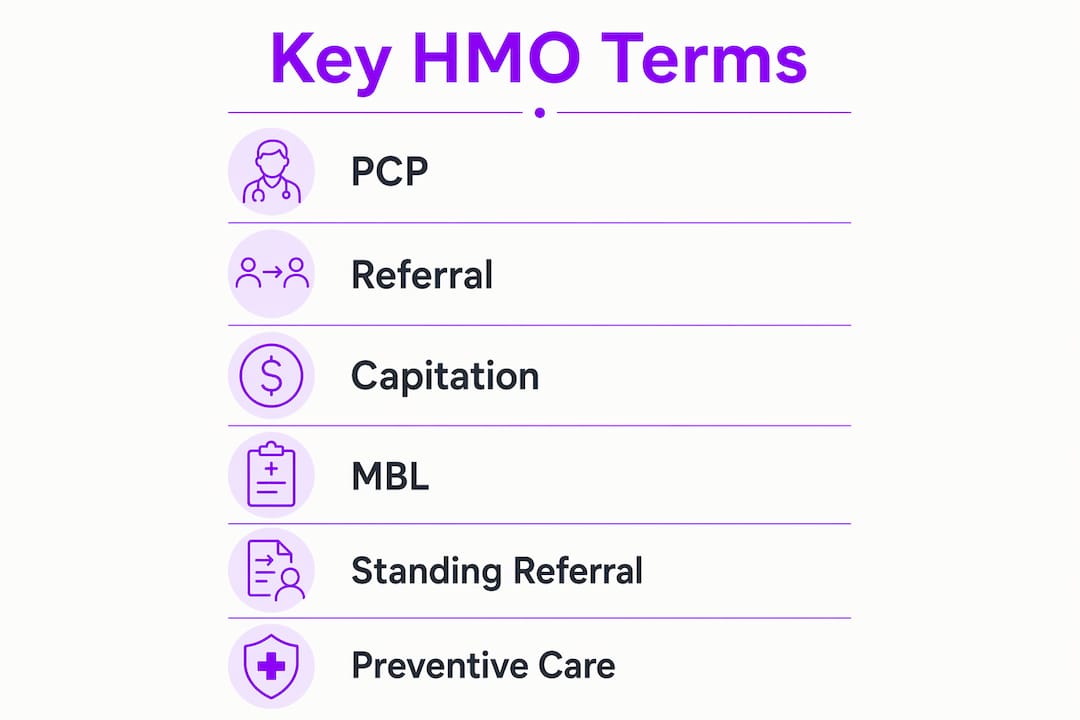
Primary Care Physician (PCP) is the gatekeeper of care inside an HMO. The PCP manages an employee’s overall health, coordinates referrals to specialists, and maintains a complete record of medical history, medications, and lifestyle factors. Coordinated care via PCPs produces predictable costs and better health outcomes. That predictability is exactly what Philippine SMEs need when budgeting for annual health benefits.

Referral is the formal authorization a PCP issues before an employee can see a specialist. Without it, the HMO typically will not cover the specialist’s fees. PCP referrals are processed within a few business days in most plans. HR teams should factor that processing window into absence management and return-to-work timelines.
Here are the core cost terms every HR manager must know:
- Premium: The fixed monthly amount your company pays to keep employees enrolled in the HMO plan.
- Deductible: The amount an employee pays out of pocket before the HMO begins covering certain services.
- Copayment (copay): A flat fee the employee pays at the time of a visit, such as a fixed amount per outpatient consultation.
- Maximum Benefit Limit (MBL): The ceiling on total coverage per employee per year. Once reached, the employee pays remaining costs.
- In-network provider: A hospital, clinic, or doctor accredited by the HMO. Visits here are covered under the plan.
- Out-of-network provider: A provider outside the accredited list. Most HMOs do not cover these visits except in emergencies.
Pro Tip: When onboarding new employees, distribute a one-page glossary of these six terms. Employees who understand their copay and MBL file fewer confused claims and generate fewer HR support tickets.
How do different HMO models affect coverage and cost?
Four HMO model types exist, and each one affects how employees access care and how much the plan costs your company.
| HMO Model | How it works | Provider flexibility | Cost level |
|---|---|---|---|
| Staff model | Providers are employed directly by the HMO | Very low | Lowest |
| Group model | HMO contracts with a physician group | Low | Low to moderate |
| Network model | HMO contracts with multiple physician groups | Moderate | Moderate |
| Independent Practice Association (IPA) | HMO contracts with individual private practice doctors | Highest among HMO types | Moderate to higher |
The staff model delivers the tightest cost control because the HMO employs its own doctors. The IPA model offers the widest provider choice but introduces more variability in care coordination. Philippine HMO providers typically operate closer to the network or IPA model, which is why accredited provider lists matter so much.
All four models share one financial mechanism: capitated payment. Under this system, providers receive a fixed amount per enrolled member per month, regardless of how many services that member uses. Capitation incentivizes prevention over treatment. It also explains why HMOs push annual physical exams and wellness programs.
The cost difference between HMO and non-HMO plans is real. Silver-tier HMO plans average $674 per month in the U.S. market, significantly less than comparable PPO plans. The Philippine market reflects a similar pattern. HMOs cost less because the network is limited. That trade-off is the central design principle of every HMO plan.
Pro Tip: When comparing plans for your SME, ask each provider which model type they use. A network or IPA model gives your employees more provider options, which reduces complaints about access while still controlling costs.
What managed care concepts affect employee experience and HR administration?
Managed care is the broader system that HMOs operate within. Several concepts inside this system directly affect how employees experience their benefits and how much administrative work lands on HR.
Referral management and standing referrals
The referral process is the most common source of employee frustration in HMO plans. An employee needs to see a cardiologist, but the appointment cannot be booked until the PCP issues a referral, and the referral takes two to three business days. HR can reduce this friction by educating employees to request referrals before symptoms become urgent.
Standing referrals solve the repeat-visit problem. For employees managing chronic conditions or ongoing physical therapy, a standing referral covers multiple visits without requiring a new authorization each time. HR should proactively request standing referrals for employees with known long-term conditions.
Preventive care and its business value
HMOs place a strong emphasis on preventive care because the capitated payment model rewards keeping members healthy. Annual physical exams, vaccinations, and screenings are typically covered at no additional cost to the employee. For employers, this translates directly into fewer sick days and lower claims over time.
Emergency care coverage
HMOs generally do not cover out-of-network care, but emergency situations are a legal exception. If an employee has a medical emergency and the nearest facility is outside the network, the HMO must cover that care. HR teams should communicate this clearly during onboarding. Employees who do not know this rule may delay seeking emergency care out of fear of the bill.
Here is a practical checklist for HR when communicating managed care concepts to employees:
- Explain the PCP’s role as the first point of contact for all non-emergency health needs.
- Describe how to request a referral and how long it takes.
- Confirm which hospitals and clinics are in-network before employees need them.
- Clarify that emergency care is covered even outside the network.
- Communicate the MBL so employees can plan for high-cost health events.
What common HMO misunderstandings should HR watch out for?
HR teams that assume employees understand their HMO plan create avoidable problems. Several recurring misunderstandings generate claim disputes, employee dissatisfaction, and administrative delays.
- Outdated provider directories: Provider networks change frequently without insurer notification. An employee who visits a doctor listed in the directory may discover that doctor is no longer accredited. The claim gets denied. HR should advise employees to call the provider directly before any appointment to confirm current network status.
- Referral confusion: Employees often assume a PCP visit automatically triggers a specialist referral. It does not. The employee must specifically request the referral and wait for it to be processed.
- Emergency coverage gaps: Employees frequently believe that any out-of-network visit will be denied. Emergency care is legally protected. HR should correct this misconception explicitly.
- MBL misunderstanding: Employees with serious illnesses sometimes exhaust their MBL mid-year without realizing it. HR should flag high-utilization cases early and help employees understand their remaining coverage.
- PhilHealth interaction: In the Philippines, HMO plans supplement PhilHealth coverage. Employees sometimes expect the HMO to cover everything PhilHealth covers and more, without understanding that the two systems interact differently depending on the plan.
Pro Tip: Run a short annual benefits briefing, ideally in january or february before the plan year is fully underway. Cover the five points above. Employees who understand their plan file better claims and escalate fewer issues to HR.
For a deeper look at HMO basics for new HR managers, the foundational concepts apply across all plan types and company sizes.
Key takeaways
Mastering HMO terminology gives HR managers and business owners the vocabulary to select better plans, communicate benefits clearly, and prevent the claim disputes that erode employee trust.
| Point | Details |
|---|---|
| PCP is the care coordinator | The Primary Care Physician manages referrals, history, and cost control for every enrolled employee. |
| Capitation drives prevention | Providers receive fixed payments per member, which incentivizes wellness programs and annual exams. |
| Standing referrals reduce friction | Employees with chronic conditions should receive standing referrals to avoid repeated authorization delays. |
| Verify network status directly | Provider directories go out of date. Always confirm accreditation by calling the provider before appointments. |
| Emergency care is always covered | Out-of-network emergency care is legally protected. Employees must know this to seek care without hesitation. |
Why glossary fluency changes how you manage benefits
I have worked with Philippine SMEs across tech, hospitality, and healthcare, and the pattern is consistent. The HR managers who struggle most with HMO administration are not the ones with bad plans. They are the ones who never fully learned the vocabulary.
When you do not know what an MBL is, you cannot explain to an employee why their claim was partially denied. When you do not understand capitation, you cannot evaluate whether your provider is genuinely incentivized to keep your team healthy. The terminology is not bureaucratic noise. It is the operating logic of the entire system.
The most underused tool I see in Philippine SME HR is the standing referral. Employees with diabetes, hypertension, or recurring musculoskeletal issues spend weeks waiting for new referrals every time they need a follow-up. A single conversation with the HMO provider to set up standing referrals eliminates that delay entirely. That one change improves employee experience more than most policy rewrites.
Glossary fluency also makes you a better buyer. When you can read a plan document and immediately identify the MBL, the copay structure, and the network model, you negotiate from a position of knowledge. That knowledge saves your company money and your employees frustration.
— Eumir
How Hmoplans makes HMO terms work for Philippine SMEs
Hmoplans, powered by Purple Cow with Etiqa as the insurance underwriter, builds its plans around one principle: no complicated terms, no hidden limits. For Philippine SMEs that want clear HMO coverage, the platform offers cashless access to accredited hospitals including the Big 9 Hospitals and Healthway Clinics, 24/7 nationwide coverage, and 100% coverage for pre-existing and congenital conditions up to the Maximum Benefit Limit.
HR managers can explore plan features including optional dental HMO, annual physical exams, and life and accident insurance add-ons. Hmoplans also offers member services support to help employees navigate referrals, verify providers, and understand their coverage without calling HR every time. If your SME needs a plan that matches the clarity this glossary provides, Hmoplans is the direct next step.
FAQ
What does PCP mean in an HMO plan?
PCP stands for Primary Care Physician. The PCP is the first doctor an employee sees for most health concerns and the one who issues referrals to specialists.
What is the Maximum Benefit Limit in an HMO?
The Maximum Benefit Limit (MBL) is the total amount the HMO will pay for an employee’s healthcare in a given year. Once that limit is reached, the employee covers remaining costs out of pocket.
Are out-of-network providers ever covered under an HMO?
HMOs do not cover out-of-network care in standard situations, but emergency care outside the network is legally protected and must be honored by the plan.
What is a standing referral and who benefits from it?
A standing referral is an ongoing authorization that covers multiple specialist visits without requiring a new PCP referral each time. Employees managing chronic conditions like diabetes or requiring regular physical therapy benefit most from this arrangement.
How does an HMO differ from PhilHealth in the Philippines?
PhilHealth is the government-mandated social health insurance program in the Philippines. An HMO plan supplements PhilHealth by covering costs and services that PhilHealth does not fully fund, including private hospital rooms, specialist access, and outpatient consultations.
