

Occupational Hazards and HMO Coverage for Philippine Employers
TL;DR:
- Philippine employers must fulfill statutory obligations for occupational hazards through ECC and PhilHealth contributions. HMO plans offer additional healthcare coverage but cannot replace ECC for work-related injuries. Proper administration of HMO benefits includes timely remittance, employee authorization, and compliance to minimize legal risks.
Occupational hazards are defined as workplace dangers that can cause injury, illness, disability, or death, requiring mandatory coverage through the Employees’ Compensation Commission (ECC) and PhilHealth, supplemented by HMO health plans. Philippine employers must understand the legal distinction between these statutory obligations and voluntary HMO benefits to protect workers and stay compliant. Getting this wrong exposes your business to labor complaints, financial penalties, and coverage gaps that leave employees without support when they need it most. This guide clarifies the full picture of occupational hazards and HMO coverage so you can manage both without confusion.
What occupational hazards must Philippine employers address?
Occupational hazards are workplace risks that fall into five recognized categories: physical, chemical, biological, ergonomic, and psychosocial. Physical hazards include noise, heat, and machinery. Chemical hazards cover exposure to solvents, dust, and fumes. Biological hazards affect healthcare and food workers exposed to pathogens. Ergonomic hazards cause musculoskeletal strain from repetitive tasks or poor workstation design. Psychosocial hazards, such as chronic stress and workplace violence, are increasingly recognized in Philippine labor discussions.

Philippine law mandates that every private-sector employer maintain active ECC coverage for all employees. The ECC monthly contribution ranges from ₱10 to ₱30 depending on the employee’s monthly salary credit. This contribution funds compensation for work-related injury, illness, disability, or death. No HMO plan replaces this obligation.
PhilHealth runs parallel to ECC as a second statutory layer. The PhilHealth premium rate is 5% of basic monthly salary, split equally between employer and employee under Republic Act 11223, the Universal Health Care Act, and is capped between ₱500 and ₱5,000 per month. PhilHealth covers hospitalization and certain outpatient procedures regardless of whether the cause is work-related. Together, ECC and PhilHealth form the statutory floor that every employer must maintain.
Common hazards across Philippine industries
- Manufacturing and construction: machinery injuries, chemical burns, and heat stress
- Healthcare: biological exposure, needle-stick injuries, and high psychosocial load
- Business process outsourcing (BPO): ergonomic strain, night-shift disruption, and stress-related illness
- Food and hospitality: burns, slips, and biological contamination
- Retail and logistics: repetitive strain, heavy lifting, and road accident risk
Each of these risk profiles affects how you should structure your supplemental benefits alongside statutory coverage.
How does HMO coverage complement statutory protections?
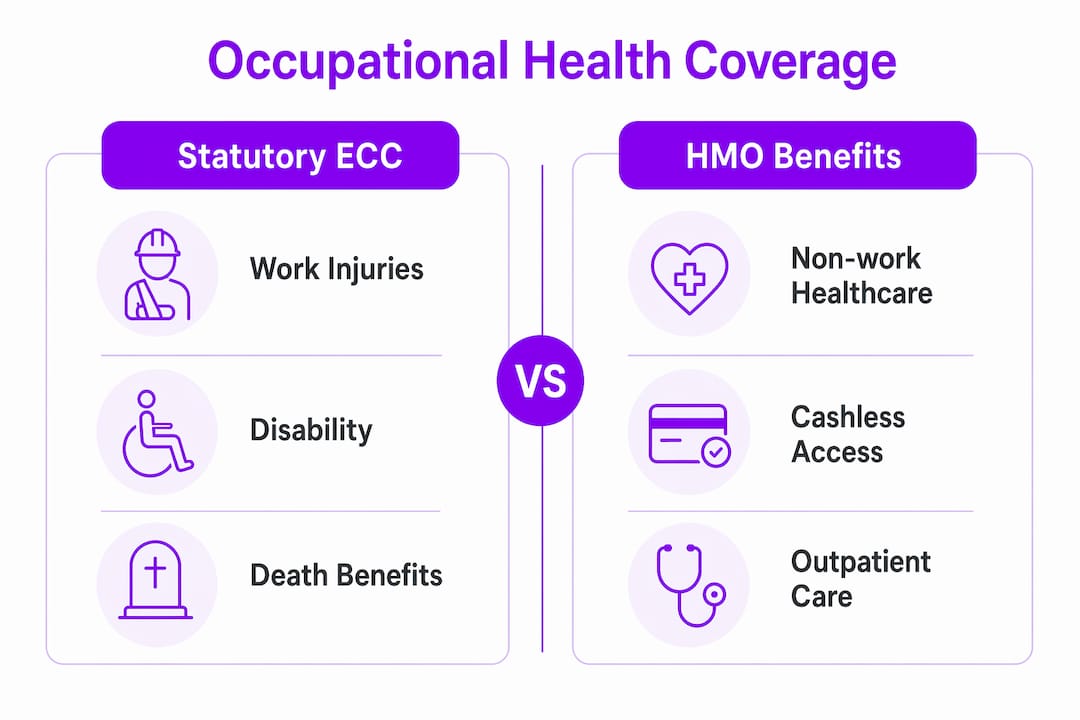
An HMO plan is a voluntary, contractual benefit that employers offer on top of ECC and PhilHealth. It is not required by law, but once established as company practice, it carries legal weight. The distinction between statutory and contractual benefits is critical: ECC and PhilHealth are government-mandated, while HMO coverage is a private arrangement between the employer, the HMO provider, and the employee.
HMO plans cover a much broader range of healthcare needs than ECC alone. Standard corporate HMO benefits include outpatient consultations, inpatient hospitalization, emergency care, laboratory tests, and specialist referrals. Corporate HMO plans typically cover pre-existing conditions from day one of employment by pooling risk across the entire workforce, unlike individual plans that impose 6–24 month waiting periods. That day-one coverage is a significant advantage for employees with chronic conditions.
HMOs also provide cashless, network-based healthcare access that removes the financial barrier of upfront payment at accredited hospitals and clinics. Coverage depends on hospital accreditation status, letter of authorization approval, benefit limits, and plan inclusions. Employees get faster care because they do not need to pay out of pocket and seek reimbursement later.
The key limitation: HMOs generally exclude or limit coverage for work-related injuries. Those claims belong to ECC. Treating an HMO as a substitute for ECC is a compliance error that exposes your company to liability. You can learn more about how HMOs support SME benefits and where they fit within a complete coverage structure.
Pro Tip: Review your HMO plan’s exclusion list specifically for work-related injury language. If the exclusion is broad, confirm that your ECC contributions are current and that employees know to file ECC claims for workplace accidents, not HMO claims.
What HMO plans typically include for corporate groups
- Day-one coverage for pre-existing conditions in group plans
- Cashless access to accredited hospitals and clinics
- Inpatient room and board, surgery, and intensive care
- Outpatient consultations, diagnostics, and pharmacy benefits
- Emergency care, including accidents not classified as work-related
- Optional add-ons: dental, annual physical exams, and life and accident insurance
What employers must know about HMO administration and legal compliance
Managing HMO benefits correctly requires more than selecting a plan. The legal obligations around deductions, remittances, and benefit changes are specific and enforceable. Deducting HMO premiums from employee wages without remitting payment to the HMO provider violates labor laws and can trigger civil and criminal liability. This is one of the most common and costly HR errors in Philippine SMEs.
- Remit premiums on time. Every peso deducted from an employee’s salary for HMO coverage must reach the HMO provider. Delays or shortfalls create coverage lapses that leave employees unprotected and expose the employer to money claims.
- Get written authorization for dependent deductions. Under Article 113 of the Philippine Labor Code, employers must obtain written consent before deducting HMO premiums for an employee’s dependents. Verbal agreement is not sufficient.
- Preserve benefit equivalence when changing providers. Changing HMO providers without maintaining equivalent coverage and network accessibility may constitute diminution of employee benefits under Philippine labor law. Employees can legally contest unilateral reductions in coverage value.
- Document everything. Keep records of enrollment dates, premium deductions, remittance receipts, and any changes to plan terms. These records are your defense in a labor dispute.
- Coordinate final pay accurately. If your HMO plan is prepaid annually and an employee resigns mid-year, the accounting for unused premium must be handled carefully. Mismanagement of final pay deductions related to prepaid HMO premiums creates legal exposure.
Pro Tip: Audit your HMO remittance records quarterly. Cross-check payroll deduction totals against actual payments sent to your HMO provider. A one-month gap in remittance can void an employee’s coverage without either party realizing it until a claim is denied.
Understanding the difference between PhilHealth and HMO coverage helps HR managers assign claims to the right channel and avoid confusion during employee health events.
How to build a complete occupational health protection plan
The strongest employee health programs layer statutory and supplemental coverage without gaps or overlap. Start by mapping your workplace hazards to the five categories above. A BPO company faces different risks than a construction firm, and your benefit structure should reflect that.
- Confirm statutory compliance first. Verify that ECC and PhilHealth contributions are current for every employee. No supplemental benefit compensates for a lapsed statutory obligation.
- Choose an HMO plan with adequate network coverage. Accredited hospital access matters most in the cities where your employees live and work. A plan with a wide network in Metro Manila but no coverage in Cebu or Davao fails employees in those locations.
- Match benefit limits to your workforce risk profile. Higher-risk roles may warrant higher Maximum Benefit Limits (MBL) or supplemental accident insurance riders.
- Communicate coverage clearly to employees. Employees who do not understand their benefits cannot use them effectively. A one-page summary of what ECC covers versus what the HMO covers prevents misdirected claims.
- Review HMO eligibility rules. Some plans restrict coverage based on headcount or employment type. Understanding HMO eligibility for SMEs prevents enrollment errors that leave workers uncovered.
- Balance cost and coverage. Cutting HMO benefits to reduce payroll costs is a short-term saving with long-term legal and reputational risk. Affordable plans exist that maintain meaningful coverage without excessive premiums.
| Coverage layer | Primary purpose | Who administers it |
|---|---|---|
| ECC | Work-related injury, illness, disability, death | Government (Social Security System) |
| PhilHealth | General hospitalization and outpatient care | Government (PhilHealth) |
| HMO plan | Broader healthcare access, cashless services | Private HMO provider |
| Supplemental accident insurance | Additional financial protection for accidents | Private insurer or HMO add-on |
Key Takeaways
Philippine employers must maintain ECC and PhilHealth as non-negotiable statutory obligations, then layer HMO coverage on top to provide broader healthcare access, while managing deductions, remittances, and benefit changes in strict compliance with the Labor Code.
| Point | Details |
|---|---|
| ECC is mandatory, not optional | Every employer must maintain ECC contributions regardless of HMO status. |
| HMOs do not cover work-related injuries | ECC remains the primary mechanism for occupational injury and illness claims. |
| Deduction without remittance is illegal | Deducting HMO premiums without paying the provider triggers civil and criminal liability. |
| Benefit changes require equivalence | Switching HMO providers without equivalent coverage may constitute illegal benefit diminution. |
| Written consent is required for dependents | Article 113 of the Labor Code mandates written employee authorization for dependent premium deductions. |
What I’ve learned from watching employers get this wrong
Most compliance failures I’ve seen in Philippine SMEs come from one misunderstanding: treating the HMO as the primary safety net for all employee health events, including workplace accidents. That assumption is expensive. When an employee files an HMO claim for a work-related injury and the HMO denies it, the employer scrambles to process an ECC claim that should have been filed from day one. The delay costs the employee money and the employer credibility.
The second pattern I’ve seen is the remittance gap. An HR team deducts premiums faithfully every payroll cycle but falls behind on actual payments to the HMO provider. The employee’s card still works for a few months because the provider hasn’t flagged the account yet. Then a major hospitalization hits, and the claim is denied because coverage lapsed two months earlier. That scenario ends in a labor complaint almost every time.
The fix is not complicated. Separate your statutory obligations from your contractual ones. Treat ECC and PhilHealth contributions the same way you treat tax remittances: non-negotiable, time-bound, and documented. Treat your HMO as a benefit that enhances employee satisfaction and attracts talent, but never as a substitute for the legal floor. When you view the two systems as complementary rather than interchangeable, the administration becomes straightforward and the compliance risk drops significantly.
— Eumir
How Hmoplans can help you get coverage right
Philippine SMEs need HMO plans that are clear, compliant, and genuinely useful for employees. Hmoplans partners with Purple Cow and Etiqa to deliver corporate HMO plans with 100% coverage for pre-existing conditions, cashless access to the Big 9 Hospitals and Healthway Clinics, and 24/7 nationwide coverage. There are no complicated exclusion clauses to decode.
Hmoplans offers flexible add-ons including dental coverage, annual physical exams, and life and accident insurance, so you can build a benefit package that fits your workforce’s actual risk profile. If you are ready to give your employees comprehensive HMO coverage that complements your statutory obligations without the administrative headache, Hmoplans makes enrollment straightforward for SMEs across every industry.
FAQ
What is the difference between ECC and HMO coverage?
ECC is a government-mandated program that covers work-related injury, illness, disability, and death, funded by employer contributions. An HMO is a voluntary, contractual benefit that covers broader healthcare needs but generally excludes work-related injuries.
Are employers in the Philippines required to provide HMO coverage?
HMO coverage is not required by law, but once established as company practice it may be legally protected as a benefit that cannot be unilaterally reduced. Statutory ECC and PhilHealth contributions are mandatory for all private-sector employers.
Can an HMO plan replace ECC for workplace injury claims?
No. HMOs generally exclude work-related injuries, which fall under ECC jurisdiction. Employers must maintain active ECC contributions regardless of their HMO arrangements.
What happens if an employer deducts HMO premiums but does not remit them?
Deducting premiums without remitting payment to the HMO provider violates the Labor Code and can result in labor money claims and regulatory penalties against the employer.
Do corporate HMO plans cover pre-existing conditions?
Corporate group HMO plans typically provide day-one coverage for pre-existing conditions by pooling risk across all enrolled employees, unlike individual plans that impose waiting periods of 6–24 months.
