

The Role of Health Insurance Brokers: Individuals & Employers
A health insurance broker is a licensed professional who represents you, not any single insurance carrier, and helps you research, compare, enroll in, and manage health plans — typically at no added cost to you at the point of sale.
Here is what a qualified broker does for you:
- Needs assessment: Reviews your coverage priorities, budget, and preferred providers
- Plan comparison: Evaluates premiums, deductibles, out-of-pocket maximums, networks, and drug formularies side by side
- Enrollment assistance: Guides you through applications, Marketplace submissions, and subsidy checks
- Claims support: Advocates on your behalf when claims are denied or delayed
- No added consumer fee: Brokers are typically paid by carrier commissions, so you pay no extra fee at the point of sale
- Licensing: Must hold a state insurance producer license; must complete federal Marketplace certification to sell Marketplace plans
Pro Tip: Before your first meeting, ask your broker for their state license number and, if you are shopping Marketplace plans, their CMS certification ID. Both are verifiable in minutes through your state Department of Insurance.
Table of Contents
- What does a broker do for individual buyers and Marketplace shoppers?
- How brokers serve employers and small businesses
- Brokers vs. agents vs. navigators: which professional do you need?
- How are brokers licensed, paid, and regulated in the U.S.?
- How to choose the right health insurance broker
- What are the real benefits and limits of using a broker?
- Why broker demand is rising: statistics and industry trends
- Key Takeaways
- What I have learned from watching brokers change plan outcomes
- Authoritative sources for verifying broker credentials
What does a broker do for individual buyers and Marketplace shoppers?
For individual buyers, a broker’s first job is understanding your situation before recommending anything. That means asking about your current doctors, any prescriptions you take regularly, your expected income for the year, and how much premium versus out-of-pocket cost you can realistically absorb.

From there, brokers provide post-enrollment support like claims advocacy and ID card replacement, not just initial plan selection. That ongoing relationship is where much of the real value shows up.
What brokers compare for individual buyers:
- Monthly premiums and annual deductibles
- Out-of-pocket maximums and co-pay structures
- In-network provider and hospital lists
- Prescription drug formularies and tier costs
- Marketplace premium tax credit eligibility
Documents to have ready before your first broker call:
- Social Security number (for all household members applying)
- Proof of income (pay stubs, prior-year tax return, or self-employment records)
- Current provider list (your doctors, specialists, and preferred hospital)
- List of ongoing prescriptions with dosages
Typical timeline for individual enrollment:
- Initial needs assessment call: 30–60 minutes
- Broker delivers plan comparison options: 2–5 business days
- You review and select a plan: 1–3 days
- Enrollment submitted (on or off Marketplace): same day to 48 hours
- Coverage confirmation and ID card delivery: 7–14 days
Pro Tip: If you are transitioning from employer coverage to an individual plan, tell your broker the exact date your group coverage ends. That date triggers a Special Enrollment Period, and missing it can leave you uninsured for months.
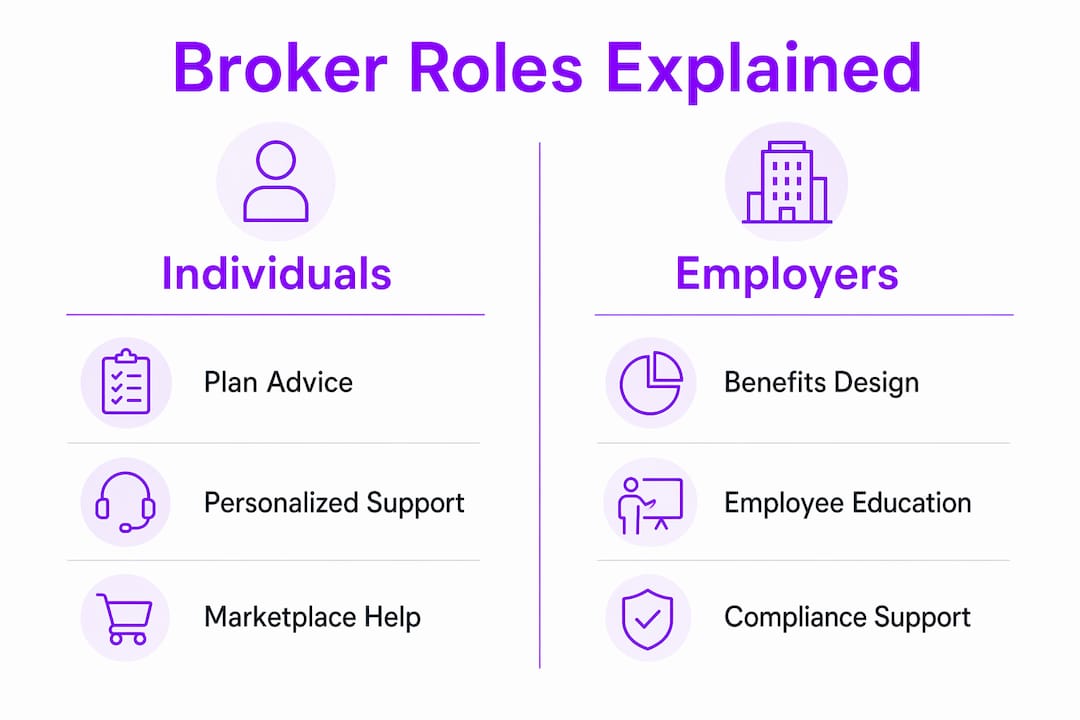
How brokers serve employers and small businesses
For small and medium businesses, a broker does far more than pull quotes. According to NABIP, brokers act as a practical extension of the HR team, handling employee communication, plan education, and renewal management that small HR departments often cannot sustain on their own.
Core broker tasks for employers:
- Group plan quoting and carrier benchmarking
- Plan design and customization (deductible tiers, co-pay structures, add-ons)
- Employee enrollment administration and eligibility tracking
- Benefits education sessions and open enrollment support
- COBRA administration guidance and dependent eligibility audits
Typical employer onboarding steps with a new broker:
- Discovery meeting: review current plan, census data, and renewal date
- Broker delivers market comparison with at least two carrier alternatives
- Employer selects plan design; broker prepares employee communication materials
- Open enrollment window opens; broker fields employee questions directly
- Enrollment closes; broker submits data to carrier and confirms payroll deductions
- Broker schedules a 90-day check-in and sets the next renewal review date
What separates a good SME broker from a great one: A great broker shows up at renewal with a documented market comparison, not just the incumbent carrier’s renewal offer. Employers who benchmark annually avoid “renewal creep,” the gradual premium drift that happens when no one re-shops the market each year.
Pro Tip: Ask any broker candidate for two or three client references from businesses your size. A broker who hesitates to provide references is a broker who has not earned them.
For employers building out their benefits communication strategy, health benefits communication guidance can help HR teams translate plan details into language employees actually understand.
Brokers vs. agents vs. navigators: which professional do you need?
The terminology in health insurance is genuinely confusing, and the differences matter when you are deciding who to trust with your plan selection.
| Professional | Who They Represent | Can Recommend Plans? | How They Are Paid | Marketplace Role |
|---|---|---|---|---|
| Broker | The consumer | Yes, across multiple carriers | Carrier commissions, fees, or both | Can enroll on and off exchange |
| Agent | Often one or a few carriers | Yes, within their appointments | Carrier commissions | Can enroll on and off exchange |
| Consultant | Employer (advisory) | Yes, strategic advice | Typically fee-based | Limited or none |
| Navigator / Assister | Consumer (neutral) | No specific plan recommendations | Grant-funded, no commission | Exchange enrollment only |
Brokers must hold an insurance producer license in each state where they work and, unlike navigators or Certified Application Counselors (CACs), can make specific plan recommendations and enroll clients both on and off an exchange. Navigators are grant-funded, cannot accept commissions, and are limited to exchange enrollment assistance.
Which professional fits your situation:
- Individual with subsidy questions: A licensed broker with Marketplace certification handles both the enrollment and the premium tax credit calculation
- SME designing a group plan: A broker or benefits consultant with employer group experience and documented carrier relationships
- Complex multi-state employer: A benefits consultant or large-group broker with multi-state carrier appointments
- Someone who just needs enrollment help and has already chosen a plan: A navigator or CAC can assist at no cost through the exchange
How are brokers licensed, paid, and regulated in the U.S.?
Brokers are paid primarily through commissions built into the carrier’s premium rate. Because the commission comes from the carrier, you typically pay no extra fee at the point of sale. Some brokers also work on a fee-plus-commission or fee-only model, particularly for large employer accounts or complex consulting engagements.
Licensing and certification requirements:
- State insurance producer license required in every state where the broker conducts business
- Federal Marketplace certification required on top of state licensure for brokers selling Marketplace plans
- Annual recertification for Marketplace brokers; training requirements vary by state
- NABIP membership signals ongoing professional training and adherence to a code of conduct, though it is voluntary
Steps to verify a broker’s credentials:
- Ask for their state insurance producer license number
- Look up the license on your state Department of Insurance website
- Request their CMS Marketplace certification ID if you are shopping exchange plans
- Ask directly: “Are you appointed with all major carriers in this market, or only some?”
- Request written disclosure of all commission structures before signing any enrollment forms
Regulatory note: 2026 CMS guidance places increased emphasis on broker compensation transparency for Marketplace enrollments. Requesting written commission disclosure is not just good practice — it is increasingly expected.
Pro Tip: A broker who refuses to disclose their commission structure in writing is a red flag, not a negotiating position. Transparency here protects you from being steered toward a plan that pays the broker more rather than one that fits you best.
How to choose the right health insurance broker
Broker selection checklist:
- Confirm active state insurance producer license (verify on state DOI site)
- Confirm Marketplace certification if you need exchange plan enrollment
- Ask which carriers they are appointed with and whether that list covers your market
- Request two to three client references from accounts similar to yours
- Clarify the full scope of services: enrollment only, or ongoing advocacy and renewals?
- Ask how renewals are handled: do they re-shop the market, or auto-renew?
- Request their data-handling and privacy practices in writing
- Confirm their commission disclosure policy before signing anything
Questions to ask in your first call:
- “How are you compensated, and will you provide that in writing?”
- “Which carriers are you appointed with in this state?”
- “How do you handle a claim denial on my behalf?”
- “What does your renewal process look like — do you benchmark alternatives?”
- “Who on your team handles day-to-day questions after enrollment?”
- “Can you share a sample case where you changed a client’s plan outcome?”
Red flags to watch for:
- Refuses to disclose commission structure
- Pushes a single-carrier solution without comparing alternatives
- Cannot provide client references
- Vague about post-enrollment service commitments
- No documented renewal strategy or benchmarking process
Pro Tip: In your first 30 days after engaging a broker, you should receive: a written service agreement, a carrier appointment list, a communication plan for your team, and a confirmed renewal review date. If any of those are missing at day 30, ask for them in writing.
For employers building a benefits package from scratch, a health insurance checklist for companies covers the key decision points in sequence.
What are the real benefits and limits of using a broker?
Brokers save time, but that is the least interesting thing they do. The more valuable function is plan fit: a broker who knows your provider network, your prescription needs, and your risk tolerance will find a plan that a comparison website simply cannot surface on its own.
Where brokers add the most value:
- Narrowing dozens of plan options to two or three genuinely relevant choices
- Identifying subsidy eligibility that self-service shoppers often miss
- Advocating on denied claims, especially for complex or high-cost procedures
- Managing employer renewals and preventing premium drift year over year
- Providing specialist knowledge for unusual cases (Medicare transitions, multi-state coverage, high-risk employees)
Known limitations to plan for:
- Commission incentives can create conflicts of interest if the broker is not transparent
- Not every broker holds appointments with every carrier in your market
- Service quality varies significantly; there is no universal standard beyond licensure
- Most brokers do not have a legal fiduciary duty to individual clients in the way a financial advisor might
How to mitigate those limits:
- Require written commission disclosure before enrollment
- Ask annually whether the broker re-shopped your renewal against market alternatives
- Get service-level commitments in writing, including response time for claims issues
- Verify your local hospital network coverage directly with the carrier, not just through the broker
For employers who want to pair strong broker guidance with a wellness-integrated benefits approach, combining plan selection expertise with employee health programs tends to produce better long-term claims outcomes.
Why broker demand is rising: statistics and industry trends
A 2023 KFF survey found that 51% of insured adults reported difficulty understanding at least one aspect of their health insurance—including coverage details, out-of-pocket costs, and benefit explanations. That figure explains broker demand more clearly than any marketing claim.
The broker role is shifting. Industry commentary from Forbes notes that high-performing brokers have moved beyond initial plan sales toward active care facilitation: guiding clients to preventive services, advocating on complex claims, and re-shopping renewals to prevent premium drift. The brokers who thrive in this environment are the ones who maintain direct relationships with insurer contacts and know which internal routes can reverse a denial quickly.
What these trends mean for you:
- Expect your broker to do more than enroll you once and disappear
- Ask specifically about their claims advocacy track record
- Verify that they re-shop your renewal each year rather than defaulting to the incumbent carrier
- Confirm they are current on 2026 CMS Marketplace certification requirements if exchange plans are relevant to you
Key Takeaways
A qualified health insurance broker represents you, not the insurer, and delivers the most value when you treat the relationship as ongoing, not transactional.
| Point | Details |
|---|---|
| Brokers represent you | They work for the consumer, not the carrier, and can compare plans across multiple insurers. |
| Verify credentials first | Check the state DOI license and CMS Marketplace certification ID before signing anything. |
| No added consumer fee | Brokers are typically paid by carrier commissions, so you pay no extra fee at the point of sale. |
| SMEs gain an HR extension | Brokers handle enrollment, employee education, and renewal benchmarking that small HR teams cannot sustain alone. |
| Require commission disclosure | Ask for written disclosure of all compensation structures to protect against plan steering. |
What I have learned from watching brokers change plan outcomes
The conventional wisdom says brokers save you time. That is true, but it undersells what actually matters. The real test of a broker is what happens after enrollment, specifically when a claim is denied, a network changes mid-year, or a renewal comes in 18% higher than last year with no explanation.
High-performing brokers maintain direct relationships inside carrier organizations. They know which contacts can escalate a denial and which administrative routes move faster than the standard appeals process. That knowledge is not listed on any license certificate. It comes from years of working the same market.
For SMEs in particular, the broker relationship should look less like a vendor transaction and more like a benefits partnership. The first 15 minutes of any broker call should cover three things: how they handle renewals, who on their team handles day-to-day employee questions, and what their process is when a claim goes wrong. If those answers are vague, keep looking.
Hmoplans works with SMEs who want coverage built around their team’s actual needs, including cashless access, 24/7 support, and coverage for pre-existing conditions up to the Maximum Benefit Limit. Whether you are building a benefits package from scratch or re-evaluating an existing plan, the right broker, paired with the right plan, makes a measurable difference.
Authoritative sources for verifying broker credentials
Key resources for consumers and employers:
- HealthCare.gov broker glossary: Plain-language definition of broker and agent roles
- CMS Marketplace agent and broker registration: Federal certification requirements and training resources
- CMS Marketplace oversight: Regulatory framework for Marketplace plans and broker accountability
- NABIP broker FAQs: Professional standards, compensation models, and how to find a member broker
- KFF health insurance research: Consumer survey data and policy analysis on coverage understanding
How to verify a broker’s credentials:
- State license: search your state’s Department of Insurance website by name or license number
- Marketplace certification: ask the broker directly for their CMS certification ID; CMS publishes registered agent and broker lists
- Professional affiliation: NABIP membership is searchable at nabip.org
Next steps:
- If you are an SME evaluating group coverage options, explore Hmoplans’ SME plan features to understand what a well-structured group plan looks like before your first broker conversation
- If you need help structuring employee benefits communication, health benefits guidance for HR teams covers the enrollment and education steps in detail
This article is general information, not professional legal, medical, or financial advice. Confirm current licensing requirements, Marketplace rules, and plan details with your state Department of Insurance, CMS, or a qualified licensed broker for your specific situation.
