

The Role of Healthcare Networks for SME Success
TL;DR:
- Healthcare networks enable coordinated, proactive care that reduces costs and improves patient outcomes. They rely on data standards like HL7 and FHIR to facilitate real-time information sharing and improve referral efficiency. For SMEs, investing in well-structured networks with strong provider relationships offers long-term operational and financial benefits.
Healthcare networks are structured groups of providers, facilities, and organizations that collaborate to deliver coordinated care, control costs, and improve patient outcomes. For business owners managing employee health benefits, understanding the role of healthcare networks is the difference between a health plan that drains your budget and one that actually works. Integrated Health Services Networks, or IHSNs, represent the formal industry standard for this model. They dismantle fragmented care by organizing services around people-centered principles that improve equity and access across all care levels.
What is the role of healthcare networks in coordinated care?
Healthcare networks shift care delivery from fragmented, reactive treatment to coordinated, proactive management. Without a network structure, providers operate in silos. A patient sees a general practitioner, gets referred to a specialist, and the two doctors may never share a single record. The result is duplicate tests, delayed diagnoses, and higher costs for everyone involved.
The Pan American Health Organization’s IHSN framework addresses this directly. It organizes care around continuity and coordination across all levels, from primary clinics to tertiary hospitals. That structure matters because fragmented healthcare systems limit disease surveillance and response capacity, as the COVID-19 pandemic made painfully clear.
Network-based care also introduces standardized data sharing. Protocols like HL7 and FHIR allow different systems to exchange patient records in real time. This means a physician at one facility can see a patient’s full history from another, without phone calls or fax machines. The practical result is faster decisions and fewer medical errors.
Pro Tip: When evaluating an HMO plan for your team, ask specifically whether the provider network uses HL7 or FHIR data standards. Plans built on these protocols deliver faster referrals and fewer administrative delays.
Healthcare network collaboration also creates what researchers call patient value networks. These are dynamic ecosystems of resources that adapt to changing patient needs rather than operating as static lists of contracted vendors. For business owners, that distinction matters. A static vendor list gives your employees access to providers. A dynamic patient value network gives them coordinated care.
What are the operational and financial benefits for SMEs?
The financial case for healthcare networks is concrete. Business owners who invest in well-structured health plans see measurable returns, not just in employee satisfaction, but in direct cost reduction.
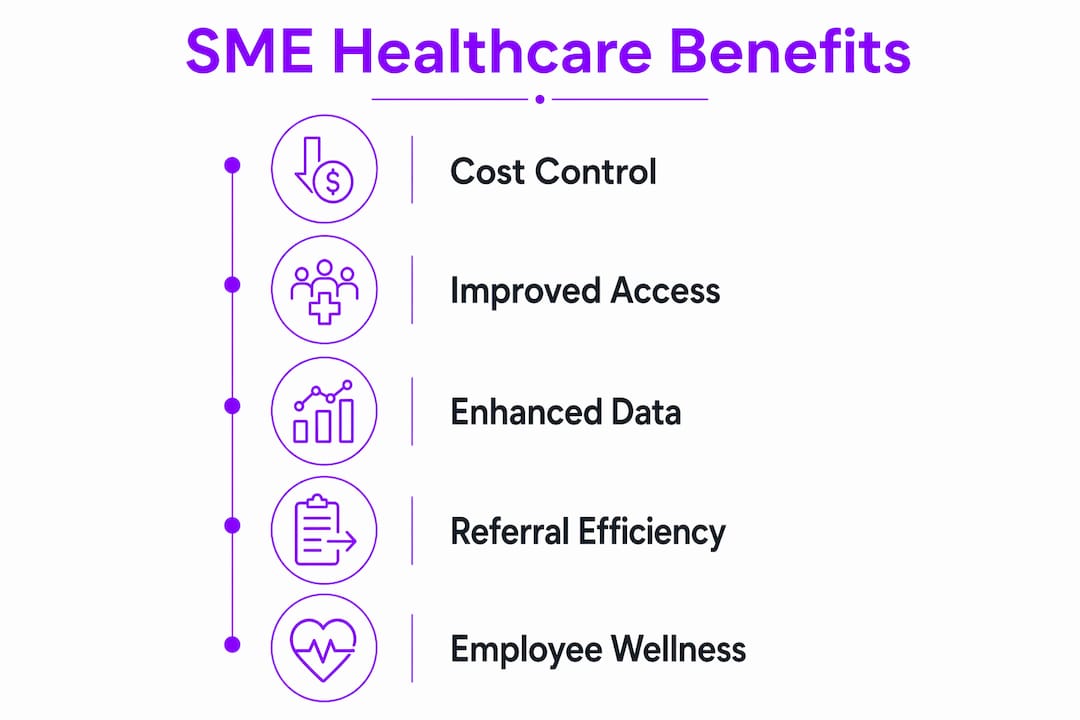
Here are the four primary operational and financial benefits that healthcare networks deliver to SMEs:
-
Higher patient capacity. High-functioning clinic networks enable patient throughput over 250 times greater than under-resourced models. That scale means your employees get appointments faster, reducing lost work time from delayed care.
-
Lower hospitalization costs. Primary care-led networks significantly lower hospitalization costs by reducing unnecessary specialist visits and reactive care. Employees who receive consistent primary care stay healthier and require fewer expensive interventions.
-
Reduced administrative burden. Network-based interoperability reduces the administrative burden on HR teams by replacing manual referral tracking with digital workflows. Your HR staff spends less time chasing records and more time on actual people management.
-
Better employee health outcomes. Integrated, coordinated care models catch health problems earlier. Earlier intervention means shorter recovery times, fewer sick days, and a more productive workforce.
The cost control benefit compounds over time. When your employees use a coordinated network, they are less likely to visit emergency rooms for conditions that primary care could have addressed. Emergency care costs multiples of what a clinic visit costs. A well-structured HMO plan that emphasizes primary care access is one of the most direct ways an SME can control its healthcare spend.
For HR leaders thinking about employee wellness benefits in 2026, the network structure of a health plan deserves as much scrutiny as the premium cost.
How do technology and data standards improve network performance?
Technology is what separates a functional healthcare network from a high-performing one. The protocols and platforms that connect providers determine how quickly and accurately information flows across the network.

HL7 and FHIR are the two dominant data exchange standards in modern healthcare. HL7 defines how clinical messages are structured. FHIR builds on that by enabling web-based API connections between systems. Together, they allow a hospital, a clinic, and an insurance platform to share patient data without manual intervention. Implementing these protocols is now considered essential for enabling AI-driven health tools with actionable clinical data.
Frameworks like TEFCA and CommonWell extend these standards across organizations and state lines. They create a shared infrastructure so that a patient’s record follows them regardless of which provider they visit. For SMEs with employees in multiple locations, this is particularly valuable.
The operational trap that many organizations fall into is what IT teams call the “swivel chair” problem. Without interoperable systems, administrative staff manually re-enter data between platforms, rotating between screens and systems to complete a single task. Without network-based interoperability, referrals and records still move through fax and phone, creating significant workflow inefficiencies. That is a direct cost to your business in staff time and error rates.
Cloud-based platforms solve this by extending network benefits to smaller providers who cannot afford enterprise-level infrastructure. A small clinic in a provincial city can participate in the same data network as a major hospital when both connect to a shared cloud platform. For SMEs in the Philippines, this means your employees can access coordinated care even outside major urban centers.
Pro Tip: When reviewing digital tools for HR, prioritize platforms that connect directly to your HMO provider network. Disconnected tools create the same swivel chair problem at the HR level.
How do provider networks affect referral efficiency and specialist access?
The strength of a provider network determines how quickly your employees reach the right specialist. This is not just about how many doctors are listed in a directory. It is about how well those doctors communicate and collaborate with each other.
Research on physician referral behavior reveals a counterintuitive finding. Professional relationships among physicians, including shared training programs and institutional affiliations, predict referral efficiency better than geographic proximity. Two doctors in the same city who trained at different institutions and have no professional overlap will refer patients less efficiently than two doctors in different cities who share a professional network.
This has direct implications for how business owners should evaluate health plans:
- Network depth matters more than network size. A plan with 500 deeply connected providers delivers faster specialist access than one with 2,000 loosely affiliated names on a list.
- Physician centrality drives outcomes. Centralizing attending physicians within collaboration networks reduces hospitalization costs and improves patient outcomes, including maternal and neonatal mortality rates.
- Referral speed affects productivity. Every day an employee waits for a specialist appointment is a day of reduced performance or absence. Efficient referral networks reduce that wait.
- Equitable access depends on network structure. A well-governed provider network actively manages access so that employees in different locations or income brackets receive the same quality of care.
For SME decision-makers, the practical question is simple. Ask your HMO provider how physicians in their network communicate with each other. Ask whether referrals are tracked digitally or managed by phone. The answers tell you more about real network quality than any provider count.
Key Takeaways
Healthcare networks deliver measurable value only when they combine coordinated provider relationships, standardized data protocols, and primary care-led structures that reduce unnecessary costs.
| Point | Details |
|---|---|
| Network structure reduces costs | Primary care-led networks lower hospitalization rates by cutting unnecessary specialist visits. |
| Data standards enable real performance | HL7 and FHIR protocols allow real-time data sharing that supports faster, more accurate clinical decisions. |
| Provider relationships predict referral speed | Physician co-training and shared affiliations drive referral efficiency more than geographic proximity. |
| Capacity scales with investment | Well-resourced clinic networks handle dramatically higher patient volumes, reducing wait times for employees. |
| Dynamic networks outperform static lists | Treating provider networks as patient value ecosystems improves care coordination and long-term health outcomes. |
Why most SMEs are evaluating healthcare networks the wrong way
Most business owners I speak with evaluate health plans by comparing premium costs and listed provider counts. Both metrics are nearly useless on their own. A low premium attached to a fragmented network costs more in the long run through higher hospitalization rates, longer sick leaves, and HR time spent managing referral failures.
The insight that changed how I think about this comes from the patient value network model. Viewing a provider network as a dynamic ecosystem rather than a vendor list reframes the entire decision. You stop asking “how many doctors are covered?” and start asking “how well do these doctors work together?”
The other mistake I see consistently is treating health benefits as separate from operational strategy. Employee health directly affects output, retention, and recruitment. An SME that invests in a well-structured HMO plan with genuine network integration is making an operational decision, not just a benefits decision.
The future of healthcare networks for SMEs points toward greater digital integration. Plans that connect your HR systems, your employees’ health records, and your provider network through a single platform will outperform those that keep these functions separate. Aligning your insurance selection, your internal wellness culture, and your digital health access tools is the approach that actually delivers returns.
— Eumir
Hmoplans and Purple Cow: built for SME healthcare networks
Hmoplans, powered by Purple Cow and underwritten by Etiqa, gives SMEs in the Philippines direct access to a coordinated HMO plan network that includes the Big 9 Hospitals and Healthway Clinics. The plan covers pre-existing conditions, congenital conditions, and special procedures at 100% up to the Maximum Benefit Limit, with no complicated exclusion language.
For business owners who want the operational benefits of integrated healthcare without the administrative complexity, Hmoplans delivers cashless access, 24/7 nationwide coverage, and digital platform support in a single plan. Optional add-ons include dental HMO, annual physical exams, and life and accident insurance. Explore the full plan features to see how Hmoplans fits your team’s specific needs.
FAQ
What is the role of healthcare networks in employee health?
Healthcare networks coordinate providers and resources so employees receive continuous, connected care rather than fragmented treatment. This reduces sick days, lowers hospitalization rates, and improves overall workforce health.
How do healthcare networks work for SMEs?
SMEs access healthcare networks through HMO plans that contract with groups of hospitals, clinics, and specialists. Employees use these networks for cashless care, referrals, and specialist access without managing separate insurance claims.
What is the importance of healthcare networks for cost control?
Primary care-led networks reduce unnecessary specialist visits and emergency room use, which are the two largest drivers of healthcare cost for employers. Structured networks keep care at the most cost-effective level.
How does healthcare network collaboration improve referral outcomes?
Physician professional relationships, including shared training and institutional affiliations, predict referral efficiency better than geography alone. Networks built on strong provider collaboration deliver faster and more accurate specialist access.
What technology standards support healthcare network performance?
HL7 and FHIR are the primary data exchange standards that enable real-time information sharing across providers. Plans and networks built on these protocols support AI-driven clinical tools and reduce administrative bottlenecks.
