

What Is Group Accident Insurance for SMEs?
TL;DR:
- Group accident insurance provides lump-sum cash benefits directly to employees after covered injuries or deaths, filling gaps left by traditional health plans. It offers 24/7 worldwide coverage for accidents, with guaranteed acceptance and low premiums, supporting employees’ financial stability during recovery. SMEs benefit from reduced liability, improved retention, and flexible, affordable protection that complements existing health benefits.
Group accident insurance is defined as a supplemental policy that pays lump-sum cash directly to employees following a covered accidental injury or death. Unlike standard health insurance, which reimburses medical providers, this coverage puts money in the hands of the employee to spend without restriction. For SME owners and HR managers, it fills a real gap: traditional health plans cover hospital bills, but they do not replace lost wages, cover childcare during recovery, or help an employee keep up with mortgage payments. Voluntary employee costs typically range from $6 to $20 monthly, making it one of the most affordable additions to any benefits package.
What is group accident insurance and how does it work?
Group accident insurance is a form of group personal accident (GPA) coverage purchased by an employer on behalf of a defined group of employees. When a covered accident occurs, the policy triggers a fixed cash benefit paid directly to the insured employee or their named beneficiary. No invoices are required. No approval from a hospital billing department is needed. The payment is unconditional.

Types of events covered
Most group accident policies cover three primary categories of loss:
- Accidental death: A lump-sum benefit paid to the employee’s beneficiary if the accident results in death.
- Permanent total or partial disability: A benefit paid when an accident causes lasting loss of function, such as loss of a limb or eyesight. Disability diagnoses are typically required within 180 days of the accident, meaning a claim cannot be filed years later without documented medical evidence linking the disability to the event.
- Medical expense reimbursement: Some policies include a sub-benefit that reimburses out-of-pocket medical costs not covered by the primary health plan.
The 180-day diagnosis window matters operationally. HR managers should communicate this timeline to employees at enrollment so claims are not delayed or denied due to late medical documentation.
How cash benefits differ from health insurance
Accident insurance pays employees directly, covering recovery-related costs well beyond medical bills. This distinction is the core value proposition. An employee recovering from a fractured spine may have their surgery covered by their HMO, but they still face weeks of lost income, transportation to physical therapy, and childcare for dependents. The cash payout model empowers employees to cover indirect costs like childcare or mortgage payments, which are critical during income disruption periods.
Pro Tip: When presenting this benefit to employees, frame it as income protection, not just accident coverage. Employees respond more strongly to the concept of keeping their household running than to abstract insurance terminology.
Enrollment and acceptance
Guaranteed acceptance is standard for group accident policies. There are no medical exams, no health questionnaires, and no pre-existing condition exclusions. This makes onboarding fast and paperless, which is a practical advantage for SMEs that cannot dedicate HR staff to complex underwriting processes.
Benefits of group accident insurance for SMEs and their employees
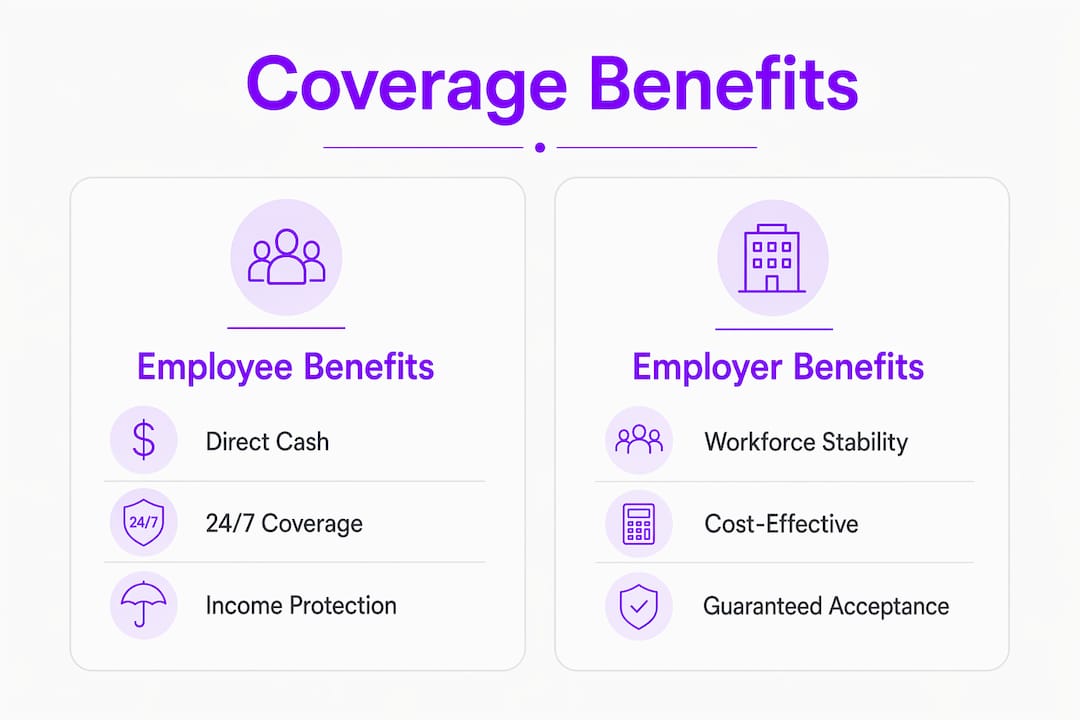
Group accident coverage delivers value on two levels simultaneously: it protects employees financially and reduces risk exposure for the employer.
Financial protection that health insurance does not provide
Standard HMO or health insurance plans pay medical providers. They do not compensate employees for income lost during recovery or for the indirect costs of an accident. This financial bridge supplements major medical and disability insurance by addressing the expenses that fall through the cracks. For an SME employee earning a modest salary, a two-week recovery period without supplemental income can create serious financial hardship.
Employer liability and workforce stability
Providing group accident coverage also reduces legal liability for fatal workplace accidents. When an employer can demonstrate that a comprehensive benefits structure was in place, it strengthens their position in any post-incident legal review. Beyond liability, the benefit directly supports employee retention. Workers who feel financially protected are less likely to leave for competitors offering richer benefits packages.
Here are the primary advantages SMEs gain by adding group accident coverage to their benefits program:
- Affordable group pricing: Risk is spread across the entire enrolled workforce, which keeps individual premiums low compared to individual accident policies.
- Recruitment differentiation: Voluntary plans cost the company nothing while giving candidates a tangible reason to choose your organization over a competitor.
- Employee morale: Demonstrating financial care beyond salary builds loyalty, particularly in industries with physical job demands.
- Flexible benefit use: Funds can be used for childcare, transportation, mortgage payments, or everyday living expenses during recovery, giving employees genuine financial flexibility.
- Simplified administration: Guaranteed issue enrollment means HR does not manage individual medical underwriting for each employee.
Voluntary group accident plans provide SMEs with a cost-effective way to expand benefits without burdening budgets, which directly enhances workforce satisfaction without requiring a budget reallocation.
How group accident policies differ: voluntary vs. employer-paid
The funding structure of a group accident policy determines who pays the premium and how the benefit is positioned to employees. SME decision-makers need to understand both models before selecting a plan.
Voluntary plans
In a voluntary structure, employees elect coverage and pay premiums through payroll deduction. The employer facilitates the plan but bears no premium cost. Voluntary plans via payroll deduction increase recruitment and retention with no significant operating budget impact. This model works well for SMEs with tight margins that still want to offer a competitive benefits package.
Employer-paid plans
In an employer-paid structure, the company funds all premiums. This approach positions the benefit as a direct employer investment in employee welfare, which carries stronger morale and retention value. The trade-off is a line item in the operating budget, though group pricing keeps this cost manageable.
| Feature | Voluntary plan | Employer-paid plan |
|---|---|---|
| Who pays premiums | Employee via payroll deduction | Employer |
| Budget impact | Minimal to none | Moderate, offset by group rates |
| Employee perception | Optional personal benefit | Employer-provided protection |
| Enrollment flexibility | Employee chooses coverage level | Uniform coverage for all staff |
| Best for | Cost-conscious SMEs | Companies prioritizing morale and retention |
Group size and eligibility requirements
Group size requirements vary significantly depending on the type of group. Employer-based groups often qualify with as few as 10 members, while non-employer associations typically require 50 or more. For most SMEs, the 10-member threshold is easily met, making this coverage accessible even to small teams.
Pro Tip: If your workforce is below the minimum threshold for a standard group policy, ask your provider about association-based plans or bundled HMO add-ons that include accident coverage. Hmoplans, for example, offers life and accident insurance as an optional add-on to its core HMO plans, which sidesteps minimum group size barriers entirely.
Practical tips for implementing group accident coverage in your SME
The most common mistake SMEs make when introducing group accident insurance is assuming employees already understand what it covers. Most do not.
Clarify the 24/7 scope of coverage
Most group accident policies are 24/7, protecting employees during vacations, sports activities, and commutes, not just during work hours. This is the single most important misconception to correct. Employees who believe coverage only applies on the job are less likely to value the benefit and less likely to file legitimate claims when they qualify.
Communicate the cash benefit clearly
Employees accustomed to health insurance expect the insurer to pay the hospital. When introducing group accident coverage, HR managers should explicitly state: “This money goes to you, not to a provider.” That framing changes how employees perceive the value of the benefit.
Budget and cost planning
For voluntary plans, the employer’s cost is primarily administrative. For employer-paid plans, budget based on group size and the benefit levels selected. Typical voluntary employee costs run between $6 and $20 monthly per person, which means a 50-person workforce on a voluntary plan costs the company nothing in premiums while delivering meaningful financial protection to every enrolled employee.
Here is a practical checklist for SMEs implementing group accident coverage:
- Confirm your workforce meets the minimum group size requirement for the policy type.
- Decide between voluntary and employer-paid funding based on budget and retention goals.
- Review how the accident policy integrates with your existing HMO or health plan to avoid coverage gaps.
- Prepare a one-page employee communication that explains the 24/7 scope, the cash benefit model, and how to file a claim.
- Set a reminder to review benefit levels annually as your workforce grows.
For a broader look at how accident coverage fits within your overall benefits strategy, the accident insurance options for Philippine SMEs resource from Hmoplans covers the full range of coverage structures available to local employers.
Pro Tip: Run a brief Q&A session during open enrollment specifically for accident insurance. The questions employees ask reveal exactly which misconceptions need correcting, and addressing them live builds far more confidence in the benefit than a brochure ever will.
Key takeaways
Group accident insurance delivers direct cash payments to employees after covered accidents, making it the most flexible financial protection tool an SME can add to its benefits package.
| Point | Details |
|---|---|
| Direct cash payments | Benefits go to the employee, not a provider, covering any recovery-related expense. |
| 24/7 worldwide coverage | Protection applies outside work hours, including vacations and sports activities. |
| Affordable group pricing | Voluntary plans cost employees $6 to $20 monthly with no budget impact on the employer. |
| Fast enrollment | Guaranteed acceptance with no medical exams speeds onboarding for any group size. |
| Dual employer benefit | Coverage reduces legal liability and improves employee retention simultaneously. |
Why SMEs consistently underestimate this benefit
I have reviewed a lot of SME benefits packages, and group accident insurance is almost always the last item added and the first item cut when budgets tighten. That pattern reflects a misunderstanding of what the benefit actually does.
The instinct is to compare it to health insurance and ask whether you really need both. But that comparison misses the point entirely. Health insurance pays the hospital. Accident insurance pays the person. Those are solving completely different problems. An employee who breaks their wrist and cannot work for three weeks does not need help paying the surgeon. They need help paying rent.
What I find most compelling about this coverage for SMEs specifically is the guaranteed acceptance model. There is no underwriting friction, no HR overhead, and no employee who gets declined. You add it to your benefits package and every enrolled employee is covered from day one. For a small team where every person matters, that simplicity has real operational value.
The voluntary structure is also underused as a recruitment tool. Candidates comparing two similar job offers will notice a benefits package that includes accident coverage. It signals that the employer has thought carefully about what employees actually need during hard times, not just during routine medical visits. That perception matters, particularly when you are competing for talent against larger companies with bigger salary budgets.
My advice: treat group accident insurance as the financial safety net that sits underneath your HMO plan, not as a replacement for it. When you position it that way internally, employees understand its value immediately.
— Eumir
Add accident coverage to your SME benefits package today
Hmoplans offers life and accident insurance as a flexible add-on to its core HMO plans for Philippine SMEs, making it straightforward to build a complete benefits package without managing multiple providers. Whether you are setting up employee benefits for the first time or filling gaps in your existing coverage, Hmoplans provides tailored solutions backed by Purple Cow and Etiqa. Explore how SME health insurance plans from Hmoplans can include accident coverage that protects your team around the clock. Get a quote today and see how affordable comprehensive protection can be for your workforce.
FAQ
What does group accident insurance cover?
Group accident insurance covers accidental death, permanent total or partial disability, and in many cases medical expense reimbursement. Cash benefits are paid directly to the employee or their beneficiary with no restrictions on how the funds are used.
Is group accident insurance only for workplace injuries?
No. Most group accident policies provide 24/7 coverage worldwide, including accidents that occur during vacations, sports activities, and daily commutes. The workplace-only assumption is the most common misconception about this type of coverage.
How much does group accident insurance cost for employees?
Voluntary group accident coverage typically costs employees between $6 and $20 per month through payroll deduction. Employer-paid plans vary based on group size and benefit levels selected, but group risk pooling keeps premiums significantly lower than individual accident policies.
What is the difference between group and individual accident insurance?
Group accident insurance is purchased through an employer or association and benefits from pooled risk pricing, guaranteed acceptance, and simplified enrollment. Individual accident insurance is purchased directly by the employee, typically costs more, and may require medical underwriting.
How does group accident insurance work alongside an HMO plan?
Group accident insurance supplements an HMO plan by covering expenses the HMO does not, including lost income, childcare, and transportation during recovery. The HMO pays the medical provider; the accident policy pays the employee directly. For a deeper look at how these two benefits work together, the supplemental accident cover guide from Hmoplans explains the integration clearly.
