

What Is Preventive Care HMO and Why It Matters
TL;DR:
- HMO plans focus on preventive care by fully covering in-network screenings and wellness visits at no cost. The primary care physician manages screenings, referrals, and health tracking to ensure timely, cost-effective prevention. Understanding network requirements and early PCP selection maximizes benefits and prevents unexpected out-of-pocket expenses.
Most people assume their health insurance covers routine checkups, only to discover unexpected copays, out-of-network bills, or confusing referral requirements. Understanding what is preventive care HMO coverage actually means puts you ahead of that frustration. Unlike other plan types, HMOs are uniquely structured to prioritize prevention. They pair you with a single primary care physician, require you to stay in-network, and in return deliver a category of services that are fully covered at zero cost to you. This guide breaks down how that system works, who benefits most, and what both individuals and HR managers need to know before enrolling.
Table of Contents
- Key takeaways
- What preventive care HMO coverage actually includes
- How the HMO structure supports preventive care
- Benefits of preventive care for individuals and employers
- Important limitations to understand before you use it
- How HR managers can build on HMO preventive benefits
- My take: the most underused advantage in HMO coverage
- Ready to find the right preventive care HMO plan?
- FAQ
Key takeaways
| Point | Details |
|---|---|
| Preventive care is fully covered | HMO members pay no copay or deductible for in-network preventive services under ACA rules. |
| The PCP is your care coordinator | Your primary care physician schedules screenings, manages referrals, and keeps your preventive timeline on track. |
| Network status determines coverage | Out-of-network preventive visits can result in full out-of-pocket charges, so always verify provider status first. |
| Early enrollment matters | Selecting a PCP within 120 days of enrollment helps you avoid delays in accessing preventive services. |
| Employers save real money | HMO plans with strong preventive care focus reduce absenteeism, emergency visits, and long-term treatment costs. |
What preventive care HMO coverage actually includes
When people ask what is preventive care HMO coverage, they often expect a short list of annual checkups. The reality is much broader. All Marketplace plans, including HMOs, must cover preventive services at no cost to the member when those services are delivered in-network. That means no copayment and no coinsurance, even if you have not yet met your deductible for the year.
The services that qualify as preventive under ACA guidelines include:
- Annual physical exams and wellness visits
- Blood pressure, cholesterol, and diabetes screenings
- Cancer screenings such as mammograms, colonoscopies, and cervical cancer tests
- Immunizations including flu, hepatitis, and HPV vaccines
- Mental health screenings and depression assessments
- Prenatal and well-woman visits
- Pediatric preventive care including developmental screenings and vaccinations
This is where understanding preventive health plans pays off. The word “preventive” has a specific legal meaning under the ACA. A service is only preventive if it is delivered as a routine screening or immunization with no existing symptoms or diagnosed condition driving the visit. If your doctor orders a colonoscopy because you reported blood in your stool, that becomes a diagnostic procedure and different cost-sharing rules apply. The distinction matters more than most members realize.
HMOs provide structured preventive screenings and wellness visits designed to catch potential problems before they require intensive treatment. For HR managers evaluating plan types, this structural emphasis on prevention is a core reason why HMOs consistently outperform other plan designs on long-term cost metrics.
How the HMO structure supports preventive care
To understand why HMO preventive services work the way they do, you need to understand what is an HMO at its structural core. Every HMO member selects a Primary Care Physician, referred to as a PCP, who serves as the gatekeeper for all healthcare services. This is not just an administrative rule. It is the mechanism that makes preventive care delivery more consistent and less expensive.

The PCP manages your full medical history, which means they can schedule age-appropriate screenings on the right timeline, identify risk factors before they become diagnoses, and avoid ordering duplicate tests that other providers might not know you already had. That coordination reduces waste. It also reduces the chance that a critical screening gets skipped simply because no one was tracking it.
The gatekeeper role includes several practical functions:
- Scheduling preventive screenings based on your age, sex, and risk profile
- Issuing referrals to specialists when needed after an initial preventive visit
- Monitoring follow-up care and keeping preventive timelines current
- Flagging overdue screenings during routine visits
Pro Tip: Schedule your annual wellness visit within the first few months of a new plan year. This gives your PCP the full year to order any follow-up screenings or referrals without running into authorization delays near the end of the coverage period.
Dr. Anil Keswani notes that HMOs’ emphasis on prevention keeps members healthy across life stages rather than simply responding to illness after it develops. That philosophy is baked into the structure of the plan itself, not just the marketing. Experts also reinforce that the PCP gatekeeper role is a vital function, not simply a bureaucratic step. Your PCP is your health advocate inside the system.
Benefits of preventive care for individuals and employers
The benefits of preventive care inside an HMO extend well beyond a free annual physical. For individuals, catching a condition early, whether it is hypertension, pre-diabetes, or early-stage cancer, dramatically changes the treatment required and the outcome expected. Early detection means simpler, less expensive interventions. It means fewer missed workdays. It means better quality of life over the long term.
For employers choosing health plans for their workforce, the financial case is just as clear.
Integrated preventive care services lower costs and improve health across populations, and prevention reduces need for costly treatments that would otherwise consume a disproportionate share of health plan budgets.
The numbers back this up. The average annual premium for employer-sponsored family coverage exceeded $27,000 in 2026. Any plan structure that reduces the frequency of emergency visits, hospitalizations, and specialist-driven treatment cycles produces direct savings. HMOs, with their lower base premiums and preventive care cost structure, are designed to do exactly that.
For HR managers reviewing plan options, consider these measurable workplace benefits:
- Fewer unplanned absences driven by untreated chronic conditions
- Reduced short-term disability claims when conditions are caught early
- Lower total healthcare spend per employee over multi-year periods
- Improved employee morale when staff feel their health is genuinely supported
When you compare those outcomes to the alternative, a workforce that avoids routine care because of cost and then arrives at the emergency room with an advanced condition, the math is not close. Preventive healthcare HMO coverage is not a perk. It is a cost-control strategy.
Important limitations to understand before you use it
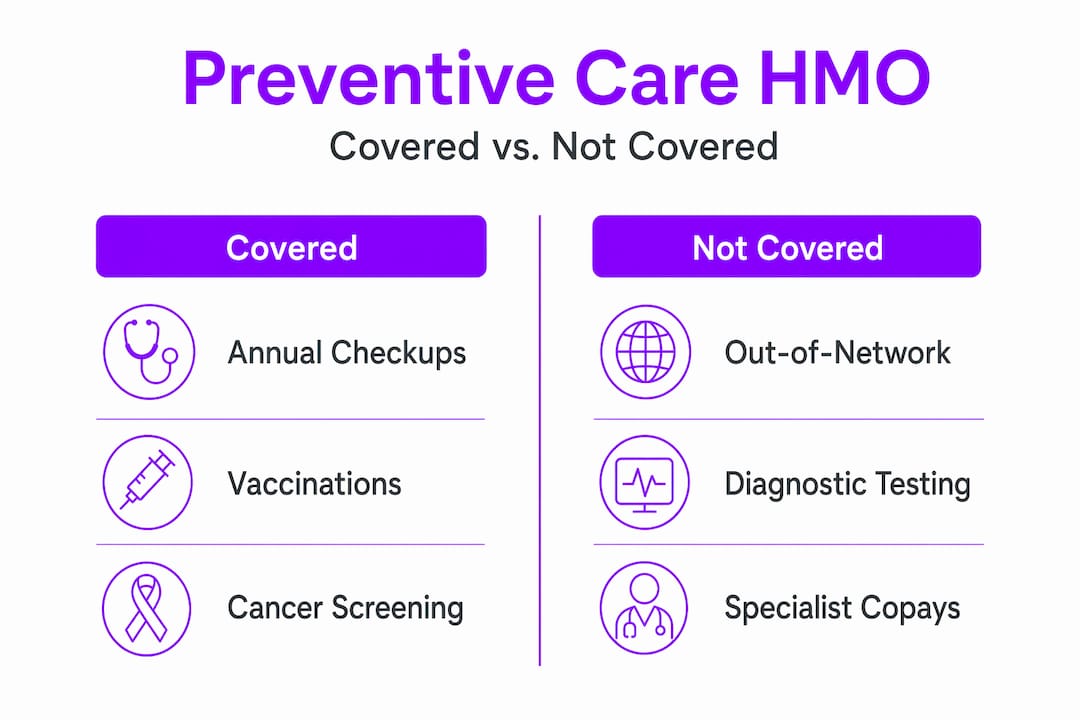
Knowing the benefits of preventive care in an HMO is not enough on its own. The plan’s structure creates specific constraints that catch members off guard when they do not know the rules in advance.
Here are the key limitations to keep in mind:
- Network dependency is absolute. Out-of-network preventive services are typically not covered and can result in full out-of-pocket charges. Always confirm a provider’s network status before scheduling.
- Establish your PCP relationship early. Many HMOs require selecting a PCP within 120 days of enrollment to avoid care disruptions. Delay this and you may face gaps in coverage or administrative barriers to accessing preventive services.
- Pre-authorization applies to certain screenings. Some specialized screenings, particularly advanced imaging or genetic testing, require prior authorization from your PCP. Skipping that step can result in denied claims even if the service itself qualifies as preventive.
- Diagnostic versus preventive coding matters. If a visit is coded as diagnostic rather than preventive, different cost-sharing rules apply. Ask your provider how the visit will be billed before it happens.
- Specialist visits require a referral. You cannot self-refer to a dermatologist, cardiologist, or any other specialist for preventive screenings. Your PCP must initiate the referral.
Pro Tip: Before any appointment, call your insurance member services line and confirm two things: that the provider is in-network and that the specific service you are receiving will be billed as preventive. This two-minute call prevents the most common surprise bills.
Here is a quick comparison to clarify which services typically fall under preventive versus diagnostic coverage:
| Service | Preventive (no cost) | Diagnostic (cost-sharing applies) |
|---|---|---|
| Colonoscopy with no symptoms | Yes | No |
| Colonoscopy after reported symptoms | No | Yes |
| Annual blood pressure screening | Yes | No |
| Blood test ordered for specific complaint | No | Yes |
| Routine immunization | Yes | No |
| Vaccine during treatment for illness | No | Yes |
The table above reflects general guidelines. Specific plan documents always govern what your plan will cover.
How HR managers can build on HMO preventive benefits
Selecting an HMO that covers preventive services is step one. Making sure your employees actually use those services is where most HR strategies fall short. Research consistently shows that employees who do not understand their benefits leave preventive services unused, which defeats the entire cost-control rationale for choosing an HMO in the first place.
Practical strategies that move the needle include:
- Communicate clearly at enrollment. Use plain language to explain what preventive services are covered at zero cost, which providers are in-network, and how to select a PCP. Most benefits confusion starts at enrollment and never gets corrected.
- Send reminders on a schedule. A simple email in January reminding employees to book their annual wellness visit pays for itself many times over in avoided downstream costs.
- Track utilization data. Your HMO administrator can provide aggregate data on how many employees are using preventive services. If the number is low, that is a signal to increase communication, not to switch plans.
- Tie preventive care to wellness program incentives. Many SMEs add modest rewards, such as additional PTO or wellness credits, for completing annual physicals and recommended screenings.
For SMEs specifically, exploring HMO options for small and medium enterprises helps you understand which plans are designed to integrate preventive care seamlessly into a workforce health program. The right plan does much of the administrative heavy lifting for you.
A workforce that uses preventive care consistently is a healthier workforce. Healthier employees miss fewer days, perform better, and stay with their employers longer. The return on investment is not theoretical. It shows up in your claims data within two to three years.
My take: the most underused advantage in HMO coverage
I have spent years watching both individuals and HR teams treat preventive care as a minor line item in their health plan review. Most of the time, the conversation centers on premiums, deductibles, and specialist copays. The preventive care section gets skimmed.
That is a significant mistake. In my experience, the zero-cost preventive care structure inside an HMO is the single highest-return feature in the entire plan. It is also the most underused. I have seen employees with three years of HMO coverage who have never scheduled an annual physical, largely because no one told them it was free and how to book it correctly.
The PCP gatekeeper model, which gets criticized for limiting flexibility, actually solves a real problem. Most people do not know which screenings they need at what age. Their PCP does. When the relationship is functioning as it should, your PCP becomes less of a gatekeeper and more of a navigator. That difference in framing changes how employees engage with the system.
What I find consistently true is that organizations that invest time in genuinely educating employees about their HMO preventive benefits see lower overall healthcare costs within a few years. Not because the plan changed. Because people started using what was already there. That is a culture shift, not a financial one. And it starts with understanding the mechanics clearly enough to act on them.
— Eumir
Ready to find the right preventive care HMO plan?
Understanding your options on paper is only half the work. The other half is finding a plan that delivers on the preventive care promise without burying you in fine print.
Hmoplans partners with Purple Cow and Etiqa to offer HMO coverage built for SMEs in the Philippines, with strong preventive care foundations including annual physical exam add-ons, access to premier hospital networks, and 100% coverage commitments for a wide range of conditions up to the Maximum Benefit Limit. If you are an HR manager or a business owner ready to compare specific plan options, visit the Hmoplans member services page to review plan details and connect with an advisor. You can also explore the HMO coverage comparison for 2026 to see how preventive benefits stack up across leading plans.
FAQ
What services does an HMO cover for preventive care?
HMO preventive care covers annual physicals, immunizations, cancer screenings, mental health screenings, and prenatal visits at no cost to the member when delivered in-network, per ACA guidelines.
Do I pay a copay for preventive care in an HMO?
No. Under ACA rules, all Marketplace HMO plans must provide in-network preventive services with no copayment or coinsurance, even before you meet your deductible.
What is the PCP’s role in HMO preventive care?
Your primary care physician coordinates all preventive screenings, manages referrals, tracks your health history, and schedules age-appropriate tests to keep your care current and complete.
What happens if I use an out-of-network provider for preventive care?
Out-of-network preventive services in an HMO are typically not covered, which means you could be responsible for the full cost of the visit. Always verify your provider’s network status before scheduling.
How soon should I select a PCP after joining an HMO?
Select your PCP as soon as possible after enrollment. Many HMOs require you to establish that relationship within 120 days to avoid disruptions or delays in accessing preventive services.
